


Unusual Treatment Shows Promise for Kids with Brain Tumors

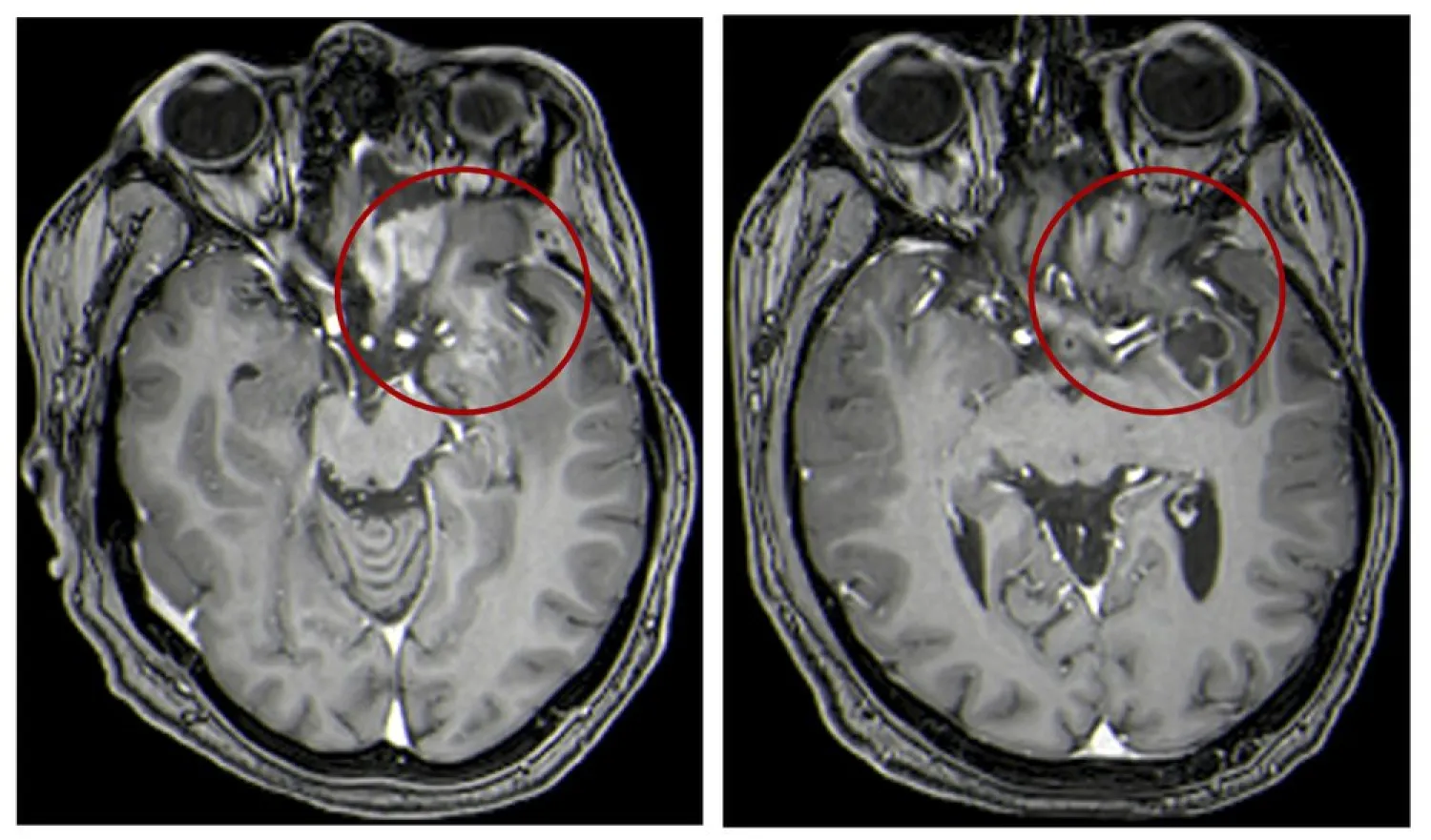
This combination of MRI images provided by the University of Alabama in April 2021 shows scans of a child with a brain tumor, before and after a treatment that involves using viruses to spur an immune system response to the cancerous cells. (UAB via AP)
TT

Unusual Treatment Shows Promise for Kids with Brain Tumors

This combination of MRI images provided by the University of Alabama in April 2021 shows scans of a child with a brain tumor, before and after a treatment that involves using viruses to spur an immune system response to the cancerous cells. (UAB via AP)

For decades, a deadly type of childhood cancer has eluded science’s best tools. Now doctors have made progress with an unusual treatment: Dripping millions of copies of a virus directly into kids’ brains to infect their tumors and spur an immune system attack.

A dozen children treated this way lived more than twice as long as similar patients have in the past, doctors reported Saturday at an American Association for Cancer Research conference and in the New England Journal of Medicine.

Although most of them eventually died of their disease, a few are alive and well several years after treatment -- something virtually unheard of in this situation.

“This is the first step, a critical step,” said the study’s leader, Dr. Gregory Friedman, a childhood cancer specialist at the University of Alabama at Birmingham.

“Our goal is to improve on this,” possibly by trying it when patients are first diagnosed or by combining it with other therapies to boost the immune system, he said. The patients in the study were given the experimental approach after they failed other treatments.

The study involved gliomas, which account for 8% to 10% of childhood brain tumors. They’re usually treated with surgery, chemotherapy or radiation but they often recur. Once they do, survival averages just under six months.

In such cases, the immune system has lost the ability to recognize and attack the cancer, so scientists have been seeking ways to make the tumor a fresh target. They turned to the herpes virus, which causes cold sores and spurs a strong immune system response. A suburban Philadelphia company called Treovir developed a treatment by genetically modifying the virus so it would infect only cancer cells.

Through tiny tubes inserted in the tumors, doctors gave the altered virus to 12 patients ages 7 to 18 whose cancer had worsened after usual treatments. Half also received one dose of radiation, which is thought to help the virus spread.

Eleven showed evidence in imaging tests or tissue samples that the treatment was working. Median survival was just over a year, more than double what’s been seen in the past. As of last June -- the cutoff for analyzing these results -- four were still alive at least 18 months after treatment.

Tests also showed high levels of specialized immune system cells in their tumors, suggesting the treatment had recruited the help needed from the body to attack the disease.

No serious safety issues were seen, though there were several procedure-related complications and mild side effects including nausea, vomiting, diarrhea and fatigue.

Jake Kestler had the treatment when he was 12.

“It went very well. He lived for a year and four months after that,” long enough to celebrate his bar mitzvah, go with his family to Hawaii and see a brother be born, said his father, Josh Kestler, a financial services executive from Livingston, New Jersey.

Jake died April 11, 2019, but “we have no regrets whatsoever” about trying the treatment, said Kestler, who with his wife has started a foundation, Trail Blazers for Kids, to further research.

“It’s a devastating disease for these patients and their families,” and the early results suggest the virus treatment is helping, but they need to be verified in a larger study, which doctors are planning, said Dr. Antoni Ribas, a cancer specialist at the University of California, Los Angeles, and president of the group holding the conference.

Friedman said studies are continuing in adults as well, and plans are in the works for other types of childhood brain tumors. US government grants and several foundations paid for the study, and several doctors have financial ties to Treovir.

Only one similar virus therapy is currently approved in the United States -- Imlygic, also a modified herpes virus, for treating melanoma, the most serious type of skin cancer.


Imam Turki bin Abdullah Royal Reserve Launches Fifth Beekeeping Season

Jazan’s Annual Honey Festival - File Photo/SPA
TT

Imam Turki bin Abdullah Royal Reserve Launches Fifth Beekeeping Season

Jazan’s Annual Honey Festival - File Photo/SPA

The Imam Turki bin Abdullah Royal Nature Reserve Development Authority launched the fifth annual beekeeping season for 2026 as part of its programs to empower the local community and regulate beekeeping activities within the reserve.

The launch aligns with the authority's objectives of biodiversity conservation, the promotion of sustainable environmental practices, and the generation of economic returns for beekeepers, SPA reported.

The authority explained that this year’s beekeeping season comprises three main periods associated with spring flowers, acacia, and Sidr, with the start date of each period serving as the official deadline for submitting participation applications.

The authority encouraged all interested beekeepers to review the season details and attend the scheduled virtual meetings to ensure organized participation in accordance with the approved regulations and the specified dates for each season.


Hail Municipality Named Arab Green City For 2024-2025

The achievement establishes Hail as a leading Arab model for sustainable urban development - SPA
TT

Hail Municipality Named Arab Green City For 2024-2025

The achievement establishes Hail as a leading Arab model for sustainable urban development - SPA

The Hail Region Municipality has secured first place in the Arab Green City award for 2024-2025 at the 15th session of the Arab Towns Organization.

This recognition honors the municipality’s commitment to environmental sustainability, the expansion of green spaces, and the implementation of urban practices that elevate the quality of life, SPA reported.

The award follows a series of strategic environmental initiatives, including large-scale afforestation, the modernization of public parks, and the adoption of eco-friendly solutions to enhance the urban landscape and resource efficiency.

By aligning its projects with the sustainability goals of Saudi Vision 2030, the municipality continues to foster a healthy and safe environment for residents and visitors.

This achievement establishes Hail as a leading Arab model for sustainable urban development.


'Large-scale' Avalanche Kills Two Skiers in French Alps

Members of the CRS Alpes Grenoble mountain rescue team prepare to board a Securite Civile helicopter (emergency management) after after an avalanche emergency response rescue mission in an off-piste area of the Ecrins massif, French Alps on January 29, 2026. (Photo by JEFF PACHOUD / AFP)
TT

'Large-scale' Avalanche Kills Two Skiers in French Alps

Members of the CRS Alpes Grenoble mountain rescue team prepare to board a Securite Civile helicopter (emergency management) after after an avalanche emergency response rescue mission in an off-piste area of the Ecrins massif, French Alps on January 29, 2026. (Photo by JEFF PACHOUD / AFP)

An avalanche has killed two off-piste ski tourers in the French Alps, a local prosecutor said on Sunday.

According to local rescue services, the two men died when an avalanche was triggered on Saturday afternoon near the village of Saint-Veran, known as the highest village in the French Alps.

The two victims-- one born in 1997 and the other in 1991 -- were part of a group of four unguided skiers when a "large-scale" avalanche swept down the north side of the Tete de Longet mountain peak, Gap prosecutor Marion Lozac'hmeur told AFP.

The other two skiers were unharmed, Lozac'hmeur added.

An autopsy has been ordered as part of an investigation into the cause of death, according to the prosecutor.

Avalanches have already claimed the lives of more than 20 skiers across the French, Swiss and Austrian Alps so far this season.