


$69 Million Digital Art Buyer Shines Light on 'NFT' Boom

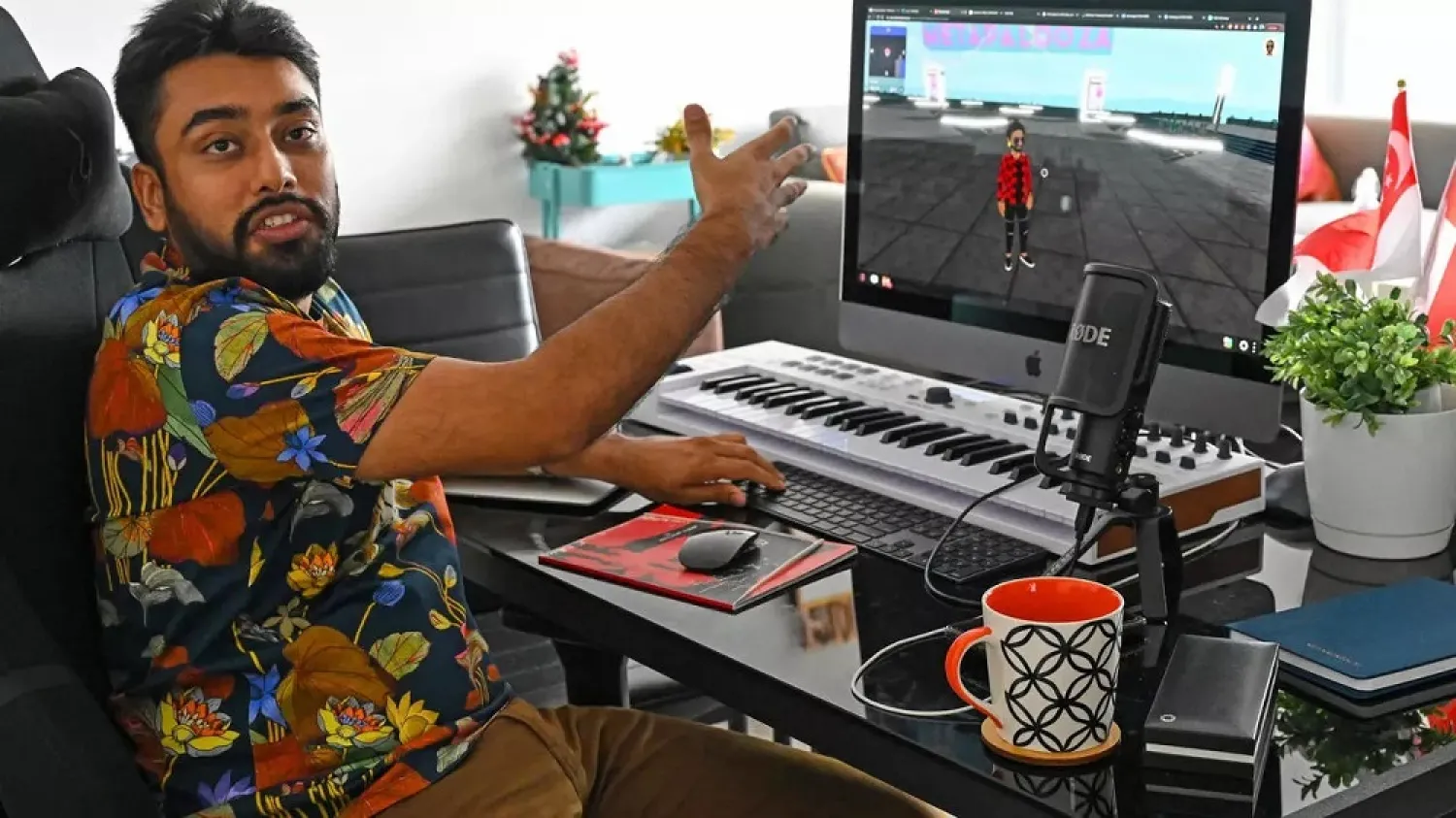
Vignesh Sundaresan's unpretentious demeanor offers no clue that he is a multimillionaire investor. (AFP)
TT

$69 Million Digital Art Buyer Shines Light on 'NFT' Boom

Vignesh Sundaresan's unpretentious demeanor offers no clue that he is a multimillionaire investor. (AFP)

The blockchain entrepreneur who paid a record $69.3 million for a digital artwork looks, at first glance, nothing like a wealthy collector.

The 32-year-old is casually dressed in a t-shirt and chinos, lives in a regular Singapore apartment, and does not own any property or a car -- with most of his investments in the virtual world.

"My prize possession would be my computer. And maybe my watch," Indian-born Vignesh Sundaresan, also known by his pseudonym MetaKovan, told AFP from his sparsely decorated flat.

His unpretentious demeanor offers no clue that he is a multimillionaire investor financing a fund focused on "non-fungible tokens" (NFTs), which use blockchain technology to turn anything from art to internet memes into virtual collector's items.

Last month the programmer bought the world's most expensive NFT -- US artist Beeple's "Everydays: The First 5,000 Days" -- highlighting how virtual work is establishing itself as a new creative genre.

With NFTs, many see an opportunity to monetize digital art of all kinds, offering collectors the bragging rights to ultimate ownership, even if the work can be endlessly copied.

Sundaresan defended the price he paid for the collage of 5,000 pieces of art created on consecutive days, which has transformed its creator, real name Mike Winkelmann, into the third-most valuable living artist.

"I thought this piece was that important," he said.

"As a piece itself it's awesome. But there is this signaling and symbolic intention also to show the world that... there's this whole thing that's going on underground."

The popularity of NFTs has been slowly growing, but only really hit the headlines with the sale of Beeple's latest work.

'Soul connection'
Sundaresan's Metapurse fund bought another set of 20 Beeple works in December and sold partial ownership of the collection as "tokens" -- originally priced at $0.36 per token and now worth around $5.

But he said buying "The First 5,000 Days" was emotionally draining -- the sale at Christie's auctioneers lasted two weeks, with the price starting at just $100 and 22 million people logging on to watch the final dramatic moments.

"I did not think it will be this competitive actually," he said. "Even for me to spend that much money, it's quite hard."

He plans to display his digital art in a virtual gallery -- and plans to hire an architect to design it.

"As an avatar, you will be able to go there and go to different floors and look at this art," he said.

Sundaresan said he felt a personal connection to "The First 5,000 Days" as his own story mirrored Beeple's -- both men started as relative amateurs in their field but found success after years of hard work.

Beeple began "The First 5,000 Days" in 2007, when he was a bored web designer, and created a work of art each day.

"He has grown over every day -- he has worked 13 years now to get to this point," said Sundaresan.

"I felt this soul connection with him."

'Right place, right time'
As an undergraduate engineering student, Sundaresan said he could not even afford a laptop.

He tried to build various web services which failed, but he got his break by founding a cryptocurrency company in 2013.

Now, he is chief executive of an IT consulting firm as well as financing the NFT-investing fund Metapurse.

However, he denies that his most recent purchase was a stunt to raise the value of his other NFTs, as some critics have suggested, and insists he is trying to help artists.

But not everyone believes the NFT boom offers much support.

"I see the occasional artist getting a lot of money because they're lucky, they're in the right place at the right time," said Antonio Fatas, a professor of economics at INSEAD business school.

"But for the regular artist trying to make themselves known, I do not see how this is helping."



China Approves First Two Level-3 Autonomous Driving Cars from State-owned Automakers

People pass by the entrance to Volkswagen (China) Technology Company, a 3 billion euros ($3.5 billion) R&D center in Hefei in eastern China's Anhui province, on Feb. 25, 2025. (AP Photo/Ken Moritsugu)
TT

China Approves First Two Level-3 Autonomous Driving Cars from State-owned Automakers

People pass by the entrance to Volkswagen (China) Technology Company, a 3 billion euros ($3.5 billion) R&D center in Hefei in eastern China's Anhui province, on Feb. 25, 2025. (AP Photo/Ken Moritsugu)

China's industry regulator on Monday approved two Chinese cars with level-3 autonomous driving capabilities, marking the first time such vehicles have been cleared by the national regulator as legitimate products ready for mass adoption.

The Ministry of Industry and Information Technology approved the two electric sedans from state-owned automakers Changan Auto and BAIC Motor in its latest automobile product entry category, said Reuters.

The two models are allowed to activate conditional autonomous driving in designated areas of Chongqing and Beijing with speed limits of 50km/h and 80km/h, respectively, the ministry said in a statement. The automakers will conduct trial operation with the cars on the specific roads via their ride-hailing units, it added.

The auto industry has defined five levels of autonomous driving, from cruise control at level one to fully self-driving cars at level five, and level three allows drivers to take their eyes and hands off the road in certain situations.

The move underscored China's ambition to lead the development and adoption of autonomous driving, a technology poised to disrupt the auto industry globally. Last year, China lined up nine automakers for public tests to advance the adoption of self-driving cars.

Chinese regulators earlier this year had sharpened scrutiny of the assisted driving technologies following an accident involving a Xiaomi SU7 sedan in March. That incident killed three occupants when their car crashed seconds after the driver took control from the assisted-driving system.

But government officials are pressing Chinese automakers to rapidly deploy even more advanced systems. In their level-3 push, Chinese regulators also are upping the regulatory ante by holding automakers and parts suppliers liable if their systems fail and cause an accident.

Autonomous driving developers such as Pony AI and WeRide have been testing their level-4 cars with licenses granted by local governments across China.

Tesla's Full Self-Driving, a level-2 driver assistance system, has been partially approved in China since February and falls short of its capabilities in the United States.


Elm Company Named Strategic Partner for International Data and AI Conference

Elm Company Named Strategic Partner for International Data and AI Conference
TT

Elm Company Named Strategic Partner for International Data and AI Conference

Elm Company Named Strategic Partner for International Data and AI Conference

The Saudi Data and Artificial Intelligence Authority (SDAIA) announced a strategic partnership with Elm Company for the International Conference on Data and AI Capacity Building (ICAN 2026), enhancing collaboration to empower the data and artificial intelligence ecosystem and promote innovation in education and human capacity development.

This partnership comes as part of preparations for ICAN 2026, organized by SDAIA from January 28 to 29 at King Saud University in Riyadh, with the participation of a select group of specialists and experts from around the world, SPA reported.

The step represents a qualitative addition that contributes to enriching the conference’s knowledge content and expanding partnerships with leading national entities.

Elm Company brings extensive experience in designing digital solutions and building technical capabilities, reinforcing its role as a strategic partner in supporting the conference. It contributes by developing training tracks and digital empowerment programs, participating in the technology exhibition, and presenting qualitative initiatives that help empower national competencies in the fields of data and artificial intelligence.


Foxconn to Invest $510 Million in Kaohsiung Headquarters in Taiwan

Construction is scheduled to start in 2027, with completion targeted for 2033. Reuters
TT

Foxconn to Invest $510 Million in Kaohsiung Headquarters in Taiwan

Construction is scheduled to start in 2027, with completion targeted for 2033. Reuters

Foxconn, the world’s largest contract electronics maker, said on Friday it will invest T$15.9 billion ($509.94 million) to build its Kaohsiung headquarters in southern Taiwan.

That would include a mixed-use commercial and office building and a residential tower, it said. Construction is scheduled to start in 2027, with completion targeted for 2033.

Foxconn said the headquarters will serve as an important hub linking its operations across southern Taiwan, and once completed will house its smart-city team, software R&D teams, battery-cell R&D teams, EV technology development center and AI application software teams.

The Kaohsiung city government said Foxconn’s investments in the city have totaled T$25 billion ($801.8 million) over the past three years.