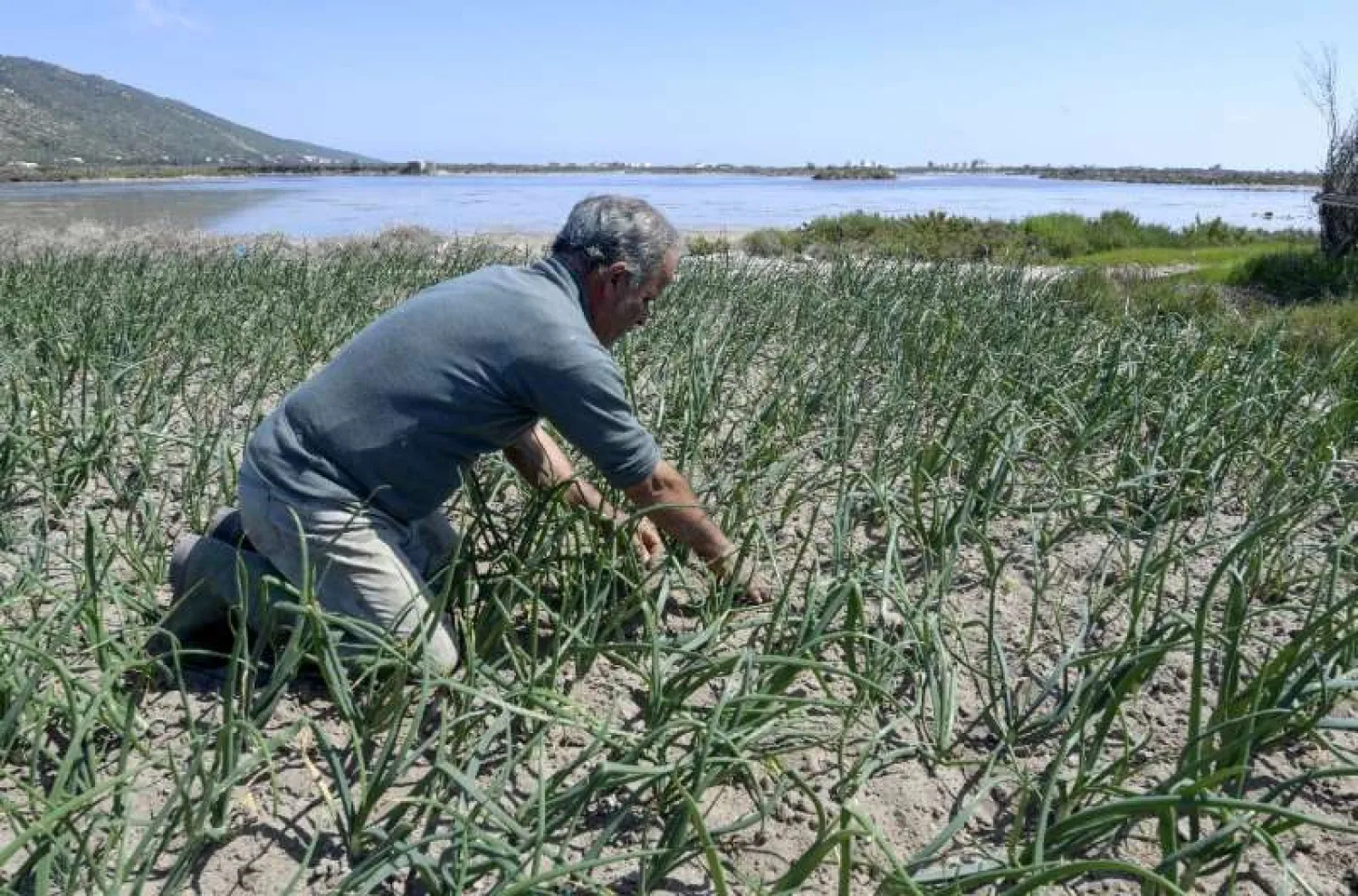

Tunisia 'Sandy' Farms Resist Drought, Development

Known as 'ramli' farms, this delicate balance with nature is under threat as rainfall becomes less regular due to climate change - AFP
TT

Tunisia 'Sandy' Farms Resist Drought, Development

Known as 'ramli' farms, this delicate balance with nature is under threat as rainfall becomes less regular due to climate change - AFP

Farmers near a seaside lagoon in northern Tunisia are fighting to preserve a unique, traditional irrigation system that has sparked renewed interest as North Africa's water shortages intensify.

Retired schoolteacher Ali Garci wanders among tiny sandy plots, inspecting his potatoes, lettuces and onions.

"It's not land that we cultivate for the profit it brings, but for the art and the pleasure," says the 61-year-old, who works around a hectare (2.5 acres) inherited from his family.

Local farmers have used the "ramli" technique since the 17th century. Some found safety in Ghar El Melh, a small fishing town in Tunisia's north. But they had to battle a lack of cultivated land and water, AFP reported.

They learned to take advantage of the light, sandy soil, and the fact that underground freshwater, which is lighter than seawater, "floats" above the saltier groundwater below.

When rainwater from the hills reaches the sandy area around Ghar El Melh's lagoons, instead of mixing immediately with the brine below, it forms a thin layer of fresh groundwater.

Twice a day, the tides of the nearby Mediterranean raise the level of both, bringing precious freshwater in contact with the vegetables in the ramli plots.

"It's as if the sea is suckling its young," said Abdelkarim Gabarou, who has worked the traditional plots for more than 40 years.

The ramli farms -- ramli is Arabic for "sandy" -- cover around 200 hectares (500 acres) and support around 300 people.

They were listed last year in the UN Food and Agriculture Organization's (FAO) list of Globally Important Agricultural Heritage Systems.

The FAO said the ramli system was "unique not only in Tunisia but in the whole world".

Ramli produce is said to have a particular taste, and is in high demand both locally and in Tunis.

But farmers voice regret that their products lack formal certification, despite the FAO designation.

They must also contend with growing threats to their unique farming system, both from climate change and development.

As rainfall becomes less regular and sea levels rise, the ramli farmers' delicate dance with nature is becoming harder.

"We're totally dependent on rainwater," Garci said. "We try to preserve it in the most natural way possible."

For the system to work, the roots of the vegetables must reach freshwater but also, crucially, not the saltwater below.

That requires precisely the right amount of sand above: a layer exactly 40 centimetres (15-and-a-half inches) thick.

Raoudha Gafrej, an expert on water resources and climate change, says it would be near-impossible to reproduce the ramli system elsewhere.

"This ingenious system doesn't cover a huge area... but we have to preserve it, because the country needs every drop of water it can get," she said.

Unlike in other parts of Tunisia, these farms thrive all year round without artificial irrigation, allowing the farmers to produce up to 20 tonnes (22 tons) of crops per year.

Reeds protect the plots, just four metres wide, from wind and erosion, but shielding them from human activity is another matter.

This beautiful coastline, where a long strip of white sand separates the lagoon from the sea, is popular with holidaymakers.

"Lots of farmers are thinking of selling their land for good prices, to people who want to build houses overlooking the sea and the hills," said Garci.

Meanwhile, he says, very few young Tunisians want to become farmers.

But in a country where 80 percent of water goes to irrigation, any effort to make more efficient use of water is valuable.

On the Tunisian island of Djerba, where summer water outages are common, an NGO recently renovated 15 ancient reservoirs to collect rainwater for irrigation in the drier months.

Gafrej said such efforts were vital.

"We need to help this culture of water preservation to take root," she said.


Riyadh Becomes First City in Region to Receive Global Active City Certification

General view of Riyadh, Saudi Arabia. (SPA)
TT

Riyadh Becomes First City in Region to Receive Global Active City Certification

General view of Riyadh, Saudi Arabia. (SPA)

The Royal Commission for Riyadh City (RCRC) announced that the capital has been awarded the Global Active City (GAC) certification, becoming the first city in the Middle East to attain this designation, in recognition of its efforts to promote healthy lifestyles, physical activity, and community well-being for all.

According to a press release issued by the commission Monday, CEO of the RCRC Eng. Ibrahim bin Mohammed Al-Sultan explained that this achievement reflects the continued support and ambitious vision of the Kingdom’s leadership, which has enabled Riyadh to make significant progress in improving quality-of-life indicators across the city, in line with the targets of Saudi Vision 2030, SPA reported.

Eng. Al-Sultan expressed appreciation to the main partners, Ministry of Sport and Saudi Sports for All Federation, whose active contributions played a vital role in securing this international recognition. He also acknowledged the efforts of relevant entities, noting that their collaboration highlights the Kingdom’s regional and global leadership in enhancing quality of life.

The release added that the Active Well-being Initiative, founded by Association for International Sport for All (TAFISA) and Evaleo Organization, and supported by the International Olympic Committee (IOC), awards the Global Active City certification to cities that excel in creating active living opportunities and implementing targeted systems and standards aimed at encouraging physical activity across all segments of society.

This achievement reaffirms RCRC’s commitment to transforming the capital into a city that enables residents and visitors to live healthier, more active lifestyles. This approach aligns with the goals of Saudi Vision 2030 and the Quality of Life Program through an integrated, citywide strategy that expands access to public spaces, walking and cycling paths, sports facilities, and community programs that inspire active living.

Riyadh’s approach brings together the sport, health, transport, education, and urban planning sectors to build a supportive urban environment that enhances well-being and ensures inclusivity for all members of the community.

The certification process was led by RCRC, with the support and participation of Ministry of Sport, Saudi Sports for All Federation, and more than 20 relevant entities. This collaborative effort has made physical activity an essential and accessible part of Riyadh’s urban vision.

The Global Active City classification reflects Riyadh’s progress in infrastructure, programs, governance systems, and policy frameworks dedicated to improving quality of life, strengthening community participation, and supporting sustainable well-being. It also recognizes the city’s measurable advancements in promoting physical activity and public health.


Interstellar Comet Keeps Its Distance as It Makes Its Closest Approach to Earth

This image, provided by NASA, shows the interstellar comet 3I/Atlas captured by the Hubble Space Telescope on Nov. 30, 2025, about 178 million miles (286 million kilometers) from Earth. (NASA, ESA, STScI, D. Jewitt (UCLA), M.-T. Hui (Shanghai Astronomical Observatory), J. DePasquale (STScI) via AP)
TT

Interstellar Comet Keeps Its Distance as It Makes Its Closest Approach to Earth

This image, provided by NASA, shows the interstellar comet 3I/Atlas captured by the Hubble Space Telescope on Nov. 30, 2025, about 178 million miles (286 million kilometers) from Earth. (NASA, ESA, STScI, D. Jewitt (UCLA), M.-T. Hui (Shanghai Astronomical Observatory), J. DePasquale (STScI) via AP)

A stray comet from another star swings past Earth this week in one last hurrah before racing back toward interstellar space.

Discovered over the summer, the comet known as 3I/Atlas will pass within 167 million miles (269 million kilometers) of our planet on Friday, the closest it gets on its grand tour of the solar system.

NASA continues to aim its space telescopes at the visiting ice ball, estimated to be between 1,444 feet (440 meters) and 3.5 miles (5.6 kilometers) in size. But it’s fading as it exits, so now’s the time for backyard astronomers to catch it in the night sky with their telescopes, The AP news reported.

The comet will come much closer to Jupiter in March, zipping within 33 million miles (53 million kilometers). It will be the mid-2030s before it reaches interstellar space, never to return, said Paul Chodas, director of NASA’s Center for Near Earth Object Studies.

It’s the third known interstellar object to cut through our solar system. Interstellar comets like 3I/Atlas originate in star systems elsewhere in the Milky Way, while home-grown comets like Halley's hail from the icy fringes of our solar system.

A telescope in Hawaii discovered the first confirmed interstellar visitor in 2017. Two years later, an interstellar comet was spotted by a Crimean amateur astronomer. NASA’s sky-surveying Atlas telescope in Chile spotted comet 3I/Atlas in July while prowling for potentially dangerous asteroids.

Scientists believe the latest interloping comet, also harmless, may have originated in a star system much older than ours, making it a tantalizing target.


Japan’s Only Two Pandas to Be Sent Back to China 

Giant panda Lei Lei eats bamboo at Ueno Zoological Gardens in Tokyo, Japan, 28 November 2025. (EPA)
TT

Japan’s Only Two Pandas to Be Sent Back to China 

Giant panda Lei Lei eats bamboo at Ueno Zoological Gardens in Tokyo, Japan, 28 November 2025. (EPA)

Two pandas at a Tokyo zoo will be returned to China in January, the Tokyo government said on Monday, potentially leaving Japan without the beloved animals for the first time in half a century.

Loaned out as part of China's "panda diplomacy" program, the distinctive black-and-white animals have symbolized friendship between Beijing and Tokyo since the normalization of diplomatic ties in 1972.

Japan currently has only two pandas, Lei Lei and Xiao Xiao, at Tokyo's Zoological Gardens in the Ueno neighborhood.

But the twins are now set to be repatriated a month before their loan period expires in February, said Tokyo Metropolitan Government, which operates the Ueno zoo.

Tokyo's regional government has been asking for the immensely popular mammals to remain at the zoo -- where they attract huge crowds -- but China didn't agree, according to the Nikkei business daily.

In September last year, animal lovers in Tokyo bid farewell to the parents of Lei Lei and Xiao Xiao who returned home.

Just before they left, thousands of tearful fans came out to catch a final glimpse and take photographs of the beloved bears.

The Asahi Shimbun reported that Tokyo is seeking the loan of a new pair, although their arrival before the return of Lei Lei and Xiao Xiao is seen as unlikely.

Ties between Asia's two largest economies are fast deteriorating after Japan's conservative premier Sanae Takaichi hinted that Tokyo could intervene militarily in the event of any attack on Taiwan.

Her comment provoked the ire of Beijing, which regards the island as its own territory.

Japan's top government spokesman Minoru Kihara said pandas have helped ties with China.

"Exchanges through pandas have contributed to improving the feelings between the people of Japan and China. We hope such exchanges will continue," Kihara told a regular press briefing.

He said that "several local governments and zoos have expressed interest in receiving pandas on loan" but did not state whether the national government was asking China for new animals.

The Ueno zoo has long been the beneficiary of panda diplomacy, having cooperated with facilities in China and the United States to successfully breed giant pandas.

Lei Lei and Xiao Xiao were delivered in 2021 by their mother Shin Shin, who arrived in 2011 and was returned to China last year.

Breeding pandas in a zoo environment is fiendishly tricky due to their difficulties mating, false pregnancies and high mortality rates of newborn cubs.