


Lebanese Doctor's Drive to Curb COVID-19 with Sniffer Dogs

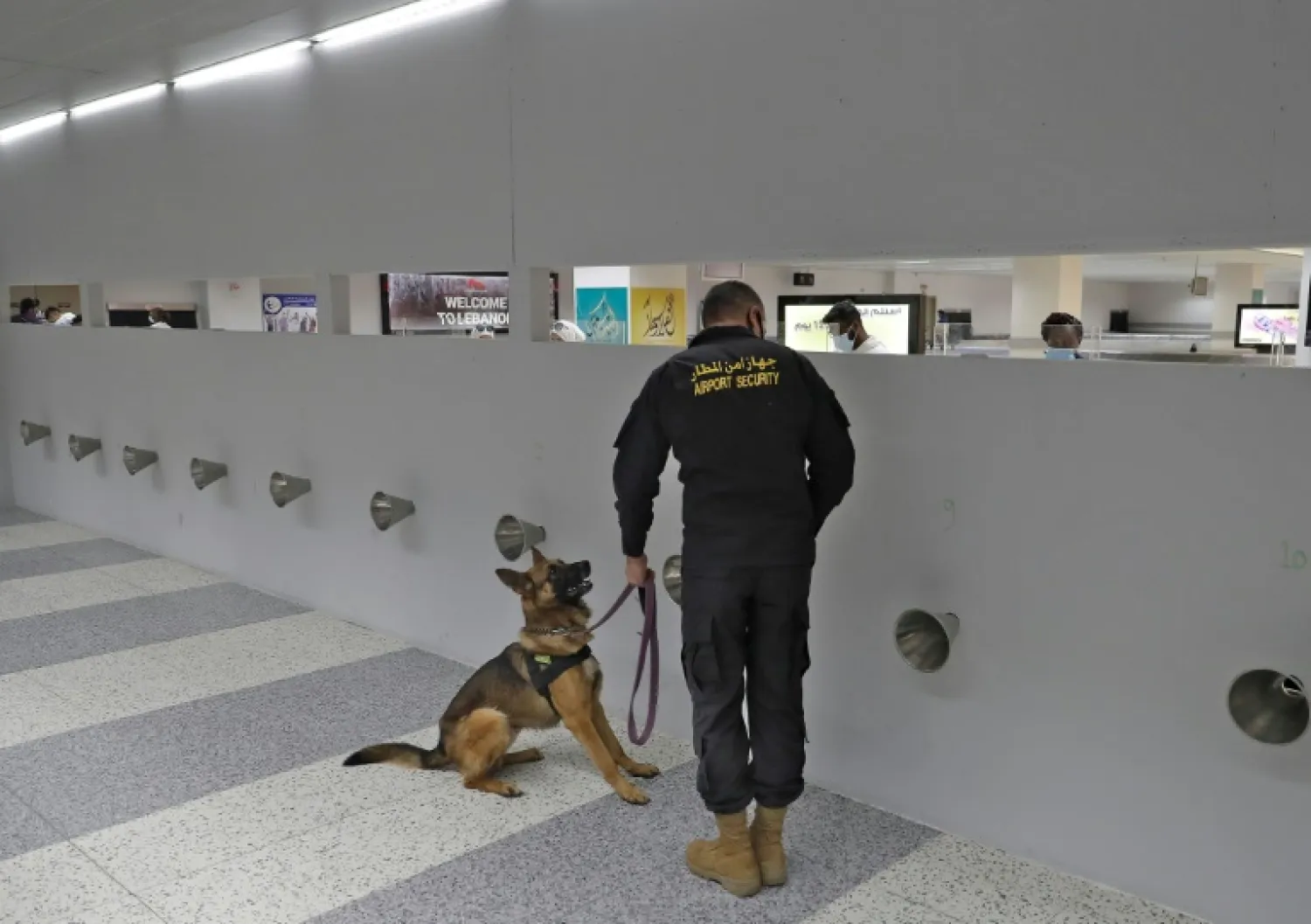
The samples are placed in a long line of cones for the sniffer dog to check with a speed and accuracy that Dr Sarkis says makes the method ideal for use in places like airports or entertainment venues - AFP
TT

Lebanese Doctor's Drive to Curb COVID-19 with Sniffer Dogs

The samples are placed in a long line of cones for the sniffer dog to check with a speed and accuracy that Dr Sarkis says makes the method ideal for use in places like airports or entertainment venues - AFP

Lebanese doctor Riad Sarkis says he can help curb Covid-19 globally. As he speaks inside Beirut airport, one of his secret weapons is wagging its tail next to him.

Specifically trained sniffer dogs can detect Covid in a person in a few seconds, including in very early stages when a PCR test would yield a negative result.

"Man's best friend" doesn't even begin to describe how Dr Sarkis views dogs, which he argues can save more human lives than ever before by stopping the spread of the pandemic.

"The day we build a machine with an electronic nose that amplifies smells 10,000 times, then we can replace the dogs. For now, we need them," Sarkis says, AFP reported.

The effusive professor, who splits his time and work between France and Lebanon, has temporarily sidelined his passions for music and poetry to stay on a war footing against the pandemic that has brought the world to a standstill.

A digestive system surgery professor and oncologist, Sarkis had spent 12 years researching how dogs could help detect cancer and increase chances of early treatment.

"When Covid appeared, I thought why not try. And it worked," he recounts.

Research was conducted with France's Maisons-Alfort veterinary school, a leading institution founded in the 18th century, and various labs and universities.

The results were staggering: the hyper-sensitive snouts of trained sniffer dogs were almost infallible.

"PCR tests have a margin of error that can reach 30 percent. With dogs, it's less than five percent," he says.

Each dog can process hundreds of samples every day, the only wages they need are biscuits or rubber toys and they deliver results on the spot.

The technique is not intended to replace PCR testing but has been rolled out in a number of international airports such as Dubai, Helsinki and Sydney.

At a training facility provided by Bank Audi in Beirut, Rox and Sky, an Alsatian and a Malinois, are being trained by dog handler Carlo Selman.

"These dogs are a gift from God to combat Covid," he says, as Sky wiggles in excitement ahead of a new exercise.

Replicating the set-up at an airport terminal, a partition shields the dogs from the testing area, where passengers are ushered into booths.

The underarm sweat sample is collected by the passengers, who are generally only too happy not to have a swab drilled into their nostrils.

The cotton pad is dropped in a glass container, which is in turn placed at the small end of cones that flare open on the other side of the partition.

Pacing down the row of cones on their handlers' leash, the dogs poke their muzzles in each one.

If a sample is positive, they stop and sit in front of it, waiting for their treat.

Sniffer dogs with K9 unit experience in explosives or drugs detection can be trained in weeks.

Sarkis explains that the accuracy and speed of the dogs' testing skills should be a key to stemming the spread of the Covid pandemic.

"By the time a passenger carrying Covid gets PCR results, he has entered the country and very often the damage is done," he says.

Dogs can detect Covid at a very early stage, which allows for the isolation of asymptomatic people who would otherwise be unwittingly spreading the virus.

The use of dogs is not limited to airports and Sarkis hopes to spread the technique to a wide range of occasions and locations.

The speed of canine screening could make it an attractive option for buildings and events hosting large numbers of visitors, such as theaters and weddings.

The use of dogs for Covid detection is also a milestone in scientific research, Sarkis said.

"It's a fantastic innovation because it's the first time we're able to demonstrate that a virus gives off specific scents," he said.

"This technique will be implemented with a lot of pathologies in the future," he predicts.

"Unfortunately, we should expect pathologies that could be even worse than Covid."


UN: 53 Migrants Dead or Missing in Shipwreck Off Libya

(FILES) Migrants sit on board a RHIB (Rigid inflatable boat) after being evacuated by crew members of the “Ocean Viking” rescue ship from the oil tanker the 'Maridive 703' in the search-and-rescue zone of the international waters between Malta and Tunisia, on December 31, 2025. (Photo by Sameer Al-DOUMY / AFP)
TT

UN: 53 Migrants Dead or Missing in Shipwreck Off Libya

(FILES) Migrants sit on board a RHIB (Rigid inflatable boat) after being evacuated by crew members of the “Ocean Viking” rescue ship from the oil tanker the 'Maridive 703' in the search-and-rescue zone of the international waters between Malta and Tunisia, on December 31, 2025. (Photo by Sameer Al-DOUMY / AFP)

The UN migration agency on Monday said 53 people were dead or missing after a boat capsized in the Mediterranean Sea off the Libyan coast. Only two survivors were rescued.

The International Organization for Migration said the boat overturned north of Zuwara on Friday.

"Only two Nigerian women were rescued during a search-and-rescue operation by Libyan authorities," the IOM said in a statement, adding that one of the survivors said she lost her husband and the other said "she lost her two babies in the tragedy.”

According to AFP, the IOM said its teams provided the two survivors with emergency medical care upon disembarkation.

"According to survivor accounts, the boat -- carrying migrants and refugees of African nationalities departed from Al-Zawiya, Libya, at around 11:00 pm on February 5. Approximately six hours later, it capsized after taking on water," the agency said.

"IOM mourns the loss of life in yet another deadly incident along the Central Mediterranean route."

The Geneva-based agency said trafficking and smuggling networks were exploiting migrants along the route from north Africa to southern Europe, profiting from dangerous crossings in unseaworthy boats while exposing people to "severe abuse.”

It called for stronger international cooperation to tackle the networks, alongside safe and regular migration pathways to reduce risks and save lives.


Eight Muslim Countries Condemn Israel’s ‘Illegal’ West Bank Control Measures

 Israeli soldiers stand guard during a weekly settlers' tour in Hebron, in the Israeli-occupied West Bank, February 7, 2026. (Reuters)
Israeli soldiers stand guard during a weekly settlers' tour in Hebron, in the Israeli-occupied West Bank, February 7, 2026. (Reuters)
TT

Eight Muslim Countries Condemn Israel’s ‘Illegal’ West Bank Control Measures

 Israeli soldiers stand guard during a weekly settlers' tour in Hebron, in the Israeli-occupied West Bank, February 7, 2026. (Reuters)
Israeli soldiers stand guard during a weekly settlers' tour in Hebron, in the Israeli-occupied West Bank, February 7, 2026. (Reuters)

Saudi Arabia and seven other Muslim countries on Monday condemned new Israeli measures to tighten control of the West Bank and pave the way for more settlements on the occupied Palestinian territory.

Saudi Arabia, Jordan, the UAE, Qatar, Indonesia, Pakistan, Egypt and Türkiye "condemned in the strongest terms the illegal Israeli decisions and measures aimed at imposing unlawful Israeli sovereignty", a Saudi Foreign Ministry statement said.

Israel's security cabinet approved a series of steps on Sunday that would make it easier for settlers in the occupied West Bank to buy land while granting Israeli authorities more enforcement powers over Palestinians, Israeli media reported.

The West Bank is among the territories that the Palestinians seek for a future independent state. Much of it is under Israeli military control, with limited Palestinian self-rule in some areas run by the Palestinian Authority (PA).

Citing statements by Finance Minister Bezalel Smotrich and Defense Minister Israel ‌Katz, Israeli ‌news sites Ynet and Haaretz said ‌the ⁠measures included scrapping ‌decades-old regulations that prevent Jewish private citizens buying land in the West Bank.

They were also reported to include allowing Israeli authorities to administer some religious sites, and expand supervision and enforcement in areas under PA administration in matters of environmental hazards, water offences and damage to archaeological sites.

Palestinian President Mahmoud Abbas said ⁠the new measures were dangerous, illegal and tantamount to de-facto annexation.

The Israeli ministers ‌did not immediately respond to requests for ‍comment.

The new measures come three ‍days before Prime Minister Benjamin Netanyahu is scheduled to ‍meet in Washington with US President Donald Trump.

In his statement, Abbas urged Trump and the UN Security Council to intervene.

Jordan’s foreign ministry condemned the decision, which it said was “aimed at imposing illegal Israeli sovereignty” and entrenching settlements. The Hamas group called on Palestinians in the West Bank to “intensify the confrontation with the occupation and its settlers.”

Trump has ruled out Israeli annexation of the West Bank, but his administration has not sought to curb Israel's accelerated settlement building, which the Palestinians say denies them a potential state ⁠by eating away at its territory.

Netanyahu, who is facing an election later this year, deems the establishment of any Palestinian state a security threat.

His ruling coalition includes many pro-settler members who want Israel to annex the West Bank, land captured in the 1967 Middle East war to which Israel cites biblical and historical ties.

The United Nations' highest court said in a non-binding advisory opinion in 2024 that Israel's occupation of Palestinian territories and settlements there is illegal and should ‌be ended as soon as possible. Israel disputes this view.

The West Bank is divided between an Israeli-controlled section where settlements are located and sections equaling 40% of the territory where the Palestinian Authority has autonomy.

Palestinians are not permitted to sell land privately to Israelis. Settlers can buy homes on land controlled by Israel’s government.

More than 700,000 Israelis live in the occupied West Bank and east Jerusalem, territories captured by Israel in 1967 from Jordan and sought by the Palestinians for a future state. The international community overwhelmingly considers Israeli settlement construction in these areas to be illegal and an obstacle to peace.

Smotrich, previously a firebrand settler leader and now finance minister, has been granted cabinet-level authority over settlement policies and vowed to double the settler population in the West Bank.

In December, Israel’s Cabinet approved a proposal for 19 new Jewish settlements in the West Bank as the government pushes ahead with a construction binge that further threatens the possibility of a Palestinian state. And Israel has cleared the final hurdle before starting construction on a contentious settlement project near Jerusalem that would effectively cut the West Bank in two, according to a government tender reported in January.


Shibani Meets Barrack in Riyadh

Syrian Foreign Minister Asaad Hassan al-Shibani during his meeting with US Special Envoy to Syria Thomas Barrack in Riyadh (SANA)
TT

Shibani Meets Barrack in Riyadh

Syrian Foreign Minister Asaad Hassan al-Shibani during his meeting with US Special Envoy to Syria Thomas Barrack in Riyadh (SANA)

Syrian Foreign Minister, Asaad al-Shibani, met on Monday in Riyadh with US Special Envoy for Syria, Tom Barrack, the Syrian Foreign Ministry reported via its Telegram channel.

According to the Syrian Arab News Agency (SANA), the meeting took place on the sidelines of the meeting of political leaders of the International Coalition to Defeat ISIS.

Al-Mikdad, accompanied by General Intelligence Chief Hussein al-Salama, arrived in Riyadh on Sunday to participate in the Coalition’s discussions.

On February 4, the UN Security Council warned during a session on threats to international peace and security that the terrorist group remains adaptable and capable of expansion.

The council emphasized that confronting this evolving threat requires comprehensive international cooperation grounded in respect of international law and human rights.
