


Fashion Industry Evolves, as Virus Forces a Rethink

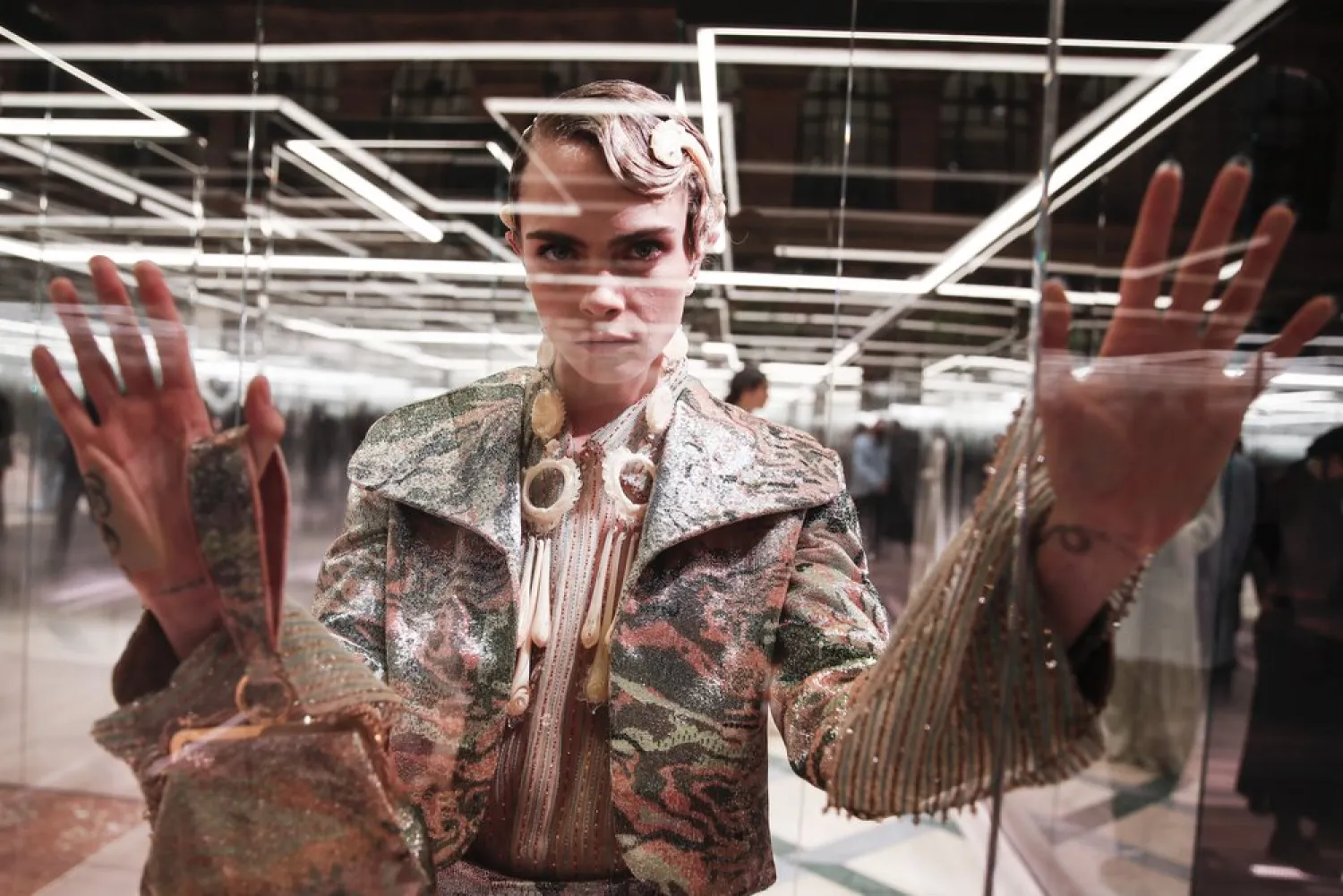
In this Jan. 27, 2021 file photo, model Cara Delevingne wears a creation for Fendi's Spring-Summer 2021 Haute Couture fashion collection presented in Paris. (AP)
TT

Fashion Industry Evolves, as Virus Forces a Rethink

In this Jan. 27, 2021 file photo, model Cara Delevingne wears a creation for Fendi's Spring-Summer 2021 Haute Couture fashion collection presented in Paris. (AP)

The pandemic has torn a multibillion-dollar bite out of the fabric of Europe's fashion industry, stopped runway shows and forced brands to show their designs digitally instead.

Now, amid hopes of a return to near-normality by the year’s end, the industry is asking what fashion will look like as it dusts itself off and struggles to its well-heeled feet again.

Answers vary. Some think the Fashion Week format, in use since the 1940s, will be radically rethought. Others believe Asia will consolidate its huge gains in influence. Many see brands seeking greater sustainability to court a younger clientele.

“The impact of the pandemic will be unquestionably to increase the importance and influence of Asia on fashion,” said Gildas Minvielle, economist at the Institut Francais de la Mode in Paris.

“Luxury in Europe has already rebounded but it’s only because it’s globalized, only because of Asian buyers," Minvielle said. "They spent on European brands.”

Asian buyers are still considered a largely untapped market, yet their wealth has recently tipped over that of Westerners. China, in particular, was already considered the worldwide engine of growth in the luxury industry before the pandemic. Its quicker containment of the virus will leave it in an even stronger position.

“In the next 50 years money will come from the East as it has been (coming) in the last 50 years from the West,” said Long Nguyen, chief fashion critic of The Impression.

This could see a designer aesthetic that panders more to Chinese tastes.

Another trend that's been strengthened during the pandemic is the decision to forgo the frenetic pace of runway calendar shows.

As the virus tore across the globe from East to West, these morphed overnight from a live, in-person, sensory experience to a pre-taped digital display released online. Many predicted devastation for the industry, but houses have proved surprisingly resilient. That's because the system was already overdue a shift.

Since the advent of social media, brands have become much less reliant on traditional advertising outlets such as fashion magazines. Now, they create their own online channels, circumventing the glossies, to get their designs out.

“Each brand is a media entity unto itself,” Nguyen said, calling the way the industry operates “obsolete.”

Moreover, as buyers themselves move online, houses have necessarily become much less dependent on traditional sales outlets such as department stores.

Some houses have done better than expected with the new digital format. Smaller brands, in particular, have welcomed the break from staging runway shows that can be astronomically expensive — for relatively little return.

Paris couture designer Julien Fournie said the virus has led him to question “whether fashion shows were really necessary” in the first place.

The virus saw many brands, including Balenciaga, Alexander McQueen and Bottega Veneta of French luxury giant Kering, tearing up the traditional calendar to show their new collections when it suits them — both creatively and financially. Saint Laurent started the trend last year, drawing headlines for quitting Paris Fashion Week to “take control of its pace.”

The advantage for these brands is to set dates on their own terms, with collections that don't compete with others for attention at the same time. Yet many nostalgic critics, buyers and consumers argue that nothing can replace the physical runway experience.

“Brands have been deciding more and more when their optimal time to show is... They want to control their business more and that is their right,” Pascal Morand, Paris fashion federation Executive President.

“But this is not the end to Fashion Week. No matter what people say they are all awaiting a return to the runway and to come back to the physical experience.”

Stella McCartney, who unveiled her fall collection off-schedule last month, said that the industry has been seriously questioning the relevance of seasons “even before COVID,” as climate change has sadly highlighted how absurd it is.

“There was a moment at the beginning of lockdown — in the sky there were no airplanes, you could hear birds," McCartney said. "Everyone was talking about nature reclaiming its rightful place,” she added, expressing frustration with the industry’s lifestyle that requires thousands of kilometers of travel per year.

McCartney said that across the industry now there is a sense that brands must embrace sustainability “in order to survive,” especially to attract the young, more environmentally conscious consumer.

One example of such eco-thinking is in reducing waste in collections. Luxury giants have been criticized in the past for burning unused or unsold luxury goods.

And McCartney also doesn’t seem to think that this will be the end of the runway show.

“I don’t think we will throw away where we are today and I don’t think we’ll dismiss where we were yesterday," she said. "It took me a while, but I miss the energy at the end of the show, the engagement with my community, I miss seeing clothes in real life and moving, expressions of the models, the sound. That is the art.”


Kering’s Fourth-Quarter Sales Fall Less Than Expected as Gucci Slide Continues

The logo of French luxury group Kering is seen at Kering headquarters in Paris, France, February 13, 2023. (Reuters)
TT

Kering’s Fourth-Quarter Sales Fall Less Than Expected as Gucci Slide Continues

The logo of French luxury group Kering is seen at Kering headquarters in Paris, France, February 13, 2023. (Reuters)

Kering reported on Tuesday a slightly smaller-than-expected drop in fourth-quarter sales, as investors await details of CEO Luca de Meo's plans ​to revive the Gucci owner's flagging fortunes.

Sales reached 3.9 billion euros ($4.64 billion), down 3% from the previous year when adjusted for currency swings. That beat analysts' consensus forecast for a 5% drop, according to Visible Alpha.

The revenue drop was 10% at Italian flagship label Gucci, which accounts for most of Kering's profits, versus analyst expectations of a 12% decline.

It ‌was the brand's ‌10th straight quarter of revenue ‌decline.

Finance ⁠Chief ​Armelle ‌Poulou told journalists Gucci saw some improvement at the end of last year in "almost all regions", helped by newly introduced products and handbag sales.

Grappling with weak sales since the maximalist styles of Gucci's former star designer Alessandro Michele fell out of fashion in 2022, Kering has faced heightened investor scrutiny over its high ⁠debt and declining profitability.

Free cash from operations fell by 35% last year ‌when excluding one-off payments from real estate ‍sales, reaching 2.3 billion euros, Kering ‍said.

"For Kering, it's really about (restoring) the broad desirability globally," said ‍JPMorgan analyst Chiara Battistini.

Facing an uncertain business outlook, the group, which also owns Gucci Balenciaga, Bottega Veneta and Yves Saint Laurent, further reduced its store network by 75 boutiques with further closures planned, Poulou said.

The ​earnings underscored the steep challenges Kering faces to catch up with peers even though its shares have ⁠risen around 50% since de Meo's appointment was announced last June.

"2025 did not reflect Kering's true potential or the strength of our brands, but it enabled us to lay the foundations for our future recovery," said Poulou.

Kering's annual operating income reached 1.63 billion euros, less than a third of its 2022 level. Kering's operating profit margin fell to 11% group-wide and 16% at Gucci, down from 28% and 36% three years earlier.

By contrast, LVMH delivered a 22% margin last year amid ‌a broader luxury slowdown, with its leather and fashion division - home to Louis Vuitton and Dior - hitting 35%.


Pieter Mulier Named Creative Director of Versace

(FILES) Pieter Mulier attends the 2025 CFDA Awards at The American Museum of Natural History on November 03, 2025 in New York City. (Photo by Dimitrios Kambouris / GETTY IMAGES NORTH AMERICA / AFP)
TT

Pieter Mulier Named Creative Director of Versace

(FILES) Pieter Mulier attends the 2025 CFDA Awards at The American Museum of Natural History on November 03, 2025 in New York City. (Photo by Dimitrios Kambouris / GETTY IMAGES NORTH AMERICA / AFP)

Belgian fashion designer Pieter Mulier has been named the new creative director of the Milan fashion house Versace starting July 1, according to an announcement on Thursday from the Prada Group, which owns Versace.

Mulier is currently creative director of the French fashion house Alaïa, and was previously the right-hand man of fellow Belgian designer and Prada co-creative director Raf Simons at Calvin Klein, Jil Sander and Dior.

In his new role, Mulier will report to Versace executive chairman Lorenzo Bertelli, the designated successor to manage the family-run Prada Group. Bertelli is the son of Miuccia Prada and Prada Group chairman Patrizio Bertelli.

“We believe that he can truly unlock Versace’s full potential and that he will be able to engage in a fruitful dialogue,’’ The Associated Press quoted Lorenzo Bertelli as saying of Mulier in a statement.

Mulier takes over from Dario Vitale, who departed in December after previewing just one collection during his short-lived Versace stint.

Mulier was honored last fall by supermodel and longtime Alaïa muse Naomi Campbell at the Council of Fashion Designers of America for his work paying tribute to brand founder Azzedine Alaïa. Mulier took the creative helm in 2021, after Alaïa’s death.


Ralph Lauren’s Margin Caution Eclipses Stronger‑than‑expected Quarterly Results

Guests wait after viewing the latest Ralph Lauren collection in New York City, US, April 17, 2025. REUTERS/Caitlin Ochs/File photo
TT

Ralph Lauren’s Margin Caution Eclipses Stronger‑than‑expected Quarterly Results

Guests wait after viewing the latest Ralph Lauren collection in New York City, US, April 17, 2025. REUTERS/Caitlin Ochs/File photo

Ralph Lauren posted third-quarter results above Wall Street estimates on Thursday, but the luxury retailer's warning of margin pressure tied to US tariffs sent its shares down nearly 6.4% in premarket trading.

The company expects fourth-quarter margins, its smallest revenue period, to shrink about 80 to 120 basis points due to higher tariff pressure and marketing spend.

Ralph Lauren, which sources its products from regions such as China, India and Vietnam, has relied on raising prices and reallocating production to regions with lower duty exposure to offset US tariff pressures, Reuters reported.

"Ralph Lauren has been able to raise prices for some time now. There is some limit on how long it can continue to do this. I think (the company's) gross margins are near peak levels," Morningstar analyst David Swartz said.

The company, which sells $148 striped linen shirts and $498 leather handbags, has tightened inventory, lifted full-price sales and refreshed core styles, boosting its appeal among wealthier and younger customers, including Gen Z.

Higher-income households are still splurging on luxury items, travel and restaurant meals, while lower- and middle-income consumers are strained by higher costs for rents and food as well as a softer job market.

The New York City-based company saw quarterly operating costs jump 12% year-on-year as it ramped up brand building efforts through sports-focused brand campaigns such as Wimbledon and the US Open tennis championship.

The luxury retailer said revenue in the quarter ended December 27 rose 12% to $2.41 billion, above analysts' estimates of a 7.9% rise to $2.31 billion, according to data compiled by LSEG.

It earned $6.22 per share, excluding items, compared to expectations of $5.81, aided by a 220 basis points increase in margins and an 18% rise in average unit retail across its direct-to-consumer channel.

Ralph Lauren now expects fiscal 2026 revenue to rise in the high single to low double digits on a constant currency basis, up from its prior forecast of a 5% to 7% growth.