

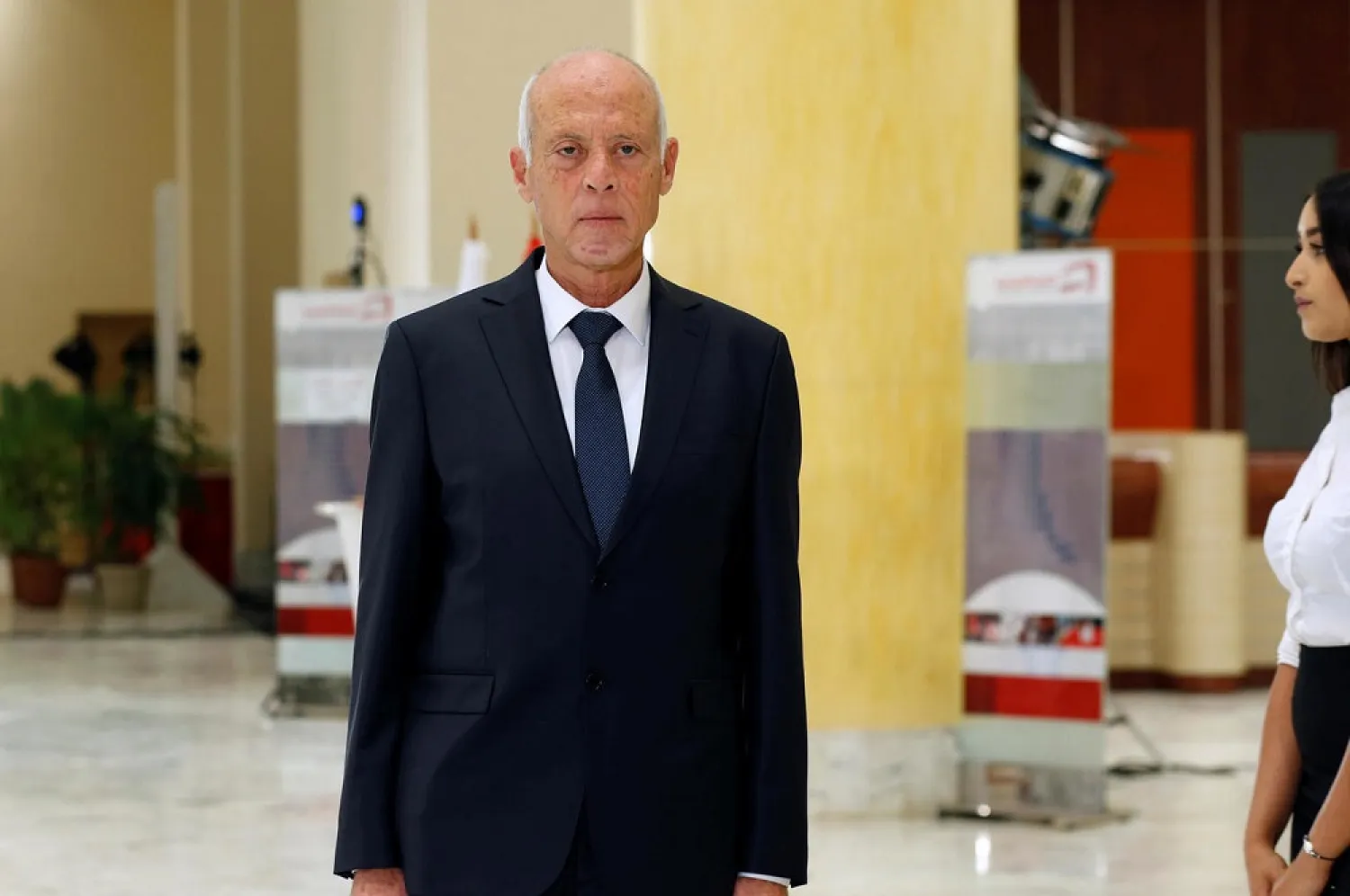

Tunisia's Ennahda Criticizes President as Political Crisis Deepens

Tunisia's President Kais Saied. (Reuters)
TT

Tunisia's Ennahda Criticizes President as Political Crisis Deepens

Tunisia's President Kais Saied. (Reuters)

Tunisia’s moderate Islamist Ennahda party publicly criticized President Kais Saied on Tuesday, warning his policies threatened democracy, in an escalation of the country’s political crisis.

Ennahda, which holds a majority at parliament, accused Saied of “violating the constitution”, having a “tendency towards individual rule” and “encroaching on the political system and the powers of the prime minister”.

It was a response to Saied’s comments on Sunday that his constitutional control of the military extended to the internal security forces, part of a wider power struggle between him, parliament and the prime minister.

Tunisia has suffered near political stalemate since 2019 elections that returned a deeply fragmented parliament in which Ennahda, as the biggest party, had only a quarter of seats, while putting Saied, an independent, into the presidency.

Prime Minister Hichem Mechichi, Saied’s own nominee for the role, has since his appointment last year been at odds with him and backed by Ennahda, whose leader, Rached Ghannouchi, is the parliament speaker.

Mechichi tried to reshuffle the cabinet this year but Saied refused to endorse the appointment of new ministers. It left Mechichi as acting interior minister, a position Saied has challenged.

Tunisia’s 2014 constitution has until now been widely interpreted as putting the internal security forces and the Interior Ministry under the control of the prime minister.

Saied is a professor of constitutional law whose surprise election victory in 2019 has rattled Tunisian politics.

Mechichi responded to Saied’s speech by saying: “There is no need for individual, odd readings which, moreover, are taken out of context.”

Tunisia was meant to establish a constitutional court to adjudicate on such disputes by 2015, but politicians have been unable to agree on the names of the judges to sit on it.



EU Condemns Israel's West Bank Control Measures

The Israeli settlement of Har Homa, seen from the West Bank city of Bethlehem, Tuesday, Dec. 17, 2024. (AP)
TT

EU Condemns Israel's West Bank Control Measures

The Israeli settlement of Har Homa, seen from the West Bank city of Bethlehem, Tuesday, Dec. 17, 2024. (AP)

The European Union on Monday condemned new Israeli measures to tighten control of the West Bank and pave the way for more settlements in the occupied Palestinian territory, AFP reported.

"The European Union condemns recent decisions by Israel's security cabinet to expand Israeli control in the West Bank. This move is another step in the wrong direction," EU spokesman Anouar El Anouni told journalists.


Atrocities in Sudan's El-Fasher Were 'Preventable Human Rights Catastrophe'

Sudanese displaced people who left El Fasher after its fall, sit in the shade in Tawila at the Rwanda camp reception point on December 17, 2025. (Photo by AFP)
TT

Atrocities in Sudan's El-Fasher Were 'Preventable Human Rights Catastrophe'

Sudanese displaced people who left El Fasher after its fall, sit in the shade in Tawila at the Rwanda camp reception point on December 17, 2025. (Photo by AFP)

The atrocities unleashed on El-Fasher in Sudan's Darfur region last October were a "preventable human rights catastrophe", the United Nations said Monday, warning they now risked being repeated in the neighbouring Kordofan region.


"My office sounded the alarm about the risk of mass atrocities in the besieged city of El-Fasher for more than a year ... but our warnings were ignored," UN rights chief Volker Turk told the Human Rights Council in Geneva.


He added that he was now "extremely concerned that these violations and abuses may be repeated in the Kordofan region".


Arab League Condemns Israel's Decisions to Alter Legal, Administrative Status of West Bank

A general view shows the opening session of the meeting of Arab foreign ministers at the Arab League Headquarters (Reuters)
TT

Arab League Condemns Israel's Decisions to Alter Legal, Administrative Status of West Bank

A general view shows the opening session of the meeting of Arab foreign ministers at the Arab League Headquarters (Reuters)

The General Secretariat of the Arab League strongly condemned decisions by Israeli occupation authorities to impose fundamental changes on the legal and administrative status of the occupied Palestinian territories, particularly in the West Bank, describing them as a dangerous escalation and a flagrant violation of international law, international legitimacy resolutions, and signed agreements, SPA reported.

In a statement, the Arab League said the measures include facilitating the confiscation of private Palestinian property and transferring planning and licensing authorities in the city of Hebron and the area surrounding the Ibrahimi Mosque to occupation authorities.

It warned of the serious repercussions of these actions on the rights of the Palestinian people and on Islamic and Christian holy sites.

The statement reaffirmed the Arab League’s firm support for the legitimate rights of the Palestinian people, foremost among them the establishment of their independent state on the June 4, 1967 borders, with East Jerusalem as its capital.