

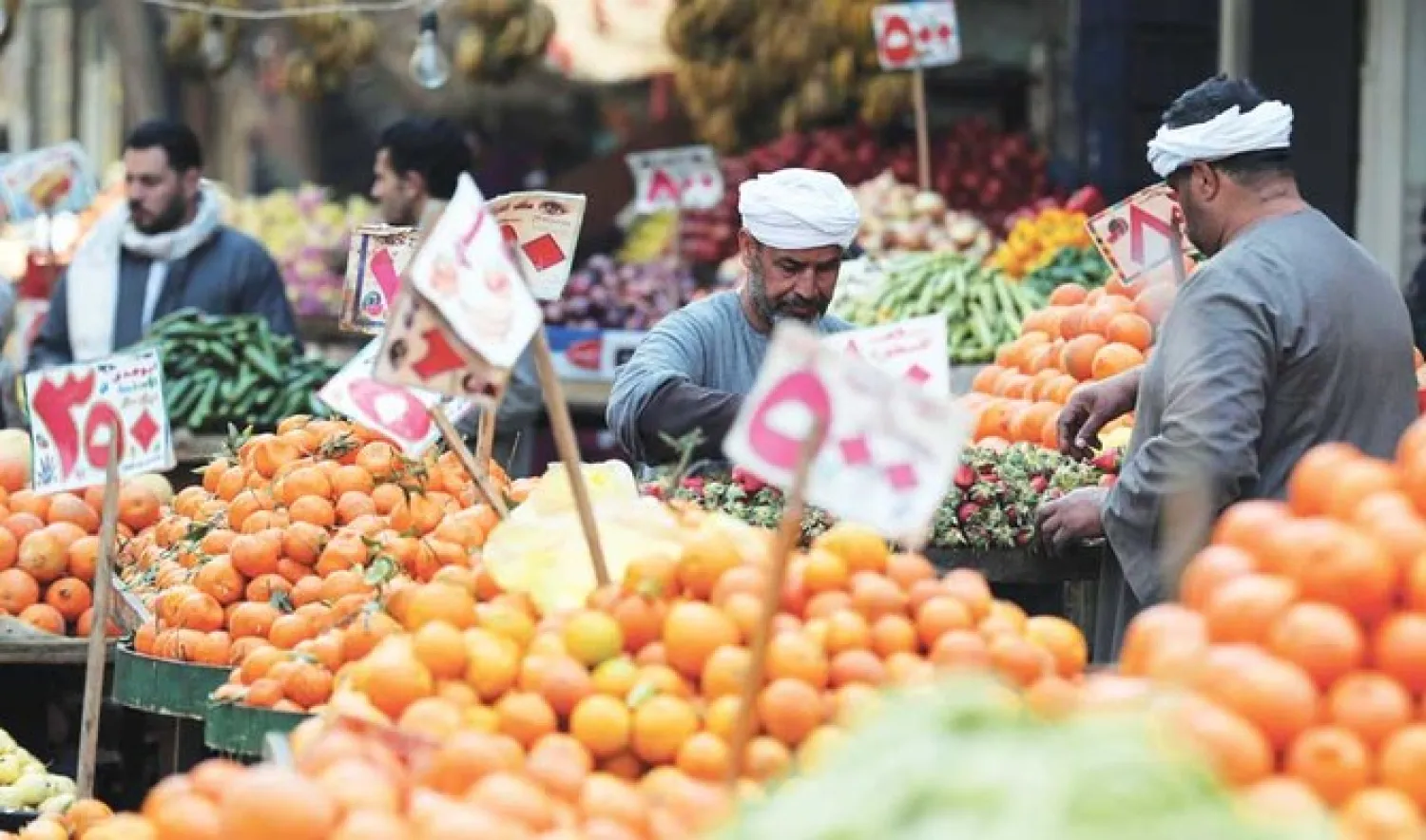

Fitch: Egypt among Top MENA Countries to See Pre-COVID Growth Rates in 2021

Vendors work at a vegetable market amid the coronavirus disease pandemic in Cairo. (File/Reuters)
TT

Fitch: Egypt among Top MENA Countries to See Pre-COVID Growth Rates in 2021

Vendors work at a vegetable market amid the coronavirus disease pandemic in Cairo. (File/Reuters)

Egypt is one of three MENA economies that will see GDP growth return to pre-covid levels in 2021, Fitch Solutions analysts said on Tuesday.

“The Central Bank of Egypt’s (CBE) monetary easing of 400 bps last year, as well as expanded fiscal spending and well-executed stimulus policies, helped to cushion the economic blow of the pandemic,” MENA country risk analyst Selim Elbadri said.

Egypt’s GDP is expected to grow at a 2.9% clip in FY2020-2021, marking a slight downwards revision of the 3% Fitch predicted in January due to the vaccine rollout.

The recovery of the tourism sector, the expansion in natural gas production, and Suez Canal revenues, as well as the monetary easing policies of the Central Bank of Egypt (CBE) are expected to drive the country’s economic growth, according to Badri.

Also, the International Monetary Fund (IMF) forecast that the Egyptian economy's growth rate during the current year will be 2.5 percent compared with 3.6 percent in 2020.

In its April report, the IMF raised its global growth forecast to 6 percent in 2021. However, it expected it to shrink to 4.4 percent in 2020.

“As the recovery strengthens in 2021, global trade is projected to accelerate to 8.4 percent, mainly because of the rebound in merchandise volumes. Cross-border services trade (tourism, transportation) is expected to remain subdued until the pandemic is brought under control everywhere.” the report said.

“The pandemic continues to exact a large toll on sub-Saharan Africa. Following the largest contraction ever for the region (–1.9 percent in 2020), growth is expected to rebound to 3.4 percent in 2021, significantly lower than the trend anticipated before the pandemic,” IMF added in its report.

Larry Fink from Davos: In Age of Artificial Intelligence, Trust Is Hardest Currency

Chairman and CEO of BlackRock, Larry Fink, attends the 56th annual World Economic Forum (WEF) meeting in Davos, Switzerland, January 21, 2026. (Reuters)
TT

Larry Fink from Davos: In Age of Artificial Intelligence, Trust Is Hardest Currency

Chairman and CEO of BlackRock, Larry Fink, attends the 56th annual World Economic Forum (WEF) meeting in Davos, Switzerland, January 21, 2026. (Reuters)

CEO of BlackRock Larry Fink kicked off the World Economic Forum on Tuesday with a stark message, acknowledging a significant erosion of trust in global institutions and elites.

Speaking at the 56th Annual Meeting of the WEF in Davos, which gathered around 65 heads of state and government and nearly 850 of the world's top CEOs and chairpersons, he acknowledged that the gathering has lost trust and “feels out of step with the moment.”

“But now for the harder question: Will anyone outside this room care? Because if we’re being honest, for many people this meeting feels out of step with the moment: elites in an age of populism, an established institution in an era of deep institutional distrust,” he admitted.

Fink, who was appointed interim co-chair of the World Economic Forum in August 2025, said it is also obvious that the world now places far less trust in the forum to help shape what comes next.

“If WEF is going to be useful going forward, it has to regain that trust,” he said.

The billionaire boss of the world’s largest asset manager said that prosperity is not just growth in the aggregate. “It can’t be measured by GDP or the market caps of the world’s largest companies alone. It has to be judged by how many people can see it, touch it, and build a future on it.”

Fink said that since the fall of the Berlin Wall, more wealth has been created than in any time prior in human history, but in advanced economies, that wealth has accrued to a far narrower share of people than any healthy society can ultimately sustain.

He noted that now AI threatens to replay the same pattern.

Fink said early gains are flowing to the owners of models, data, and infrastructure, questioning what AI does to white-collar work what globalization did to blue-collar.

He urged those gathered at Davos to create a “credible plan” for broad participation in the gains AI can deliver.

“Not with abstractions about the jobs of tomorrow, but with a credible plan for broad participation in the gains.”

In another dimension of change, Fink said the forum shouldn’t want panels where everyone agrees 95% of the time.

“The objective isn’t agreement. It’s understanding. It’s sitting with people we disagree with, taking their arguments seriously, and being willing to admit that they might see something we don’t,” he said.

Fink also noted that the central tension of the forum is that many of the people most affected by what participants talk about will never come to the conference. “Davos is an elite gathering trying to shape a world that belongs to everyone.”

He added, “That’s why this year’s theme is the Spirit of Dialogue. Because dialogue is the only way a room like this earns the legitimacy to shape ideas for people who aren’t in it.”

Fink called for WEF to start doing something new: showing up and listening in the places where the modern world is actually built. “Davos, yes. But also places like Detroit and Dublin and cities like Jakarta and Buenos Aires. The mountain will come down to earth.”


China’s Vice Premier Tells Davos World Cannot Revert to 'Law of the Jungle'

20 January 2026, Switzerland, Davos: Vice Premier of the People's Republic of China He Lifeng speaks during "Special Address by He Lifeng, Vice-Premier of the People's Republic of China session" at the World Economic Forum annual meeting in Davos. (Boris Baldinger/World Ecomonic Forum/dpa)
TT

China’s Vice Premier Tells Davos World Cannot Revert to 'Law of the Jungle'

20 January 2026, Switzerland, Davos: Vice Premier of the People's Republic of China He Lifeng speaks during "Special Address by He Lifeng, Vice-Premier of the People's Republic of China session" at the World Economic Forum annual meeting in Davos. (Boris Baldinger/World Ecomonic Forum/dpa)

Chinese Vice Premier He Lifeng warned Tuesday the world must not revert to the "law of the jungle", speaking at the World Economic Forum in Davos as Washington steps up its bid to take Greenland.

"A select few countries should not have privileges based on self-interest, and the world cannot revert to the law of the jungle where the strong prey on the weak," He said in a speech which came as US President Donald Trump pushes his increasingly assertive America First agenda, and demands NATO ally Denmark to cede Greenland to him.

"All countries have the right to protect their legitimate interests," He added.

In a veiled reference to Trump's mercurial trade policies, He slammed the "unilateral" actions and trade agreements of "some countries" which he said violates the rules of the World Trade Organization.

Beijing and Washington last year were locked in a blistering trade war that saw both countries impose tit-for-tat tariffs on each others' products.

"The current multilateral trading system is facing unprecedented and severe challenges," He said.

"We must firmly uphold multilateralism and promote the improvement of a more just and equitable international economic and trade order."


Saudi Finance Minister at Davos: Fiscal Discipline Drove Our Credit Upgrades

Finance Minister Mohammed Al-Jadaan and senior Saudi officials at a panel at the World Economic Forum in Davos on Tuesday.
TT

Saudi Finance Minister at Davos: Fiscal Discipline Drove Our Credit Upgrades

Finance Minister Mohammed Al-Jadaan and senior Saudi officials at a panel at the World Economic Forum in Davos on Tuesday.

Saudi Finance Minister Mohammed Al-Jadaan said on Tuesday strict fiscal discipline lay behind the Kingdom’s string of credit rating upgrades, arguing that Saudi Arabia has built a buffer against oil price shocks after restructuring its economy to lift the non-oil sector’s share to 56%.

Speaking to CNBC on the sidelines of the World Economic Forum in Davos, Al-Jadaan said dialogue, not confrontation, remains the only viable path to rebalancing global geoeconomic power.

He stressed that the Kingdom’s receipt of three credit rating upgrades last year was no coincidence, describing it as an international vote of confidence in the government’s fiscal discipline.

Global rating agencies and the International Monetary Fund are now clearly seeing the results of structural transformation, he remarked, noting that the Saudi budget is no longer hostage to energy price volatility, but instead rests on strong institutional foundations.

He also reaffirmed that Saudi-US relations remain “strategic” and ongoing at all levels of leadership and the ministerial level, adding that a previously cited figure of one trillion dollars in Saudi investment in the United States is not only realistic but could be exceeded.

The US market represents a core growth area, offering the Kingdom financial returns as well as knowledge and expertise transfers that serve national interests, the minister added.

In the face of the threat of global tariff hikes, Al-Jadaan called for resolving trade disputes through multilateral institutions, stressing that companies need certainty and that constructive dialogue with Washington and other strategic partners is essential to safeguarding global trade stability.

Investment discipline

Responding to questions about budget deficits alongside massive investments, Al-Jadaan outlined a different fiscal philosophy, describing the deficit as a deliberate policy design rather than a result of financial strain.

The Kingdom is borrowing to finance tomorrow’s growth, not today’s operating expenses, he said.

He pointed to last year’s three credit upgrades as evidence of the policy’s success, saying fiscal space is being managed with high discipline to channel resources toward jobs and gross domestic product, particularly as the non-oil economy now accounts for about 56% of total output.

Breaking the historical link

Asked about the US administration’s preference for oil prices around $50 a barrel, Al-Jadaan said Saudi Arabia has succeeded over the past decade in decoupling its economy from oil volatility, with non-oil revenues now making up 30% of total revenues.

He warned that excessively low prices could discourage global investment and trigger sharp price spikes in the future due to supply shortages, stressing that Saudi Arabia’s priority is market stability that balances the interests of both investors and consumers.

On monetary policy, Al-Jadaan underlined the Kingdom’s firm commitment to the riyal’s peg to the US dollar, calling it a cornerstone of stability and investor expectations.

He downplayed the impact of ongoing investigations into the US Federal Reserve on the Saudi economy, saying the Kingdom has policy tools beyond monetary policy that have kept inflation at very safe levels.

He added that markets determine long-term borrowing costs based on supply and demand, rather than short-term Federal Reserve decisions, helping reduce currency volatility risks and boost investor confidence.

Al-Jadaan announced a landmark step, starting on February 1, when the stock and real estate markets will be further opened to foreign investors.

The rise in institutional investor ownership in 2025 is a vote of confidence in the Saudi market's value, despite challenges, he stressed.

He warned, however, that the greatest risk facing any economy is complacency, stressing that Saudi Arabia is working institutionally to ensure sustainable results and that reforms no longer depend on daily interventions but have become a default approach whose benefits are felt by citizens and investors alike.