


Saudi Arabia Inks Deals on Construction, Tourism Projects in Madinah

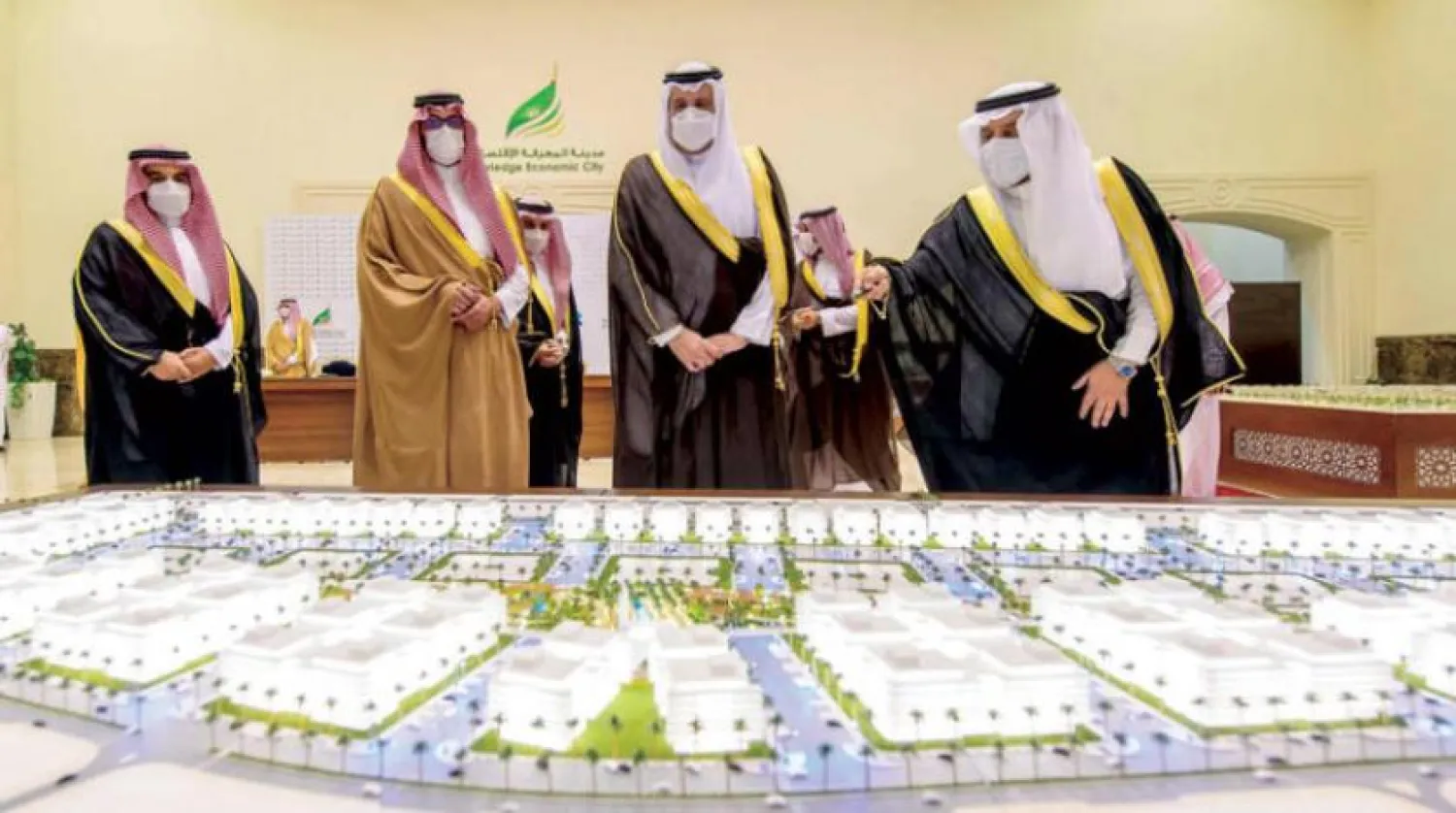
Prince Faisal bin Salman reviews the models of the mega projects expected in Madinah. (Asharq Al-Awsat)
TT

Saudi Arabia Inks Deals on Construction, Tourism Projects in Madinah

Prince Faisal bin Salman reviews the models of the mega projects expected in Madinah. (Asharq Al-Awsat)

The Governor of the Madinah region, Prince Faisal bin Salman bin Abdulaziz, inaugurated a number of projects in the Knowledge Economic City (KEC) and witnessed the signing of a number of contracts and agreements for the development of commercial, residential, tourism and entertainment projects.

The contracts included a tripartite agreement between the Saudi Tourism Development Fund (TDF), Riyadh Bank and the KEC to finance Phase 1 of the project, which will be implemented with the support of the Madinah Region Development Authority.

Phase 1 includes the construction of a commercial market, Hilton Hotel, the Boulevard commercial walkway, recreational area and health and sports centers.

The Tourism Development Fund, of the Ministry of Tourism, is financing the project as part of the fund’s strategy to provide support to private sector investors and boost the establishment of modern tourism projects that help enhance and develop the capabilities of the tourism sector in the Kingdom.

KEC has also agreed to the terms for the management of the Madinah Gate Fund Project Development with Riyadh. It aims to develop the lands adjacent to the Haramain high-speed train station in Madinah and the area overlooking Prince Nayef Road.

The development includes the construction of a four-star hotel and hotel apartments with 325 hotel units managed by the Hilton Group, markets, shops, restaurants, entertainment area, a bus stop and other services.

Public transport will be directly linked to the Haramain high-speed train station.

Prince Faisal also inaugurated the construction works on the Aliaa residential project in Dar al-Jiwar, and the development of Elite International Schools, a model international school complex for boys and girls from kindergarten to grade 12.

The complex of schools will be built on a 20,000-square-meter plot of land as part of a 25-year lease agreement and will be able to accommodate around 1,700 students. The first school is scheduled to open in September 2022.

CEO of TDF Qusai al-Fakhri said that the agreement is one of several successful deals with local banks aimed at providing investors with attractive financial solutions that encourage investments into this promising sector.

“It exemplifies our commitment to delivering on the National Tourism Strategy, increasing the GDP contribution of the tourism sector from 3 to 10 percent by 2030 and creating 1 million new jobs,” noted Fakhri.

The KEC Hub will be a 68,000-square meter tourism complex in Madinah, valued at $346.3 million making it among the biggest tourist projects in Madinah.

The new complex is located only around 6km from the Prophet’s Mosque, and it is easily accessible through the Haramain high-speed railway at the Knowledge City. The railway connects Madinah with Makkah in around 55 minutes.

The project will benefit from the position of Madinah in the Islamic world, in addition to its being an international destination for tourism and heritage.

It ranked 23rd among the top 100 City Destinations for 2019 with around 9 million tourists, according to the latest report by Euromonitor International.



Saudi Industry Ministry Concludes Ninth Licensing Round, with 24 Companies and Consortia Awarded 172 Mining Sites

Saudi Industry Ministry Concludes Ninth Licensing Round, with 24 Companies and Consortia Awarded 172 Mining Sites
TT

Saudi Industry Ministry Concludes Ninth Licensing Round, with 24 Companies and Consortia Awarded 172 Mining Sites

Saudi Industry Ministry Concludes Ninth Licensing Round, with 24 Companies and Consortia Awarded 172 Mining Sites

The Saudi Ministry of Industry and Mineral Resources announced on Wednesday the names of 24 companies and consortia that have won licenses in the ninth exploration licensing round, the largest in the Kingdom’s history to date.

The winning entities were awarded 172 mining sites, including 76 sites that advanced to a multi-round public auction, across three mineralized belts in the regions of Riyadh, Madinah, and Qassim, with total committed exploration spend of over SAR671 million during the first two years of their work programs.

This milestone comes as part of the ministry’s ongoing efforts to accelerate mineral exploration and development in the Kingdom, in line with the objectives of Vision 2030, which positions the mining sector as the third pillar of the national industrial economy, said the ministry in a statement.

The ninth round offered over 24,000 km2, spanning the Ad-Duwaihi/Nabitah gold belt in Riyadh Region, as well as the Nuqrah and Sukhaybirah/As-Safra gold belts in Madinah and Qassim regions. These areas are rich in strategic minerals, including gold, copper, silver, zinc, and nickel. The round witnessed strong interest and high-quality competition from leading local and international companies, reflecting growing confidence in Saudi Arabia’s mining investment environment and its attractiveness at both regional and global levels.

The list of winning companies includes several leading international firms and prominent local companies, namely: Desert EX Pty Ltd Company; Batin Alard for Gold Company; Royal Roads Arabia Company; Sierra Nevada Gold Inc. Company; Aurum Global Group; Brunswick Exploration Incorporated; EQLEED-INDOTAN Mining Company; Helderberg Limited Company; Rawafed Alola for Mining Company; Saudi Gold Refinery Limited Company; Arabian Discovery Mining Company; Al Ghazal Al Arabi Mining Company; Almasar Minerals Holding Limited Company; Al Tasnim Enterprises LLC Company; Arabian Gulf Skylark. The Distinguished Consortium Mining Company, Two Limited Company; Maaden Ivanhoe Electric Exploration and Development Limited Company.

Several newly formed consortia also emerged winners in the licensing round, such as Demir Engineering Ltd, Dahrouge Geological Consulting Ltd, and Kaz United Mining LLC Consortium; KENZ Global Resources Ltd, and Manahil Al Sharq Mining and Al Rayyan Mining Resources Co. Consortium; Maaden Barrick Technology Experts Co. and Andiamo Exploration Ltd Company; Shandong Gold (Beijing) Industrial Investment Co., Ltd., Development Co., Ltd., and Ajlan & Bros Company for Mining; Midana Exploration Pty Ltd and Saudi Arabian Mining Company (Maaden) Consortium; and McEwen Mining Inc. and Sumou Holding Company Consortium.

The ninth round saw 26 qualified companies participate via the electronic bidding platform. The round was conducted in several stages with the highest levels of transparency: prequalification, site selection via the platform, and a multi-round public auction for sites attracting more than one bidder.

The ministry further noted that the scale of investment commitments in this round supports the development of underexplored greenfield areas and helps unlock the Kingdom’s estimated mineral wealth of SAR9.4 trillion, thereby strengthening the resilience of mineral supply chains.

The ministry confirmed that licensing will continue through the 10th round, spanning 13,000 km2 across Madinah, Makkah, Riyadh, Qassim, and Hail. It will include new sites that extend the mineralized belts offered in the ninth round.

The ministry will announce additional exploration and investment opportunities for 2026 at the fifth edition of the Future Minerals Forum (FMF), scheduled to take place in Riyadh from January 13 to 15.

These efforts are part of the Kingdom’s comprehensive strategy for the mining and mineral industries, aimed at maximizing the value of mineral resources, attracting global investment, creating jobs, enhancing value-chain integration, and reinforcing Saudi Arabia’s position as a global mining hub, in line with the ambitions of Vision 2030, it stressed.


Expo 2030 Riyadh Awards the Main Utilities and Infrastructure Works Package

The milestone demonstrates the project’s increasing momentum as it shifts from early works to large-scale construction activity. (SPA)
TT

Expo 2030 Riyadh Awards the Main Utilities and Infrastructure Works Package

The milestone demonstrates the project’s increasing momentum as it shifts from early works to large-scale construction activity. (SPA)

In a step aimed at advancing construction activities, Expo 2030 Riyadh awarded its Main Utilities and Civil Works package to Nesma and Partners - marking a significant moment in the journey to bring to life one of the most ambitious global mega-events ever developed.

The milestone demonstrates the project’s increasing momentum as it shifts from early works to large-scale construction activity.

In a statement on Wednesday, Expo 2030 Riyadh Company said the Main Utilities and Infrastructure Works package aims to prepare the site for subsequent construction phases and supports the operational requirements of the event itself.

The scope of work includes constructing roads within the Expo site and installing essential utilities that will form the infrastructure backbone of the entire development.

Around 50 kilometers of infrastructure networks will be delivered as part of this package – including water, sewage, EV charging stations, and electrical and communication systems. Together, these works are essential to support the next stages of master plan development and allow Expo 2030 Riyadh’s experience-defining structures to take shape.

CEO of Expo 2030 Riyadh Company Talal Al-Marri said: “This milestone marks an important step in accelerating construction activities in the Expo 2030 Riyadh site. By moving early on the infrastructure that underpins the entire site, we are creating the conditions for safe, coordinated, and high-quality delivery across all future phases of development, while ensuring a lasting legacy well beyond 2030.”

“The contract has been awarded ahead of schedule to accelerate the delivery timeline as part of a phased approach that will see construction across infrastructure, buildings, and public spaces advance steadily through 2026 and into early 2027,” he stressed.

President and Chief Executive Officer of Nesma and Partners Samer Abdul Samad said: “We are proud to be entrusted with delivering this phase of infrastructure for Expo 2030 Riyadh. This project is not only about scale, but also about precision, integration, and responsibility.”

“Our focus will be on delivering high-quality infrastructure that supports the ambition of Expo 2030 Riyadh and sets a strong foundation for everything that follows,” he added.

Expo 2030 Riyadh Company has embedded high standards for quality, sustainability, innovation, worker welfare, and health and safety into the delivery of the works, reinforcing its commitment to responsible construction and creating a safe, inclusive environment for everyone involved in the program.


Saudi Arabia Closes 2025 with Historic Industrial Reform, Global Digital Leadership, Record-Breaking Economic Activity

As 2025 draws to a close, Saudi Arabia records a year defined not merely by statistical growth, but by structural transformation across every major sector. (SPA)
TT

Saudi Arabia Closes 2025 with Historic Industrial Reform, Global Digital Leadership, Record-Breaking Economic Activity

As 2025 draws to a close, Saudi Arabia records a year defined not merely by statistical growth, but by structural transformation across every major sector. (SPA)

The second half of December marked a transformative conclusion to the year for Saudi Arabia, defined by a major policy shift to empower the industrial sector, world-class recognition in digital governance, and unprecedented levels of commercial and religious tourism activity.

Industrial empowerment and economic surge

In a decisive move to boost the competitiveness of the national industry, the Cabinet approved the cancellation of the expat levy for licensed industrial establishments. This decision builds on six years of exemptions that have already driven a 56% increase in industrial GDP to over SAR501 billion and a 74% rise in industrial employment.

Global leadership in tech and health

The Kingdom’s digital transformation strategy achieved a major milestone, ranking second globally in the World Bank’s GovTech Maturity Index with a score of 99.64%, placing it in the "very advanced" category.

In healthcare, the King Faisal Specialist Hospital and Research Center (KFSHRC) was ranked first in the Middle East for oncology and orthopedics and successfully pioneered a novel 3D-printing technique to treat inner ear disorders.

The period by numbers:

SAR30.7 billion: The record value of e-commerce sales in October 2025, marking a 68% annual increase.

68.7 million: The total number of worshippers and visitors received at the two holy mosques during the month of Jumada Al-Akhira.

8 million: The number of visitors to Riyadh Season 2025 since its launch in October.

32.3%: The year-on-year growth in non-oil exports for October 2025.

11.9 million: The number of Umrah performances completed in the month of Jumada Al-Akhira.

95 tons: The quantity of seasonal seeds stored by the Kingdom, setting a new Guinness World Record.

26: The number of awards won by Saudi students at the World Artificial Intelligence Competition for Youth (WAICY), taking 1st place globally.

$160 million: The total value of development loans signed with Mauritania for water and electricity projects.

158,000 tons: The volume of citrus production in the Kingdom as the new season launches.
.9%: The annual inflation rate in Saudi Arabia for November 2025.

12,000+: The number of industrial facilities now operating in the Kingdom, up from 8,822 in 2019.

2: The number of new Dark Sky Reserves accredited in AlUla (Sharaan and Wadi Nakhlah).

As 2025 draws to a close, Saudi Arabia records a year defined not merely by statistical growth, but by structural transformation across every major sector. From welcoming record numbers of tourists and pilgrims to securing top global rankings in digital governance and industrial competitiveness, the Kingdom has effectively translated strategic planning into tangible reality.

These milestones, spanning economic diversification, technological leadership, and international diplomacy, serve as cumulative evidence of a maturing ecosystem.

With every regulatory reform implemented and every global partnership secured this year, Saudi Arabia has done more than catalogue achievements; it has systematically narrowed the distance to its ultimate goals, moving one decisive year closer to the complete realization of Vision 2030.