


White House Faces Pressure to Intervene Effectively in Yemeni Crisis

Joe Biden speaks during a campaign stop in Detroit, Michigan, March 9. REUTERS/Brendan McDermid
TT

White House Faces Pressure to Intervene Effectively in Yemeni Crisis

Joe Biden speaks during a campaign stop in Detroit, Michigan, March 9. REUTERS/Brendan McDermid

Progressive legislators have put the Biden administration under pressure to work harder on resolving the humanitarian crisis in Yemen, where suffering continues to grip the lives of millions enduring the violent upshot of a nationwide coup launched by Houthi militias in 2014.

Criticism is building up despite White House Press Secretary Jen Psaki having reassured US media that resolving the humanitarian crisis and achieving a ceasefire in Yemen topped the list of priorities of Washington’s special envoy for the war-torn country.

According to Psaki, US Special Envoy for Yemen Tim Lenderking is expected to discuss humanitarian relief efforts, achieving a ceasefire, and many other key topics with UN Special Envoy for Yemen Martin Griffiths in his latest trip to the Middle East.

“A handful of progressive legislators gathered in the Situation Room early Wednesday with national security adviser Jake Sullivan to discuss the war in Yemen,” reported US news website Axios.

Those who met Sullivan included Representative Ro Khanna and Senator Bernie Sanders, multiple sources familiar with the meeting confirmed to Axios, adding that they also spoke by phone this week with Lenderking.

“We’re not going to comment on individual meetings, but we regularly engage with lawmakers on progress towards our commitment to ending the catastrophic war in Yemen,” said National Security Council Spokeswoman Emily Horne, signaling the administration’s willingness to take the legislators’ concerns seriously.

State Department Spokesman Ned Price, for his part, told reporters on Thursday that a senior inter-agency delegation will be traveling over the coming week to discuss several important matters related to US national security and ongoing efforts to de-escalate tensions in the Middle East.

However, Price stressed that the delegation is not focused on any one issue, especially not Iran.

“Lenderking is, as of today, in Saudi Arabia. He’ll also travel to Oman on this trip. He’s meeting with senior government officials and is always working closely with the UN Special Envoy Martin Griffiths as part of this,” noted Price.

He added that Lenderking’s discussions are centered around ensuring the regular and unimpeded delivery of commodities and humanitarian assistance throughout Yemen, promoting a lasting ceasefire, and advancing that political process.


Al-Burhan’s Agreement to Conditional Dialogue Sparks Debate in Sudan

 Chairman of the Transitional Sovereignty Council and Commander of the Sudanese Army Abdel Fattah al-Burhan delivers a speech at the presidential palace in Khartoum. (SUNA)
Chairman of the Transitional Sovereignty Council and Commander of the Sudanese Army Abdel Fattah al-Burhan delivers a speech at the presidential palace in Khartoum. (SUNA)
TT

Al-Burhan’s Agreement to Conditional Dialogue Sparks Debate in Sudan

 Chairman of the Transitional Sovereignty Council and Commander of the Sudanese Army Abdel Fattah al-Burhan delivers a speech at the presidential palace in Khartoum. (SUNA)
Chairman of the Transitional Sovereignty Council and Commander of the Sudanese Army Abdel Fattah al-Burhan delivers a speech at the presidential palace in Khartoum. (SUNA)

The agreement by Chairman of the Transitional Sovereignty Council and Commander of the Sudanese Army Abdel Fattah al-Burhan to launch intra-Sudanese dialogue has sparked debate among political forces in the war-torn country.

The questions raised went beyond whether to take part or boycott, but to whether political dialogue held during war can stop the fighting and unify the country, or will it just be confined to regions held by the army.

Burhan declared last week that he was agreeing to an initiative to form an independent national mechanism that would prepare “comprehensive dialogue”. He vowed to provide legal, security, political and logistic guarantees for the participants, saying no foreign powers would be involved.

While agreeing to the dialogue, al-Burhan also rejected peace that would return the paramilitary Rapid Support Forces (RSF) and its supporters to power.

Peace begins with the RSF laying down its weapons, otherwise the army will continue its operations against it, he warned.

Prime Minister Kamil Idris said on Sunday that his government wants to restore peace and preserve Sudan’s unity.

He also added that the RSF should be designated a terrorist organization, vowing that the army will not be lenient with its forces.

Lawyer Nabil Adib, who was part of the committee that proposed the dialogue, told local media that his committee does not aim to end the war, but reaching political consensus.

He hastily added, however, that that “ending the war may be one of the outcomes of the dialogue if the participants agree to it.”

His statements reveal a dilemma: if the dialogue participants reach a consensus demanding an end to the war, implementing it would require the approval of both warring parties. Should the RSF remain outside the process, the dialogue may succeed in producing a political stance against the war, but it lacks a mechanism to enforce a ceasefire.

Adib notably kept the door open to members of the RSF-aligned Sudan Founding Alliance (Tasis) to take part in the dialogue. The alliance includes political and armed factions that are opposed to the army.

“Alliance parties that do not carry weapons can take part in the dialogue,” he confirmed.

The pro-army Democratic Bloc welcomed the dialogue initiative, saying it was a step forward in “resolving the crisis through national political means”.

On the other side of the divide, the Somoud civilian alliance, led by former PM Abdalla Hamdok, rejected any dialogue held while the war rages.

In a statement, it said that any “political process - independent of the warring parties - must start with an end to the war and addressing the humanitarian catastrophe.”

It warned against holding dialogue in areas held by the army, saying it would “consolidate the unofficial division” of Sudan.

Sudan’s People's Liberation Movement-Revolutionary Democratic Current (SPLM-RDC), led by Yasir Arman, said the current crisis “goes beyond the war.”

It is tied to building the state and the presence of several armies and militias in the country, it noted in a statement. It warned against dialogue that does not address the root causes of the crisis.

The National Umma Party demanded dialogue that includes all segments of society, except for the National Congress Party.

Umma Party leader Mubarak al-Fadil al-Mahdi called for an end to the fighting, as well as national reconciliation and negotiations over security arrangements that would lead to the unification of the army.

He echoed warnings that holding the dialogue in army-held regions would consolidate divisions in the country and fuel the fighting.

The army believes that excluding the RSF from power is a refusal to grant political legitimacy to a force that took up arms against it. However, the RSF’s continued control over parts of the country will undermine any constitutional or governmental arrangements produced by the dialogue in areas under its authority.


Egypt Warns Ethiopia against Plans to Control Nile River Flows

The Ethiopian national flag is seen at the Grand Ethiopian Renaissance Dam (GERD) in Guba, Ethiopia, Feb. 19, 2022. (AFP)
TT

Egypt Warns Ethiopia against Plans to Control Nile River Flows

The Ethiopian national flag is seen at the Grand Ethiopian Renaissance Dam (GERD) in Guba, Ethiopia, Feb. 19, 2022. (AFP)

An official Egyptian source warned on Sunday Ethiopia against plans to control the flows of the Nile River to downstream countries, in the latest tensions between Cairo and Addis Ababa over the Grand Ethiopian Renaissance Dam (GERD).

The official made the warning in wake of Ethiopia’s Minister of Water and Energy Habtamu Geleta saying that his country may build more dams on the river, effectively controlling its flow to Egypt and Sudan.

The source said Egypt has “several means at its disposal and is capable of defending the interests of its people when it comes to the Nile,” reported the state news agency MENA.

“Egypt will not accept or allow any party to control the Nile’s flow to downstream countries,” he declared.

Diplomats and observers told Asharq Al-Awsat that Ethipoia’s comments prove that the construction of the dam aimed to apply political pressure on Cairo and was not a development project as it had claimed.

The dispute over the Nile goes back 15 years since Ethiopia began constructing the dam and which it inaugurated around a year ago. Egypt fears that the dam will impact its share of the river water, which is vital for the people.

Arab and local media reported Geleta as saying that his country “will control the flows of the Nile” and that it is “determined to build more dams as part of its right to the fair use of its waters and achieve sustainable development.”

The Egyptian source, however, slammed the statements as more evidence of Addis Ababa’s unilateral actions and violation of international law.

They reflect its “delusions about its ability to impose control over a river it shares with others,” he added.

He warned that the statements are “dangerous” because they reveal an intent to impose a status quo on the ground and impose monopoly over a joint international water source.

“Ethiopia is using its geographic location to threaten the water rights and interests of downstream countries in violation of international law. Egypt will not allow it,” he vowed.

Cairo had previously declared before the UN Security Council that it will resort to all means at its disposal to protect the rights of people to the Nile, he noted.

‘Several options’

Salah Halima, former Assistant Foreign Minister and Deputy Chairman of the Egyptian Council for Foreign Affairs, said Cairo has “several options” at its disposal to protect its interests.

It can again resort to the Security Council and demand measures to resolve conflicts in line with Chapter 6, he told Asharq Al-Awsat.

Failure to comply, means it can resort to Chapter 7, which would then view the GERD as an act of aggression and a threat to human life, which demands self-defense, he added.

Chapter 6 calls for resolving disputes peacefully through negotiations and mediations, while Chapter 7 allows the Security Council the authority to impose measures through military and non-military means to preserve international peace and security.

Halima said Ethiopia’s latest statements demonstrate that the construction of the GERD was politically motivated to pressure Egypt.

The dam has already caused damage to Sudan where water levels are low, he noted.


Eight Muslim Countries Condemn Israel’s Rejection of Trump’s Gaza Plan

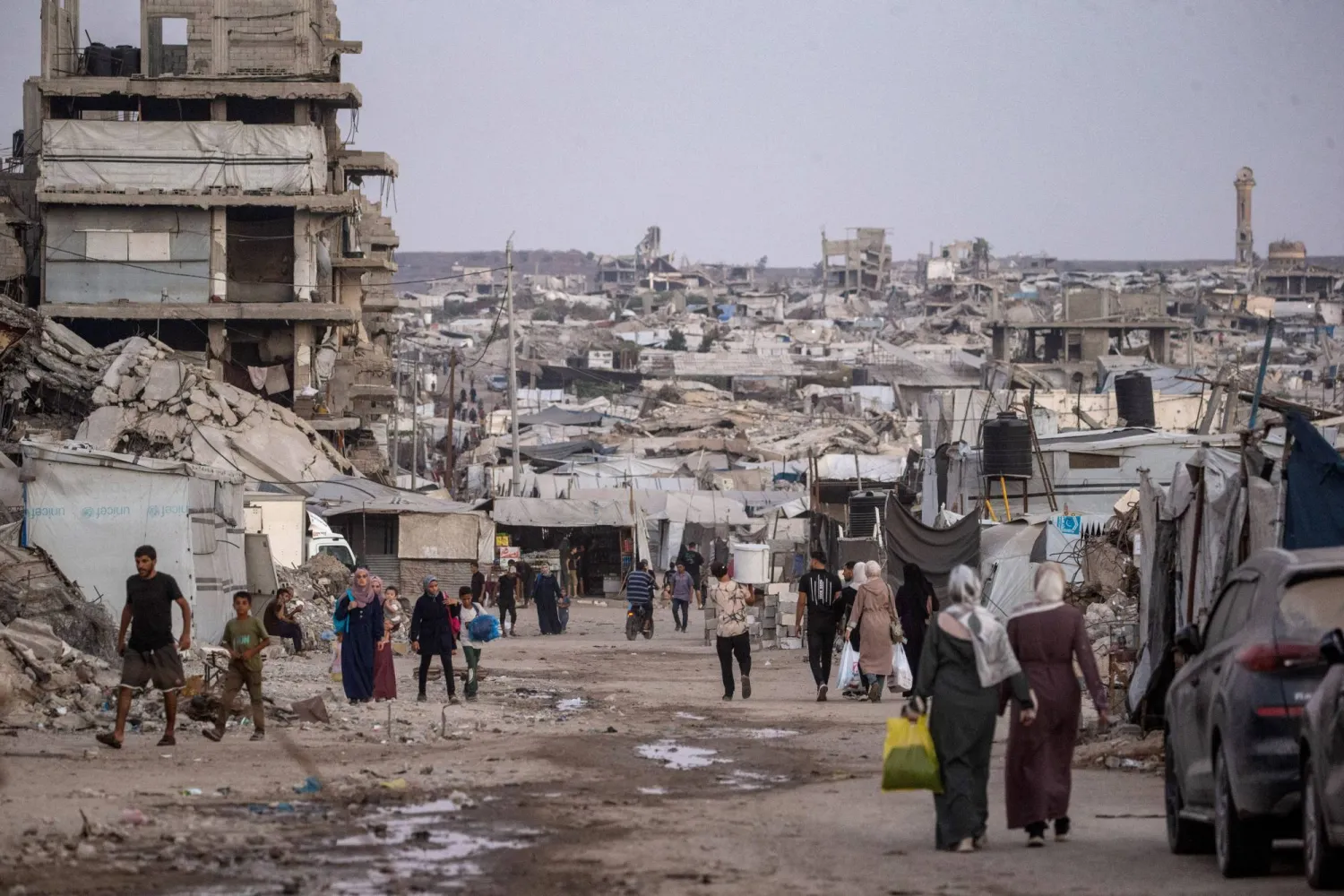
 Displaced Palestinian children carry food portions in Deir al-Balah, central Gaza Strip, Friday, Aug 14, 2026. (AP)
Displaced Palestinian children carry food portions in Deir al-Balah, central Gaza Strip, Friday, Aug 14, 2026. (AP)
TT

Eight Muslim Countries Condemn Israel’s Rejection of Trump’s Gaza Plan

 Displaced Palestinian children carry food portions in Deir al-Balah, central Gaza Strip, Friday, Aug 14, 2026. (AP)
Displaced Palestinian children carry food portions in Deir al-Balah, central Gaza Strip, Friday, Aug 14, 2026. (AP)

The foreign ministers of eight Muslim countries on Sunday condemned Israel's rejection of a recently released roadmap for fully implementing US President Donald Trump's Gaza peace plan.

The foreign ministers of Saudi Arabia, Egypt, Jordan, Pakistan, Indonesia, Türkiye, Qatar, and the United Arab Emirates said the rejection amounts to a “direct repudiation” of the peace plan, “jeopardizes its implementation, and fundamentally undermines the collective efforts to achieve a just and lasting peace.”

“Such rejection confirms that Israel now bears responsibility for obstructing the efforts to bring peace in Gaza and the rest of the Occupied Palestinian Territory,” they said in statement.

The roadmap, which has been accepted by the Palestinian factions, is the conclusion of extensive efforts exerted by the mediators, namely Egypt, Qatar, Türkiye, the US, the High Representative of Gaza and the Board of Peace and constitutes a vital milestone for the decommissioning of weapons concurrently with the withdrawal of Israeli forces, the deployment of the International Stabilization Force, the transfer of the administrative authority to the National Committee for the Administration of Gaza and the reconstruction of Gaza as stipulated in the Comprehensive Plan, they went on to say.

Rejecting the roadmap is “an explicit refusal to proceed with the implementation of the peace plan, and directly threatens to derail the extensive efforts exerted by Trump to bring an end to the war in Gaza and establish the conditions for lasting peace.”

The ministers underscored “the importance of sustained and active US engagement to ensure and enforce Israel’s full compliance with the commitments and arrangements envisaged under the peace plan and its roadmap, and to prevent further obstruction of their implementation.”

“Israel bears direct and full responsibility for any consequences resulting from its continued rejection, obstruction, delay or non-compliance, including any resulting deterioration of the situation on the ground and disruption of ending the war in Gaza,” they added.

They underlined the urgent need for the full and immediate implementation of the peace plan in order to address the grave humanitarian situation, ensure security and stability for all in Gaza, and pave the way for reconstruction and recovery and advancing a just and lasting peace grounded in the Palestinian right to self-determination and statehood in accordance with international law, paving the way for security and stability for all countries and peoples of the region.

They categorically rejected any attempt to deny or foreclose Palestinian statehood including through unilateral actions.

“A just, lasting and comprehensive peace only will be achieved by the implementation of two-state solution, by the realization of an independent and sovereign Palestinian State based on the 1967 borders, with East Jerusalem as its capital in accordance with international law and relevant United Nations resolutions,” they added.

“Any attempt to deny or foreclose Palestinian statehood therefore directly undermines the prospects for peace, security and stability throughout the region,” they warned.

The ministers underscored the importance of the continued role of the Board of Peace and call all parties to support its efforts for the implementation of the roadmap and advancing the second phase of Trump’s peace plan.

The ministers called on the Board of Peace, with the active support and engagement of the US, to take immediate and concrete measures within its mandate to uphold the integrity of the peace plan and prevent any party from obstructing its implementation.
