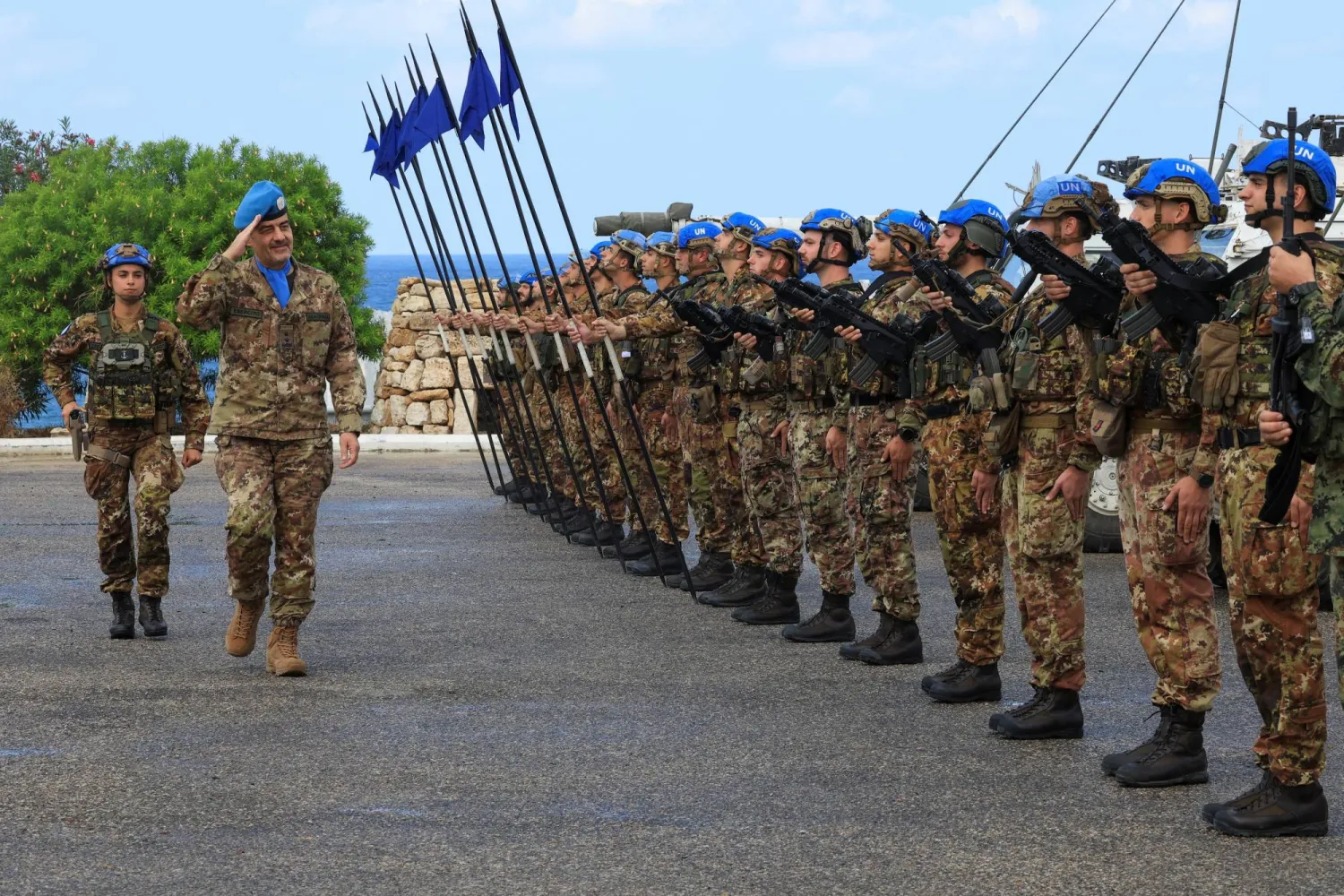
An Israeli policemen stands guard as Palestinians queue at the Bethlehem checkpoint in the occupied West Bank, to try crossing to Jerusalem to attend the third Friday prayers of the fasting month of Ramadan at the Al-Aqsa mosque, on April 30, 2021. / AFP / HAZEM BADER
Two Palestinians were arrested and ten people injured in clashes in east Jerusalem, according to Israeli police and the Palestinian Red Crescent.
The confrontations on Monday evening came as Palestinian families face eviction, part of an ongoing effort by Jewish Israelis to take control of homes in the in the Sheikh Jarrah neighborhood.
Israeli police and border police arrived "after a protest including dozens of protesters who disturbed the order" according to the police, who said demonstrators threw stones and bottles at security forces and blocked traffic, AFP reported.
Police said they gave protesters "a reasonable time" to leave the "unlawful protest" before they dispersed the demonstration.
An AFP reporter saw Palestinians singing songs and defying the order to disperse. Officers ended the demonstration with mounted police and foul-smelling water.
The Red Crescent said three of the injured were hospitalized.
Sheikh Jarrah is in east Jerusalem, which Israel conquered in 1967 and annexed in a move not recognized by most of the international community.
Israeli Jews backed by courts have taken over houses in Sheikh Jarrah on the grounds that Jewish families lived there before fleeing in Israel's 1948 war for independence.
No such protection exists for Palestinians who lost their land.
Now Jewish claimants seek to evict a total of 58 more Palestinian families, according to the watchdog group Peace Now. Israel's Supreme Court is set to announce a decision for four of those families on Thursday.
Jordan has intervened, saying that when it administered the area from 1948 to 1967, it built the homes for Palestinian refugees who fled their homes in what became Israel.
Opponents of the evictions have gathered regularly in the neighborhood, including a Jewish Israeli lawmaker who last month was filmed being beaten by police.
Sheikh Jarrah is a short walk from the Old City's Damascus Gate, a plaza popular with Palestinians especially during the fasting month of Ramadan.
The latest protests follow days of clashes after Israeli police blocked the plaza.
Police quelled those protests with stun grenades, water cannons and skunk water before ultimately removing the barriers.
Trump Says Syria ‘Will Do the Job’ with Hezbollah if Israel Unablehttps://english.aawsat.com/arab-world/5284732-trump-says-syria-%E2%80%98will-do-job%E2%80%99-hezbollah-if-israel-unable
A Hezbollah flag flutters amid rubble of destroyed buildings, in Deir Qanoun al-Nahr, Tyre district, southern Lebanon, June 15, 2026. (Reuters)
TT
TT
Trump Says Syria ‘Will Do the Job’ with Hezbollah if Israel Unable
A Hezbollah flag flutters amid rubble of destroyed buildings, in Deir Qanoun al-Nahr, Tyre district, southern Lebanon, June 15, 2026. (Reuters)
US President Donald Trump said Tuesday he had suggested to Israel that Syrian President Ahmed al-Sharaa should deal with Lebanon's Tehran-backed Hezbollah group as the Israeli campaign was causing too many casualties.
Praising Sharaa as doing an "amazing job", Trump said at a G7 summit: "If Israel can't do the job (against Hezbollah) without killing everyone else, than he (Sharaa) will do the job. Syria will do the job."
Sharaa last week quelled renewed speculation that Syria could become involved in the war in Lebanon, saying reports that Damascus intends to intervene militarily are “mere rumors.”
Sources in Damascus told Asharq Al-Awsat at the time: “So far, there has been no official US request to Damascus related to any form of Syrian military intervention in Lebanon.”
They said Tom Barrack, Trump’s envoy to Syria and Iraq and Washington’s ambassador in Ankara, had previously asked Damascus “to take a clear, explicit and serious position against Hezbollah.”
They added that “entering the quagmire of war and sending military forces unilaterally is completely ruled out,” and that it was “very, very early” to discuss the possibility of Syrian forces entering Lebanon in support of the Lebanese army.
Syria’s Interior Ministry said, “Lebanon is a sovereign state and not a backyard, as the former regime viewed it,” stressing that “coordination with Lebanon is the basic pillar for any assistance Syria provides to Lebanon.”
Brigadier General Hassan Abdul Ghani, commander of the Border Guard Forces in the Syrian Arab Army, met last Thursday with a Lebanese army delegation headed by liaison official Brigadier General Michel Boutros.
The talks focused mainly on “enhancing cooperation and coordination between the two sides in border control and combating smuggling activities, in a way that contributes to strengthening border security between the two countries.”
Israeli Supreme Court Rejects Appeal for Release of Gaza Doctor Held without Chargehttps://english.aawsat.com/arab-world/5284718-israeli-supreme-court-rejects-appeal-release-gaza-doctor-held-without-charge
Palestinian doctor Hussam Abu Safiya, who was captured by the Israeli military in Gaza in late 2024 and still held in detention, appears via video link at the Israeli Supreme Court hearing in Jerusalem, June 10, 2026. (Reuters)
TT
TT
Israeli Supreme Court Rejects Appeal for Release of Gaza Doctor Held without Charge
Palestinian doctor Hussam Abu Safiya, who was captured by the Israeli military in Gaza in late 2024 and still held in detention, appears via video link at the Israeli Supreme Court hearing in Jerusalem, June 10, 2026. (Reuters)
Israel's Supreme Court on Tuesday rejected an appeal to release a prominent Palestinian doctor who has been held without charge since he was captured in Gaza in late 2024.
Hussam Abu Safiya, the director of the Kamal Adwan hospital, is among at least 14 doctors from Gaza who have been detained in Israel without charge for more than a year.
The court based its decision on "confidential materials" that were not shared with Abu Safiya or his lawyer, Naji Abbas, director of the Prisoners and Detainees Department at the Israeli rights organization Physicians for Human Rights Israel (PHRI), told Reuters on Tuesday.
A spokesperson for the Supreme Court declined to comment.
"The message sent by this decision is unmistakable: a medical professional can be deprived of his liberty indefinitely without being charged and without the authorities presenting evidence against him in open court," Abbas said in a statement.
Abu Safiya's lawyer and human rights groups say the medic has been denied sufficient food and assaulted in prison.
Israel's prison service has denied the allegations.
Abu Safiya appeared by video link at a Supreme Court hearing in Jerusalem last Wednesday, looking noticeably thinner.
For the past 13 days, Abu Safiya has also been held in solitary confinement, PHRI said.
The Israeli military has accused Abu Safiya of being a member of the Palestinian group Hamas. It has not provided evidence and Gaza's health ministry and Hamas have denied the allegation.
In 2023, Abu Safiya was among the doctors who refused to leave the dozens of newborn infants they were treating after the Israeli military ordered them to leave.
Al-Aradah to Asharq Al-Awsat: Saudi Arabia Spared Yemen from Another Civil Warhttps://english.aawsat.com/arab-world/5284712-al-aradah-asharq-al-awsat-saudi-arabia-spared-yemen-another-civil-war
Al-Aradah to Asharq Al-Awsat: Saudi Arabia Spared Yemen from Another Civil War
Al-Aradah stressed that Saudi Arabia averted a new civil war in Yemen. (Asharq Al-Awsat)
Maj. Gen. Sultan Al-Aradah, a member of Yemen’s Presidential Leadership Council and governor of Marib, said Saudi Arabia helped prevent Yemen from sliding into a new civil war through what he described as its “sincere” support during the tensions that unfolded in Hadramawt and Al-Mahra last December.
In an interview with Asharq Al-Awsat, Al-Aradah maintained that the Yemeni people, with their long history, civilization and standing, cannot remain hostage to a militia – a reference to the Iran-backed Houthis. “Sometimes peace can only be achieved by imposing peace,” he said.
He described relations with Saudi Arabia as far deeper than conventional political ties, calling them “a relationship of shared destiny,” and praised Saudi development projects across Yemen, noting their visible impact on communities throughout the country.
German ambassador’s visit
Al-Aradah viewed last week’s visit by German Ambassador Hubert Jäger to Marib as evidence of the strength of Yemeni-German relations and Berlin’s commitment to supporting Yemen through difficult circumstances.
Germany has played an important role in humanitarian and development efforts over many years, he noted.
The relationship between the two countries spans decades and includes a wide range of shared interests, making the ambassador’s visit an opportunity to gain first-hand insight into conditions in Marib and the challenges facing the province.
The Houthis and the regional conflict
Al-Aradah criticized the Houthi involvement in the wider regional conflict, arguing that it serves neither Yemen’s interests nor those of the region and does nothing to preserve state institutions.
“What interest do the Houthis have in intervening in issues that have no direct connection to Yemen?” he asked.
Such policies, he said, have brought Yemen repeated crises and deepened the suffering endured by Yemenis over the past decade.
According to Al-Aradah, Yemen cannot achieve lasting stability until the state regains its authority and institutions.
He indicated that the legitimate government and its regional and international partners will continue working toward that objective.
“The Yemeni people, with their history, civilization and stature, cannot remain hostage to a militia, whatever form it takes,” he said, adding that Yemenis will continue their efforts, with the support of allies and partners, to rebuild their state and restore its institutions.
Maj. Gen. Sultan Al-Aradah, a member of Yemen’s Presidential Leadership Council and governor of Marib. (Saba)
Why Marib held firm
Asked about Marib’s ability to withstand years of military and political pressure, Al-Aradah dismissed the idea of any “secret” or “magic formula.”
The province’s resilience stemmed from a profound sense of responsibility at a decisive moment in Yemen’s history, he explained. As state institutions collapsed and Yemenis faced attacks on their lives, dignity, property and national values, many rallied behind Marib.
For many Yemenis, Marib became more than a safe haven; it became the center of the struggle to defend the republic and restore the state, he added.
Assessing the performance of the legitimate government over recent years, Al-Aradah acknowledged that numerous domestic and external factors had hindered progress.
Without elaborating, he noted that these obstacles affected development, the economy and security. Nevertheless, he described them as challenges that can be overcome and suggested that meaningful progress has already been made in addressing some of them.
Peace efforts
Al-Aradah reiterated that peace remains the preferred option, but argued that it requires parties willing to embrace it.
“The problem is that we do not have a party that believes in peace,” he said. “The other side views peace as the end of its project. We want peace, but the question is: with whom?”
One of the principal reasons the war continues, he added, is the belief among the Houthis that a genuine settlement would undermine their political and ideological project.
Asked whether that implied a military solution, Al-Aradah replied that history offers many examples of conflicts that ended only through decisive action after negotiations failed and one side showed no real commitment to peace.
Perpetual war is not a viable option. The interests of the Yemeni people must take precedence over all other considerations, he stressed.
Keeping the state intact
Al-Aradah described the Presidential Leadership Council’s ability to preserve the state and maintain cohesion under extraordinarily difficult circumstances as a significant achievement in itself.
Yemen, he observed, faced challenges that could easily have led to fragmentation and dangerous divisions. Instead, the council endured and overcame many obstacles with support from regional and international partners.
The council is pursuing several priorities simultaneously, including unifying military formations, strengthening joint operations, improving coordination among national forces, supporting the government and preserving state institutions.
It is also working to improve economic conditions, consolidate state revenues and help government institutions resume normal operations.
While acknowledging the scale of public suffering, Al-Aradah said that the current situation must be judged against the alternative.
“When we look at the alternative, we realize the other option was chaos, fragmentation and total collapse,” he noted.
Prince Mohammed bin Salman, Crown Prince and Prime Minister, meets with Al-Aradah. (SPA file)
The challenge within
The most difficult challenge facing the PLC, Al-Aradah noted, has been internal rather than external.
The council has grappled with major internal issues since its formation, although many of those matters were not suitable for public discussion at the time.
He credited PLC Chairman Dr. Rashad Al-Alimi with playing a central role in containing those challenges.
“He has shown remarkable patience and endurance and has faced considerable criticism,” Al-Aradah said. “We have now seen the results of that patience.”
Collective leadership models are inherently difficult and often encounter serious obstacles, he remarked.
The council was not created arbitrarily, but emerged from a careful assessment of Yemen’s political, military and regional realities, he went on to say. Its members represent different forces, constituencies and regions, with the aim of unifying national political and military power against common challenges.
Building a unified military
Discussing efforts to unify military formations, Al-Aradah said important progress has been made through joint operations and military committees that bring together commanders from different forces.
He credited Saudi Arabia with playing a pivotal role, not only through political backing but also through logistical and military support and sustained coordination among various factions.
The Kingdom views military unification as an integral part of the broader effort to restore the Yemeni state and works directly with different military formations, providing support and funding, he told Asharq Al-Awsat
Hadramawt and the threat of escalation
Turning to developments in Hadramawt, Al-Aradah expressed regret over the tensions that unfolded there, arguing that the province never deserved to be drawn into conflict.
Hadramawt has long been one of Yemen’s most peaceful and stable regions, he noted. The tensions resulted from poor calculations at both local and external levels, prompting Yemen’s leadership to act in order to preserve national unity and prevent broader confrontations.
He praised Saudi Arabia’s role during the crisis, describing the Kingdom as “a sincere brother” that stood beside Yemen at a critical moment and helped prevent the country from sliding further toward fragmentation.
According to Al-Aradah, that coordinated effort protected Yemen from a new civil war that could have spread across large parts of the country.
Yemen is already fighting a war against the Houthis while enduring a severe economic crisis, he noted. Opening new fronts inside government-controlled areas would have posed a grave threat to the country’s future.
Many Yemenis, including some who disagreed with decisions taken at the time, will eventually recognize the significance of the Kingdom’s role in preventing further divisions and conflict, he predicted.
A reckoning for Yemen’s political elite
Al-Aradah argued that the key question facing Yemen’s political elite is not their own future but whether they can guide the country out of its crisis and restore state institutions.
The political class, he suggested, must undertake an honest assessment of its own record, since much of Yemen’s current predicament resulted from rivalries, disputes and conflicts among competing elites.
Their moral and national responsibility now is to correct those mistakes by working to restore the state and improve the lives of ordinary Yemenis.
The Yemeni Presidential Leadership Council during a meeting. (Yemeni Presidency)
Saudi-Yemeni relations
Speaking at length about Saudi-Yemeni relations, Al-Aradah described them as ties of “shared destiny” that transcend ordinary politics.
Al-Aradah said the relationship is rooted in history, kinship, religion, common interests and intertwined security concerns.
Saudi Arabia’s greatest contribution to Yemen, in his view, has been political rather than financial.
“The most important thing Saudi Arabia provided was diplomatic and political backing for Yemen’s legitimate government from the very beginning of the crisis,” he said.
Without that support and the accompanying diplomatic efforts, parts of the international community might have treated the Houthis as a permanent authority or alternative government.
The Kingdom has also supported state institutions, assisted the government and provided humanitarian aid and relief.
“Saudi Arabia is committed to restoring the Yemeni state and its sovereignty perhaps more than many Yemenis themselves,” Al-Aradah said.
Saudi development efforts in Yemen
He praised Saudi-funded projects throughout Yemen and thanked Custodian of the Two Holy Mosques King Salman bin Abdulaziz and Prince Mohammed bin Salman, Crown Prince and Prime Minister, for their continued support.
He highlighted the work of the King Salman Humanitarian Aid and Relief Center and commended the Masam landmine-clearance program, noting that Houthi landmines continue to threaten farmers, shepherds, travelers, children and civilians.
He also praised the Saudi Development and Reconstruction Program for Yemen, led by Ambassador Mohammed Al Jaber, crediting it with strengthening health care, education, water services, infrastructure and local development.
لم تشترك بعد
انشئ حساباً خاصاً بك لتحصل على أخبار مخصصة لك ولتتمتع بخاصية حفظ المقالات وتتلقى نشراتنا البريدية المتنوعة