

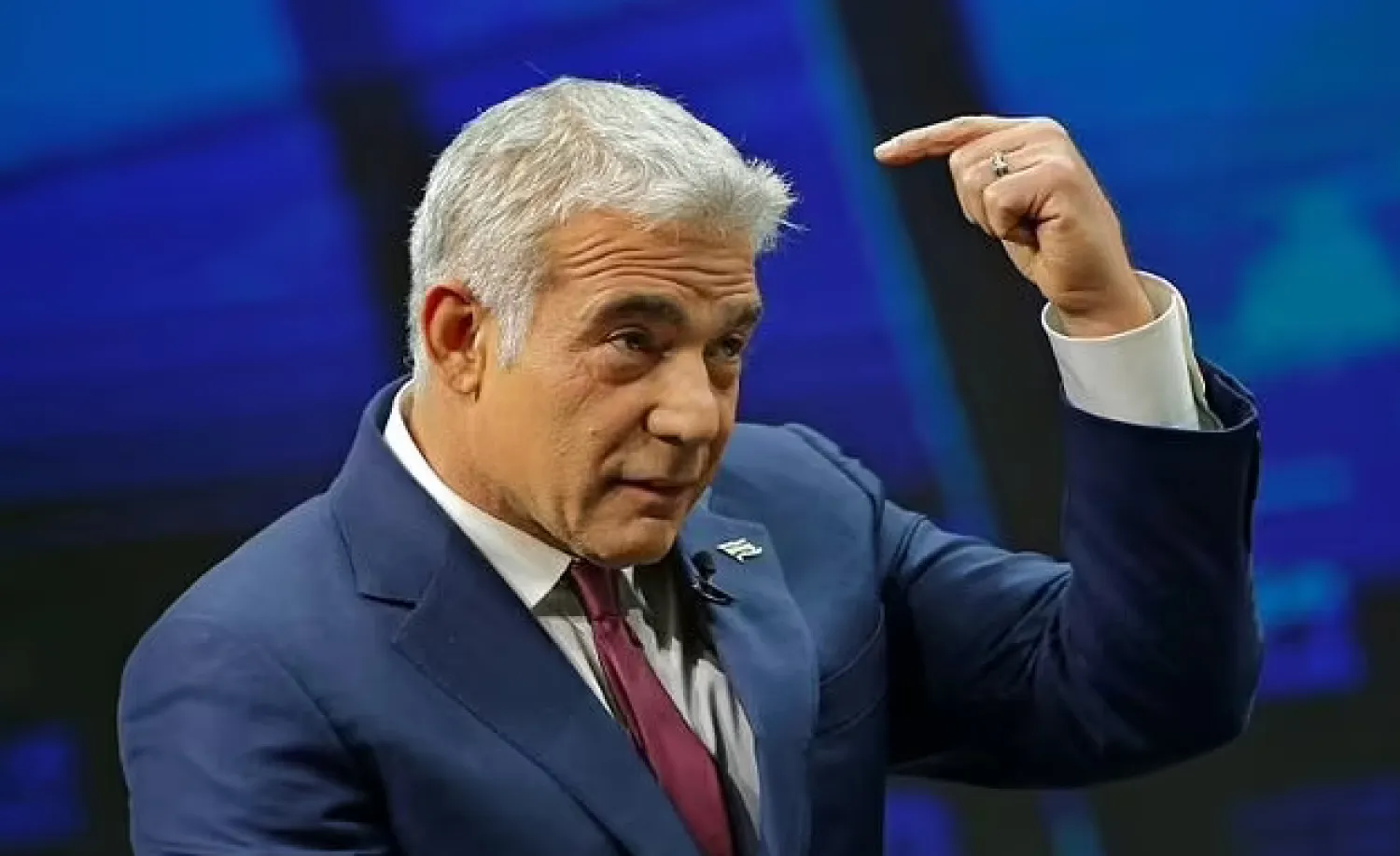

Israel's Lapid Faces Daunting Path to Anti-Netanyahu Govt

Israeli opposition leader Yair Lapid has been given the chance to end Prime Minister Benjamin Netanyahu's record 12 straight years in office but to do so he must bring together the most unlikely of bedfellows  - AFP
Israeli opposition leader Yair Lapid has been given the chance to end Prime Minister Benjamin Netanyahu's record 12 straight years in office but to do so he must bring together the most unlikely of bedfellows - AFP
TT

Israel's Lapid Faces Daunting Path to Anti-Netanyahu Govt

Israeli opposition leader Yair Lapid has been given the chance to end Prime Minister Benjamin Netanyahu's record 12 straight years in office but to do so he must bring together the most unlikely of bedfellows  - AFP
Israeli opposition leader Yair Lapid has been given the chance to end Prime Minister Benjamin Netanyahu's record 12 straight years in office but to do so he must bring together the most unlikely of bedfellows - AFP

Israeli opposition leader Yair Lapid, who has been given 28 days to form a government, has said his goal is to forge a coalition that ends Prime Minister Benjamin Netanyahu's divisive rule.

But doing so will require walking a tightrope unrivaled in Israeli political history.

Lapid will have to build a coalition united primarily by opposition to Netanyahu from disparate groups ranging from right-wing Jewish nationalists to Arab lawmakers who have never before sat in an Israeli government.

And, in an unprecedented twist, the centrist former television anchor will probably have to sacrifice his own prime ministerial ambitions at least in the short term.

Israel's fourth inconclusive election in less than two years produced a fractured parliament, AFP reported.

Lapid can likely count on the support of centrist and left-wing lawmakers as well as two right-wing parties firmly committed to removing Netanyahu.

The New Hope party is made up of defectors from Netanyahu's right-wing Likud, while Yisrael Beitenu is backed by many immigrants from the former Soviet Union.

Barring defections, those parties would give a Lapid coalition 51 of the 61 seats in parliament it needs for majority.

Netanyahu's Likud, two ultra-Orthodox Jewish parties and the far-right Religious Zionism alliance collectively hold 52 seats and would almost certainly rebuff any outreach from Lapid.

To reach the magic number of 61, Lapid has to draw in Naftali Bennett's religious nationalist Yamina party, which holds seven seats, and at least some Arab lawmakers, an ideologically diverse group belonging to different parties that collectively hold 10 seats.

There is general consensus that Lapid's path to power requires offering Bennett first turn at a rotating prime ministership as part of coalition deal.

Lapid has already made such an offer to Bennett, a former Netanyahu protege whose relationship with the premier has disintegrated.

"The only viable option is Bennett-Lapid with Bennett going first," said Gayil Talshir, political scientist at Hebrew University.

The logic of the strategy, is that it brings key kingmaker Bennett on board and makes the coalition more palatable to right-wingers, especially in New Hope.

It could also appeal to the center and left by accomplishing something that has eluded them since 2009: removing Netanyahu from power.

"Lapid must postpone his dream of being prime minister," in order to have a chance of reaching 61 seats, political analyst Shmuel Rosner told AFP.

The Lapid-Bennett rotation plan could easily crumble in the hornet's nest of Israeli politics.

Bennett has enthusiastically backed Jewish settlement expansion in the occupied West Bank, a red line for Arab lawmakers firmly committed to Palestinian statehood.

Lawmakers from the Arab-led Joint List reiterated their support for a potential Lapid government on Wednesday, but told President Reuven Rivlin in writing that they "do not support a government headed by Naftali Bennett."

Mansour Abbas, head of the Islamic conservative Raam party, which has four seats, has generally voiced openness to any arrangement that improves living conditions for Israel's 20 percent Arab minority.

But now that he has been given a chance to form a government, Lapid still has no obvious way of bridging the Bennett-Arab divide.

Perhaps the most serious threat to a unity government is Netanyahu himself.

Moments after Lapid was tapped, he made a television address directed at right-wingers alleging Bennett was about to sell them out to achieve his prime ministerial ambitions.

"Everyone knows (Bennett) wants to form a dangerous left-wing government," Netanyahu charged without evidence.

Politics experts agree that Netanyahu will now commit himself to making it uncomfortable for any right-winger to join a pro-Lapid government.

"Netanyahu is now in full sabotage mode," said the headline in the center-left Haaretz newspaper.

Talshir said there was already "humongous pressure on Bennett's people to defect or to abstain," when asked to support a government formed under Lapid's mandate.



UK Police Charge Two Men with Belonging to Hezbollah, Attending Terrorism Training

Hezbollah flags flutter as protesters, mainly Houthi supporters, rally to show support to Palestinians in the Gaza Strip and Lebanon's Hezbollah, in Sanaa, Yemen September 27, 2024. (Reuters)
TT

UK Police Charge Two Men with Belonging to Hezbollah, Attending Terrorism Training

Hezbollah flags flutter as protesters, mainly Houthi supporters, rally to show support to Palestinians in the Gaza Strip and Lebanon's Hezbollah, in Sanaa, Yemen September 27, 2024. (Reuters)

Two British-Lebanese men appeared in a London court on Tuesday, charged with belonging to the banned Iran-backed group Hezbollah and attending terrorism training camps, with one of the two accused of helping procure parts for drones.

Annis Makki, 40, is charged with attending a terrorist training camp at the Birket Jabbour airbase in Lebanon in 2021, being involved in the preparation of terrorist acts, being a member of Hezbollah, and expressing support both for Hezbollah and the banned Palestinian group Hamas.

Mohamed Hadi Kassir, 33, is also accused of belonging to Hezbollah and attending a training camp in Baffliyeh in south Lebanon in 2015 and at the Birket Jabbour airbase in 2021. He indicated not guilty pleas to the charges.

Prosecutor Kristel Pous told Westminster Magistrates' Court that Kassir was "an entrenched member of Hezbollah" and that images had been found of him "training in a Hezbollah-controlled camp and undertaking hostage training exercises in 2015".

Pous also said Makki had access to a "wide-ranging Hezbollah network" which was linked to facilitating the acquisition of parts to be used in unmanned aerial vehicles.

Judge Paul Goldspring remanded both men in custody until their next court appearance at London's Old Bailey court on January 16.

The men were arrested at their home addresses in London in April and rearrested last week when they were subsequently charged.

Commander Dominic Murphy, head of London's Counter Terrorism Policing, said in a statement before Tuesday's hearing: "I want to reassure the public that I do not assess there is an ongoing threat to the wider public as a result of the activities of these two individuals."


Millions Facing Acute Food Insecurity in Afghanistan as Winter Looms, UN Warns

Boys stay on a hilltop overlooking Kabul, Afghanistan, Feb. 27, 2022. (AP)
TT

Millions Facing Acute Food Insecurity in Afghanistan as Winter Looms, UN Warns

Boys stay on a hilltop overlooking Kabul, Afghanistan, Feb. 27, 2022. (AP)

More than 17 million people in Afghanistan are facing crisis levels of hunger in the coming winter months, the leading international authority on hunger crises and the UN food aid agency warned Tuesday.

The number at risk is some 3 million more than a year ago.

Economic woes, recurrent drought, shrinking international aid and influx of Afghans returning home from countries like neighboring Iran and Pakistan have strained resources and added to the pressures on food security, reports the Integrated Food Security Phase Classification, known as IPC, which tracks hunger crises.

"What the IPC tells us is that more than 17 million people in Afghanistan are facing acute food insecurity. That is 3 million more than last year," said Jean-Martin Bauer, director of food security at the UN's World Food Program, told reporters in Geneva.

"There are almost 4 million children in a situation of acute malnutrition," he said by video from Rome. "About 1 million are severely acutely malnourished, and those are children who actually require hospital treatment."

Food assistance in Afghanistan is reaching only 2.7% of the population, the IPC report says — exacerbated by a weak economy, high unemployment and lower inflows of remittances from abroad — as more than 2.5 million people returned from Iran and Pakistan this year.

More than 17 million people, or more than one-third of the population, are set to face crisis levels of food insecurity in the four-month period through to March 2026, the report said. Of those, 4.7 million could face emergency levels of food insecurity.

An improvement is expected by the spring harvest season starting in April, IPC projected.

The UN last week warned of a "severe" and "precarious" crisis in the country as Afghanistan enters its first winter in years without US foreign assistance and almost no international food distribution.

Tom Fletcher, the UN humanitarian chief, told the Security Council on Wednesday that the situation has been exacerbated by "overlapping shocks," including recent deadly earthquakes, and the growing restrictions on humanitarian aid access and staff.

While Fletcher said nearly 22 million Afghans will need UN assistance in 2026, his organization will focus on 3.9 million facing the most urgent need of lifesaving help in light of the reduced donor contributions.


Suspected Militants Kill 2, Including a Police Officer Guarding Polio Team in Northwestern Pakistan

A health worker marks a child’s finger after administering a polio vaccination in Hyderabad, Pakistan, 15 December 2025. EPA/NADEEM KHAWAR
TT

Suspected Militants Kill 2, Including a Police Officer Guarding Polio Team in Northwestern Pakistan

A health worker marks a child’s finger after administering a polio vaccination in Hyderabad, Pakistan, 15 December 2025. EPA/NADEEM KHAWAR

Suspected militants opened fire on a police officer guarding a team of polio workers in northwestern Pakistan on Tuesday, killing the officer and a passerby before fleeing, police said.
No polio worker was harmed in the attack that occurred in Bajaur, a district of Khyber Pakhtunkhwa province bordering Afghanistan, according to local police chief Samad Khan, The Associated Press said.
No group immediately claimed responsibility for the attack, but suspicion is likely to fall on the Pakistani Taliban and other militant groups blamed by the government for similar attacks in the region and elsewhere in the country.
The shooting came a day after Pakistan launched a weeklong nationwide vaccination campaign aimed at immunizing 45 million children. According to the World Health Organization, Pakistan and Afghanistan remain the only two countries where polio has not been eradicated.
Prime Minister Shehbaz Sharif condemned the attack in a statement and vowed strong action against those responsible.
Pakistan has reported 30 polio cases since January, down from 74 during the same period last year, according to a statement from the government-run Polio Eradication Initiative.
Pakistan regularly launches campaigns against polio despite attacks on the workers and police assigned to the inoculation drives. Militants falsely claim the vaccination campaigns are a Western conspiracy to sterilize children.
More than 200 polio workers and police assigned to protect them have been killed in Pakistan since the 1990s, according to health and security officials.