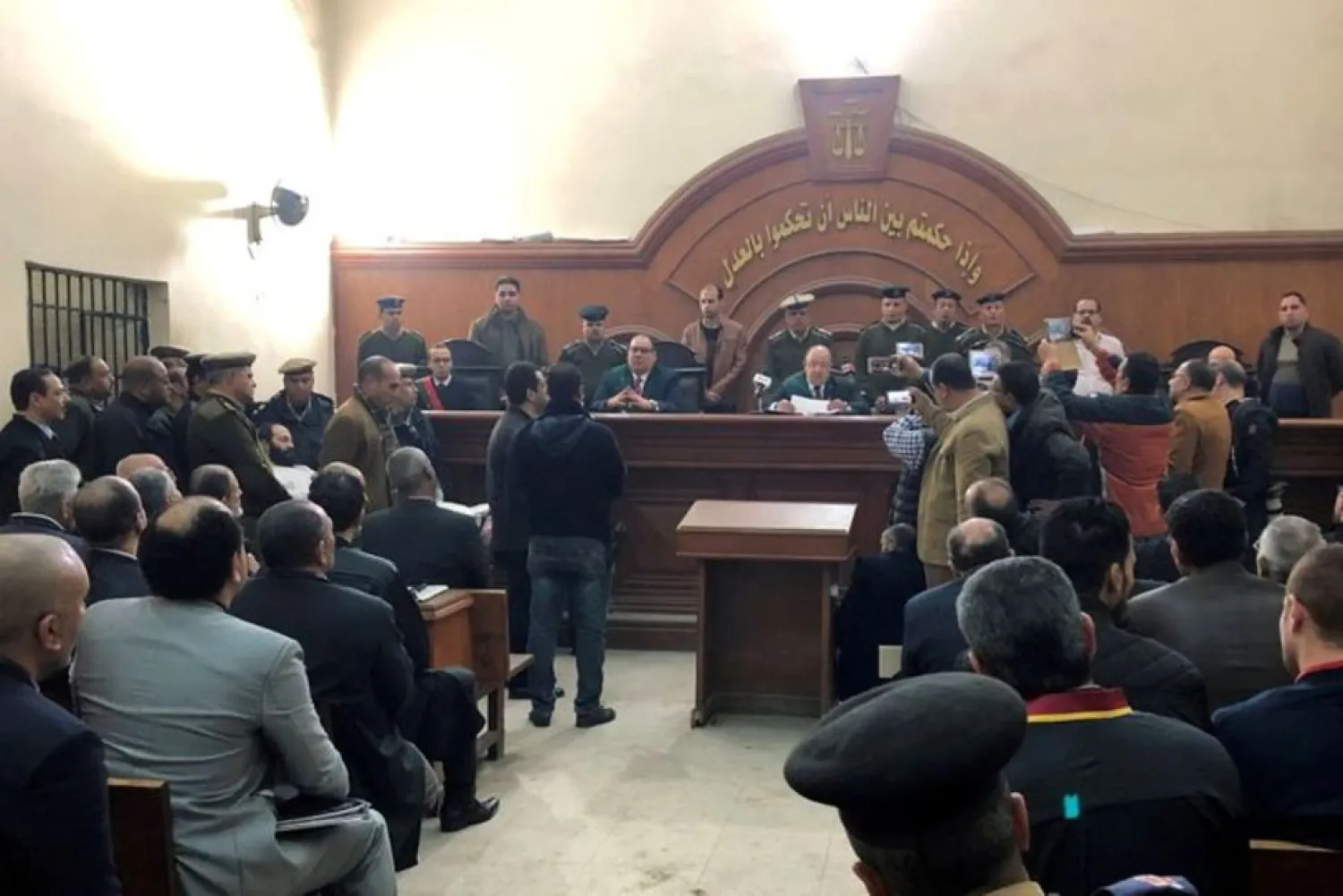
A general view of the court where Saad and Rasmi Mansour were convicted of murdering Bishop Epiphanius, Damanhour, Egypt February 23, 2019. (Reuters)
Egyptian authorities executed on Sunday an Egyptian monk convicted of killing an abbot at the St. Macarius Monastery in 2018, in a case that shocked the Egyptian community.
The case refers to July 2018, when head of the Saint Macarius Monastery in Wadi El-Natroun, Bishop Epiphanius was found dead at one of the monastery’s corridors suffering from head injuries.
Following extended investigations, Wael Saad and Ramon Rasmi Mansour, known by their monastic names Isaiah al-Makari and Faltaous al-Makari, were convicted of the killing of Bishop Epiphanius, 64.
Prosecutors had said during their trial that Saad struck the bishop three times in the back of the head with a steel pipe while Mansour stood guard outside.
The two monks were sentenced to death by a criminal court in April 2019.
Last year, the Court of Cassation upheld the death sentence against Isaiah, while Faltaous received a life sentence in a retrial.
Saad and Mansour were stripped of their monkhood shortly after the bishop was killed.
Local security and media sources said that Saad was executed on Sunday morning at the Nile Delta town of Damanhour.
St. Macarius Monastery, which is situated near the town of Wadi El-Natroun, 100km northwest of Cairo, is the oldest and biggest Coptic Orthodox monastery in Egypt.
The case provoked widespread shock in Egypt's Coptic Church and it pushed Pope Tawadros II of Alexandria to institute new monasticism laws, including the deactivation of the social media accounts of all monks and bishops and a freeze in the recruitment of new monks for a year was announced.
15 Years After Gaddafi's Death, Supporters Struggle to Find Political ‘Heir’https://english.aawsat.com/arab-world/5331681-15-years-after-gaddafis-death-supporters-struggle-find-political-%E2%80%98heir%E2%80%99
15 Years After Gaddafi's Death, Supporters Struggle to Find Political ‘Heir’
Late Libyan leader Muammar al-Gaddafi. (Reuters)
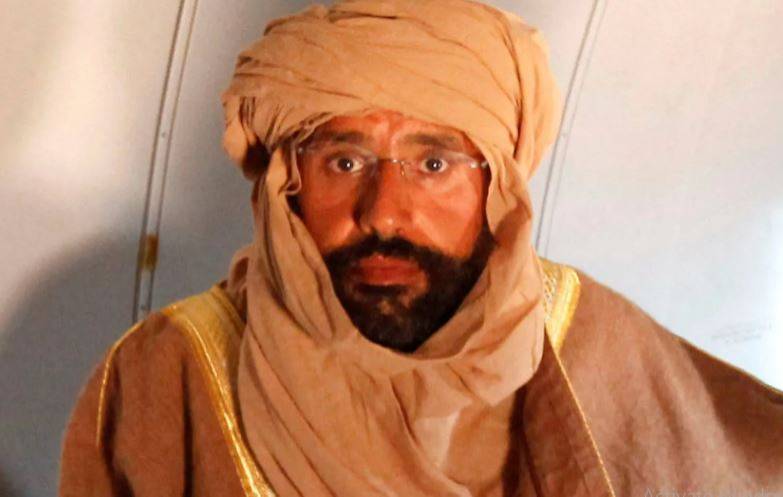
Fifteen years after the killing of Libyan leader Muammar al-Gaddafi, his supporters are still searching for a political heir, with the assassination of his son Saif al-Islam last February extinguishing hopes of a comeback that had grown since his ill-fated presidential bid in 2021.
Gaddafi was captured by opposition fighters in the city of Misrata on Oct. 20, 2011, before being killed as his rule of more than four decades came to an end. His downfall left a political vacuum among loyalists who later rallied around Saif al-Islam as the most prominent face of the former regime.
Hopes of a political revival gained momentum when Saif al-Islam announced his presidential candidacy in November 2021. But the elections never took place, and his assassination in Zintan in February reopened the question of succession, leaving the movement without a figure capable of uniting its supporters.
Political analyst Hossam Fenaish told Asharq Al-Awsat that Gaddafi loyalists were searching for a successor, with attention turning to his surviving children Aisha, Al-Saadi and Mohammed. Hannibal, he said, appeared to have the weakest prospects. Two other sons, Khamis and Saif al-Arab, were killed during the 2011 uprising.
Saif al-Islam Gaddafi in November 2011. (Reuters)
The most notable shift came in September, when supporters of the former regime began promoting Aisha Gaddafi on social media as a possible contender.
Their campaign drew on an open online poll that reportedly put her more than 30,000 votes ahead of her nearest rival. But there was no verified information on the number of participants or whether the results reflected wider public opinion.
Aqila Dalhoum, head of the media and human rights team at the National Truth Committee investigating Saif al-Islam's killing, backed the idea. He said the poll reflected both the Gaddafi family's enduring symbolic appeal among some Libyans and frustration over the country's political, economic and living crises.
Aisha, however, has largely stayed out of public politics. She lives in Oman with her brother Mohammed and has turned to visual art, exhibiting works depicting her father and brother Mutassim at Moscow's State Museum of Oriental Art in 2024, followed by an exhibition in Muscat this year.
Yet enthusiasm for her possible candidacy is far from unanimous.
Two prominent former regime figures declined to comment on calls for her to run. One questioned whether such discussions were premature.
"Where are the presidential elections at this point, given the stalled political process in Libya?" he told Asharq Al-Awsat.
A former Libyan army spokesman also played down the campaign, saying it reflected individual initiatives rather than a collective decision by Gaddafi loyalists.
No candidate had secured a consensus, he told Asharq Al-Awsat.
"Aisha is a Libyan citizen who has the right to run for office like anyone else," he said. "Choosing a representative of the former regime's supporters begins with a family decision, followed by consultations within the movement. The final say then rests with voters."
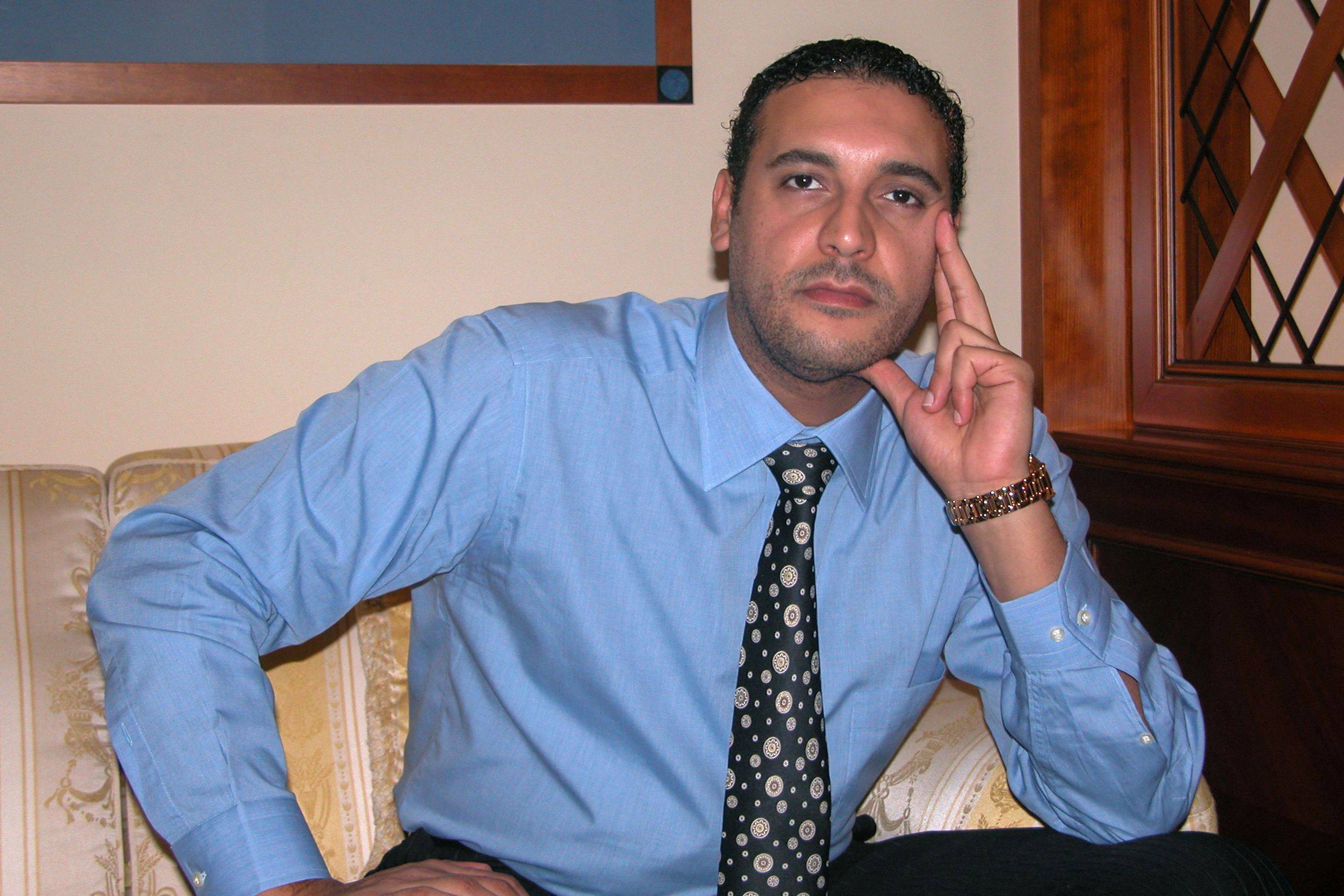
Hannibal Gaddafi. (Reuters file)
Aisha is not the only Gaddafi family member whose name has surfaced.
Supporters have also floated Al-Saadi Gaddafi, who lives in Türkiye, as a possible contender. But he publicly ruled out a political role in June, saying in a post on X that he had no intention of entering politics, contesting elections or backing any faction.
Instead, he said he wanted to live an ordinary life devoted to learning and wished success to whoever Libyans chose to lead the country.
Al-Saadi was freed from a Tripoli prison in 2021 after spending years in detention following his extradition from Niger in March 2014 over allegations linked to the crackdown on the 2011 uprising.
Attention has also turned to Mohammed Gaddafi, the former leader's eldest son from his first wife, Fathia Nuri Khalid.
Mohammed resurfaced on social media after Saif al-Islam's assassination, pressing for the findings of the murder investigation to be made public.
Last month, he raised questions about a suspected sabotage cell apprehended in Tripoli and its possible links to the assassination, urging relevant international organizations to investigate and uncover the circumstances of the killing.
Pages aligned with the former regime have since touted Mohammed as another potential successor.
One page, "Gaddafi Speaks," portrayed him as a man suited to a time when Libyans are seeking a strong, independent state. Blogger Ahmed Faraj also voiced support for him as a future candidate.
But activist Rania Gaddafi dismissed suggestions that Mohammed was preparing to enter politics as rumors.
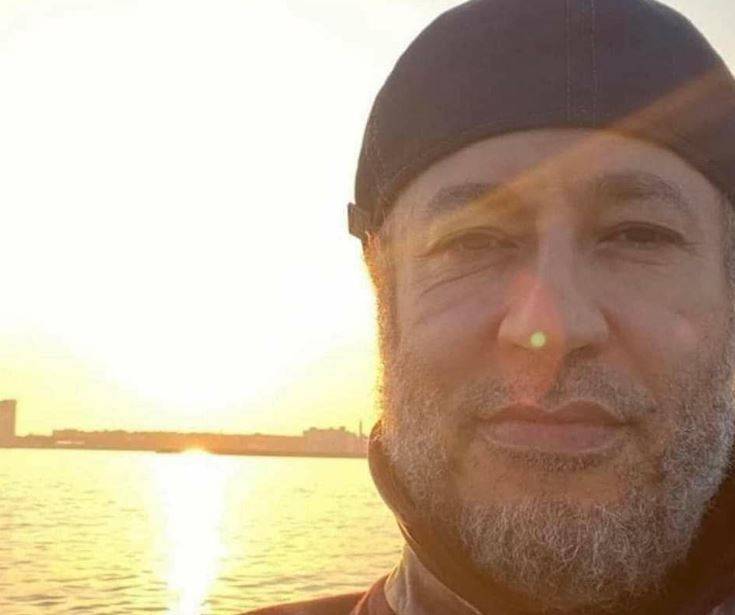
Al-Saadi Gaddafi. (Al-Saadi Gaddafi on Facebook)
She said he had no interest in running for election or holding office, and was concerned only with seeing Libya regain security, stability and national unity.
Born in 1970, Mohammed previously headed the Libyan Olympic Committee and chaired the board of the General Posts and Telecommunications Company.
Hannibal Gaddafi, meanwhile, remains entangled in one of the family's most complicated chapters, far from Libya's political stage.
He spent about a decade in detention in Lebanon in connection with the 1978 disappearance of Lebanese cleric and politician Musa al-Sadr and his two companions before his release.
Feneish said Hannibal appeared to be out f the running for now.
But beyond the competing names, some Gaddafi loyalists reject the idea that his political legacy belongs to any single family member. They argue that the former leader left behind not a conventional political inheritance but a set of national and pan-Arab values and principles.
Libyan writer and researcher Mustafa al-Fetouri, a supporter of the former regime, told Asharq Al-Awsat that the question of succession went beyond the Gaddafi family.
"Anyone who believes in those principles can be his heir, beyond his family and children," he said.
Iran Says Iraq Will Expel Exiled Kurdish Opposition Membershttps://english.aawsat.com/arab-world/5331664-iran-says-iraq-will-expel-exiled-kurdish-opposition-members
Officials are seen at a meeting between Iraq and Iran to review the security framework agreement between their countries in Baghdad on October 19. (Government media)
TT
TT
Iran Says Iraq Will Expel Exiled Kurdish Opposition Members
Officials are seen at a meeting between Iraq and Iran to review the security framework agreement between their countries in Baghdad on October 19. (Government media)
Iran's ambassador to Iraq said on Tuesday that Baghdad had agreed to "expel" or hand over members of Iranian Kurdish opposition groups who have taken refuge on the Iraqi side of the border.
The announcement came after senior Iraqi security officials repeatedly told AFP that Baghdad was refusing to do so, fearing for the lives of the Kurdish exiles.
Iraq's autonomous Kurdistan region, an oil-rich area in the north of the country, has long hosted camps and bases for Iranian Kurdish rebel groups, which Tehran labels terrorists who serve US or Israeli interests.
"During a meeting of the joint security commission -- attended by the Iranian delegation and the Iraqi National Security Adviser -- the two parties agreed to expel the members of the Iranian separatist terrorist groups from the Iraqi Kurdistan region or hand them over to Iran," ambassador Mohammad Kazem Al-Sadegh wrote on X.
On Monday, Iraq's National Security Council hosted a meeting of the two delegations in Baghdad. A governmental delegation from the Kurdistan region also took part, according to a statement from the media office of Iraqi National Security Adviser Qassim Al-Abboudi.
The statement said the talks focused on "ways to address current challenges and to harmonize the visions of the parties concerned".
In 2023, Baghdad and Tehran signed an agreement aimed at strengthening security along their shared border -- particularly in the Kurdistan region -- and "neutralizing the Kurdish opposition".
The deal put an end to recurring Iranian bombardments targeting the groups and helped ease tensions between the two countries.
But since the outbreak of war in the Middle East in late February, triggered by US-Israeli strikes, Iran has resumed deadly attacks on the Kurdish groups.
Under the 2023 agreement, Iraqi authorities disarmed the Iranian Kurdish groups, moving them away from the border and transferring them to camps.
On February 22 this year, a few days before the outbreak of the war, five of the groups announced the formation of a political alliance aimed at overthrowing the Iranian government and guaranteeing the right to self-determination for the Kurds.
Türkiye Troops to Stay in Syria, Iraq ‘Until Border Security Ensured’, Defense Minister Sayshttps://english.aawsat.com/arab-world/5331661-t%C3%BCrkiye-troops-stay-syria-iraq-%E2%80%98until-border-security-ensured%E2%80%99-defense-minister
Türkiye's Defense Minister Yasar Guler attends the meeting of Ministers of Defense of the North Atlantic Council at the NATO headquarters in Brussels on February 15, 2024. (AFP)
TT
TT
Türkiye Troops to Stay in Syria, Iraq ‘Until Border Security Ensured’, Defense Minister Says
Türkiye's Defense Minister Yasar Guler attends the meeting of Ministers of Defense of the North Atlantic Council at the NATO headquarters in Brussels on February 15, 2024. (AFP)
Türkiye will keep its own troops in Syria and Iraq until border security with its two neighbors has been fully ensured, Defense Minister Yasar Guler told AFP.
"We are maintaining our military presence in Iraq and Syria," he said in a written answer to AFP questions.
"When we assess that the necessary conditions have been met in terms of regional and border security, the status of our base areas and our presence in the region will be reconsidered."
Türkiye has for years maintained troops in northern Syria and Iraq to contain the threat along its borders posed by separatist militants from the Kurdistan Workers' Party (PKK) and from ISIS extremists.
But over the past two years, the situation has shifted with the emergence of a new Ankara-allied government in Syria following Bashar al-Assad's fall, and following Türkiye's push to draw a line under its decades-long conflict with the PKK.
Since Assad's fall, Türkiye had established "close coordination in the field of security" with the new Syrian government, with its troops working to "strengthen the capacity" of the Syrian military and "to ensure the security of our borders", the minister said.
"Once the terrorist threat in the region has been completely eliminated, border security has been ensured, and state authority has been fully and uniformly established throughout Syria without exception, the status of our forces will be reassessed," he said.
When the Assad regime fell, Türkiye had between 16,000 and 18,000 troops in northern Syria, a Turkish official said.
Since then, there has been no reliable figure for troops deployed in Syria, although a Turkish official last month said talks were under way to determine their legal status there.
But Guler refused to be drawn on any future plans.
"At this stage it would not be appropriate to make a prior assessment regarding deployment or base plans that have not been made public," he said.
"Issues related to the future posture of the Turkish armed forces in Syria will be addressed by taking into account Syria's sovereignty and territorial integrity, the mutual understanding of the two countries, the security conditions on the ground and the evolution of the terrorist threat."
- Troop numbers according to needs -
Turkish troops have also long been operational in northern Iraq, regularly conducting cross-border operations and air raids on PKK hideouts, while maintaining their own bases there -- putting a strain on ties between Ankara and Baghdad.
Troops have been based there since 2015, and today they number between 800 and 1,000, an Iraqi security source told AFP.
Without disclosing any figures, Guler said troop numbers in both Iraq and Syria were assessed in proportion to what was needed on the ground.
"It would not be accurate to assess our military presence in Iraq and Syria solely on the basis of personnel numbers. Our force structure and posture on the ground are shaped according to needs" linked to threat levels, border security and developments on the ground, he said.
As the PKK process has advanced, the Kurdish militants destroyed weapons at a symbolic ceremony last year, and this month, withdrew from four key bases in northern Iraq in a move confirmed by Turkish intelligence.
For lasting success, the PKK must "fully implement their decision to dissolve" with Türkiye "meticulously monitoring the next phases of the process" while not dropping its guard.
"The progress of the process doesn't mean security measures have been relaxed," he said, with troops continuing to "take the necessary measures" against any situation viewed as a security threat.
Like in Syria, Türkiye was also closely watching Iraq's own efforts "to disarm armed groups and bring them under state control", he said, hailing recent successes in the Sinjar region.
Iraq has set a June 30 deadline for pro-Iran factions to hand over their weapons to the state following the end of the US-led coalition's mission there.
Following the successful Sinjar push, Türkiye said last month it would "gradually" hand control to Baghdad of its Bashiqa base near the northern city of Mosul although no timeline was given.
Türkiye would continue to support Iraq and was planning "to elevate military and security cooperation between the two countries to a higher level" in the coming period, he said.
لم تشترك بعد
انشئ حساباً خاصاً بك لتحصل على أخبار مخصصة لك ولتتمتع بخاصية حفظ المقالات وتتلقى نشراتنا البريدية المتنوعة