


Israeli Military Accused of Using Media to Trick Hamas Militants in Gaza

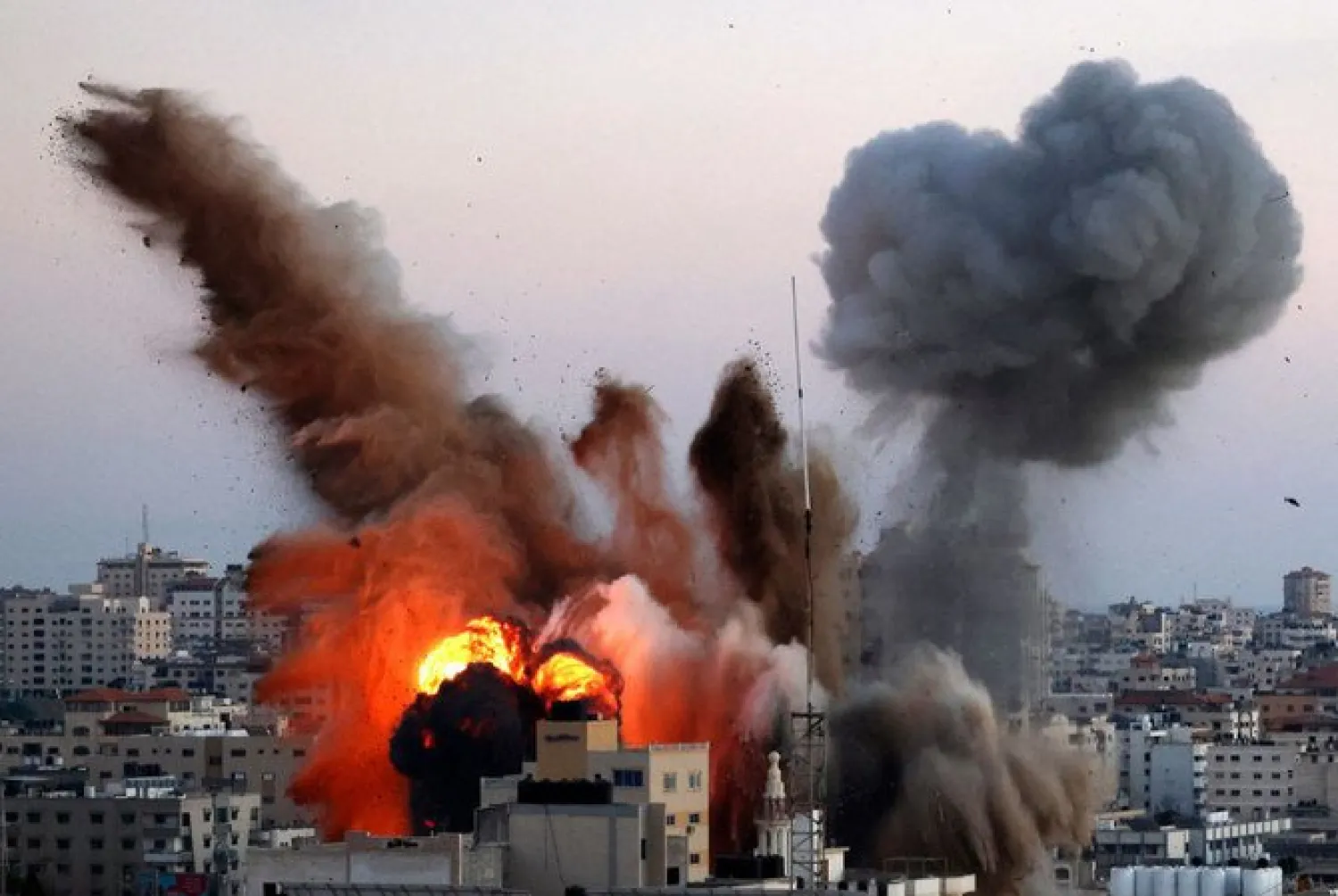
Smoke billows after an Israeli airstrike on Gaza City targeted the Ansar compound, linked to the Hamas movement, in the Gaza Strip on May 14, 2021. (AFP)
TT

Israeli Military Accused of Using Media to Trick Hamas Militants in Gaza

Smoke billows after an Israeli airstrike on Gaza City targeted the Ansar compound, linked to the Hamas movement, in the Gaza Strip on May 14, 2021. (AFP)

Early Friday, just after midnight, the Israeli military put out an ominous statement to the media saying its air and ground troops are currently attacking in the Gaza Strip.”

The terse statement set off frenzied speculation that Israel had launched a ground invasion of Gaza — a much-feared scenario that would mark a bloody escalation of this week’s operation against Hamas militants.

Some reporters were even told outright the incursion had begun, according to The Associated Press.

Hours later, the military issued a “clarification.”

There were no troops inside Gaza. But by then, several major news outlets had erroneously reported the ground offensive was under way.

While the army attempted to play down the incident as a misunderstanding, well-placed Israeli military commentators said the media had been used as part of an elaborate ruse to lure Hamas militants into a deadly trap that may have killed dozens of fighters.

“They didn’t lie,” said Or Heller, a veteran military correspondent on Israel’s Channel 13 TV. “It was a manipulation. It was smart and it was successful.”

This is how it unfolded:

Late Thursday, after days of airstrikes, Israel announced it was calling up thousands of reservists and amassing troops along the border ahead of a possible ground invasion. In another sign of escalation, Israeli tanks stationed along the border opened fire at targets inside Gaza.

In previous rounds of fighting, ground incursions have resulted in widespread destruction in Gaza and heavy casualties on both sides.

That set the stage for the late-night deception. According to Heller, Israel began scrambling forces along the border in what appeared to be final preparations for an invasion. Then came the announcement to the media, issued simultaneously in Hebrew and Arabic on Twitter. There followed alerts in major outlets that the invasion was under way.

The Israeli moves sent Hamas fighters rushing into defensive positions in an underground network of tunnels known as the Metro, according to Heller and other Israeli reports.

Israel called in 160 warplanes and bombarded the tunnels for 40 minutes, the military said. Heller said it was his understanding that scores of militants had been killed, though he said it was impossible to say.

“What we saw tonight was a very sophisticated operation that had a media aspect to it,” Heller said.

Hamas has not commented on the incident, and it was impossible to confirm the Israeli reports.

Heller said veteran Israeli correspondents, who have close ties to the military and in many cases have served themselves, knew that there was no way Israel was sending troops across enemy lines at this stage. Heller and other military correspondents even put out statements on Twitter assuring the jittery public that there was no ground operation.

The AP, based on its analysis of the army’s statement, phone calls to military officials and on the ground reporting in Gaza, concluded there was no ground incursion and did not report there was one.

But others said the military had misled them or even lied when asked to clarify, turning the foreign media into an accessory of sorts.



A Man Detonates Explosive Belt during Arrest Attempt in Iraq, Injuring 2 Security Members

A man wearing an explosives belt blew himself up Friday while a security force was trying to arrest him in western Iraq near the Syrian border, killing himself and wounding two security members, an Iraqi security official said. (Reuters/File)
TT

A Man Detonates Explosive Belt during Arrest Attempt in Iraq, Injuring 2 Security Members

A man wearing an explosives belt blew himself up Friday while a security force was trying to arrest him in western Iraq near the Syrian border, killing himself and wounding two security members, an Iraqi security official said. (Reuters/File)

A man wearing an explosives belt blew himself up Friday while a security force was trying to arrest him in western Iraq near the Syrian border, killing himself and wounding two security members, an Iraqi security official said.

The raid was being conducted in the al-Khaseem area in Qaim district that borders Syria, said the official who spoke on condition of anonymity in line with regulations.

The official added that “preliminary information” confirms that no members of the security forces were killed, while two personnel were injured and transferred for medical treatment, The Associated Press said.

Iraq’s National Security Agency said in a statement that its members besieged a hideout of an ISIS group security official and two of his bodyguards. One bodyguard ignited his explosives belt, killing him. It gave no further details.

ISIS once controlled large parts of Syria and Iraq and declared a caliphate in 2014. The extremist group was defeated on the battlefield in Iraq in 2017 and in Syria in 2019 but its sleeper cells still carry out deadly attacks in both countries.

In December, two US service members and an American civilian were killed in an attack in Syria that the United States blamed on ISIS. The US carried out strikes on Syria days later in retaliation.

US and Iraqi authorities in January began transferring hundreds of the nearly 9,000 ISIS members held in jails run by the US-backed and Kurdish-led Syrian Democratic Forces in northeast Syria to Iraq, where Iraqi authorities plan to prosecute them.


UN Peacekeepers in Lebanon Allege Surge in Israeli Violence toward Them

United Nations Spanish UNIFIL forces arrive to inspect chalets, after the Israeli army reportedly booby-trapped and blew them up at dawn, on the outskirts of the town of al-Khiam, southern Lebanon on January 31, 2026. (Photo by Rabih DAHER / AFP)
TT

UN Peacekeepers in Lebanon Allege Surge in Israeli Violence toward Them

United Nations Spanish UNIFIL forces arrive to inspect chalets, after the Israeli army reportedly booby-trapped and blew them up at dawn, on the outskirts of the town of al-Khiam, southern Lebanon on January 31, 2026. (Photo by Rabih DAHER / AFP)

UN peacekeepers patrolling southern Lebanon have faced a dramatic surge of “aggressive behavior” by Israeli forces over the last year, including drone-dropped grenades and machine-gun fire, according to an internal report seen by The Associated Press.

The report by one of the 48 nations that together have more than 7,500 peacekeepers in southern Lebanon says the number of incidents jumped from just one in January to 27 in December. The hilly frontier zone where the UNIFIL force patrols has seen decades of cross-border violence. Israel and Lebanon's Hezbollah militants fought a full-scale war in 2024.

The targeting of peacekeepers appears aimed at undermining the international force and strengthening Israel’s military footprint along the UN-drawn border with Lebanon, known as the Blue Line, the report alleges. It was shared with AP on condition that the news organization not identify the country whose peacekeepers compiled the findings for internal use by their senior command.

Israel has long mistrusted UNIFIL, accusing it of failing to prevent Hezbollah from building up its military presence along the border in violation of ceasefire agreements going back two decades.

The growing catalog of run-ins comes as a half-century of international peacekeeping efforts along the border face an uncertain future. UNIFIL’s mission is scheduled to end this year and US President Donald Trump ’s administration regards it as a waste of money.

Israel says it tries to reduce harm

In a statement to AP, the Israeli military said it “is not conducting a deterrence campaign against UNIFIL forces" and is working within accepted frameworks to dismantle Hezbollah, largely based in southern Lebanon.

The military “takes steps to reduce harm to UNIFIL forces and other international actors operating in the area,” it said.

UNIFIL said in a statement that “the number of attacks on or near peacekeepers, as well as aggressive behavior toward peacekeepers, have increased since September 2025,” with most of those incidents attributed to the Israeli military.

“The majority of incidents do not involve physical harm to peacekeepers, but any action that interferes with our mandated activities is a matter of concern,” it said.

The UN force has reported additional incidents this year. An Israeli tank opened fire with small-caliber bullets on a UNIFIL post on Jan. 16, it said. This week, it reported that a drone dropped a stun grenade that exploded in the vicinity of a peacekeeping patrol before flying toward Israeli territory.

Report details array of incidents

The report seen by AP details multiple instances in 2025 of grenades being dropped by Israeli drones near UNIFIL patrols, including an attack in October that wounded a peacekeeper, as well as machine-gun fire near UNIFIL positions. In some cases, UNIFIL vehicles were damaged.

The last four months of 2025 also saw a surge in incidents of direct fire at all targets from Israeli positions on both sides of the Blue Line, the report says. Such incidents spiked to 77 in December, up from just two in January, it says.

UNIFIL vehicles and positions are clearly marked as belonging to the UN, and Hezbollah militants have not maintained a visible presence or fired on Israeli forces in recent months.

The report says “it cannot be excluded” that Israel is using the incidents to maintain a military presence north of the border and prevent people who have fled the zone from returning.

Israel-Hezbollah conflict

After the Oct. 7, 2023, Hamas -led attack on Israel that triggered war in Gaza, Hezbollah began firing rockets from Lebanon into Israel in support of Hamas and the Palestinians.

Israel responded with airstrikes and shelling. The low-level conflict escalated into full-scale war in September 2024, later reined in but not fully stopped by a US-brokered ceasefire two months later.

Since then, Israel has accused Hezbollah of trying to rebuild in the south, in violation of the ceasefire, and has carried out near-daily strikes in Lebanon that it says target Hezbollah militants and facilities. Israeli forces also continue to occupy five hilltop points on the Lebanese side of the border. Hezbollah has claimed one strike against Israel since the ceasefire.

Spraying of chemicals spurs an outcry

The UN and Lebanon say Israeli forces dropped herbicide on Lebanese territory on Sunday, forcing a more than nine-hour pause in peacekeeping activities, including patrols.

“The use of herbicides raises questions about the effects on local agricultural lands, and how this might impact the return of civilians to their homes and livelihoods in the long-term,” UN spokesperson Stéphane Dujarric said. There was no Israeli comment.

Dujarric added that “any activity” by the Israeli military north of the Blue Line violates a UN resolution adopted in 2006 that expanded the UNIFIL mission, in hopes of restoring peace to the area after a monthlong war between Israel and Hezbollah.

Uncertain future for border area UNIFIL was created nearly five decades ago to oversee Israel's withdrawal from southern Lebanon after its troops invaded in 1978.

The UN Security Council voted last August to terminate its mission at the end of 2026.

Israel had long sought an end to its mandate, saying UNIFIL failed to keep Hezbollah away from the border. Under the 2006 UN ceasefire, the Lebanese army was supposed to maintain security in the south with backing from UNIFIL and militants were to disarm.

Hezbollah supporters in Lebanon have frequently accused UNIFIL of collusion with Israel and have sometimes attacked its patrols.

The Lebanese government says UNIFIL serves a necessary purpose. Prime Minister Nawaf Salam said in December that Lebanon will need a follow-up force to fill the vacuum and to help Lebanese troops along the border as they expand their presence there.

In an AP interview this week, Lebanese Deputy Prime Minister Tarek Mitri said several proposals are under discussion.

One possibility is an expansion of the United Nations Truce Supervision Organization, or UNTSO, which maintains a small observer force in Lebanon. The European Union has also offered to contribute to an international observer force, he said.

Whatever the arrangement, Mitri said: “We need a neutral, internationally mandated force to observe and make sure that whatever is agreed upon in negotiations is fully respected."


France to Rally Aid for Lebanon as It Warns Truce Gains Remain Fragile

This handout photograph released by the Lebanese Presidency Press Office shows Lebanon's President Joseph Aoun (R) receiving France's Minister for Europe and Foreign Affairs Jean-Noel Barrot (L) at the Presidential Palace in Baabda, east of Beirut, on February 6, 2026. (Photo by Lebanese Presidency Press Office / AFP)
TT

France to Rally Aid for Lebanon as It Warns Truce Gains Remain Fragile

This handout photograph released by the Lebanese Presidency Press Office shows Lebanon's President Joseph Aoun (R) receiving France's Minister for Europe and Foreign Affairs Jean-Noel Barrot (L) at the Presidential Palace in Baabda, east of Beirut, on February 6, 2026. (Photo by Lebanese Presidency Press Office / AFP)

France said on Friday that Lebanon's recovery remains precarious despite positive signs following a ceasefire and government transition, and it stood ready to support the country's reconstruction if it continues with reforms.

French Minister for Europe and Foreign Affairs Jean-Noel Barrot, addressing reporters after meetings in Beirut with Lebanese President Joseph Aoun and other top officials, said France was prepared to host a dedicated conference in Paris on reconstruction, but only if reforms continue, legislation is passed ‌and decisions ‌are implemented.

While Lebanon has adopted ‌banking ⁠secrecy and ‌bank resolution laws, it must still complete restructuring, reach an IMF agreement and pass a loss-sharing law, Barrot said. He also urged swift action on Hezbollah disarmament and national reconciliation.

Barrot said Lebanon had reached a crucial juncture in implementing the November 2024 truce with Israel, as well as restoring ⁠state authority over weapons and stabilizing a shattered financial system.

France, the ‌country's former colonial power, plans ‍to mobilize international backing for ‍the Lebanese armed forces and internal security forces at ‍a separate conference scheduled for March 5 in Paris.

"Lebanon must work to restore confidence - that of its citizens, businesses, depositors, and the diaspora," Barrot said.

France's immediate focus was ensuring respect for the ceasefire, which he emphasized "implies that Israel withdraws from Lebanese territory, in accordance with its ⁠commitments, and that civilians are protected from strikes," alongside implementation by Lebanese authorities of an agreed-upon arms monopoly plan.

Lebanon has pledged to bring all arms in the country under state control, in line with the 2024 agreement that ended a devastating war between Hezbollah and Israel, and has asserted control over areas of the country closest to the border with Israel. But Hezbollah has warned the government that pressing on with efforts to disarm ‌the group throughout the country would trigger chaos and possibly civil war.