


Russia Expects Iran to End 60% Enrichment Soon

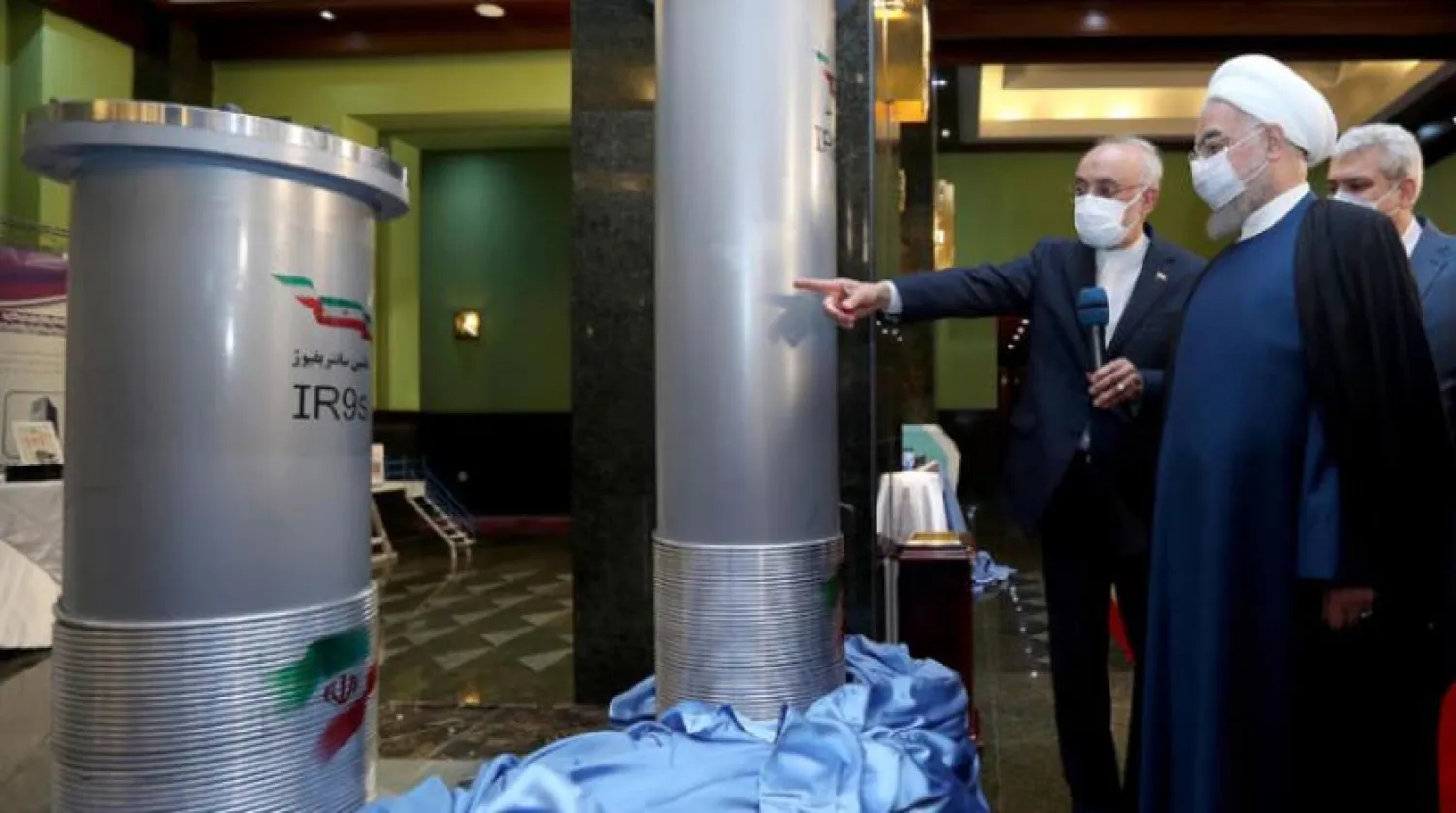
Iranian President Hassan Rouhani touring a nuclear exhibition in Tehran last month (AFP)
TT

Russia Expects Iran to End 60% Enrichment Soon

Iranian President Hassan Rouhani touring a nuclear exhibition in Tehran last month (AFP)

Head of the Russian delegation to the nuclear negotiations in Vienna Mikhail Ulyanov is optimistic that the parties could reach tangible results by June.

Ulyanov told the Echo of Moscow that the US decided to return to the nuclear agreement, noting that the parties might soon reach an agreement on various issues, including the sanctions imposed on Iran.

The diplomat expects Iran to end the 60 percent enrichment soon, stressing that the nuclear deal is the most ideal solution for all regional parties.

Ulyanov said the only possible option is to restore the nuclear agreement in its entirety and original form, noting that it is very difficult to set a timeline to announce a completion in the negotiations.

He added that since the beginning of April, Washington has taken a very pragmatic stance, and a political decision to return to the deal, noting that they are working seriously in this direction.

The diplomat revealed some of the current discrepancies, explaining that the discussion revolves around the sanctions that must be lifted and the steps that Iran must take so that it can be said that it has returned to full compliance.

Ulyanov is confident these “issues will be solved,” indicating that the Iranian official position is that Washington should take all the required steps, and then Tehran will do whatever is required.

However, he believes this scenario is not possible, saying that the situation requires compromises.

Ulyanov added that the “sabotage operations” that targeted Iran led to the development of the nuclear program. He hinted that after restoring the deal, the nuclear verification mechanism would be reinstated.

“In principle, the Iranians are ready for that, but on the condition that their interests are taken into account,” he noted.

Sanctions are also being negotiated, but Ulyanov did not go into details, revealing that the Iranians are asking for lifting all sanctions imposed under former President Donald Trump.

The US has three lists of sanctions: red, green, and yellow. Red is non-negotiable, yellow is negotiable, and green is what they are ready to lift and covers the majority of economic sanctions.

Iranian officials are demanding compensation from the United States for withdrawing from the nuclear deal, which Ulyanov believes is natural and possible through the development of active economic and trade relations.

Regarding the Russian Iranian cooperation at the Bushehr station, Ulyanov refused to discuss any details, however, he asserted that this issue would have a positive outcome.

Iran is a member of the Treaty on the Non-Proliferation of Nuclear Weapons (NPT), and this grants Tehran the right to peaceful uses of nuclear energy including building a nuclear power plant, said the diplomat.

He warned that denying Iran this right will give it every reason to discuss abandoning its non-proliferation obligations.

The best option for all parties to ensure the success of the nuclear deal is if Tehran achieves its economic gains and strengthens its international position, as other parties are ensured that Iran does not have nuclear weapons.



Netanyahu Says He Was Successfully Treated for Prostate Cancer

Israel’s Prime Minister Benjamin Netanyahu attends a ceremony commemorating Israel’s Remembrance Day for fallen soldiers, or Yom HaZikaron, at the Military Cemetery on Mount Herzl in Jerusalem April 21, 2026. (Reuters)
TT

Netanyahu Says He Was Successfully Treated for Prostate Cancer

Israel’s Prime Minister Benjamin Netanyahu attends a ceremony commemorating Israel’s Remembrance Day for fallen soldiers, or Yom HaZikaron, at the Military Cemetery on Mount Herzl in Jerusalem April 21, 2026. (Reuters)

Israeli Prime Minister Benjamin ‌Netanyahu said on Friday that he had received successful treatment for early-stage prostate cancer.

In a statement on X, as his annual medical report was released, Netanyahu, 76, said that during a routine checkup a “tiny spot” of less than a centimeter was found in his prostate and that further examination confirmed it was an early-stage malignant tumor with no spread or metastasis.

The PM had previously undergone surgery about a year and a half ago for an enlarged benign prostate.

Neither the recent medical report nor Netanyahu said when the treatment occurred, but the PM said he opted for immediate targeted treatment which successfully eliminated the issue.

Netanyahu said ‌that ⁠he had delayed the release of the medical report by two months to prevent Iran from spreading “false propaganda against Israel.”

The PM underwent surgery on his prostate in 2024 after he was diagnosed with a urinary tract infection resulting ⁠from a benign prostate enlargement. In 2023, he was fitted with a pacemaker.

Elections are due to be held in Israel by October.


US Envoys Heading to Pakistan for Uncertain Iran Talks

A view of a deserted road amid a high-level security lockdown due to anticipated US-Iran peace talks, in Islamabad, Pakistan, 25 April 2026. (EPA)
TT

US Envoys Heading to Pakistan for Uncertain Iran Talks

A view of a deserted road amid a high-level security lockdown due to anticipated US-Iran peace talks, in Islamabad, Pakistan, 25 April 2026. (EPA)

US envoys headed to the Pakistani capital Saturday in a bid to kickstart a new round of peace negotiations with Iran amid a fragile ceasefire, though the prospect of direct talks remained uncertain.

The White House said emissaries Steve Witkoff and Jared Kushner would engage in an "in-person conversation" with Iranian representatives, but Iranian state media said that direct negotiations were not in the cards.

Iran's foreign minister arrived in Islamabad on Friday.

Despite President Donald Trump's announcement on Thursday of a three-week ceasefire extension in Lebanon, Israeli strikes in the south of the country killed six people on Friday, the Lebanese health ministry said.

While Trump expressed confidence at the prospect of a lasting peace in Lebanon, sealing a deal to end the wider Middle East war is a thornier proposition, even as urgency mounts to reopen the Strait of Hormuz, a vital conduit for the world's oil and liquefied natural gas (LNG).

White House Press Secretary Karoline Leavitt said Witkoff and Kushner would head to Pakistan on Saturday "to engage in talks... with representatives from the Iranian delegation".

"The Iranians reached out, as the president called on them to do, and asked for this in-person conversation," Leavitt said, adding that the talks would "hopefully move the ball forward towards a deal".

Leavitt said Vice President JD Vance, who led a first round of negotiations in Islamabad two weeks ago that concluded without a deal, would not be joining for the time being, but was on "standby to fly to Pakistan if necessary".

It remained unclear late Friday whether the Iranian side would meet directly with the US envoys.

Iranian state television said Foreign Minister Abbas Araghchi has no plans to meet with the Americans, and Islamabad would serve as a bridge to "convey" Iranian proposals to end the conflict.

Pakistan's foreign ministry said Araghchi had arrived in Islamabad to discuss "ongoing efforts for regional peace and stability" with Pakistani officials, without directly referencing talks with Witkoff and Kushner.

An Iranian spokesman said Araghchi would visit Oman and Russia after the Pakistan stop to discuss efforts to end the war launched against Iran by Israel and the United States on February 28.

- EU says opening Hormuz 'vital' -

Since the last round of talks, efforts to bring the two sides back to the table have hit an impasse, with Iran refusing to participate as long as a US naval blockade on its ports remained in place.

Iran has imposed a de facto blockade of its own on the Strait of Hormuz, allowing only a trickle of ships to pass through the vital waterway, throwing global energy markets into turmoil.

Oil prices slid on Friday amid hopes that fresh peace talks would see an end to Tehran's disruption of trade through the strait.

European Council President Antonio Costa said Friday that the strait "must immediately reopen without restrictions and without tolling".

"This is vital for the entire world," Costa said.

Major Wall Street indices closed at fresh records on Friday as markets cheered the latest batch of earnings reports and US and Iranian officials headed to Pakistan.

The United States continued meanwhile to build up its forces in the Middle East with the arrival of its third aircraft carrier in the region, the USS George H.W. Bush.

- 'Destroyed' -

Trump spoke in glowing terms on Thursday of peace prospects for Lebanon after meeting with Israeli and Lebanese envoys, voicing hope for a three-way meeting with the Lebanese and Israeli leaders.

The two countries have been officially at war for decades and until last week had not met so directly since 1993.

Mohammed Raad, the head of Hezbollah's parliamentary bloc, urged the Lebanese government to withdraw from direct talks with Israel and warned that a lasting peace deal of the kind sought by Trump "will in no way enjoy Lebanese national consensus".

Israeli Prime Minister Benjamin Netanyahu, who has vowed to destroy the Iran-backed movement, said: "We have started a process to reach a historic peace between Israel and Lebanon, and it's clear to us that Hezbollah is trying to sabotage this."

In south Lebanon's Tyre, Mohamad Ali Hijazi was searching a mountain of rubble for mementos of family members killed in an Israeli airstrike minutes before the ceasefire took hold.

"I'm trying to find my mother's hairbrush...and a bottle of perfume that she loves," said Hijazi, 48 -- some of the last things he sent her from France, where he has long lived with his wife and two daughters.

"My life has been destroyed. I haven't slept for five days," he told AFP, repeatedly fighting back tears.


Merz Floats Sanctions Relief for Iran Peace Deal, Other EU Leaders Cautious

 Germany's Chancellor Friedrich Merz speaks during a press conference after taking part in an informal meeting of the European Council in Nicosia on April 24, 2026. (AFP)
Germany's Chancellor Friedrich Merz speaks during a press conference after taking part in an informal meeting of the European Council in Nicosia on April 24, 2026. (AFP)
TT

Merz Floats Sanctions Relief for Iran Peace Deal, Other EU Leaders Cautious

 Germany's Chancellor Friedrich Merz speaks during a press conference after taking part in an informal meeting of the European Council in Nicosia on April 24, 2026. (AFP)
Germany's Chancellor Friedrich Merz speaks during a press conference after taking part in an informal meeting of the European Council in Nicosia on April 24, 2026. (AFP)

German Chancellor Friedrich Merz suggested on Friday that the European Union could ease sanctions on Tehran as part of a comprehensive deal that would end the Iran war, but other EU leaders struck a more cautious note.

The 27-nation EU has imposed sanctions on Iran for years, including travel bans and asset freezes for senior officials and entities, in response to human rights violations, nuclear activities and military support for Russia.

US officials have suggested a ‌comprehensive deal covering Iran's ‌nuclear and missile programs and the ‌re-opening ⁠of the Strait of ⁠Hormuz could bring a lasting end to the US-Israeli war with Tehran, beyond the current ceasefire.

After an EU summit in Cyprus, Merz said the bloc could gradually ease sanctions on Iran in the event that a comprehensive agreement was reached.

European leaders have been largely sidelined in the current Middle ⁠East conflict but some European officials see ‌the bloc's sanctions as a possible ‌way for the EU to be involved in a diplomatic solution.

"The ‌easing of sanctions can be part of a process," ‌Merz told reporters after the Nicosia summit.

"No one has objected to that," he said of the summit deliberations. "It is, so to speak, part of the contribution we can make to advance this ‌process and, hopefully, lead to a permanent ceasefire."

But European Council President Antonio Costa, the chair ⁠of the summit, ⁠told a press conference after the end of the meeting: "It is too early to talk about relieving any kind of sanctions."

European Commission President Ursula von der Leyen said sanctions relief could only come after clear evidence of fundamental changes of course from Iran.

"We believe that sanctions relief should be conditional on verification of de-escalation, particularly on progress on the international effort to contain its nuclear threat, and on a change to the repression of its own people," she told the same press conference.