

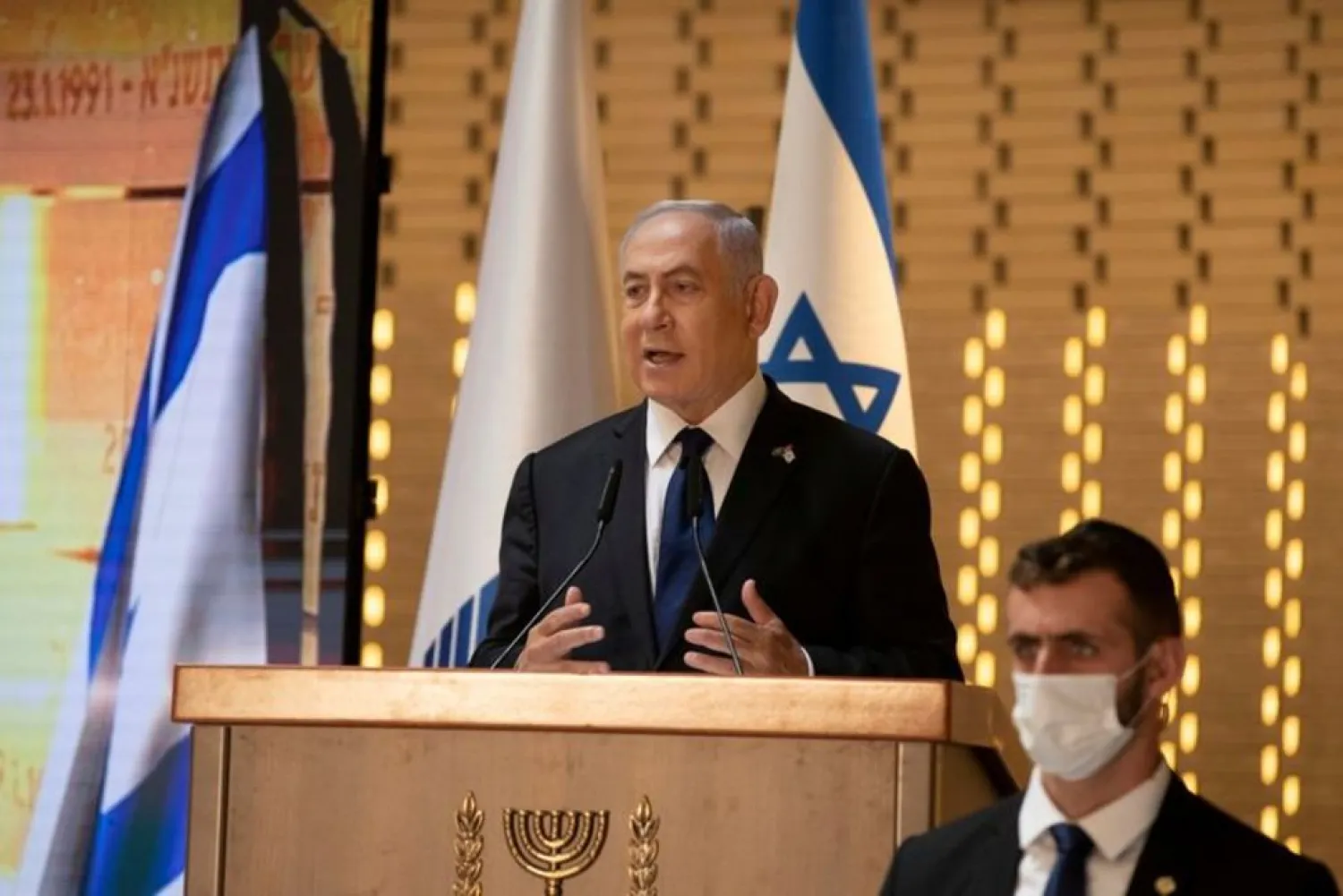

Netanyahu in Last-Minute Bid to Scupper Possible deal to Unseat Him

Israeli Prime Minister Benjamin Netanyahu. (Reuters)
TT

Netanyahu in Last-Minute Bid to Scupper Possible deal to Unseat Him

Israeli Prime Minister Benjamin Netanyahu. (Reuters)

Prime Minister Benjamin Netanyahu maneuvered on Sunday to try to dissuade opponents from forming a "government of change", with media reports saying a deal to unseat Israel's longest-serving leader could be imminent.

A mandate for opposition chief Yair Lapid to put together a coalition after four inconclusive elections in two years, expires on Wednesday. Israeli media said Lapid was closing in on an alliance of right-wing, centrist and leftist parties.

Lapid's chances of success rest largely with far-right politician Naftali Bennett, a kingmaker whose Yamina party has six key seats in parliament.

Bennett, 49, was widely expected to announce, possibly as early as Sunday, whether he would team up with Lapid, who heads the centrist Yesh Atid party. Israeli media reports largely predicted Bennett would agree to the partnership.

But first, Bennett would have to rally his own party's legislators behind joining what right-winger Netanyahu's opponents have described as a government of "change" comprising factions from the left, center and right.

Still short of a parliamentary majority after a March 23 election that ended in stalemate, such a diverse grouping could be fragile, and require outside backing by Arab members of parliament whose political views differ sharply from Yamina's.

Bennett has maintained public silence in recent days, but Israeli political commentators largely predicted he would opt for a partnership with Lapid. Faced with a possible deal, Netanyahu made a sudden counter-offer on Sunday that would entail a break in the prime minister's 12 consecutive years in office.

Triple rotation
In a proposal he signed along with leaders of parties in his current coalition, Netanyahu offered to go second in a "triple rotation" of the premiership of a right-wing government.

Under the blueprint, published by a Likud spokesman, Gideon Saar, head of the rightist New Horizon party, would become prime minister for 15 months, followed by Netanyahu for two years and then Bennett for an unspecified "remainder of its term".

Saar, a former Likud cabinet minister, swiftly rejected the offer, writing on Twitter: "Our position and commitment are unchanged - to end Netanyahu's rule."

There was no immediate comment from Bennett, a former defense minister, who has reversed course before over ousting Netanyahu, 71, a right-wing leader in power consecutively since 2009 and now on trial on corruption charges which he denies.

Yamina announced late on Saturday that Bennett would meet and update its legislators on Sunday, after reports he had agreed to a rotation deal with Lapid and would serve as prime minister first.

Netanyahu's rivals have cited his ongoing trial on corruption charges, which he denies, as a main reason why Israel needs a new leader.

Remaining in government, his critics say, could help Netanyahu in any bid to legislate immunity that could end the proceedings.

With a deal with Lapid widely reported to have been finalized just before fighting erupted on May 10 between Israel and Gaza militants, Bennett said during the hostilities he was abandoning efforts to form a coalition with the center and left.

But a ceasefire is holding, a recent wave of street violence in Israel between Arabs and Jews has ebbed, and a Lapid-Bennett partnership could be back on track.

If Lapid, 57, fails to announce a government by Wednesday, a fifth Israeli election since April 2019 - a prospect Bennett has said he wants to avoid - is likely.



Nigeria's President to Make a Sate Visit to the UK in March

Nigeria’s President Bola Tinubu gives a joint statement with Brazil’s President Luiz Inacio Lula da Silva, at the Planalto presidential palace, in Brasilia, Brazil, Aug. 25, 2025. (AP Photo/Eraldo Peres, File)
TT

Nigeria's President to Make a Sate Visit to the UK in March

Nigeria’s President Bola Tinubu gives a joint statement with Brazil’s President Luiz Inacio Lula da Silva, at the Planalto presidential palace, in Brasilia, Brazil, Aug. 25, 2025. (AP Photo/Eraldo Peres, File)

Nigeria’s president is set to make a state visit to the UK in March, the first such trip by a Nigerian leader in almost four decades, Britain’s Buckingham Palace said Sunday.

Officials said President Bola Tinubu and first lady Oluremi Tinubu will travel to the UK on March 18 and 19, The AP news reported.

King Charles III and Queen Camilla will host them at Windsor Castle. Full details of the visit are expected at a later date.

Charles visited Nigeria, a Commonwealth country, four times from 1990 to 2018 before he became king. He previously received Tinubu at Buckingham Palace in September 2024.m

Previous state visits by a Nigerian leader took place in 1973, 1981 and 1989.

A state visit usually starts with an official reception hosted by the king and includes a carriage procession and a state banquet.

Last year Charles hosted state visits for world leaders including US President Donald Trump, French President Emmanuel Macron and German President Frank-Walter Steinmeier.


Iran Strikes Hard Line on US Talks, Saying Tehran's Power Comes From Saying 'No'

Traffic moves through a street in Tehran on February 7, 2026. (Photo by ATTA KENARE / AFP)
TT

Iran Strikes Hard Line on US Talks, Saying Tehran's Power Comes From Saying 'No'

Traffic moves through a street in Tehran on February 7, 2026. (Photo by ATTA KENARE / AFP)

Iran's top diplomat insisted Sunday that Tehran's strength came from its ability to “say no to the great powers," striking a maximalist position just after negotiations with the United States over its nuclear program and in the wake of nationwide protests.

Foreign Minister Abbas Araghchi, speaking to diplomats at a summit in Tehran, signaled that Iran would stick to its position that it must be able to enrich uranium — a major point of contention with President Donald Trump, who bombed Iranian atomic sites in June during the 12-day Iran-Israel war.

Iran will never surrender the right to enrich uranium, even if war "is imposed on us,” he noted.

"Iran has paid a very heavy price for its peaceful nuclear program and for uranium enrichment." 

Israeli Prime Minister Benjamin Netanyahu is expected to travel to Washington this week, with Iran expected to be the major subject of discussion, his office said.

While Iranian President Masoud Pezeshkian praised the talks Friday in Oman with the Americans as “a step forward,” Araghchi's remarks show the challenge ahead. Already, the US moved the aircraft carrier USS Abraham Lincoln, ships and warplanes to the Middle East to pressure Iran into an agreement and have the firepower necessary to strike the Islamic Republic should Trump choose to do so, according to The AP news.

“I believe the secret of the Islamic Republic of Iran’s power lies in its ability to stand against bullying, domination and pressures from others," Araghchi said.

"They fear our atomic bomb, while we are not pursuing an atomic bomb. Our atomic bomb is the power to say no to the great powers. The secret of the Islamic Republic’s power is in the power to say no to the powers.”

‘Atomic bomb’ as rhetorical device Araghchi's choice to explicitly use an “atomic bomb” as a rhetorical device likely wasn't accidental. While Iran has long maintained its nuclear program is peaceful, the West and the International Atomic Energy Agency say Tehran had an organized military program to seek the bomb up until 2003.

Iran had been enriching uranium up to 60% purity, a short, technical step to weapons-grade levels of 90%, the only non-weapons state to do so. Iranian officials in recent years had also been increasingly threatening that Tehran could seek the bomb, even while its diplomats have pointed to Iranian Supreme Leader Ali Khamenei’s preachings as a binding fatwa, or religious edict, that Iran wouldn’t build one.

Pezeshkian, who ordered Araghchi to pursue talks with the Americans after likely getting Khamenei's blessing, also wrote on X on Sunday about the talks.

“The Iran-US talks, held through the follow-up efforts of friendly governments in the region, were a step forward,” the president wrote. “Dialogue has always been our strategy for peaceful resolution. ... The Iranian nation has always responded to respect with respect, but it does not tolerate the language of force.”

It remains unclear when and where, or if, there will be a second round of talks. Trump, after the talks Friday, offered few details but said: “Iran looks like they want to make a deal very badly — as they should.”

Aircraft carrier in the Arabian Sea During Friday's talks, US Navy Adm. Brad Cooper, the head of the American military's Central Command, was in Oman. Cooper's presence was apparently an intentional reminder to Iran about US military power in the region. Cooper later accompanied US special envoy Steve Witkoff and Jared Kushner, Trump's son-in-law, to the Lincoln out in the Arabian Sea after the indirect negotiations.

Araghchi appeared to be taking the threat of an American military strike seriously, as many worried Iranians have in recent weeks. He noted that after multiple rounds of talks last year, the US “attacked us in the midst of negotiations."

“If you take a step back (in negotiations), it is not clear up to where it will go,” Araghchi said.


Russia: Man Suspected of Shooting Top General Detained in Dubai

An investigator works outside a residential building where the assassination attempt on Russian Lieutenant General Vladimir Alexeyev took place in Moscow, Russia February 6, 2026. REUTERS/Anastasia Barashkova
TT

Russia: Man Suspected of Shooting Top General Detained in Dubai

An investigator works outside a residential building where the assassination attempt on Russian Lieutenant General Vladimir Alexeyev took place in Moscow, Russia February 6, 2026. REUTERS/Anastasia Barashkova

Russia's Federal Security Service (FSB) said on Sunday that the man suspected of shooting top Russian military intelligence officer Vladimir Alexeyev in Moscow has been detained in Dubai and handed over to Russia.

Lieutenant General Vladimir Alexeyev, deputy head of the GRU, ⁠Russia's military intelligence arm, was shot several times in an apartment block in Moscow on Friday, investigators said. He underwent surgery after the shooting, Russian media ⁠said.

The FSB said a Russian citizen named Lyubomir Korba was detained in Dubai on suspicion of carrying out the shooting.

Russian Foreign Minister Sergei Lavrov accused Ukraine of being behind the assassination attempt, which he said was designed to sabotage peace talks. ⁠Ukraine said it had nothing to do with the shooting.

Alexeyev's boss, Admiral Igor Kostyukov, the head of the GRU, has been leading Russia's delegation in negotiations with Ukraine in Abu Dhabi on security-related aspects of a potential peace deal.