


Egypt Bets on Ancient Finds to Pull Tourism out of Pandemic

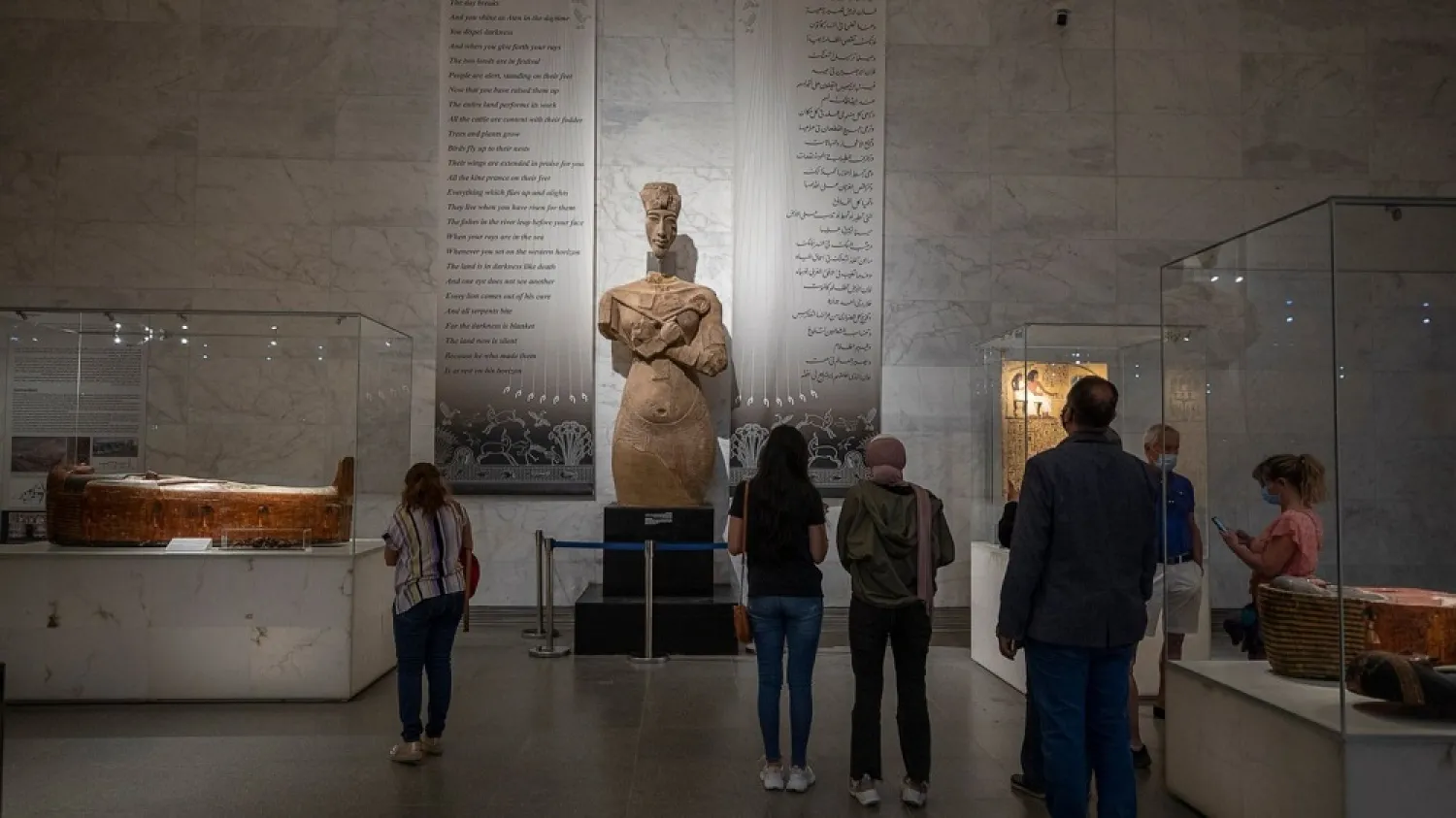
In this April 24, 2021 file photo, people visit the new National Museum of Egyptian Civilization in Old Cairo. (AP)
TT

Egypt Bets on Ancient Finds to Pull Tourism out of Pandemic

In this April 24, 2021 file photo, people visit the new National Museum of Egyptian Civilization in Old Cairo. (AP)

Workers dig and ferry wheelbarrows laden with sand to open a new shaft at a bustling archaeological site outside of Cairo, while a handful of Egyptian archaeologists supervise from garden chairs. The dig is at the foot of the Step Pyramid of Djoser, arguably the world’s oldest pyramid, and is one of many recent excavations that are yielding troves of ancient artifacts from the country’s largest archaeological site.

As some European countries re-open to international tourists, Egypt has already been trying for months to attract them to its archaeological sites and museums. Officials are betting that the new ancient discoveries will set it apart on the mid- and post-pandemic tourism market. They need visitors to come back in force to inject cash into the tourism industry, a pillar of the economy.

But like countries elsewhere, Egypt continues to battle the coronavirus. In early May, the government announced that 1 million people had been vaccinated, though that number is believed to be higher now.

In the meantime, authorities have kept the publicity machine running, focused on the new discoveries.

In November, archaeologists announced the discovery of at least 100 ancient coffins dating back to the Pharaonic Late Period and Greco-Ptolemaic era, along with 40 gilded statues found 2,500 years after they were first buried. That came a month after the discovery of 57 other coffins at the same site, the necropolis of Saqqara that includes the step pyramid.

“Saqqara is a treasure,” said Tourism and Antiquities Minister Khaled el-Anany while announcing the November discovery, estimating that only 1% of what the site contains has been unearthed so far.

“Our problem now is that we don’t know how we can possibly wow the world after this,” he said.

If they don’t, it certainly won’t be for lack of trying.

In April, Zahi Hawass, Egypt’s best-known archaeologist, announced the discovery of a 3,000-year-old lost city in southern Luxor, complete with mud brick houses, artifacts and tools from pharaonic times. It dates back to Amenhotep III of the 18th dynasty, whose reign (1390–1353 B.C.) is considered a golden era for ancient Egypt.

That discovery was followed by a made-for-TV parade celebrating the transport of 22 of the country’s prized royal mummies from central Cairo to their new resting place in a massive facility farther south in the capital, the National Museum of Egyptian Civilization.

The Red Sea resort of Sharm el-Sheikh is now home to an archaeological museum, as is Cairo’s International Airport, both opened in recent months. And officials have also said they still plan to open the massive new Grand Egyptian Museum next to the Giza Pyramids by January, after years of delays. Entrance fees for archeological sites have been lowered, as has the cost of tourist visas.

At the newly opened National Museum of Egyptian Civilization, Mahmoud el-Rays, a tour guide, was leading a small group of European tourists at the hall housing the royal mummies.

“2019 was a fantastic year,” he said. “But corona reversed everything. It is a massive blow.”

Tourism traffic strengthened in the first months of 2021, el-Anany, the minister, told The Associated Press in a recent interview, though he did not give specific figures. He was optimistic that more would continue to come year-round.

“Egypt is a perfect destination for post-COVID in that our tourism is really an open-air tourism,” he said.

It has recorded a total of 14,950 deaths from the virus and is still seeing more than a thousand new cases daily. Like other countries, the real numbers are believed to be much higher.

Egypt also had a trying experience early on in the pandemic, when it saw a coronavirus outbreak on one of its Nile River cruise boats. It first closed its borders completely until the summer of 2020, but later welcomed tourists back, first to Red-Sea resort towns and now to the heart of the country — Cairo and the Nile River Valley that hosts most of its famous archaeological sites. Visitors still require a negative COVID-19 test result to enter the country.

In a further cause for optimism, Russia said in April that it plans to resume direct flights to Egypt’s Red Sea resort towns. Moscow stopped the flights after a Russian airliner crashed over the Sinai Peninsula in October 2015, killing all on board.

Amanda, a 36-year-old engineer from Austria, returned to Egypt in May. It was her second visit in four years. She visited the Egyptian Museum, the National Museum of Egyptian Civilization and Islamic Cairo, in the capital’s historic center.

She had planned to come last year, but the pandemic interfered.

“Once they opened, I came,” she said. “It was my dream to see the Pyramids again.”

El-Rays, the tour guide, says that while he’s seeing tourists starting to come in larger numbers, he knows a full recovery will not happen overnight.

“It will take some time to return to before corona,” he said.


European Development Bank Unveils 5 Bn Euros for War-hit Economies

A Lebanese man walks past destruction at the site of an Israeli airstrike the day before that targeted a building in Beirut on April 9, 2026. (Photo by Ibrahim AMRO / AFP)
TT

European Development Bank Unveils 5 Bn Euros for War-hit Economies

A Lebanese man walks past destruction at the site of an Israeli airstrike the day before that targeted a building in Beirut on April 9, 2026. (Photo by Ibrahim AMRO / AFP)

The European development bank said Thursday it was unlocking five billion euros ($5.9 bn) to help shore up economies hit by the Middle East war.

The European Bank for Reconstruction and Development (EBRD) said it will "deploy EUR5 billion in 2026 in economies impacted by Middle East conflict".

The funds would be focused on Iraq, Jordan, Lebanon, the West Bank and Gaza "and affected neighboring economies" including Egypt, Türkiye, Armenia and Azerbaijan, the bank said in a statement.

"The economic and social impact of the conflict is already being felt across many of the bank's economies in the form of disrupted trade routes, energy and commodity shocks, weakened investor confidence and broader costs to the population," it added.

Established in 1991 to help former Soviet bloc nations embrace free-market economies, the bank later extended its reach to the Middle East and Africa.

"In a time of rising uncertainty, we are stepping up where others may pull back," said EBRD president Odile Renaud Basso.

"We are here to support economies, clients and people in our countries of operation in tough times," she added.

The bank said "the volume of conflict response investment will be demand driven due to the fast-changing nature of the situation".

The funds will provide immediate relief "by supporting economic activity" and "fostering financial sector stabilization".

EBRD will aim to strengthen energy security and aid state-owned enterprises to "ensure the uninterrupted provision of essential goods and services".

On Thursday it had approved "a project to support Lebanon's retail chain," it said, adding it also aimed to safeguard access to jobs, finance and essential services.

Since starting operations in the southern and eastern Mediterranean in 2012, the EBRD has invested more than EUR26.5 billion in 489 projects in the region.

In Türkiye alone, the lender has committed more than 23 billion euros since 2009.


Saudia to Partially Resume Flights To, From Dubai, Abu Dhabi, and Amman on Saturday

One of Saudia’s aircraft (company website)
TT

Saudia to Partially Resume Flights To, From Dubai, Abu Dhabi, and Amman on Saturday

One of Saudia’s aircraft (company website)

Saudia announced on Thursday the partial resumption of its operations to and from Dubai, Abu Dhabi, and Amman starting Saturday, April 11.

In a post on its official account on the social media platform X, the airline said the resumption will be carried out through the operation of exceptional daily flights to and from those destinations.

Saudia advised passengers to check the status of their flights before heading to the airport, noting that further updates will be published through its official channels.


IMF Expects to Provide Vulnerable Economies Hit by Iran War Up to $50 bn

FILED - 24 October 2024, US, Washington: The logo of the International Monetary Fund (IMF) is pictured on the facade of the conference building on Pennsylvania Street. Photo: Soeren Stache/dpa
TT

IMF Expects to Provide Vulnerable Economies Hit by Iran War Up to $50 bn

FILED - 24 October 2024, US, Washington: The logo of the International Monetary Fund (IMF) is pictured on the facade of the conference building on Pennsylvania Street. Photo: Soeren Stache/dpa

The International Monetary Fund expects to have to provide up to $50 billion in immediate financial assistance to countries affected by the Middle East war, its managing director said on Thursday, with the crisis likely to have lasting economic effects.

"Given the spillovers of the Middle East war, we expect near-term demand for IMF balance-of-payments support to rise to somewhere between $20 billion and $50 billion, with the lower bound prevailing if the ceasefire holds," Kristalina Georgieva said, according to prepared remarks shared with AFP.

She added that food insecurity due to transport and supply chain disruptions caused by the war was expected to affect at least 45 million people.

"Even in a best case, there will be no neat and clean return to the status quo ante," she said, as a fragile ceasefire appeared to hold on Thursday.

The IMF will pare its global growth forecast for 2026 based on the impact of the crisis, with spiraling energy costs hitting some vulnerable economies harder than others.

Georgieva said that even in the Fund's "most hopeful scenario," infrastructure damage, supply disruptions and a loss of market confidence among other "scarring effects" meant growth would be less than expected.

She highlighted the "asymmetric" effects of the crisis, hitting low-income energy importers with limited fiscal space much harder than others.

"Spare a thought for the Pacific Island nations at the end of a long supply chain, wondering if fuel will still reach them in the wake of such a severe disruption," she said.
