

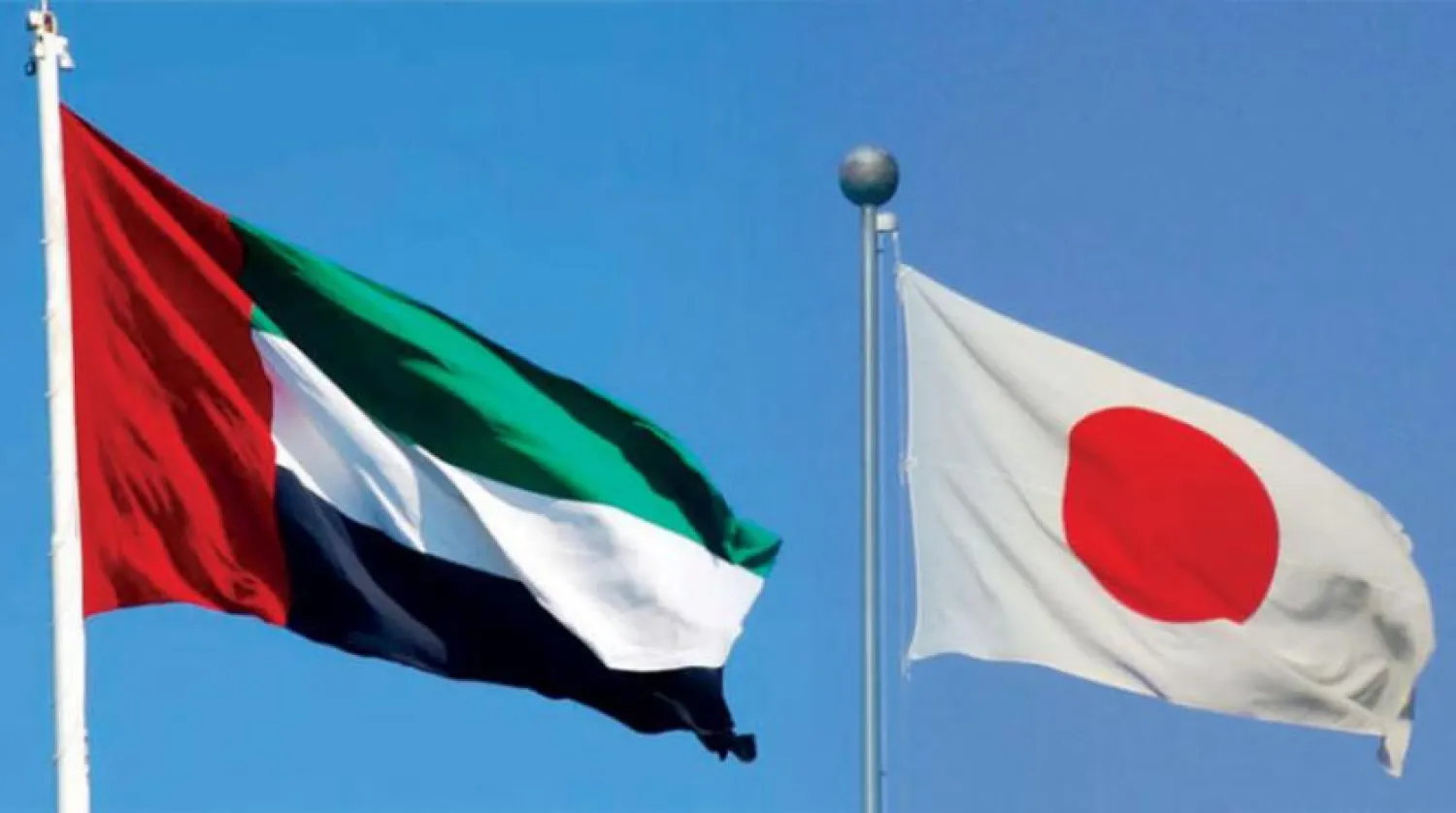

UAE, Japan Plan on Launching Business Council

The two countries are boosting cooperation in technology, electronics, advanced industries, medical research, space science, automation solutions, artificial intelligence, and entrepreneurship (WAM).
TT

UAE, Japan Plan on Launching Business Council

The two countries are boosting cooperation in technology, electronics, advanced industries, medical research, space science, automation solutions, artificial intelligence, and entrepreneurship (WAM).

The UAE and Japan are looking to put together a business council to improve the partnership between the Emirati and Japanese business communities towards creating opportunities for companies in both countries.

The council would generate added value from joint investments, provide information and services for investors, and encourage communication between relevant government authorities.

The ultimate goal is to boost mutual trade and investments and to facilitate the movement of imports and exports between the countries.

This decision was made during the virtual meeting between UAE Minister of State for Foreign Trade Dr. Thani bin Ahmed Al Zeyoudi and Japan’s Minister of Economy, Trade, and Industry Hiroshi Kajiyama.

Zeyoudi stated that the development of foreign trade vision focuses on increasing the competitiveness of the Emirati product and reinforcing its presence in big markets.

He further described Japan as a strategic partner to the UAE, noting that bilateral ties have seen a remarkable progress.

Zeyoudi said that the partnership between the UAE and Japan is reflected by positive economic indexes, with the value of Japanese direct investments in the UAE since the start of 2020 totaling $4.01 billion, a growth of 22.6 percent from 2015 until 2020.

Japan is ranked tenth globally among the list of countries investing in the UAE, and eighth globally in terms of non-oil trade, which reached $8.95 billion in the first ten months of 2020, he added.

“We will continue advancing our bilateral cooperation in target areas and sectors that support the economy of the future, especially technology, electronics, advanced industries, medical research, space sciences, automation, artificial intelligence, and entrepreneurship. The UAE-Japanese business council will play a key role in this regard,” he added.

For his part, Kajiyama highlighted his country’s desire to reinforce its relations with the UAE, most notably in the energy sector.



India Eyes Oil Exploration Expansion After Middle East War Shortages

Minister of Petroleum and Natural Gas Hardeep Singh Puri (C) gestures during his visit at the Golden temple in Amritsar on May 15, 2023. (AFP)
TT

India Eyes Oil Exploration Expansion After Middle East War Shortages

Minister of Petroleum and Natural Gas Hardeep Singh Puri (C) gestures during his visit at the Golden temple in Amritsar on May 15, 2023. (AFP)

Hit by the biggest energy supply shock in decades during the Middle East war, import-dependent India is expanding domestic crude exploration, its oil minister says.

India, the world's third-largest importer of oil and the second-largest buyer of liquefied petroleum gas, faced major disruptions due to restrictions on the Strait of Hormuz during the conflict between the United States and Iran.

With a temporary US-Iran deal in place to pause hostilities, oil and gas shipments are flowing through the Gulf waterway again, and restrictions and price hikes in India are being rolled back.

But Minister of Petroleum and Natural Gas Hardeep Singh Puri said the energy crunch provided fresh impetus for India's expansion of domestic supplies.

"We are currently in the process... to bid out about 250,000 square kilometers (96,500 square miles) of unexplored area," Puri told AFP.

India is a modest producer in global terms.

Domestic crude production in 2025-2026 was 25.98 million metric tons, according to the oil ministry.

That meets just 10 percent of India's crude needs, equivalent to roughly 522,000 barrels per day (bpd) -- a figure well below its production peak of just more than 900,000 bpd in 2011.

India survived the energy crunch by expanding its crude suppliers from 27 to 41 countries, including Iran, Venezuela, greater purchases from Russia and several African nations.

New Delhi has previously been criticized by both the United States and Europe for its purchase of Russian oil, with critics arguing that it bankrolled Moscow's war against Kyiv.

But Puri said India had a "pragmatic approach" that put its energy needs above "ideological considerations".

- 'Ocean of energy opportunities' -

The country's domestic crude production is concentrated in the west -- in its Mumbai offshore fields, Rajasthan and Gujarat -- as well as the northeastern state of Assam.

But Puri has hailed what he calls an "ocean of energy opportunities" off India's Andaman and Nicobar archipelago, an 800-kilometer-long (500-mile) chain of environmentally sensitive islands in the seas bordering Thailand and Indonesia.

The vast Andaman Basin is geologically similar to hydrocarbon-bearing basins in Southeast Asia.

Puri posted a video on social media in June of a gas flare at an exploratory well drilled in the Andaman Sea by state-owned Oil India.

"Large number of deepwater and ultra-deepwater exploration wells are planned in our offshore basins to fully exploit our hydrocarbon reserves," Puri said when he released the video.

New Delhi is working with "deepwater exploration experts" including Petrobras, TotalEnergies, BP, Shell and ExxonMobil, he said.

In the same Andaman Sea, India is readying a $9 billion Great Nicobar Island Project to build a megaport, airport and city, creating a strategic base on what is, for now, a far-flung island covered in pristine forests and home to one of Earth's most isolated peoples.

- 'Exceptionally bullish' -

The push pre-dates the Middle East war.

Hindu-nationalist Prime Minister Narendra Modi launched the "Samudra Manthan" mission during a speech marking Independence Day in August 2025.

The name refers to a central event in Hindu mythology meaning the "churning of the ocean".

"We want to work in a mission mode towards finding oil reserves, gas reserves under the sea and hence India is going to start the National Deep Water Exploration Mission," Modi said at the time.

But India's bid to reduce dependence faces challenges.

Domestic demand in the world's most populous nation of 1.4 billion people is growing rapidly -- even as the government vows to achieve carbon neutrality by 2070.

India is also ramping up investments in renewables, nuclear energy and blending petrol with ethanol.

"India's energy consumption today is growing at three times the pace compared to rest of the world," Puri said.

"It has jumped from five million barrels per day in 2021 to about 5.6 million barrels today, and would soon touch six million barrels per day, on the back of the robust economic and per capita income growth."

Puri said he was "exceptionally bullish" for the future.

"I am happy with the knowledge that our E+P (exploration & production) is going up and, believe me, it's going to rise very fast," Puri said.

He noted it was "a very capital intensive and time-consuming" process, but said he had high hopes.

"We are putting fiscal resources into oil and gas exploration in a very big way -- with a $10 billion program," he added.

"With it, we are going into one million kilometers of unexplored area."


India Says Will Keep Expanding Oil Refining Capacity

File photo: Storage tanks of an oil refinery of Essar Oil, which runs India's second biggest private sector refinery, are pictured in Vadinar in the western state of Gujarat, India, October 4, 2016. REUTERS/Amit Dave/File photo
TT

India Says Will Keep Expanding Oil Refining Capacity

File photo: Storage tanks of an oil refinery of Essar Oil, which runs India's second biggest private sector refinery, are pictured in Vadinar in the western state of Gujarat, India, October 4, 2016. REUTERS/Amit Dave/File photo

India will continue to build new crude oil refineries in order to ensure supply chain security even as Western nations shut processing units, Prime Minister Narendra Modi said.

“No new refinery has come up in the US in the last five decades and capacity in Europe has also been constantly declining,” Bloomberg quoted Modi as saying on Saturday, as he inaugurated the country’s first new refinery in a decade. He said India will continue to expand capacity.

The 180,000-barrels-a-day greenfield refinery in the heart of Rajasthan’s Thar desert, which has 2.4 million tons a year of petrochemical capacity and was built at a cost of $8.3 billion, is likely to be the only new refinery commissioned globally this year, according to BloombergNEF analysts.

The facility expands India’s refining capacity at a time when much of the West is shutting plants and investment elsewhere has slowed, highlighting New Delhi’s strategy of betting that robust domestic fuel demand, slower-than-expected electric-vehicle adoption and exports of refined products will continue to justify billions of dollars in new oil-processing infrastructure.

Meanwhile, traders have sold gasoline produced by Indian refiner Nayara Energy to Russia, which is grappling with fuel shortages triggered by Ukrainian attacks on its energy infrastructure, two sources with direct knowledge of the matter said on Thursday.

Reuters reported on Wednesday that Russia had begun seaborne imports of gasoline from India, without naming the supplier.

Reuters said that at least ⁠60,000 ⁠metric tons of gasoline had been dispatched from India to Russia, citing an industry source, with another source saying that two tankers, carrying 30,000 to 40,000 tons each, had been sent.


Egypt Expects €1.5 billion from EU Assistance Package in Coming Days

The Central Bank of Egypt in downtown Cairo (Asharq Al-Awsat)
TT

Egypt Expects €1.5 billion from EU Assistance Package in Coming Days

The Central Bank of Egypt in downtown Cairo (Asharq Al-Awsat)

Egypt expects to receive €1.5 billion ($1.72 billion) from the European Union in the coming days, the first of two remaining tranches of a €5 billion macro-financial assistance package, Foreign Minister Badr Abdelatty said on Saturday.

Speaking at a press conference in Egypt's new administrative capital alongside European Commissioner for the Mediterranean Dubravka Suica, Abdelatty said the outstanding €3 billion would be disbursed in two equal tranches of €1.5 billion each, Reuters reported.

He said Cairo hoped the last payment would be transferred by the start of the autumn.

The EU has so far disbursed €2 billion of the package, having transferred an initial €1 billion tranche in January 2025 and a second €1 billion earlier this year.

The macro-financial assistance forms part of a broader €7.4 billion funding deal the EU announced in 2024, which also includes €5 billion in concessional loans.