

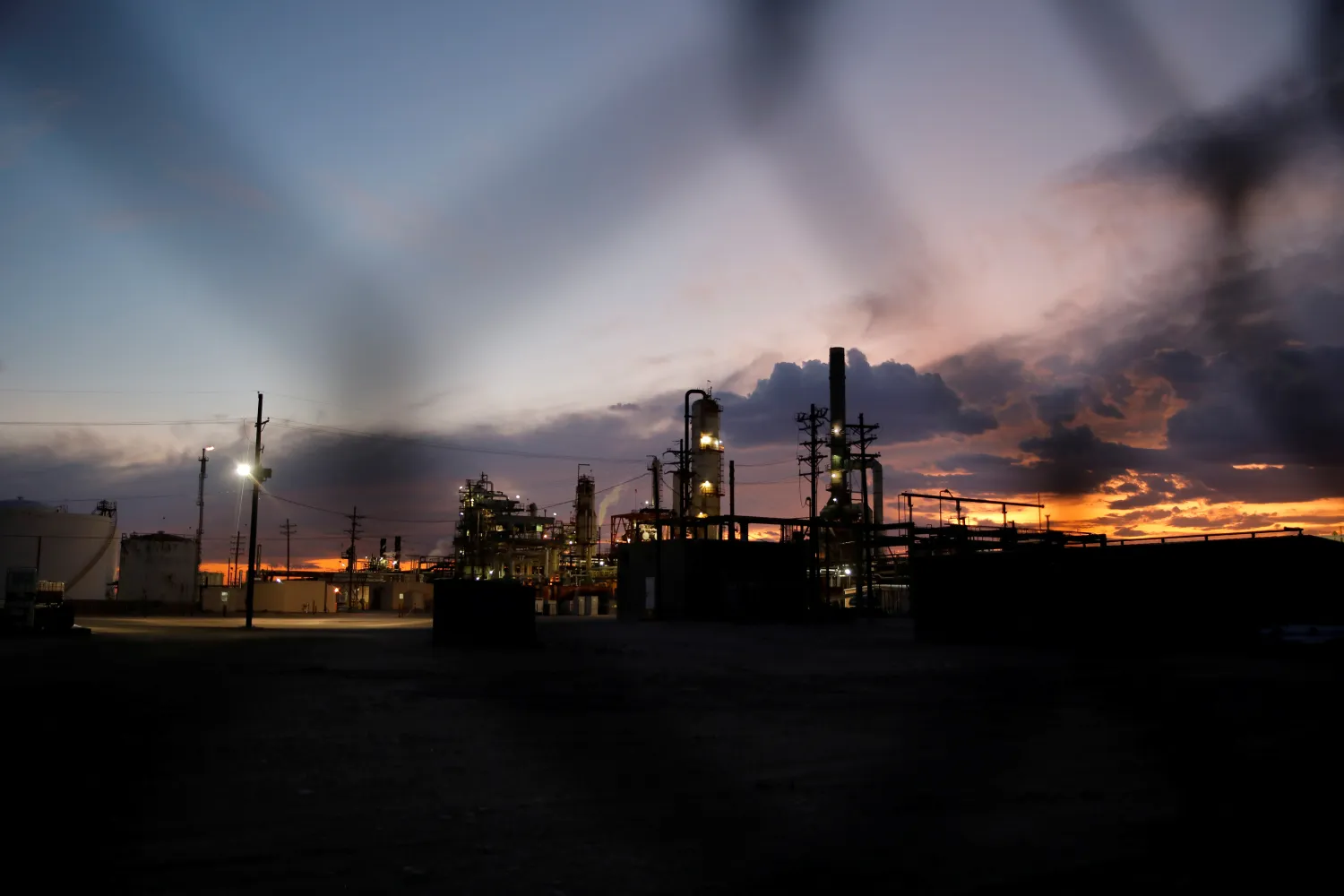

IEA: Oil Demand Set to Exceed Pre-pandemic Levels in 2022

File photo: A general view of a refinery in Hobbs, New Mexico, US September 18, 2019. REUTERS/Adria Malcolm
TT

IEA: Oil Demand Set to Exceed Pre-pandemic Levels in 2022

File photo: A general view of a refinery in Hobbs, New Mexico, US September 18, 2019. REUTERS/Adria Malcolm

Oil demand is set to rise above pre-pandemic levels by the end of next year, the IEA said Friday, but producers have sufficient capacity rise to the challenge.

In its first detailed look at next year in its regular monthly review of the oil market, the International Energy Agency sees a gradual return of demand as vaccine distribution widens and economic activity returns to normal in many countries and sectors.

"By end-2022, demand should surpass pre-Covid levels," AFP quoted it as saying.

Oil demand tanked by a record 8.6 million barrels per day (mbd) last year as countries shut down swathes of their economies as the coronavirus spread around the world.

The IEA expects it to rebound by 5.4 mbd this year and a further 3.1 mbd next year.

However, the Paris-based agency that advises oil-consuming nations warned that "the recovery will be uneven not only amongst regions but across sectors and products."

Demand is expected to recover faster in wealthy nations with earlier access to vaccines, while some sectors like aviation lag as some travel restrictions remain in place and more people work from home than before.

"A widespread return of the global aviation industry to normal capacity appears off the cards until most countries have reached herd immunity, which may not happen until late 2022," said the IEA.

It said the recent surge in cases in many developing nations should serve as a reminder that the pandemic is not over, and noted that global oil demand dipped in May due to the outbreaks.

Moreover, it doesn't exclude new outbreaks from occurring as nations such as India aren't expected to vaccinate a sufficient number of people until late next year while many African countries have yet to order enough doses.

Oil demand is expected to climb in the coming months and "meeting the expected demand growth is unlikely to be a problem," said the IEA.

It expects countries outside the OPEC+ group to boost output by 1.6 mbd next year, to exceed 2019 levels.

Meanwhile, OPEC+ nations have 6.9 mbd of spare capacity even after lifting production by 2 mbd over the May-July period.

"Even if OPEC+ producers were to fill the gap created by demand growth, the bloc's output would still be more than 2 mbd below the 2019 average," it noted.

Members of the OPEC cartel and allies like Russia slashed production last year to boost and stabilize oil prices which briefly dropped into negative territory.

OPEC+ is slowly increasing output as the global economy recovers, but at a rate where oil stocks are being slowly reduced.

The IEA noted that oil industry stocks in the OECD advanced nations fell below their pre-Covid 2015-19 average for the first time in more than a year.

Lower stocks will give OPEC+ nations greater leverage over crude prices, with the top two oil contracts recently surpassing $70.00 a barrel.

The IEA also highlighted that the expected rebound in oil demand comes as most nations have yet to adopt near-term policies to meet their pledges to become carbon neutral by mid-century, as it detailed in separate report recently.

"In the meantime, oil demand looks set to continue to rise, underlining the enormous effort required to get on track to reach stated ambitions," it said.




Gold Bounces Back on Softer Dollar, US-Iran Concerns; Silver Rebounds

Gold and silver bars are stacked in the safe deposit boxes room of the Pro Aurum gold house in Munich, Germany, January 10, 2025. REUTERS/Angelika Warmuth
TT

Gold Bounces Back on Softer Dollar, US-Iran Concerns; Silver Rebounds

Gold and silver bars are stacked in the safe deposit boxes room of the Pro Aurum gold house in Munich, Germany, January 10, 2025. REUTERS/Angelika Warmuth

Gold rebounded on Friday and was set for a weekly gain, helped by bargain hunting, a slightly weaker dollar and lingering concerns over US-Iran talks in Oman, while silver recovered from a 1-1/2-month low.

Spot gold rose 3.1% to $4,916.98 per ounce by 09:31 a.m. ET (1431 GMT), recouping losses posted during a volatile Asia session that followed a fall of 3.9% on Thursday. Bullion was headed for a weekly gain of about 1.3%.

US gold futures for April delivery gained 1% to $4,939.70 per ounce.

The US dollar index fell 0.3%, making greenback-priced bullion cheaper for the overseas buyers.

"The gold market is seeing perceived bargain hunting from bullish traders," said Jim Wyckoff, senior analyst at Kitco Metals.

Iran and the US started high-stakes negotiations via Omani mediation on Friday to try to overcome sharp differences over Tehran's nuclear program.

Wyckoff said gold's rebound lacks momentum and the metal is unlikely to break records without a major geopolitical trigger.

Gold, a traditional safe haven, does well in times of geopolitical and economic uncertainty.

Spot silver rose 5.3% to $74.98 an ounce after dipping below $65 earlier, but was still headed for its biggest weekly drop since 2011, down over 10.6%, following steep losses last week as well.

"What we're seeing in silver is huge speculation on the long side," said Wyckoff, adding that after years in a boom cycle, gold and silver now appear to be entering a typical commodity bust phase.

CME Group raised margin requirements for gold and silver futures for a third time in two weeks on Thursday to curb risks from heightened market volatility.

Spot platinum added 3.2% to $2,052 per ounce, while palladium gained 4.9% to $1,695.18. Both were down for the week.


Europe, Türkiye Agree to Work Toward Updating Customs Union

European Union (R) and Turkish flags fly at the business and financial district of Levent in Istanbul, Türkiye September 4, 2017. REUTERS/Osman Orsal
TT

Europe, Türkiye Agree to Work Toward Updating Customs Union

European Union (R) and Turkish flags fly at the business and financial district of Levent in Istanbul, Türkiye September 4, 2017. REUTERS/Osman Orsal

The European enlargement chief and the Turkish foreign minister said on Friday they had agreed to continue work toward modernizing the EU-Türkiye customs union and to improve its implementation, Reuters reported.

European Commissioner for Enlargement Marta Kos met Turkish Foreign Minister Hakan Fidan in the capital Ankara on Friday.

"They shared a willingness to work for paving the way for the modernization of the Customs Union and to achieve its full potential in order to support competitiveness, and economic security and resilience for both sides," they said in a joint statement afterward.

The sides also welcomed the gradual resumption of European Investment Bank (EIB) operations in Türkiye and said they intended to support projects across the country and neighbouring regions in cooperation with the bank.


Bitcoin Falls 8% and Asian Shares Mostly Slip after Wall Street is Hit by Tech Stock Losses

FILE PHOTO: Representation of Bitcoin cryptocurrency in this illustration taken September 10, 2025. REUTERS/Dado Ruvic/Illustration/File Photo
TT

Bitcoin Falls 8% and Asian Shares Mostly Slip after Wall Street is Hit by Tech Stock Losses

FILE PHOTO: Representation of Bitcoin cryptocurrency in this illustration taken September 10, 2025. REUTERS/Dado Ruvic/Illustration/File Photo

US futures and Asian shares traded mostly lower on Friday, tracking Wall Street’s losses as technology stocks again dragged on markets.

Bitcoin sank to roughly half its record price, giving back all it gained since US President Donald Trump won the White House for his second term.

Tokyo’s Nikkei 225 was up 0.8% to 54,253.68, recovering from losses earlier this week, with technology-related stocks leading gains. SoftBank Group rose 2.2% and chipmaker Tokyo Electron rose 2.6%. Japan will also be holding its general election on Sunday, in which Prime Minister Sanae Takaichi expects to win a stronger public mandate for her policies.

Shares of Toyota Motor were up 2%. The carmaker said Friday its CEO Koji Sato will be stepping down in April, and is to be replaced by Chief Financial Officer Kenta Kon, The Associated Press said.

South Korea’s Kospi lost 1.4% to 5,089.14, weighed down by tech shares. Samsung Electronics, the country’s biggest listed company, fell 0.4%. Chipmaker SK Hynix was also down 0.4%.

Hong Kong’s Hang Seng fell 1.4% to 26,519.60. The Shanghai Composite index was down 0.3% to 4,065.58.

In Australia, the S&P/ASX 200 shed 2% to 8,708.80.

Taiwan’s Taiex was mostly flat. India's Sensex traded 0.1% lower.

Against the backdrop of the technology sell-off this week, bitcoin, the world’s largest cryptocurrency, saw dimming enthusiasm and was trading about 8% lower at just under $65,000 early Friday, after it briefly sank over 12% to below $64,000 on Thursday. That’s down from a record of above $124,000 in October.

The future for the S&P 500 was 0.2% lower, while that for the Dow Jones Industrial Average fell 0.1%.

On Thursday, the S&P 500 fell 1.2% to 6,798.40, its sixth loss in the seven days. The Dow Jones Industrial Average fell 1.2% to 48,908.72. The Nasdaq composite dropped 1.6% to 22,540.59.

Technology stocks were among the worst hit as concerns persist over whether massive AI investments by many of the Big Tech firms will pay off.

Chipmaker Qualcomm sank 8.5% despite better-than-expected quarterly revenues. Alphabet lost 0.5% as investors were focused on its huge spendings on AI.

Amazon fell 11% in after hours trading Thursday after it announced plans to boost capital spending by more than 50% to $200 billion in AI and other areas.

American artificial intelligence startup Anthropic ’s new AI tools also fueled the sell-off of software stocks on Wall Street this week, as its sophistication means many traditional software development services and products could be disrupted or replaced.

Gold and silver prices have been volatile this week following a monthslong rally as investors moved into safe haven assets prompted by factors including elevated geopolitical tensions. Gold prices fell 0.6% on Friday to $4,858.60 per ounce, after nearing $5,600 last week.

Silver prices dropped 5.5% to $72.52 per ounce after rising earlier this week. It lost more than 31% last Friday.

In other dealings early Friday, US benchmark crude oil gained 35 cents to $63.64 a barrel. Brent crude, the international standard, rose 36 cents to $67.91 a barrel.

The US dollar fell to 156.74 Japanese yen from 157.03 yen. The euro was trading at $1.1789, up from $1.1777.