


Yemeni Govt Says Houthis Refuse to Open Sanaa Airport Despite Guarantees

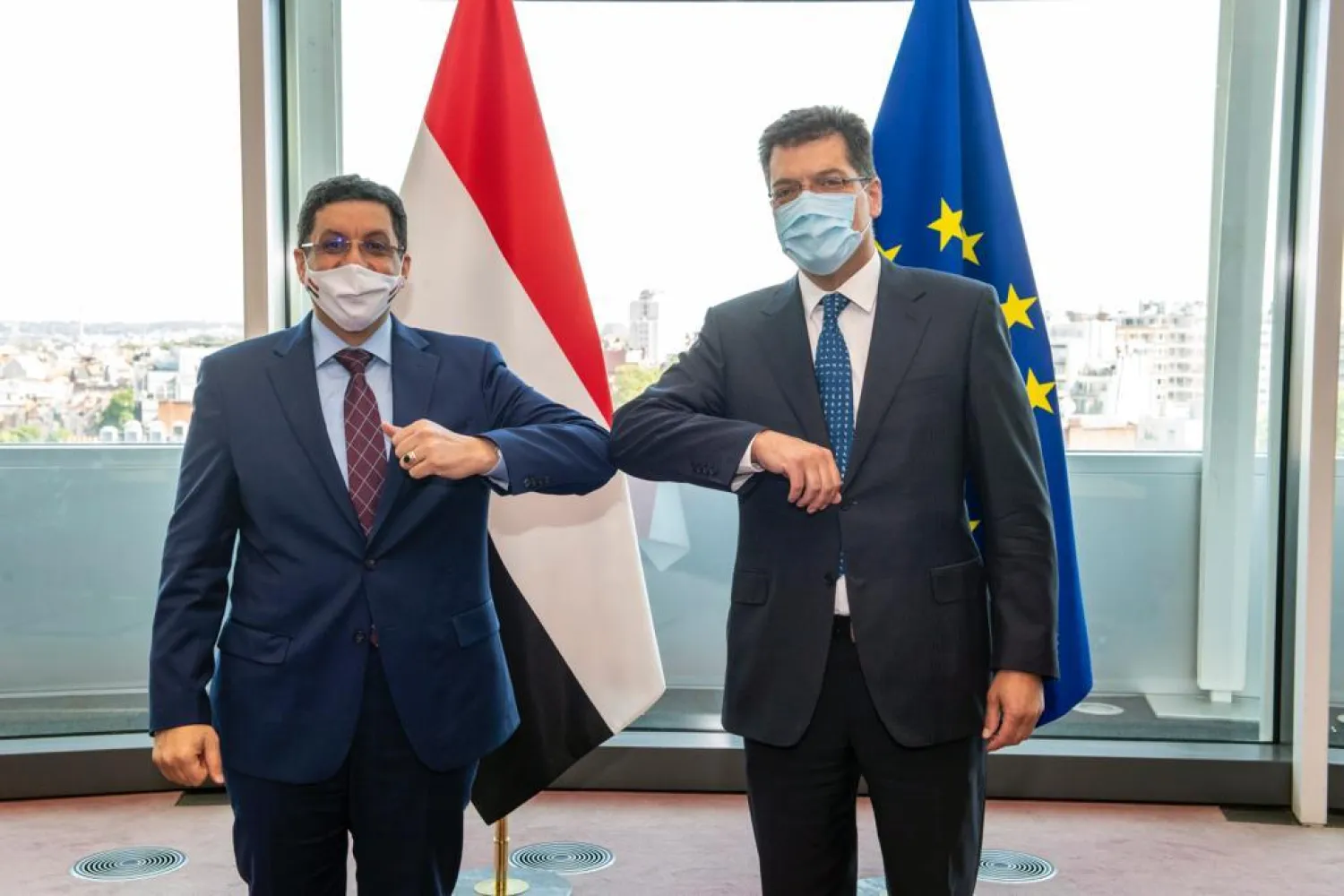
Yemeni Foreign Minister Ahmed Awad bin Mubarak with the Commissioner for Civil Protection and Humanitarian Aids in the European Commission Janiz Lenarcic (Saba News)
TT

Yemeni Govt Says Houthis Refuse to Open Sanaa Airport Despite Guarantees

Yemeni Foreign Minister Ahmed Awad bin Mubarak with the Commissioner for Civil Protection and Humanitarian Aids in the European Commission Janiz Lenarcic (Saba News)

The Yemeni government affirmed its commitment to the Saudi initiative for a comprehensive ceasefire under UN supervision, hinting that the Omani efforts aimed at persuading the Houthi militias with this initiative are failing.

Recent news reported that Houthis are intransigent towards the Omani mediation, a week after the delegation arrived in Sanaa.

The group aims to achieve political, economic, and military gains through humanitarian issues, without agreeing to the nationwide ceasefire.

The Yemeni government considered the militias’ ongoing targeting of civilians in Marib with ballistic missiles and booby-trapped drones, “a great disregard for the efforts to stop the war and bring peace to Yemen."

The government reiterated its support for opening the airport to serve the citizens while asserting that it should not be used as a military platform to kill Yemeni people.

The statement noted that the government did not close Hodeidah port, but rather suspended the mechanism after the Houthis looted all revenues, calling at the same time for securing these revenues and ensuring they reach civil servants.

The government lauded the Omani efforts as well as that of the UN and US envoys, affirming its commitment to the Saudi initiative.

It demanded an immediate cessation of missile and drone attacks against civilians, noting that "respecting the right to life for all is the basis and essence of humanitarian work."

The statement, carried by official outlets, added that opening roads, ensuring freedom of movement for citizens, and lifting the siege on cities, especially Taiz, is “at the heart of humanitarian issues, and one of the basics that the government puts at the top of its priorities.”

Over the past few weeks, a number of international efforts tried to resolve the Yemeni crisis.

An Omani delegation arrived in Sanaa to convince Houthi leader Abdul-Malik al-Houthi of the UN plan, and later UN Envoy Martin Griffiths visited Tehran for the same purpose.

Meanwhile, Yemeni Foreign Minister Ahmed Awad bin Mubarak discussed with the Commissioner for Civil Protection and Humanitarian Aids in the European Commission Janiz Lenarcic, the grave violations committed by the Houthi militias.

Bin Awad stressed the government's keenness to alleviate the suffering and end the humanitarian crisis.

The foreign minister denied Houthis’ allegations of a blockade, noting that the agreement concluded by the government under UN auspices stipulates customs revenues for fuel shipments should be allocated for the salaries of public sector employees.

“Houthi militias are trying to mislead the international community by creating a crisis of oil derivatives in the areas under their control and claiming that there is a blockade on the entry of fuel and oil derivatives,” bin Mubarak was quoted by Saba News.

He asserted that these allegations were refuted by several international reports, which confirm that fuel distribution in areas under militias’ control never stopped and that they cover civilian needs.

The real humanitarian crisis results from Houthis’ continuous aggression against Marib, which includes nearly four million Yemenis, half of whom are displaced fleeing the tyranny of these militias, according to the minister.

On Thursday, US Secretary of State Antony Blinken said the government was hoping to exert pressure on the Houthi rebels to end their offensive launched in February to seize Marib.

"It is time for the Houthis to accept a ceasefire and for all parties to resume political talks," Blinken said in a statement, adding that Washington “will continue to apply pressure to the Houthis, including through targeted sanctions, to advance those goals.”

Yemeni observers estimate that forcing the Houthis to accept any peace plan must come from Tehran, while they believe that the Omani role will not have an impact on the success of the UN plan unless the group obtains political gains.



Rescue Teams Search for Survivors in Building Collapse that Killed at Least 2 in Northern Lebanon

A Lebanese flag is pictured, in the aftermath of a massive explosion, in Beirut's damaged port area, Lebanon August 17, 2020. REUTERS/Hannah McKay
TT

Rescue Teams Search for Survivors in Building Collapse that Killed at Least 2 in Northern Lebanon

A Lebanese flag is pictured, in the aftermath of a massive explosion, in Beirut's damaged port area, Lebanon August 17, 2020. REUTERS/Hannah McKay

At least two people were killed and four rescued from the rubble of a multistory apartment building that collapsed Sunday in the city of Tripoli in northern Lebanon, state media reported.

Rescue teams were continuing to dig through the rubble. It was not immediately clear how many people were in the building when it fell.

The bodies pulled out were of a child and a woman, the state-run National News Agency reported.

Dozens of people crowded around the site of the crater left by the collapsed building, with some shooting in the air.

The building was in the neighborhood of Bab Tabbaneh, one of the poorest areas in Lebanon’s second largest city, where residents have long complained of government neglect and shoddy infrastructure. Building collapses are not uncommon in Tripoli due to poor building standards, according to The AP news.

Lebanon’s Health Ministry announced that those injured in the collapse would receive treatment at the state’s expense.

The national syndicate for property owners in a statement called the collapse the result of “blatant negligence and shortcomings of the Lebanese state toward the safety of citizens and their housing security,” and said it is “not an isolated incident.”

The syndicate called for the government to launch a comprehensive national survey of buildings at risk of collapse.


Israel to Take More West Bank Powers and Relax Settler Land Buys

A view of Israeli settlement of Maale Adumim, in the West Bank, Sunday, June 18, 2023. (AP)
TT

Israel to Take More West Bank Powers and Relax Settler Land Buys

A view of Israeli settlement of Maale Adumim, in the West Bank, Sunday, June 18, 2023. (AP)

Israel's security cabinet approved a series of steps on Sunday that would make it easier for settlers in the occupied West Bank to buy land while granting Israeli authorities more enforcement powers over Palestinians, Israeli media reported.

The West Bank is among the territories that the Palestinians seek for a future independent state. Much of it is under Israeli military control, with limited Palestinian self-rule in some areas run by the Western-backed Palestinian Authority (PA).

Citing statements by Finance Minister Bezalel Smotrich and Defense Minister Israel Katz, Israeli news sites Ynet and Haaretz said the measures included scrapping decades-old regulations that prevent Jewish private citizens buying land in the West Bank, The AP news reported.

They were also reported to include allowing Israeli authorities to administer some religious sites, and expand supervision and enforcement in areas under PA administration in matters of environmental hazards, water offences and damage to archaeological sites.

Palestinian President Mahmoud Abbas said the new measures were dangerous, illegal and tantamount to de-facto annexation.

The Israeli ministers did not immediately respond to requests for comment.

The new measures come three days before Prime Minister Benjamin Netanyahu is scheduled to meet in Washington with US President Donald Trump.

Trump has ruled out Israeli annexation of the West Bank but his administration has not sought to curb Israel's accelerated settlement building, which the Palestinians say denies them a potential state by eating away at its territory.

Netanyahu, who is facing an election later this year, deems the establishment of any Palestinian state a security threat.

His ruling coalition includes many pro-settler members who want Israel to annex the West Bank, land captured in the 1967 Middle East war to which Israel cites biblical and historical ties.

The United Nations' highest court said in a non-binding advisory opinion in 2024 that Israel's occupation of Palestinian territories and settlements there is illegal and should be ended as soon as possible. Israel disputes this view.


Arab League Condemns Attack on Aid Convoys in Sudan

A general view shows the opening session of the meeting of Arab foreign ministers at the Arab League Headquarters (Reuters)
TT

Arab League Condemns Attack on Aid Convoys in Sudan

A general view shows the opening session of the meeting of Arab foreign ministers at the Arab League Headquarters (Reuters)

Arab League Secretary-General Ahmed Aboul Gheit strongly condemned the attack by the Rapid Support Forces on humanitarian aid convoys and relief workers in North Kordofan State, Sudan.

In a statement reported by SPA, secretary-general's spokesperson Jamal Rushdi quoted Aboul Gheit as saying the attack constitutes a war crime under international humanitarian law, which prohibits the deliberate targeting of civilians and depriving them of their means of survival.

Aboul Gheit stressed the need to hold those responsible accountable, end impunity, and ensure the full protection of civilians, humanitarian workers, and relief facilities in Sudan.