


US Lifts Some Sanctions Targeting Iran’s Energy Sector

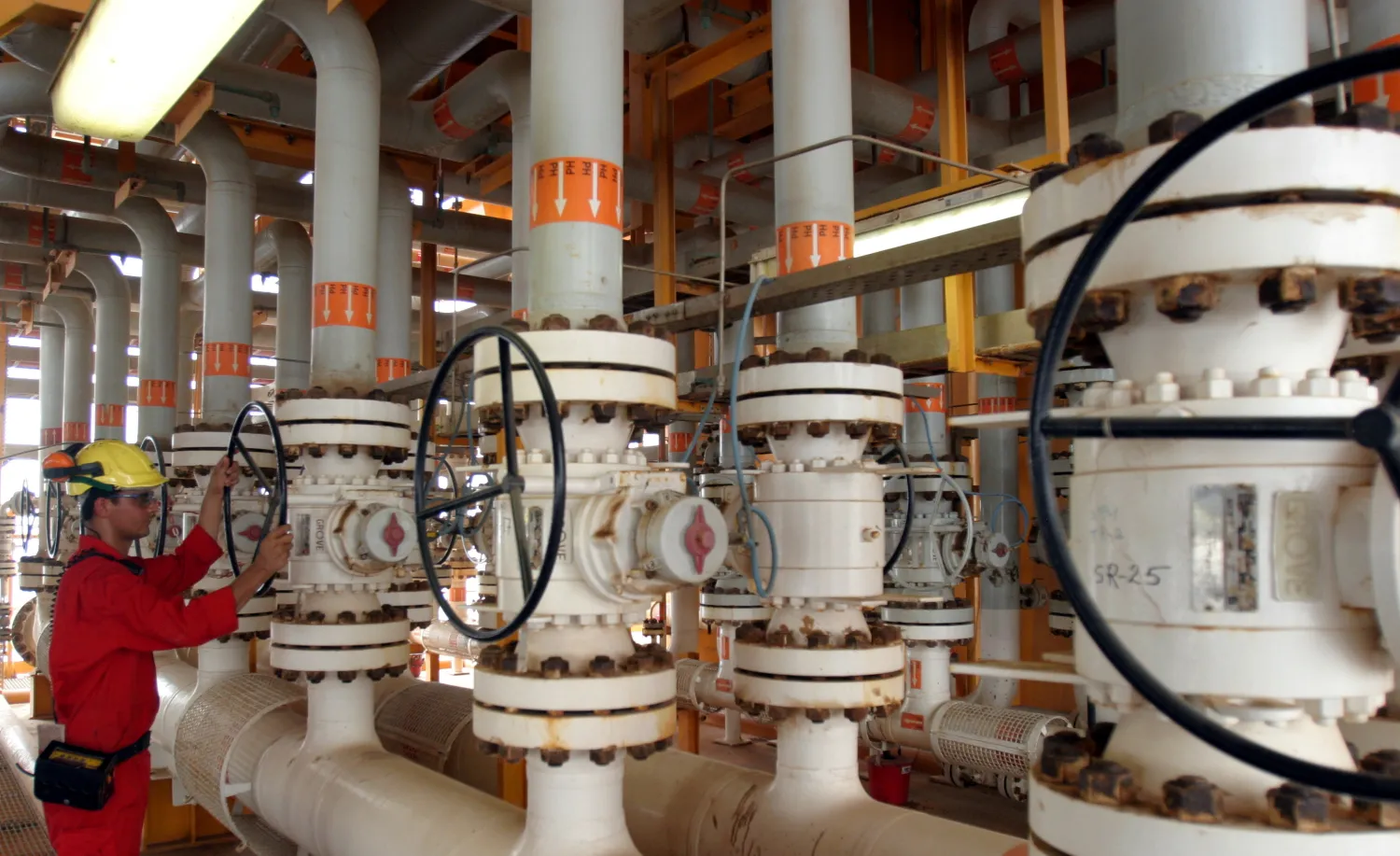
An Iranian man works on an oil production platform at the Soroush oil fields south of Iran's capital Tehran, July 25, 2005. REUTERS/File Photo
TT

US Lifts Some Sanctions Targeting Iran’s Energy Sector

An Iranian man works on an oil production platform at the Soroush oil fields south of Iran's capital Tehran, July 25, 2005. REUTERS/File Photo

The US administration lifted sanctions on three former Iranian officials and some energy companies amid the faltering nuclear negotiations in Vienna.

The Biden administration said it was willing to lift more sanctions on Tehran, in order to ease the economic pressure if the country changes course.

This came as the US, Iranian, European, and Chinese negotiators are preparing for the sixth round of talks to restore the 2015 nuclear deal between Iran, the US, and the P+1.

The talks are expected to begin again this weekend in Vienna, according to the official spokesman for the US State Department, Ned Price.

In a press conference on Thursday, Price confirmed that the US administration is prepared to leverage its applicable authorities, including sanctions, against any actor that enables Iran’s ongoing provision of weapons to violent partners and proxies.

“We will continue to apply pressure on Iran if it attempts to transfer any weapons to violent partners and proxies,” he said, adding that if this is an effort to transfer weapons or otherwise to violate its international obligations, Washington is prepared to respond.

Price explained that the recent delistings are a result of a verified change in behavior or status on the part of the sanctioned parties.

"The broader point here – and we have always maintained this – sanctions are not an end to themselves. Sanctions are a means to an end," he noted.

“Every time we impose sanctions, it is our hope that through a verified change in behavior, a verified change in status, we’ll one day be able to remove those sanctions, because that means that through one way or other, our policy objectives have been met.”

The delistings demonstrate Washington’s commitment to lifting sanctions in the event of a change in behavior or status for sanctioned persons, reiterated Price, describing it as a “normal practice. It is a practice consistent with good sanctions hygiene and administrative processes.”

However, he stressed that lifting the sanctions is not linked to the Joint Comprehensive Plan of Action (JCPOA) or to negotiations that are ongoing in Vienna.

Price noted that the US administration believes in the rules-based international order, and freedom of navigation is something that “we espouse for ourselves and for international partners.”

If Iran would seek to affect the transfer of weapons or other illicit materials, Washington would be prepared to hold it accountable.

“Freedom of navigation is a principle we defend for ourselves,” asserted Price, adding that it is an element of the broader rules-based international order that Washington believes, defends, and promotes not only because it applies to it but because it applies to the rest of the world.

He noted that the Special Envoy for Iran, Robert Malley will be returning to Vienna along with his team for the sixth round of negotiations.

“We have always said we expected this to be a multi-round set of negotiations,” he said, noting that this was an opportunity for the Iranian side to crystallize the steps they would need to take to resume compliance with the JCPOA.

The Treasury and State Departments said it lifted sanctions "on three former government of Iran officials, and two companies previously involved in the purchase, acquisition, sale, transport, or marketing of Iranian petrochemical products, as a result of a verified change in status or behavior on the part of the sanctioned parties,” as part of a routine technical practice.

Officials familiar with talks underway in Vienna on the future of the 2015 multilateral Iran nuclear agreement told the Wall Street Journal that the Biden administration has been looking at how it could inject momentum into the negotiations.

“Oil prices tumbled nearly 2 percent after the news, but quickly regained their losses, continuing to trade over $70 a barrel.”

US and European officials have said significant differences remain between Washington and Tehran over how to restore the nuclear deal, including the extent of any potential sanctions relief.

The Vienna negotiations now look very likely to drift past Iran’s presidential elections on June 18, which some Western officials saw as a target date to complete the talks because of their potential effect on Iran’s position.

US officials have said they would be prepared to lift most sanctions on Iran’s oil, petrochemical and shipping sectors as part of a deal to restore the 2015 nuclear agreement.

Washington has insisted it will maintain other anti-terrorism sanctions, including that on the Islamic Revolutionary Guard Corps (IRGC), and al-Quds Force.

Meanwhile, Russia is preparing to supply Iran with an advanced satellite system that will give Tehran an unprecedented ability to track potential military targets across the Middle East and beyond, according to current and former US and Middle Eastern officials briefed on details of the arrangement.

The Washington Post reported that the plan would deliver to the Iranians a Russian-made Kanopus-V satellite equipped with a high-resolution camera that would greatly enhance Iran’s spying capabilities, allowing continuous monitoring of facilities ranging from Gulf oil refineries and Israeli military bases to Iraqi barracks that house US troops.

Iranian military officials have been heavily involved in the acquisition, and leaders of the Revolutionary Guard Corps have made multiple trips to Russia since 2018 to help negotiate the terms of the agreement, the officials said.

As recently as this spring, Russian experts traveled to Iran to help train ground crews that would operate the satellite from a newly built facility near the northern city of Karaj, according to the officials.



Australia Warns of Floods, Fires after Cars Washed Away

Brisbane was inundated after the river running through the city burst its banks. Pic: AP
TT

Australia Warns of Floods, Fires after Cars Washed Away

Brisbane was inundated after the river running through the city burst its banks. Pic: AP

Australia's emergency services warned people Friday to stay prepared for sudden downpours and dangerous bushfires in the country's east after a flash flood swept cars into the sea.

Heavy rains on Thursday sent a deluge of water flowing through some parts of the eastern state of Victoria, which is still battling 10 major bushfires.

Photo and video images in local media showed one car rolling around in muddy waters as it was carried along the Wye River southwest of Melbourne, AFP reported.

Two cars were still partially submerged under the ocean waves on Friday, a few steps from the sandy coastline.

A local record of 186 millimeters (more than seven inches) fell in the 24 hours to Friday morning in one spot, the state meteorology service said.

Most of that water fell on Thursday.

"We've seen severe-to-extreme heat wave, catastrophic bushfires and now extreme flash flooding in the southwest of the state," Emergency Management Commissioner Tim Wiebusch told reporters.

"It really is a timely reminder that communities need to be prepared for all types of emergencies."

The flash flood cut off the state's Great Ocean Road and forced up to 300 people to flee, officials said. Many of them were reportedly holidaying at caravan camps. One child was injured and airlifted to hospital.

"It was raining, we were all in the tent playing cards with the gang, then we heard shouting," camper Matthew Stanhope told The Age newspaper, saying he and his friends ran to a nearby hill.

"It was lightning fast and quiet too. There's no noise, just all of a sudden the water is up."

Flood risks have since eased in the state.

Victoria declared a state of disaster on January 10 after days of battling bushfires that have razed homes and killed one person north of Melbourne.

Emergency services said the fires have so far destroyed 289 homes and damaged another 18, as well as hundreds of outbuildings.


Washington Enhancing Military Presence in Middle East amid Iran Tensions

The USS Abraham Lincoln and its escort group 
TT

Washington Enhancing Military Presence in Middle East amid Iran Tensions

The USS Abraham Lincoln and its escort group 

The US is enhancing its military presence in the Middle East following US President Donald Trump's threats against Iran, several US media outlets reported on Thursday.

The New York Times reported that the aircraft carrier Abraham Lincoln and some of its escort warships were steaming toward the Middle East from the South China Sea — about a weeklong journey, according to two US officials who spoke on the condition of anonymity to discuss operational matters.

In addition, an array of warplanes, likely to include a combination of fighter jets, attack planes and refueling planes, were expected to start flowing into the region soon, many from Europe, the officials said.

Some of these aircraft had been scheduled to replace units in the Middle East and could have their tours extended depending on the severity of the tensions, the officials added.

Meanwhile, Axios said that as Trump takes time to consider diplomatic options with Iran, the US military is evacuating troops from Middle East bases and sending reinforcements to the region, including the USS Abraham Lincoln and its strike group. There was no official confirmation of such deployment from the Pentagon.

Also, Fox News quoted military sources as saying that at least one US aircraft carrier is being moved toward the Middle East as tensions with Iran continue to build.

It is not yet clear whether the carrier is the USS Abraham Lincoln, currently operating in the South China Sea, or one of two carriers that departed Norfolk and San Diego earlier this week, it wrote.

Since mass protests began against the Iranian government two weeks ago, Trump has openly threatened to intervene in Iran, without giving specifics.

In an interview with CBS News on Tuesday, he vowed “very strong action” if Iran executes protesters. He also urged Iranians to keep protesting and take over institutions, declaring “help is on the way.”

Protests in Iran erupted mainly due to dire economic conditions and widespread resentment form the country’s leaderships.

Iranian security forces have exerted mounting violence against protestors, with reports of hundreds killed and thousands arrested.


Back From Iran, Pakistani Students Say They Heard Gunshots While Confined to Campus

 A Pakistani medical student Arslan Haider waits at the airport after arriving from Tehran on a commercial flight amid the ongoing nationwide protests in Iran, in Islamabad, Pakistan, January 15, 2026. (Reuters)
A Pakistani medical student Arslan Haider waits at the airport after arriving from Tehran on a commercial flight amid the ongoing nationwide protests in Iran, in Islamabad, Pakistan, January 15, 2026. (Reuters)
TT

Back From Iran, Pakistani Students Say They Heard Gunshots While Confined to Campus

 A Pakistani medical student Arslan Haider waits at the airport after arriving from Tehran on a commercial flight amid the ongoing nationwide protests in Iran, in Islamabad, Pakistan, January 15, 2026. (Reuters)
A Pakistani medical student Arslan Haider waits at the airport after arriving from Tehran on a commercial flight amid the ongoing nationwide protests in Iran, in Islamabad, Pakistan, January 15, 2026. (Reuters)

Pakistani students returning from Iran on Thursday said they heard gunshots and stories of rioting and violence while being confined to campus and not allowed out of their dormitories in the evening.

Iran's leadership is trying to quell the worst domestic unrest since its 1979 revolution, with a rights group putting the death toll over 2,600.

As the protests swell, Tehran is seeking to deter US President Donald Trump's repeated threats to intervene on behalf of anti-government protesters.

"During ‌nighttime, we would ‌sit inside and we would hear gunshots," Shahanshah ‌Abbas, ⁠a fourth-year ‌student at Isfahan University of Medical Sciences, said at the Islamabad airport.

"The situation down there is that riots have been happening everywhere. People are dying. Force is being used."

Abbas said students at the university were not allowed to leave campus and told to stay in their dormitories after 4 p.m.

"There was nothing happening on campus," Abbas said, but in his interactions with Iranians, he ⁠heard stories of violence and chaos.

"The surrounding areas, like banks, mosques, they were damaged, set on fire ... ‌so things were really bad."

Trump has repeatedly ‍threatened to intervene in support of protesters ‍in Iran but adopted a wait-and-see posture on Thursday after protests appeared ‍to have abated. Information flows have been hampered by an internet blackout for a week.

"We were not allowed to go out of the university," said Arslan Haider, a student in his final year. "The riots would mostly start later in the day."

Haider said he was unable to contact his family due to the blackout but "now that they opened international calls, the students are ⁠getting back because their parents were concerned".

A Pakistani diplomat in Tehran said the embassy was getting calls from many of the 3,500 students in Iran to send messages to their families back home.

"Since they don't have internet connections to make WhatsApp and other social network calls, what they do is they contact the embassy from local phone numbers and tell us to inform their families."

Rimsha Akbar, who was in the middle of her final year exams at Isfahan, said international students were kept safe.

"Iranians would tell us if we are talking on Snapchat or if we were riding in a cab ... ‌that shelling had happened, tear gas had happened, and that a lot of people were killed."