
Lebanon’s Banks Stuck in Reverse: Jobs Go, Lending Dives

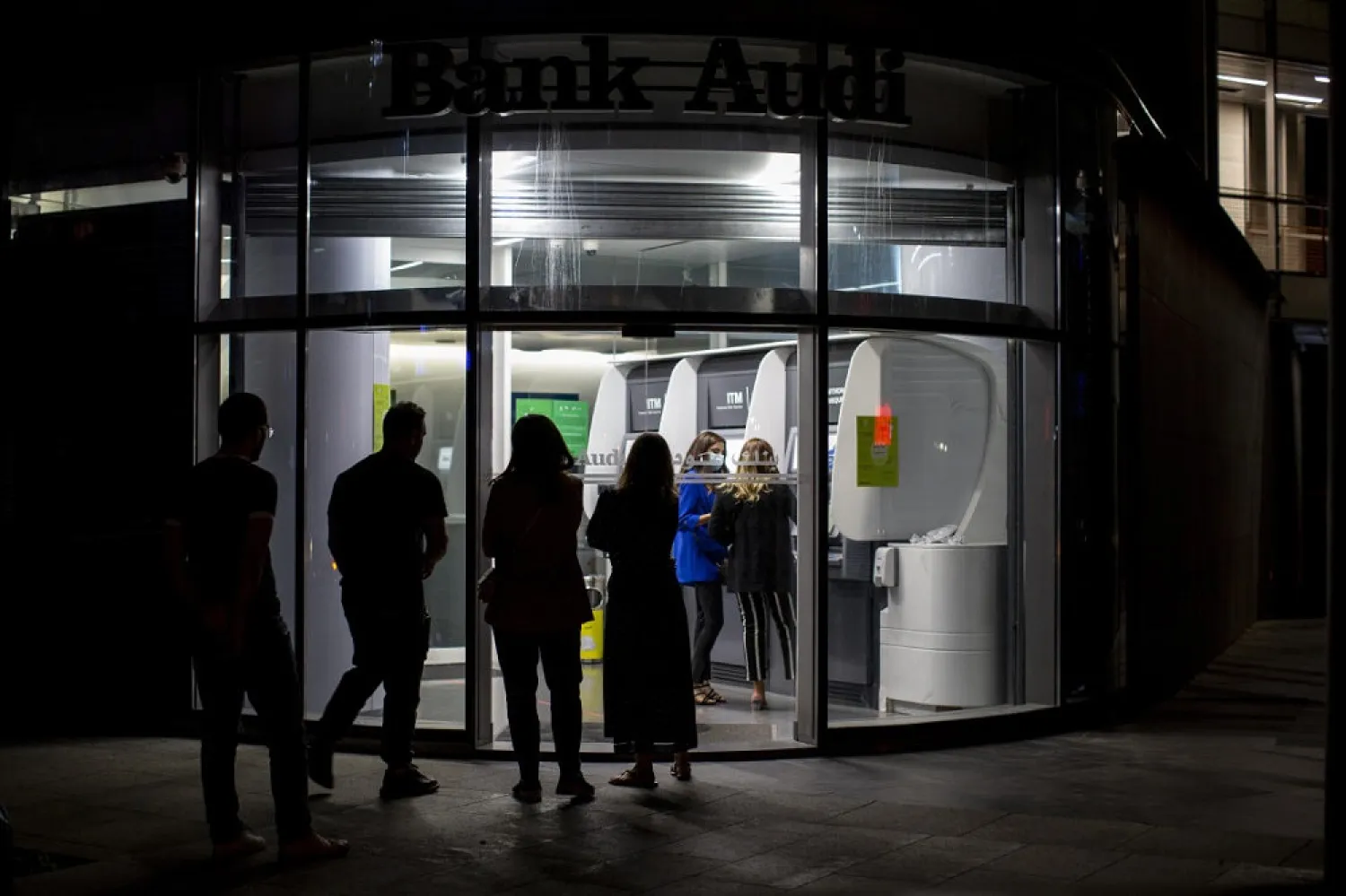
People wait to use ATM machines outside a closed bank in Beirut, Lebanon. (AP)
TT

Lebanon’s Banks Stuck in Reverse: Jobs Go, Lending Dives

People wait to use ATM machines outside a closed bank in Beirut, Lebanon. (AP)

Lebanon’s banks, which once powered the economy by sucking in billions of dollars of deposits from abroad, are shedding staff, watching loan books shrink and chasing liquidity to stay afloat.

About 3,000 bankers, or more than 10% of the banking industry workforce, have resigned or lost their jobs so far since a financial crisis flared up in late 2019 - and the numbers keep rising, four senior bankers told Reuters.

De facto capital controls are in place, depositors are locked out of most of their savings and lending to the private sector has plummeted. In April, bank loans had fallen by 25% year on year to $33 billion, according to a Byblos Bank note.

“The sector is dead. It doesn’t lend, it doesn’t make profits”, said one of the bankers, who requested anonymity.

Banks are facing their biggest challenge since a 1975-1990 civil war, a conflict which by some measures gave the lenders a smaller hangover. This crisis has left the industry nursing losses worth $83 billion, according to a government report last year, dwarfing Lebanon’s 2019 economic output of $55 billion.

“The crisis in Lebanon essentially is first of all a banking collapse,” said Toufic Gaspard, an economist who has worked as an adviser at the IMF and as an adviser to a former finance minister.

The financial services sector in Lebanon, which once fashioned itself as the Switzerland of the Middle East, accounted for nearly 9% of gross domestic product in 2018.

Supported by a central bank that offered attractive interest rates for fresh dollars to service the nation’s exploding debt, banks drew in deposits, particularly from Lebanon’s diaspora. When that financial house of cards collapsed in 2019, the economy imploded, hammering the banking system.

Salim Sfeir, chairman of the Association of Banks in Lebanon (ABL), said banks were now surviving partly thanks to liquidity generated by “deleveraging”, as many Lebanese moved money out of banks to repay individual and corporate debt.
“In normal circumstances lending is banks’ business, but in such circumstances this gives us liquidity, it gives us fresh air to continue surviving during the crisis,” said Sfeir, who is also chief executive of Bank of Beirut.

‘No strategy’
The industry, which had employed about 28,000 before the crisis, now had about 25,000, he estimated. The three other senior bankers gave similar numbers for job losses in the sector, adding that the figure continued to grow.

Most job losses were in retail banking, serving what were traditionally core banking businesses such as attracting deposits or selling loans to small and medium enterprises that have lost steam or simply collapsed, the sources said.

Job losses have accumulated amid a political deadlock which has left Lebanon without a new government, after the cabinet resigned in the aftermath of a massive Beirut port blast last year that ripped through a swathe of the capital.

Political sclerosis has delayed a deal with the International Monetary Fund, a vital element in a wider rescue plan to fix Lebanon’s broken financial and economic system. Bankers and analysts said any restructuring of Lebanon’s 40 or so banks should be part of such a comprehensive plan.

“There’s no strategy for the banking sector. We’re operating at zero visibility,” another of the senior bankers said, adding that banks were only able to function in “continuity mode”.

The full extent of bank losses would only become clear when the government restructures its mountain of debt, ratings agency S&P said, after the government defaulted last year.

S&P said the cost of restructuring the banking system could range from $23 billion to $102 billion. The central bank instructed banks to raise their capital defenses by 20% by the end of February and requested banks to boost liquidity by 3% with their corresponding banks.

ABL’s Sfeir said banks had completed the increase. “The other guideline was to increase foreign liquidity,” he said, adding that this was “more difficult because you have to liquidate some of your foreign assets, your depositors will have to repatriate some of their overseas deposits.”

“This is why it’s taking some time,” he said.


Egypt Plans $1 Billion Red Sea Marina, Hotel Development

This picture shows a partial view of Egypt's Red Sea city of Sharm el-Sheikh, October 7, 2025. (AFP)
TT

Egypt Plans $1 Billion Red Sea Marina, Hotel Development

This picture shows a partial view of Egypt's Red Sea city of Sharm el-Sheikh, October 7, 2025. (AFP)

Egypt announced plans on Monday for a new $1 billion marina, hotel and housing development on the Red Sea in a bid to boost the region's tourist industry.

Construction on the "Monte Galala Towers and Marina" project would ‌start in ‌the second ‌half ⁠of the ‌year and run for seven years, Ahmed Shalaby, managing director of the main developer, Tatweer Misr, said.

The 10-tower development - a partnership with the ⁠housing ministry and other state bodies ‌including the armed ‍forces' engineering authority - ‍would cost about 50 ‍billion Egyptian pounds ($1.07 billion), he added.

The project, also announced by the cabinet, will cover 470,000 square meters on the Gulf of Suez, about ⁠35 km south of Ain Sokhna, Shalaby said.

Egypt aims to boost total tourist arrivals to around 30 million by 2030, from around 19 million recorded by the tourism ministry in 2025.


Saudi-Polish Investment Forum Explores Prospects for Economic and Investment Cooperation

The forum brought together government officials, business leaders, and investors from both countries with the aim of enhancing economic cooperation - SPA
TT

Saudi-Polish Investment Forum Explores Prospects for Economic and Investment Cooperation

The forum brought together government officials, business leaders, and investors from both countries with the aim of enhancing economic cooperation - SPA

The Saudi-Polish Investment Forum was held today at the headquarters of the Federation of Saudi Chambers in Riyadh, with the participation of Minister of Investment Khalid Al-Falih, Minister of Finance of the Republic of Poland Andrzej Domański, and Vice President of the Federation of Saudi Chambers Emad Al-Fakhri.

The forum brought together government officials, business leaders, and investors from both countries with the aim of enhancing economic cooperation, expanding investment partnerships in priority sectors, and exploring high-quality investment opportunities that support sustainable growth in Saudi Arabia and Poland.

During a dedicated session, the forum reviewed economic and investment prospects in both countries through presentations highlighting promising opportunities, investment enablers, and supportive legislative environments.

Several specialized roundtables addressed strategic themes, including the development of the digital economy, with a focus on information and communication technologies (ICT), financial technologies (fintech), and artificial intelligence-driven innovation, SPA reported.

Discussions also covered the development of agricultural value chains from production to market access through advanced technologies, food processing, and agricultural machinery. In addition, participants examined ways to enhance the construction sector by developing systems and materials, improving execution efficiency, and accelerating delivery timelines. Energy security issues and the role of industrial sectors in supporting economic transformation and sustainability were also discussed.

The forum witnessed the announcement of two major investment agreements. The first aims to establish a framework for joint cooperation in supporting investment, exchanging information and expertise, and organizing joint business events to strengthen institutional partnerships.

The second agreement focuses on supporting reciprocal investments through the development of financing and insurance tools and the stimulation of joint ventures to boost investment flows.

The forum concluded by emphasizing the importance of continued coordination and dialogue between the public and private sectors in both countries to deepen Saudi-Polish economic relations and advance shared interests.


Gold Rises as Dollar Slips, Focus Turns to US Jobs Data

FILE PHOTO: An employee places ingots of 99.99 percent pure gold in a workroom at the Novosibirsk precious metals refining and manufacturing plant in the Siberian city of Novosibirsk, Russia, September 15, 2023. REUTERS/Alexander Manzyuk/File Photo
TT

Gold Rises as Dollar Slips, Focus Turns to US Jobs Data

FILE PHOTO: An employee places ingots of 99.99 percent pure gold in a workroom at the Novosibirsk precious metals refining and manufacturing plant in the Siberian city of Novosibirsk, Russia, September 15, 2023. REUTERS/Alexander Manzyuk/File Photo

Gold prices rose on Monday, buoyed by a softer dollar as investors braced for a week packed with US economic data that could offer more clues on the US Federal Reserve's monetary policy.

Spot gold rose 1.2% to $5,018.56 per ounce by 9:30 a.m. ET (1430 GMT), extending a 4% rally from Friday.

US gold futures for April delivery also gained 1.3% to $5,042.20 per ounce.

The US dollar fell 0.8% to a more than one-week low, making greenback-priced bullion cheaper for overseas buyers.

"The big mover today (in gold prices) is the US dollar," said Bart Melek, global head of commodity strategy at TD Securities, adding that expectations are growing for weak economic data, particularly on the labor front, Reuters reported.

Investors are closely watching this week's release of US nonfarm payrolls, consumer prices and initial jobless claims for fresh signals on monetary policy, with markets already pricing in at least two rate cuts of 25 basis points in 2026.

US nonfarm payrolls are expected to have risen by 70,000 in January, according to a Reuters poll.

Lower interest rates tend to support gold by reducing the opportunity cost of holding the non-yielding asset.

Meanwhile, China's central bank extended its gold buying spree for a 15th month in January, data from the People's Bank of China showed on Saturday.

"The debasement trade continues, with ongoing geopolitical risks driving people into gold," Melek said, adding that China's purchases have had a psychological impact on the market.

Spot silver climbed 2.9% to $80.22 per ounce after a near 10% gain in the previous session. It hit an all-time high of $121.64 on January 29.

Spot platinum was down 0.2% at $2,092.95 per ounce, while palladium was steady at $1,707.25.

"A slowdown in EV sales hasn't really materialized despite all the policy softening, so I do see that platinum and palladium will possibly slow down," after a bullish run in 2025, WisdomTree commodities strategist Nitesh Shah said.