Berlin Museum Centering on Germans Expelled after WWII Opens

Gundula Bavendamm, Director of the Foundation Flight, Expulsion, Reconciliation, stands in the foyer of the Berlin Documentation Center of the Foundation Flight, Expulsion, Reconciliation in Berlin, Germany, Wednesday, June 16, 2021. (AP)
TT

Berlin Museum Centering on Germans Expelled after WWII Opens

Gundula Bavendamm, Director of the Foundation Flight, Expulsion, Reconciliation, stands in the foyer of the Berlin Documentation Center of the Foundation Flight, Expulsion, Reconciliation in Berlin, Germany, Wednesday, June 16, 2021. (AP)

Germany is opening a museum exploring the fate of millions of Germans forced to leave eastern and central Europe at the end of World War II, along with other forced displacements of the 20th and 21st centuries — a sensitive project that has taken years to realize.

Chancellor Angela Merkel is due to speak to an opening ceremony Monday for the Documentation Center for Displacement, Expulsion, Reconciliation, more than 13 years after her government gave the plan the go-ahead. Housed in a late-1920s building in downtown Berlin, it features some 700 exhibits over 1,500 square meters (16,000 square feet).

Making the project reality was long viewed as “an impossible balancing act,” said the center’s director, Gundula Bavendamm, recalling “heated arguments about priorities and contextualization.”

Controversies revolved around one central question, she said: “How can the exodus and expulsion of Germans at the end of and after World War II be portrayed without raising the slightest doubt that this country is aware of its lasting responsibility for the German crimes of World War II and the murder of European Jews?”

The project centers on the millions of Germans who fled from advancing Soviet forces or were kicked out of parts of eastern and central Europe as Germany’s borders were moved westward after the war, “in the historical context” of Nazi crimes, said Bavendamm — the project’s third director.

“Without the Nazi policies of expulsion and annihilation, 14 million Germans wouldn’t have lost their homes as a result of flight and expulsion,” she added. “But that doesn’t change the fact that their expulsion by the Allies and the eastern and central European states in the aftermath of World War II was also an injustice.”

In its efforts to provide context, the exhibition explores “forced migration as a phenomenon of modern Europe,” including displacements during World War I, the arrival of Vietnamese “boat people” in West Germany in the 1970s, the fallout from the disintegration of Yugoslavia in 1990s and the European migration crisis of recent years.

Exhibits include some 30 passports, including a German Jew’s passport stamped with the letter “J” in the Nazi era, a “Nansen passport” for stateless refugees from 1937 and a modern-day provisional refugee passport. There is the diary of a girl from East Prussia, a territory Germany lost at the end of the war, chronicling sexual violence.

There’s also a bicycle used by a Syrian refugee to cross the Russian-Norwegian border in 2016. And there are audio accounts by people recounting their arrival in Germany.

Visitors are given a chronological account of Nazi atrocities, followed by the flight and expulsion of the Germans in the final months of the war and afterward. “At the same time, millions of Polish, Ukrainian, Hungarian or Slovakian citizens lost their homes in the time,” curator Jochen Krueger said. “We tell their story here too.”

The idea for a center commemorating the German expellees goes back to a call for a “center against expulsions” made in 1999 by Erika Steinbach, who at the time was the head of an organization representing the group and a lawmaker with Merkel’s conservative party. It raised hackles in the following years in countries whose inhabitants suffered under brutal Nazi occupation.

Steinbach, who was deeply distrusted in neighboring Poland in particular, was kept off the board of the new center. In recent years, she has become a strident hard-right critic of Merkel, whose party she left in 2017, objecting in particular to her decision to allow in large numbers of migrants from Syria and elsewhere.

Steinbach wasn’t invited to Monday’s opening — because, according to Bavendamm, that was limited due to pandemic restrictions to people directly involved with the center.

The new center opens to the public on Wednesday.


Spain and Portugal Continue to Battle Storm Leonardo as New Storm Approaches

 A mountain landslide blocks railway tracks during heavy rains, as storm Leonardo hits parts of Spain, in Benaojan, Spain, February 6, 2026. (Reuters)
A mountain landslide blocks railway tracks during heavy rains, as storm Leonardo hits parts of Spain, in Benaojan, Spain, February 6, 2026. (Reuters)
TT

Spain and Portugal Continue to Battle Storm Leonardo as New Storm Approaches

 A mountain landslide blocks railway tracks during heavy rains, as storm Leonardo hits parts of Spain, in Benaojan, Spain, February 6, 2026. (Reuters)
A mountain landslide blocks railway tracks during heavy rains, as storm Leonardo hits parts of Spain, in Benaojan, Spain, February 6, 2026. (Reuters)

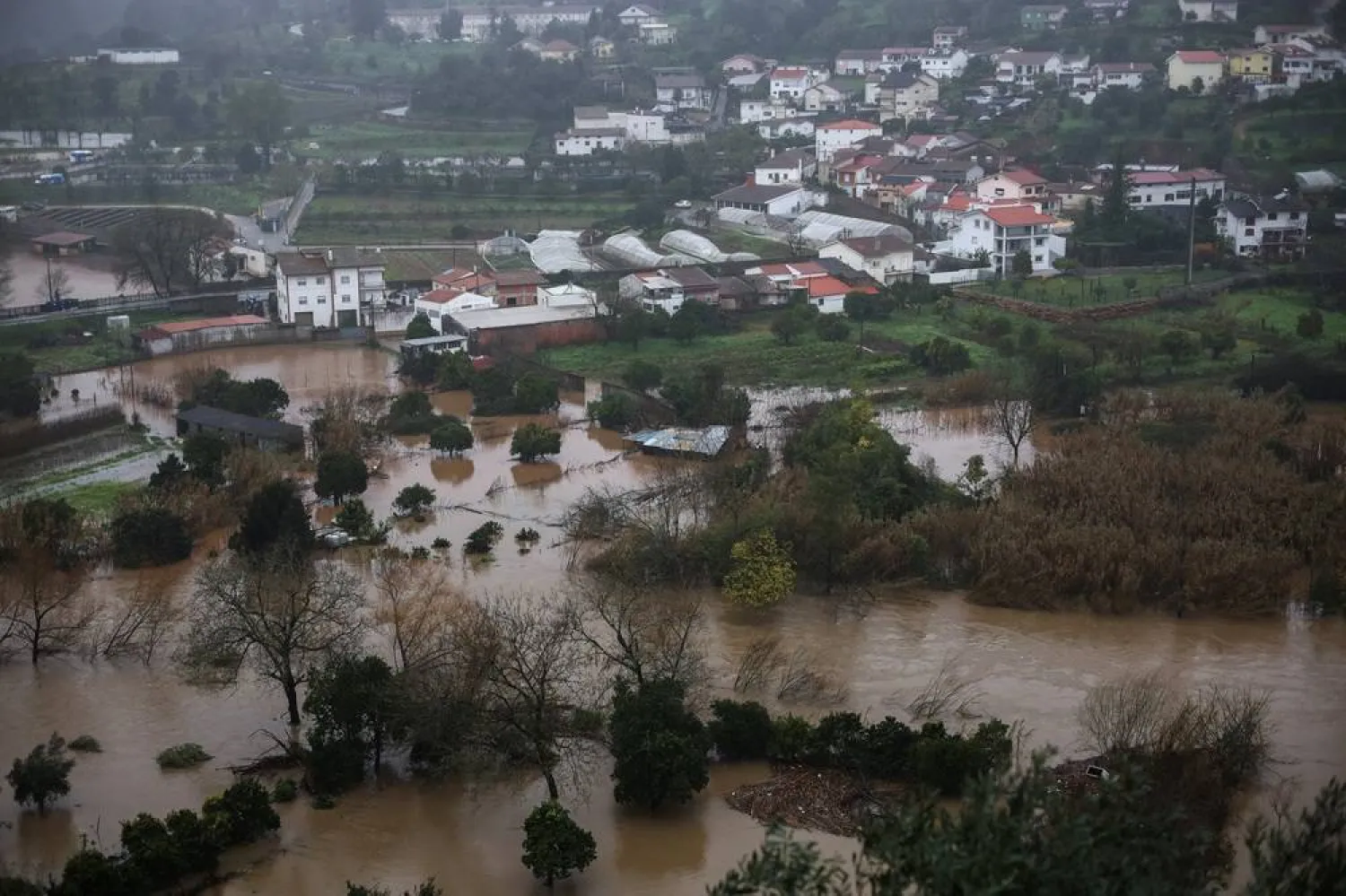
Storm Leonardo continued to batter the Iberian Peninsula on Friday, bringing floods and putting rivers at risk of bursting their banks while thousands of people were evacuated from their homes in Spain and Portugal.

In southern Spain's Andalusia region, some 7,000 people have had to leave their homes due to successive storms.

Among them were around 1,500 people ordered to evacuate the mountain village of Grazalema, where Andalusia's regional leader Juan Manuel Moreno warned that aquifers were "full to the brim with water,” and at risk of collapsing.

“It's raining on already saturated ground. The land is unable to drain," Moreno said. “We urge extreme caution. This is not over.”

Spanish police said Friday they had found a body located 1,000 meters (about 0.6 miles) away from where a woman had disappeared Wednesday after she fell into a river in Malaga province while trying to rescue her dog. Police said they had not yet identified the body, but believed it belonged to the 45-year-old woman.

Another storm front, Marta, was expected to arrive Saturday, with Spain's weather agency AEMET saying it would bring even more rain and heavy winds, including to areas already drenched by Storm Leonardo.

Marta is expected to affect Portugal, too.

Of particular concern was southern Spain's Guadalquivir River, which flows through Córdoba and Seville and eventually into the Atlantic Ocean, and whose water levels have dramatically risen in recent days.

Additional rain Saturday could leave many more homes at risk in Córdoba, local authorities warned.

In Portugal, parts of Alcacer do Sal were submerged after the Sado River overflowed, forcing residents to leave the city located 90 kilometers (about 56 miles) south of Lisbon.

Alerts were issued also for regions near the Tagus River due to rising water levels.

A separate storm in late January left a trail of destruction in Portugal, killing several people, according to Portuguese authorities.


AROYA Cruises Debuts Arabian Gulf Voyages for 2026

AROYA offers a curated experience featuring culturally inspired entertainment and diverse dining options - SPA
TT

AROYA Cruises Debuts Arabian Gulf Voyages for 2026

AROYA offers a curated experience featuring culturally inspired entertainment and diverse dining options - SPA

AROYA Cruises, a subsidiary of the PIF-owned Cruise Saudi, has officially launched its inaugural season in the Arabian Gulf.

Running from February 21 to May 8, the season marks a milestone in regional tourism by blending authentic Saudi hospitality with international maritime standards, SPA reported.

AROYA offers a curated experience featuring culturally inspired entertainment and diverse dining options.

The season is designed to provide guests with a dynamic way to explore the Gulf, setting a new benchmark for luxury travel that reflects the Kingdom's heritage on a global stage.


Snowstorm Brings Much of Denmark to a Halt

A car drives in heavy snow at Store Heddinge in South Zealand, Denmark, 05 February 2026.  EPA/Mads Claus Rasmussen
A car drives in heavy snow at Store Heddinge in South Zealand, Denmark, 05 February 2026. EPA/Mads Claus Rasmussen
TT

Snowstorm Brings Much of Denmark to a Halt

A car drives in heavy snow at Store Heddinge in South Zealand, Denmark, 05 February 2026.  EPA/Mads Claus Rasmussen
A car drives in heavy snow at Store Heddinge in South Zealand, Denmark, 05 February 2026. EPA/Mads Claus Rasmussen

Denmark authorities halted public transport, closed schools and cancelled flights on Friday as heavy snowfall blanketed much of the country.

The Nordic country's meteorological institute DMI warned that heavy snow would likely continue until Friday evening in the east, where the capital Copenhagen is located.

Police said people should avoid going outdoors unless necessary and stay indoors in the capital and the surrounding region.

Copenhagen's airport cancelled flights to Paris and Berlin and warned of "delay and cancellation risks because of snowy conditions." Many schools were closed.

In the second-largest city of Aarhus, bus services were cancelled.