


Israelis Taste the Future with Lab-Grown Chicken 'Food Revolution'

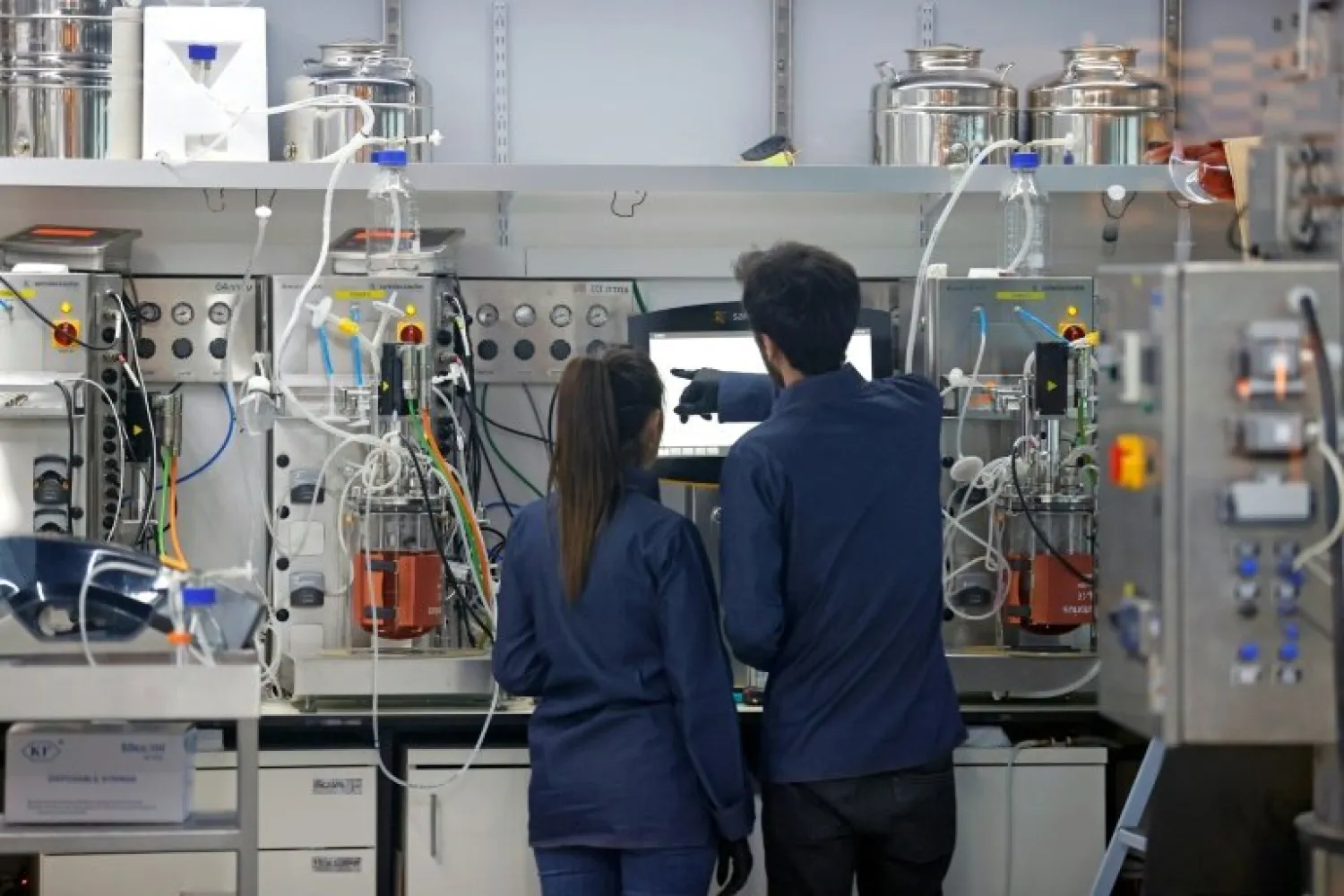
Technicians produce 'cultured chicken' meat at the food-tech startup SuperMeat - AFP
TT

Israelis Taste the Future with Lab-Grown Chicken 'Food Revolution'

Technicians produce 'cultured chicken' meat at the food-tech startup SuperMeat - AFP

It looks like chicken and tastes like chicken, but diners in Israel are tucking into laboratory-grown "meat" that scientists claim is an environmentally friendly way to feed the world's growing population.

In a small restaurant in a nondescript building in a science park in the central Israeli town of Ness Ziona, diners munched burgers and minced meat rice rolls made with "cultured chicken" -- meat grown in the adjacent SuperMeat production site, AFP reported.

"It was delicious, the flavor was great," said Gilly Kanfi, a self-described "meat eater" from Tel Aviv, who had signed up for the meal months in advance.

"If I didn't know, I would have thought it was a regular chicken burger."

The Chicken, as the eatery is called, is a testing ground of sorts for SuperMeat, hosting periodical test meals to generate customer feedback while waiting for regulatory approval.

The restaurant's dark and elegant interior is framed by large windows looking onto a bright-lit laboratory, where technicians monitor large stainless-steel fermentation vats.

"This is the first time in the world people can actually have a taste of a cultivated meat product, while observing the production and the manufacturing process in front of their eyes," said Ido Savir, SuperMeat's chief executive.

Here, at least, the laboratory has made redundant the age-old question of whether the chicken or the egg came first.

The process involves cultivating cells taken from a fertilized chicken egg.

Cell cultures are fed a plant-based liquid including proteins, fats, sugars, minerals and vitamins.

With all the feed going directly into production, it grows rapidly, with the mass doubling within a matter of hours, the company says.

Savir, a vegan with a background in computer science, sees himself as being at the "forefront of a food revolution" trying to help supply food while limiting the impact on the planet.

Developers said they are working to provide more ethical and sustainable ways to create cruelty- and slaughter-free meat, with the product grown without using genetic engineering or antibiotics.

The company is currently able to produce "hundreds of kilograms" each week, Savir said.

But he hopes to earn regulatory approval from the US Food and Drug Administration, and would then increase production to a "commercial" scale.

"This way we'll be able to reduce the amount of land, water use and so many other resources, and keep the product very healthy and clean," he said, noting the high prevalence of diseases among chickens produced in factory-style production.

Global meat production is projected to rise 15 percent by 2027, according to the UN Food and Agriculture Organization.

SuperMeat is not the first to develop the technology. In December, a Singapore restaurant made history when it became the first to sell lab-grown chicken meat.

The Israeli firm has developed a versatile product, blending muscle, fat and connective tissue cells to create different cuts -- even including pet food.

Zhuzha, a white bull terrier attending the meal along with its owner, enthusiastically devoured the SuperMeat dog food it was handed.

"Pets love our meat as well," Savir said with a smile.

The human diners said the product was as good as the real thing.

"It really surprised me," said Lisa Silver, a regular meat-eater. "If I can get that in a restaurant, I will go vegan, totally. It's a game-changer."

For her sister Annabelle, it was the first time in years she had eaten meat.

"One of the reasons that I became vegetarian originally was because it's not ethical, it's not sustainable," she said.

"To get meat minus the cruelty is just amazing, it's perfect, I could eat this every single day."

But the question whether the product should be considered meat is one faced not only by vegetarians -- but also Jewish rabbinic authorities.

Producing meat in a cruelty-free way that does not harm the environment is a positive development that will "save the world problems", said Rabbi Eliezer Simcha Weisz, a member of Israel's Chief Rabbinate Council.

While rabbis would have to learn the novel process and supervise it, Weisz said he expected the product would eventually receive a kosher designation.

Tal Gilboa, a prominent veganism activist who served as an adviser to former prime minister Benjamin Netanyahu, said Israel was leading the way on cultured meat technology.

Gilboa would like the world to turn to a plant-based diet, and sees cultivated meats as a pragmatic way for people to take the first steps to vegetarianism.

"The world population is increasing at a break-neck speed," she said, adding that the only way to keep up will be "through technology".

Savir believes the technology could change humanity for the better.

"Like we saw with the revolution of the smart phone, once this is available, we'll start producing so much meat," he said.

"It would increase food security for nations around the world, a very sustainable, animal-friendly and efficient process."




Mohammad Bakri, Renowned and Controversial Palestinian Actor and Filmmaker, Dies at 72

Palestinian actor Mohammed Bakri poses during the photocall for the film “Wajib” at the 70th Locarno International Film Festival in Locarno, Switzerland, on Aug. 5, 2017. (Urs Flueeler/Keystone via AP, File)
TT

Mohammad Bakri, Renowned and Controversial Palestinian Actor and Filmmaker, Dies at 72

Palestinian actor Mohammed Bakri poses during the photocall for the film “Wajib” at the 70th Locarno International Film Festival in Locarno, Switzerland, on Aug. 5, 2017. (Urs Flueeler/Keystone via AP, File)

Mohammad Bakri, a Palestinian director and actor who sought to share the complexities of Palestinian identity and culture through a variety of works in both Arabic and Hebrew, has died, his family announced. He was 72.

Bakri was best known for “Jenin, Jenin,” a 2003 documentary he directed about an Israeli military operation in the northern West Bank city the previous year during the second Palestinian intifada, or uprising. The film, focusing on the heavy destruction and heartbreak of its Palestinian residents, was banned by Israel, The AP news reported.

Bakri also acted in the 2025 film “ All That’s Left of You,” a drama about a Palestinian family through more than 76 years, alongside his sons, Adam and Saleh Bakri, who are also actors. The film has been shortlisted by the Academy Awards for the best international feature film.

Over the years, he made several films that spanned the spectrum of Palestinian experiences. He also acted in Hebrew, including at Israel’s national theater in Tel Aviv, and appeared in a number of famous Israeli films in the 1980s and 1990s. He studied at Tel Aviv University.

Bakri, who was born in northern Israel and held Israeli citizenship, dabbled in both film and theater. His best-known one-man-show from 1986, “The Pessoptimist,” based on the writings of Palestinian author Emile Habiby, focused on the intricacies and emotions of someone who has both Israeli and Palestinian identities.

During the 1980s, Bakri played characters in mainstream Israeli films that humanized the Palestinian identity, including “Beyond the Walls,” a seminal film about incarcerated Israelis and Palestinians, said Raya Morag, a professor at the Hebrew University of Jerusalem who specializes in cinema and trauma.

“He broke stereotypes about how Israelis looked at Palestinians, and allowing someone Palestinian to be regarded as a hero in Israeli society,” she said.

“He was a very brave person, and he was brave by standing to his ideals, choosing not to be conformist in any way, and paying the price in both societies,” said Morag.

Bakri faced some pushback within Palestinian society for his cooperation with Israelis. After “Jenin, Jenin,” he was plagued by almost two decades of court cases in Israel, where the film was seen as unbalanced and inciting.

In 2022, Israel's Supreme Court upheld a ban on the documentary, saying it defamed Israeli soldiers, and ordered Bakri to pay tens of thousands of dollars in damages to an Israeli military officer for defamation.

“Jenin, Jenin” was a turning point in Bakri’s career. In Israel, he became a polarizing figure and he never worked with mainstream Israeli cinema again, Morag said. “He was loyal to himself despite all the pressures from inside and outside,” she added. “He was a firm voice that did not change during the years.”

Local media quoted Bakri's family as saying he died Wednesday after suffering from heart and lung problems. His cousin, Rafic, told the Arabic news site Al-Jarmaq that Bakri was a tenacious advocate of the Palestinians who used his works to express support for his people.

“I am certain that Abu Saleh will remain in the memory of Palestinian people everywhere and all people of the free world,” he said, using Mohammed Bakri's nickname.


Over 60 Endangered Species Released into King Khalid Royal Reserve

These efforts align with the National Environment Strategy and Saudi Vision 2030 - SPA
TT

Over 60 Endangered Species Released into King Khalid Royal Reserve

These efforts align with the National Environment Strategy and Saudi Vision 2030 - SPA

In collaboration with the National Center for Wildlife (NCW), the Imam Abdulaziz bin Mohammed Royal Reserve Development Authority has released over 60 endangered species into the King Khalid Royal Reserve. This initiative supports a national program to reintroduce wildlife into their natural habitats.

CEO of the authority Dr. Talal Al-Harigi stated that the release aims to enhance biodiversity and restore natural habitats. He emphasized that the project fosters a stable environment for wildlife adaptation, SPA reported.

These efforts align with the National Environment Strategy and Saudi Vision 2030, which seek to improve the quality of life and promote sustainability. Dr. Al-Harigi noted that the partnership with NCW exemplifies institutional integration and the use of global best practices for successful reintroduction.

The release included species such as Arabian sand gazelles, Arabian oryx, wild hares, and mountain gazelles, contributing to biodiversity, ecological balance, and eco-tourism in the region.


'The Best Gift Ever': Baby is Born after the Rarest of Pregnancies, Defying All Odds

This photo provided by the family shows Ryu Lopez in California in October 2025. (Lopez family via AP)
TT

'The Best Gift Ever': Baby is Born after the Rarest of Pregnancies, Defying All Odds

This photo provided by the family shows Ryu Lopez in California in October 2025. (Lopez family via AP)

Suze Lopez holds her baby boy on her lap and marvels at the remarkable way he came into the world.

Before little Ryu was born, he developed outside his mom’s womb, hidden by a basketball-sized ovarian cyst — a dangerous situation so rare that his doctors plan to write about the case for a medical journal, The AP news reported.

Just 1 in 30,000 pregnancies occur in the abdomen instead of the uterus, and those that make it to full term “are essentially unheard of — far, far less than 1 in a million,” said Dr. John Ozimek, medical director of labor and delivery at Cedars-Sinai in Los Angeles, where Ryu was born. “I mean, this is really insane.”

Lopez, a 41-year-old nurse who lives in Bakersfield, California, didn’t know she was pregnant with her second child until days before giving birth.

When her belly began to grow earlier this year, she thought it was her ovarian cyst getting bigger. Doctors had been monitoring the mass since her 20s, leaving it in place after removing her right ovary and another cyst.

Lopez experienced none of the usual pregnancy symptoms, such as morning sickness, and never felt kicks. Though she didn’t have a period, her cycle is irregular and she sometimes goes years without one.

For months, she and her husband, Andrew Lopez, went about their lives and traveled abroad.

But gradually, the pain and pressure in her abdomen got worse, and Lopez figured it was finally time to get the 22-pound (10-kilogram) cyst removed. She needed a CT scan, which required a pregnancy test first because of the radiation exposure. To her great surprise, the test came back positive.

Lopez shared the news with her husband at a Dodgers baseball game in August, handing him a package with a note and a onesie.

“I just saw her face,” he recalled, “and she just looked like she wanted to weep and smile and cry at the same time.”

Shortly after the game, Lopez began feeling unwell and sought help at Cedars-Sinai. It turned out she had dangerously high blood pressure, which the medical team stabilized. They also did blood work and gave her an ultrasound and an MRI. The scans found that her uterus was empty, but a nearly full-term fetus in an amniotic sac was hiding in a small space in her abdomen, near her liver.

“It did not look like it was directly invading any organs,” Ozimek said. “It looked like it was mostly implanted on the sidewall of the pelvis, which is also very dangerous but more manageable than being implanted in the liver.”

Dr. Cara Heuser, a maternal-fetal specialist in Utah not involved with the case, said almost all pregnancies that implant outside the uterus — called ectopic pregnancies — go on to rupture and hemorrhage if not removed. Most commonly, they occur in the fallopian tubes.

A 2023 medical journal article by doctors in Ethiopia described another abdominal pregnancy in which the mother and baby survived, pointing out that fetal mortality can be as high as 90% in such cases and birth defects are seen in about 1 in 5 surviving babies.

But Lopez and her son beat all the odds.

On Aug. 18, a medical team delivered the 8-pound (3.6-kilogram) baby while she was under full anesthesia, removing the cyst during the same surgery. She lost nearly all of her blood, Ozimek said, but the team got the bleeding under control and gave her transfusions.

Doctors continually updated her husband about what was happening.

“The whole time, I might have seemed calm on the outside, but I was doing nothing but praying on the inside,” Andrew Lopez said. “It was just something that scared me half to death, knowing that at any point I could lose my wife or my child.”

Instead, they both recovered well.

“It was really, really remarkable,” Ozimek said.

Since then, Ryu — named after a baseball player and a character in the Street Fighter video game series — has been healthy and thriving. His parents love watching him interact with his 18-year-old sister, Kaila, and say he completes their family.

With Ryu’s first Christmas approaching, Lopez describes feeling blessed beyond measure.

“I do believe in miracles,” she said, looking down at her baby. “God gave us this gift — the best gift ever.”