

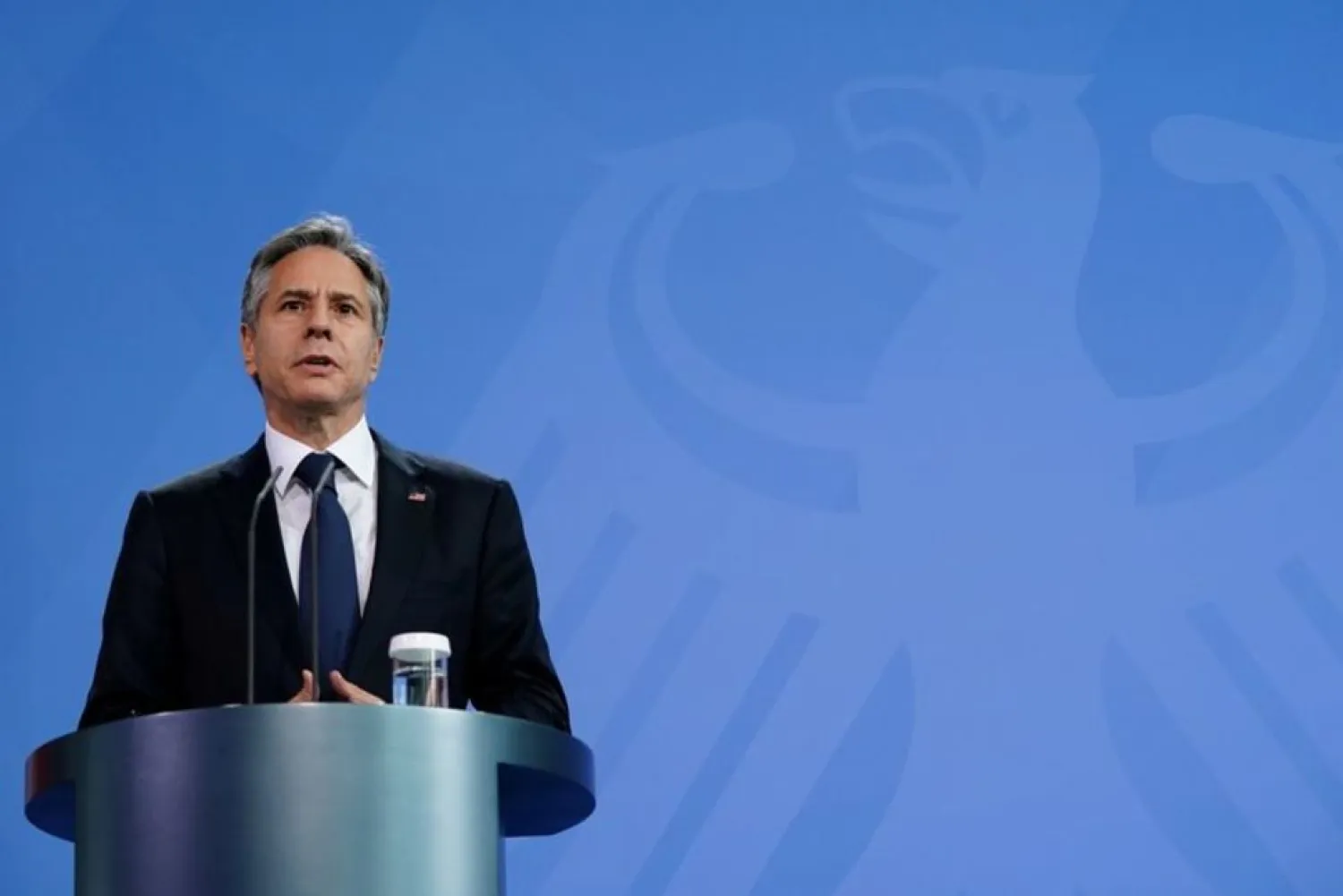

US Warns that ISIS Still a World Threat

US Secretary of State Antony Blinken speaks during a joint news conference with German Chancellor Angela Merkel (not pictured) at the Chancellery in Berlin, Germany June 23, 2021. (Reuters)
TT

US Warns that ISIS Still a World Threat

US Secretary of State Antony Blinken speaks during a joint news conference with German Chancellor Angela Merkel (not pictured) at the Chancellery in Berlin, Germany June 23, 2021. (Reuters)

As the US works on its military withdrawal from Afghanistan, members of the global coalition fighting the ISIS met Monday to chart future steps against the extremist group.

The meeting came just a day after the US launched air strikes against Iran-backed militias near the Iraq-Syria border

US Secretary of State Antony Blinken and Italian Foreign Minister Luigi Di Maio co-chaired the gathering of senior officials from the seven-year-old, 83-member bloc. Participants were taking stock of current efforts to ensure the complete defeat of ISIS, whose remnants still pose a threat in Iraq and Syria and have shown signs of surging in parts of Africa.

Amid significant other international priorities, including taming the coronavirus pandemic and stepping up the fight against climate change, the coalition is hoping to stabilize areas liberated from ISIS, repatriate and hold foreign fighters accountable for their actions and combat extremist messaging.

Blinken and Di Maio urged representatives of the 77 other countries and five organizations that make up the coalition not to drop their guard.

“We must step up the action taken by the coalition, increasing the areas in which we can operate,” said Di Maio.

Outside of Iraq and Syria, he said there was an “alarming” surge in ISIS activity, particularly in the Sahel, Mozambique and the Horn of Africa. He called for the coalition to create a special mechanism to deal with the threat in Africa.

Blinken noted that despite their defeat, ISIS elements in Iraq and Syria “still aspire to conduct large-scale attacks.”

“Together, we must stay as committed to our stabilization goals as we did to our military campaign that resulted in victory on the battlefield,” he said.

Blinken announced a new US contribution of $436 million to assist displaced people in Syria and surrounding countries and called for a new effort to repatriate — and rehabilitate or prosecute — some 10,000 ISIS fighters who remain imprisoned by the Syrian Defense Forces.

“This situation is simply untenable,” Blinken said. “It just can’t persist indefinitely.” However, no countries present made any new commitment to repatriating their citizens and it was unclear if the number of detainees could be reduced in any significant way in the near-term.

Blinken also announced sanctions against Ousmane Illiassou Djibo, a native of Niger, who is a key leader of the ISIS affiliate in the greater Sahara. Djibo was designated a global terrorist, meaning that any of his US are frozen and Americans are barred from any transactions with him.

In addition to the meeting on ISIS, foreign ministers of countries concerned about the broader conflict in Syria met in Rome ahead of a critical UN vote on whether to maintain a humanitarian aid corridor from Turkey.

Russia has resisted reauthorizing the channel amid stalled peace talks between the Syrian government and opposition factions.

Two senior US officials said Blinken told the Syria conference that the US believes the corridor must be reauthorized and expanded to prevent more deaths. The officials, who spoke on condition of anonymity because they weren’t authorized to publicly discuss the private diplomatic conversations, said Blinken made clear that any US-Russia cooperation on Syria would be dependent on Moscow agreeing to the extension. Russia, however, wasn’t present at the meeting.

Last week, the UN special envoy for Syria, Geir Pederson, said there were worrying signs that the ISIS may be getting stronger in the country and called for a boost in cooperation to counter it. Pederson has also joined calls for new international talks on ending Syria’s war.

Since the Syrian conflict erupted in March 2011, numerous high-level gatherings aimed at ending the fighting and guiding the country to a political transition have failed. The UN, US, Russia and many other countries support a 2015 Security Council resolution endorsing a roadmap to peace in Syria that calls for a new constitution followed by UN-supervised elections.

Blinken, who also met with Italian Prime Minister Mario Draghi and President Sergio Mattarella on Monday, hailed the state of US-European relations, noting that Italy, France and Germany — the three countries he visited on his current European tour — are the only members of NATO, the Group of Seven and the European Union.

“We share a deep commitment to promoting democracy and human rights,” he said. “We see the same big challenges on the horizon. And we recognize that we can’t tackle them alone.”

Blinken and Di Maio downplayed differences between the US and Italy over China, saying there was an increasing awareness of the complexities and dangers of dealing with Beijing.



Arab League Condemns Attack on Aid Convoys in Sudan

A general view shows the opening session of the meeting of Arab foreign ministers at the Arab League Headquarters (Reuters)
TT

Arab League Condemns Attack on Aid Convoys in Sudan

A general view shows the opening session of the meeting of Arab foreign ministers at the Arab League Headquarters (Reuters)

Arab League Secretary-General Ahmed Aboul Gheit strongly condemned the attack by the Rapid Support Forces on humanitarian aid convoys and relief workers in North Kordofan State, Sudan.

In a statement reported by SPA, secretary-general's spokesperson Jamal Rushdi quoted Aboul Gheit as saying the attack constitutes a war crime under international humanitarian law, which prohibits the deliberate targeting of civilians and depriving them of their means of survival.

Aboul Gheit stressed the need to hold those responsible accountable, end impunity, and ensure the full protection of civilians, humanitarian workers, and relief facilities in Sudan.


Gaza's Rafah Crossing Reopens, Allowing Limited Travel as Palestinians Claim Delays, Mistreatment

Ayada Al-Sheikh is welcomed by his sister, Nisreen, upon his arrival in Khan Younis in the southern Gaza Strip after returning to Gaza following the long-awaited reopening of the Rafah border crossing, early Thursday, Feb. 5, 2026. (AP Photo/Abdel Kareem Hana)
TT

Gaza's Rafah Crossing Reopens, Allowing Limited Travel as Palestinians Claim Delays, Mistreatment

Ayada Al-Sheikh is welcomed by his sister, Nisreen, upon his arrival in Khan Younis in the southern Gaza Strip after returning to Gaza following the long-awaited reopening of the Rafah border crossing, early Thursday, Feb. 5, 2026. (AP Photo/Abdel Kareem Hana)

A limited number of Palestinians were able to travel between Gaza and Egypt on Sunday, after Gaza's Rafah crossing reopened after a two-day closure, Egyptian state media reported.

The vital border point opened last week for the first time since 2024, one of the main requirements for the US-backed ceasefire. The crossing was closed Friday and Saturday because of confusion about reopening operations.

Egypt's Al Qahera television station said that Palestinians began crossing in both directions around noon on Sunday. Israel didn't immediately confirm the information, according to The AP news.

Meanwhile, Israeli Prime Minister Benjamin Netanyahu is expected to travel to Washington this week, though the major subject of discussion will be Iran, his office said.

Over the first four days of the crossing's opening, just 36 Palestinians requiring medical care were allowed to leave for Egypt, plus 62 companions, according to UN data, after Israel retrieved the body of the last hostage held in Gaza and several American officials visited Israel to press for the opening.

Palestinian officials say nearly 20,000 people in Gaza are seeking to leave for medical care that isn't available in the territory. Those who have succeeded in crossing described delays and allegations of mistreatment by Israeli forces and other groups involved in the crossing, including an Israeli-backed Palestinian armed group, Abu Shabab.

A group of Palestinian patients and wounded gathered Sunday morning in the courtyard of a Red Crescent hospital in Gaza’s southern city of Khan Younis, before making their way to the Rafah crossing with Egypt for treatment abroad, family members told The Associated Press.

Amjad Abu Jedian, who was injured in the war, was scheduled to leave Gaza for medical treatment on the first day of the crossing’s reopening, but only five patients were allowed to travel that day, his mother, Raja Abu Jedian, said. Abu Jedian was shot by an Israeli sniper while he doing building work in the central Bureij refugee camp in July 2024, she said.

On Saturday, his family received a call from the World Health Organization notifying them that he is included in the group that will travel on Sunday, she said.

“We want them to take care of the patients (during their evacuation),” she said. “We want the Israeli military not to burden them.”

The Israeli defense branch that oversees the operation of the crossing didn't immediately confirm the opening.

Heading back to Gaza A group of Palestinians also arrived Sunday morning at the Egyptian side of the Rafah crossing to return to the Gaza Strip, Egypt’s state-run Al-Qahera News satellite television reported.

Palestinians who returned to Gaza in the first few days of the crossing's operation described hours of delays and invasive searches by Israeli authorities and Abu Shabab. A European Union mission and Palestinian officials run the border crossing, and Israel has its screening facility some distance away.

The crossing was reopened on Feb. 2 as part of a fragile ceasefire deal to halt the Israel-Hamas war.

The Rafah crossing, an essential lifeline for Palestinians in Gaza, was the only one in the Palestinian territory not controlled by Israel before the war. Israel seized the Palestinian side of Rafah in May 2024, though traffic through the crossing was heavily restricted even before that.

Restrictions negotiated by Israeli, Egyptian, Palestinian and international officials meant that only 50 people would be allowed to return to Gaza each day and 50 medical patients — along with two companions for each — would be allowed to leave, but far fewer people have so far crossed in both directions.

A senior Hamas official, Khaled Mashaal, said the militant group is open to discuss the future of its arms as part of a “balanced approach” that includes the reconstruction of Gaza and protecting the Palestinian enclave from Israel.

Mashaal said the group has offered multiple options, including a long-term truce, as part of its ongoing negotiations with Egyptian, Qatari and Turkish mediators.

Hamas plans to agree to a number of “guarantees,” including a 10-year period of disarmament and an international peacekeeping force on the borders, “to maintain peace and prevent any clashes,” between the militants and Israel, Mashaal said at a forum in Qatar’s capital, Doha.

Israel has repeatedly demanded a complete disarmament and destruction of Hamas and its infrastructure, both military and civil.

Mashaal accused Israel of financing and arming militias, like the Abu Shabab group which operates in Israeli military-controlled areas in Gaza, “to create chaos” in the enclave.

In the forum, Mashaal was asked about Hamas’ position from US President Donald Trump’s Board of Peace. He didn’t offer a specific answer, but said that the group won’t accept “foreign intervention” in Palestinian affairs.

“Gaza is for the people of Gaza. Palestinians are for the people of Palestine,” he said. “We will not accept foreign rule.”


Three Deadly Attacks on Health Centers in Sudan's South Kordofan in Past Week, Says WHO

Sudanese families prepare to ride on trucks while on their way to Egypt through the Qustul border, after the crisis in Sudan's capital Khartoum, in the Sudanese city of Wadi Halfa, Sudan May 1, 2023. (Reuters)
TT

Three Deadly Attacks on Health Centers in Sudan's South Kordofan in Past Week, Says WHO

Sudanese families prepare to ride on trucks while on their way to Egypt through the Qustul border, after the crisis in Sudan's capital Khartoum, in the Sudanese city of Wadi Halfa, Sudan May 1, 2023. (Reuters)

Sudan's South Kordofan region has seen attacks on three health facilities in the past week alone, leaving more than 30 dead, the World Health Organization said Sunday, AFP reported.

"Sudan's health system is under attack again," WHO chief Tedros Adhanom Ghebreyesus said on X, pointing out that, since February 3, "three health facilities were attacked in South Kordofan, in a region already suffering acute malnutrition".