


Could Balloons Power Uncensored Internet in Cuba?

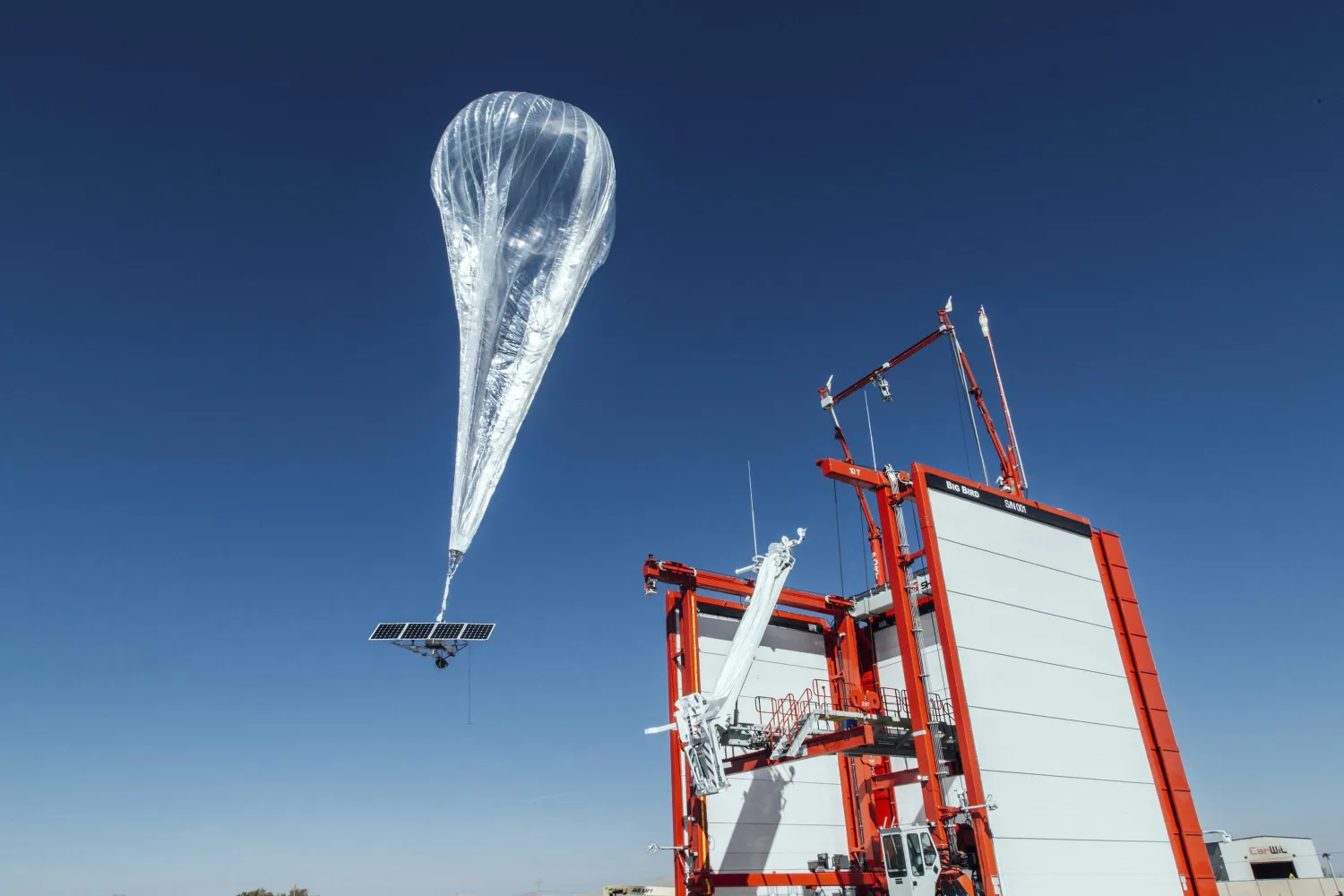
FILE - This Wednesday, Oct. 18, 2017, file photo provided by Project Loon shows a stratospheric balloon taking off for Puerto Rico from a project site in Winnemucca, Nev. For years, Alphabet, the parent company of Google, worked to perfect an internet-balloon division service called Loon. It shut down that project in January 2021, saying it wasn't commercially viable. (Project Loon via AP, File)
TT

Could Balloons Power Uncensored Internet in Cuba?

FILE - This Wednesday, Oct. 18, 2017, file photo provided by Project Loon shows a stratospheric balloon taking off for Puerto Rico from a project site in Winnemucca, Nev. For years, Alphabet, the parent company of Google, worked to perfect an internet-balloon division service called Loon. It shut down that project in January 2021, saying it wasn't commercially viable. (Project Loon via AP, File)

Florida’s Republican governor, Ron DeSantis, called this week on the administration of President Joe Biden to greenlight a plan to transmit the internet to people in Cuba via high-altitude balloons when their government has blocked access.

CAN INTERNET BE DELIVERED BY BALLOON?

Yes. For years, Alphabet — the parent company of Google — worked to perfect an internet-balloon division service called Loon. It shut down that project in January, saying it wasn't commercially viable.

Prior to the shutdown, Loon balloons had been providing service in mountainous areas in Kenya through a partnership with a local telecom, Telkom Kenya. The service also helped provide wireless communications in Puerto Rico in the aftermath of Hurricane Maria, which destroyed the island's mobile network. Loon partnered with AT&T to make service available.

HOW DOES THAT WORK?

The Loon balloons were effectively cell towers the size of a tennis court. They floated 60,000 to 75,000 feet, or 11 to 14 miles (18,000- 23,000 meters, or 18-22 kilometers), above the Earth, well above commercial jetliner routes. Made of the commonplace plastic polyethylene, the balloons used solar panels for electricity and could deliver service to smartphones in partnership with a local telecom.

Each balloon could serve thousands of people, the company said. But they had to be replaced every five months or so because of the harsh conditions in the stratosphere. And the balloons could be difficult to control. “Navigating balloons through the stratosphere has always been hard,” wrote Salvatore Candido, who had been chief technology officer for Loon, in a December 2020 blog post. The company created algorithms that tracked wind patterns.

WHAT EQUIPMENT WAS REQUIRED?

Loon had said that beyond the balloons themselves, it needed network integration with a telecom to provide service and some equipment on the ground in the region. It also needed permission from local regulators — something that the Cuban government isn't likely to grant.

COULD A NETWORK BE SET UP FROM AFAR?

Yes. Loon used multiple balloons to extend connections beyond the necessary ground link. In one 2018 test, Loon said the connection jumped 1,000 kilometers, or about 620 miles, over 7 balloons. Another time, it bridged a wireless connection over 600 kilometers, or about 370 miles, between two balloons. Cuba and Florida are only about 100 miles (160 kilometers) apart at their closest.

IS THAT FEASIBLE?

But experts aren't sure it would be that easy to set up a guerrilla internet service for Cuba this way. It would need an unused band of spectrum, or radio frequencies, to transmit a connection to Cuba, and spectrum use is typically controlled by national governments. Anyone trying this would have to find a free block of spectrum that wouldn't be interfered with, said Jacob Sharony, of Mobius Consulting, a mobile and wireless consulting firm.

Balloon- or drone-powered networks aren't likely to be economical over the long term, said Tim Farrar of TMF Associates, a satellite communications consultant. While they're suitable for bridging communications amid disasters or in war zones, the transmission capabilities of such networks isn't large — “certainly not enough to serve the entire population of Cuba or anything like that,” Farrar said.

Another challenge: The Cuban government could also try to jam the signal.

WHO IS INVOLVED IN THE CUBA EFFORT?

DeSantis promoted the balloon idea Thursday alongside two Cuban-American members of Congress from the Miami area, Reps. Maria Salazar and Carlos Gimenez, FCC commissioner Brendan Carr and Cuban-American lawyer, businessman and museum director Marcell Felipe.

Felipe said he has been talking for about two years with a defense contractor who could deploy such balloons in a cost-effective way in airspace near Cuba, but declined to name the company. Felipe said his idea would involve transmitting internet connectivity directly to mobile phones on the island without the participation of any ground provider. In comments to The Associated Press, Felipe claimed it wouldn't be feasible for the Cuban government to block these balloon-delivered signals “in any significant manner,'' though he didn't cite any evidence.

None of the supporters provided a cost estimate. Salazar said that if the federal government endorsed the plan, she believes it could be funded entirely with contributions from members of the Cuban diaspora if necessary.

WHAT IS INTERNET ACCESS LIKE IN CUBA?

Internet access in Cuba has been expensive and relatively rare until recently. Starting in December 2018, Cubans could get internet access on their phones through the state telecom monopoly. More than half of Cubans today have internet access.

But the Cuban government restricts independent media and censors what's available to Cubans online, according to Human Rights Watch. It disrupts internet access in an attempt to head off protests.




Olympic Tourists in Cortina Can Explore the Dolomites with the New ‘Uber Snowmobile’ Service

 The peaks of the Dolomites are seen from the Cortina Sliding Centre during the Milano Cortina 2026 Winter Olympic Games in Cortina d'Ampezzo on February 5, 2026. (AFP)
The peaks of the Dolomites are seen from the Cortina Sliding Centre during the Milano Cortina 2026 Winter Olympic Games in Cortina d'Ampezzo on February 5, 2026. (AFP)
TT

Olympic Tourists in Cortina Can Explore the Dolomites with the New ‘Uber Snowmobile’ Service

 The peaks of the Dolomites are seen from the Cortina Sliding Centre during the Milano Cortina 2026 Winter Olympic Games in Cortina d'Ampezzo on February 5, 2026. (AFP)
The peaks of the Dolomites are seen from the Cortina Sliding Centre during the Milano Cortina 2026 Winter Olympic Games in Cortina d'Ampezzo on February 5, 2026. (AFP)

The peaks of the Dolomites are seen from the Cortina Sliding Centre during the Milano Cortina 2026 Winter Olympic Games in Cortina d'Ampezzo on February 5, 2026. (AFP)

For one month starting on Saturday, Olympic spectators keen for a side trip to a UNESCO World Heritage Site can use Uber to reserve a ride on a snowmobile along the snow-covered road to the base of the Three Peaks of Lavaredo.

The dramatic, jagged limestone pinnacles stand just 23 kilometers (14.3 miles) from the Cortina venues where athletes are competing in the 2026 Winter Olympics and Paralympics.

One of the Olympic torchbearers, Giulia Baffetti, runs snowmobiling tours through Cortina-based winter activities outfit Snowdreamers. The company partnered with Uber, the official ride-hailing sponsor for the Games, to offer free tours on the weekends in February to people in town.

"Uber Snowmobile" tours, which can only be booked through Uber, include a ride in an Uber transfer bus for up to eight people from Cortina to the spot where riders mount their snowmobiles for departure. Tourgoers then follow the instructor, who leads the line of snowmobiles.

The first slots offered went fast, but Uber spokesperson Caspar Nixon said Friday that it planned to add more.

The three peaks are a magical place, Baffetti said, and this is a way for more people to experience it. Hikers and climbers flock there in the warmer months. In the winter, it’s a prime spot for cross-country skiing, snowshoeing and sledding. Snowmobiling is allowed in a limited area in order to protect the environment.

"We want to give an experience to the tourists, so they can feel the mountains in a different way," she said.

The Associated Press took the one-hour tour on Thursday, ahead of the Saturday launch, along with one other person. Helmets are essential, while heated handgrips are a most welcome feature. And that red button? Passengers can push it to stop the snowmobile if it veers off course or they feel unsafe.

The adrenaline-filled ride reaches speeds up to 40 kph (25 mph) when zooming past snow-covered trees, and drivers are instructed to slow when coming upon cross-country skiers and sledders. Deer and wolves are sometimes seen along the 7-kilometer (4.3-mile) route up to the base of the peaks.

Also visible on Thursday was the southernmost of the three Lavaredo peaks, rising sharply out of the fog. While the Dolomites are breathtaking from Cortina — and on Friday, the sun shone and the view was clear from town — they are even more impressive up close.

The route back includes a short loop around Lake Antorno. Before traversing all the ups and downs, the snowmobile instructor leading the tour offers a reminder about that red button.

Saher Deeb, an Israeli tourist, was along for the ride Thursday, one day after his 29th birthday. It was his first time on a snowmobile, and he was all smiles as he climbed off at the end.

"It was perfect," he said.


French Duo Finish Walking from France to Shanghai After 1.5 Years

 Performers throw molten iron to create sparks during a performance on the Bund promenade along the Huangpu river, ahead of the upcoming Lunar New Year of the Horse in Shanghai on February 2, 2026. (AFP)
Performers throw molten iron to create sparks during a performance on the Bund promenade along the Huangpu river, ahead of the upcoming Lunar New Year of the Horse in Shanghai on February 2, 2026. (AFP)
TT

French Duo Finish Walking from France to Shanghai After 1.5 Years

 Performers throw molten iron to create sparks during a performance on the Bund promenade along the Huangpu river, ahead of the upcoming Lunar New Year of the Horse in Shanghai on February 2, 2026. (AFP)
Performers throw molten iron to create sparks during a performance on the Bund promenade along the Huangpu river, ahead of the upcoming Lunar New Year of the Horse in Shanghai on February 2, 2026. (AFP)

Two French adventurers reached the end of an epic walk from France to Shanghai on Saturday, after nearly a year and a half crossing 16 countries almost entirely on foot.

Loic Voisot and Benjamin Humblot embraced as they stood by the river on the Bund promenade, the financial hub's distinctive skyline glittering in the background.

Voisot and Humblot set off from Annecy in September 2024.

"We were thinking about this moment almost every day for more than a year now, so it's a really strong feeling," Humblot said of reaching their destination.

Hanging out after work one day, the two friends realized they both yearned for a "great adventure".

They wanted to visit China -- but without flying, which they believe is too harmful to the environment.

A plan to set out on foot was hatched, and except for a stretch in Russia which was done by bus for safety reasons, 518 days and around 12,850 kilometers (7,980 miles) later they took the last steps to completing it.

Around 50 people gathered at the start point for the last 10km stretch of their odyssey, many local people who have been following them on social media.

Along the way their numbers swelled, as media, French residents of Shanghai and others joined.

"If your dreams are crazy, just take it step by step and sometimes you will not succeed, but sometimes you will," said Voisot.

Asked what he would do first now the walk was over, he joked: "Sleep a lot!"


Annual Orchids Show Brings Vivid Color to Chicago Winter

Orchids adorn a Volkswagen Beetle as finishing touches are placed on the 12th annual Chicago Botanic Garden Orchid Show, Friday, Feb. 6, 2026, in Glencoe, Ill. (AP)
TT

Annual Orchids Show Brings Vivid Color to Chicago Winter

Orchids adorn a Volkswagen Beetle as finishing touches are placed on the 12th annual Chicago Botanic Garden Orchid Show, Friday, Feb. 6, 2026, in Glencoe, Ill. (AP)

A soft layer of white snow blankets the grounds of the Chicago Botanic Garden. The air is chilly, the sky gray.

Inside, however, the air is warm and lights illuminate more than 10,000 vividly colored orchids. Staff members move in and out of greenhouses, preparing to open the garden’s 12th annual Orchid Show on Saturday.

This year’s theme is “Feelin’ Groovy" with several installations calling back to the 1970s, including a yellow Volkswagen Beetle filled with orchids.

“It’s just a really great way to get out of the winter cold and come into our greenhouses,” said Jodi Zombolo, associate vice president of visitor events and programs. “I think people are really looking for something to kind of bring happiness and something that they will enjoy and find whimsy in.”

The orchid family is one of the largest in the plant world and some of the species in the show are rare, exhibits horticulturist Jason Toth said. One example is the Angraecum sesquipedale, also known as Darwin’s orchid, on display in the west gallery.

Toth said the orchid led Darwin to correctly conclude that pollinators have adapted in order to reach down the flower's very long end.

"It has a great story and it’s quite remarkable-looking,” said Toth.

Elsewhere, massive, gnarly roots dangle from purple, pink and yellow Vanda orchids in the south greenhouse. These epiphytic orchids grow on the surface of trees instead of in soil.

“I think everyone’s tired of the winter,” said Toth. “So having some kind of flower show at this point is what we’re all craving. And 'Orchids' fits the bill.”

The show is expected to draw 85,000 visitors this year.