


Climate Change Sees Swiss Alps Add Over 1,000 Lakes

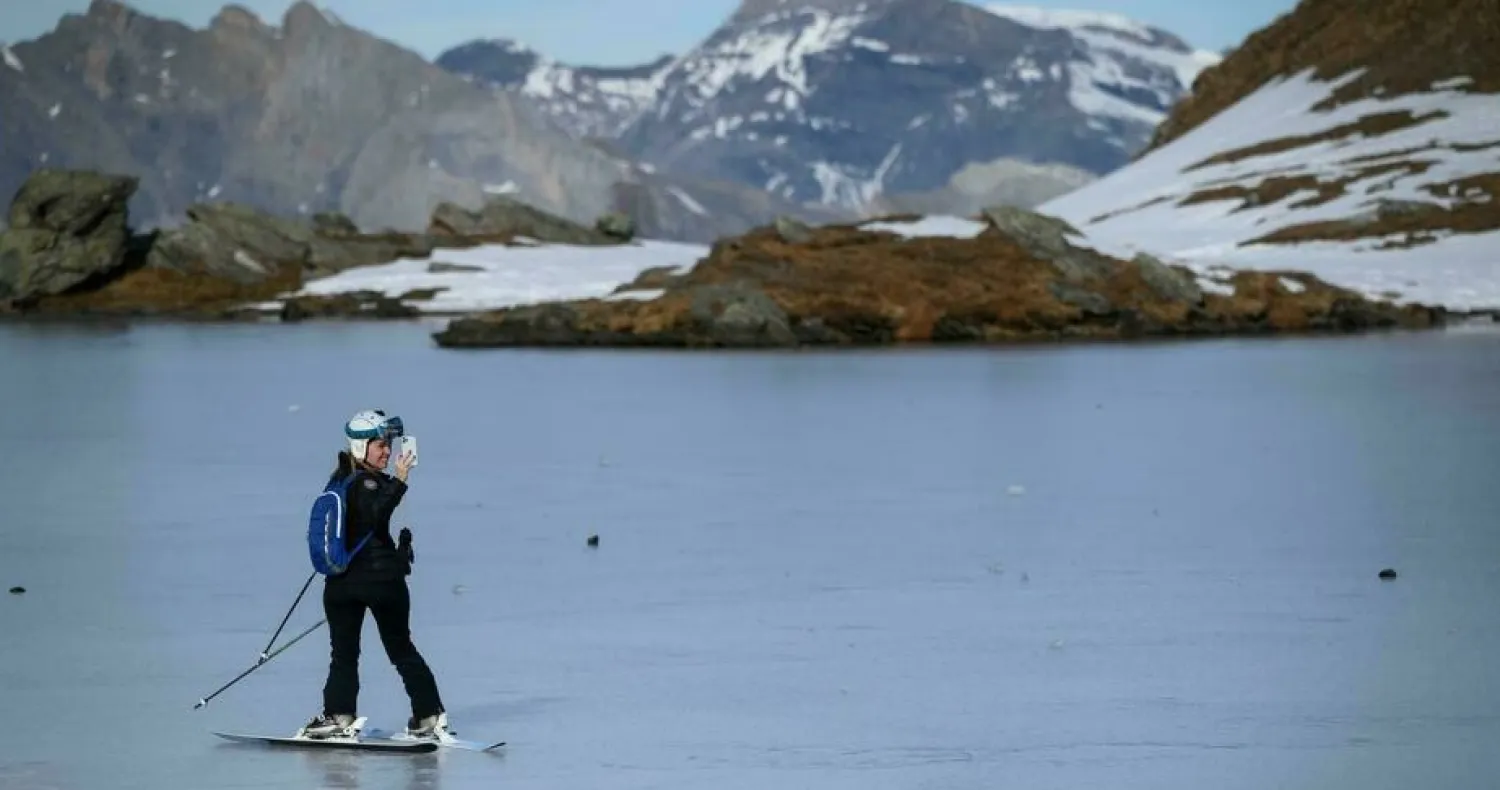
Glaciers in the Swiss Alps are in steady decline, losing a full two percent of their volume last year alone Fabrice COFFRINI AFP
TT

Climate Change Sees Swiss Alps Add Over 1,000 Lakes

Glaciers in the Swiss Alps are in steady decline, losing a full two percent of their volume last year alone Fabrice COFFRINI AFP

Climate change has dramatically altered the Swiss Alp landscape -- at a quicker pace than expected -- as melting glaciers have created more than 1,000 new lakes across in the mountains, a study published Monday showed.

The inventory of Swiss Glacial lakes showed that almost 1,200 new lakes have formed in formerly glaciated regions of the Swiss Alps since the end of the Little Ice Age around 1850.

Around 1,000 of them still exist today, according to the study published by the Swiss Federal Institute of Aquatic Science and Technology (Eawag).

That is far more than the few hundreds the researchers had expected to find at the beginning of the project, according to AFP.

"We were surprised by the sheer numbers," Daniel Odermatt, head of the Eawag Remote Sensing Group that carried out the study, said in a statement.

He said the "marked acceleration in formation" was also surprising, pointing out that "80 have been added in the last decade alone".

Glaciers in the Swiss Alps are in steady decline, losing a full two percent of their volume last year alone, according to an annual study published by the Swiss Academies of Science.

And even if the world were to fully implement the 2015 Paris Agreement -- which calls for capping global warming at at least two degrees Celsius -- two-thirds of the Alpine glaciers will likely be lost, according to a 2019 study by the ETH technical university in Zurich.

The Eawag assessment showed that there was an initial peak in glacial lake formation in the Swiss Alps between 1946 and 1973, when nearly eight new lakes appeared on average each year.

After a brief decline, the lake formation rate surged between 2006 and 2016, with 18 new lakes appearing each year on average, while the water surface swelled by over 400 square metres (4,300 square feet) annually.

This, Eawag said, is "visible evidence of climate change in the Alps".

The comprehensive inventory was made possible by large troves of data gathered from the Switzerland's glaciers since the mid-19th century.

In total, the researchers were able to draw on data from seven periods between 1850 and 2016.

For each of the 1,200 lakes formed since 1850, the scientists recorded the location, elevation, shape and area of the lake at the different times, as well as the type of material of the dam and surface drainage.

Based on such basic information, researchers can estimate hazards, including the risk of a sudden emptying in the event of a dam failure.

Eawag warned that the growing number of glacial lakes increases the risk of such outbursts and thus the danger of flood waves for the settlements below.



Coffee Regions Hit by Extra Days of Extreme Heat, Say Scientists 

17 April 2012, North Rhine-Westphalia, Vluyn: A general view of Arabica Coffee beans. (dpa)
TT

Coffee Regions Hit by Extra Days of Extreme Heat, Say Scientists 

17 April 2012, North Rhine-Westphalia, Vluyn: A general view of Arabica Coffee beans. (dpa)

The world's main coffee-growing regions are roasting under additional days of climate change-driven heat every year, threatening harvests and contributing to higher prices, researchers said Wednesday.

An analysis found that there were 47 extra days of harmful heat per year on average in 25 countries representing nearly all global coffee production between 2021 and 2025, according to independent research group Climate Central.

Brazil, Vietnam, Colombia, Ethiopia and Indonesia -- which supply 75 percent of the world's coffee -- experienced on average 57 additional days of temperatures exceeding the threshold of 30C.

"Climate change is coming for our coffee. Nearly every major coffee-producing country is now experiencing more days of extreme heat that can harm coffee plants, reduce yields, and affect quality," said Kristina Dahl, Climate Central's vice president for science.

"In time, these impacts may ripple outward from farms to consumers, right into the quality and cost of your daily brew," Dahl said in a statement.

US tariffs on imports from Brazil, which supplies a third of coffee consumed in the United States, contributed to higher prices this past year, Climate Central said.

But extreme weather in the world's coffee-growing regions is "at least partly to blame" for the recent surge in prices, it added.

Coffee cultivation needs optimal temperatures and rainfall to thrive.

Temperatures above 30C are "extremely harmful" to arabica coffee plants and "suboptimal" for the robusta variety, Climate Central said. Those two plant species produce the majority of the global coffee supply.

For its analysis, Climate Central estimated how many days each year would have stayed below 30C in a world without carbon pollution but instead exceeded that level in reality -- revealing the number of hot days added by climate change.

The last three years have been the hottest on record, according to climate monitors.


Dog Gives Olympics Organizers Paws for Thought

A dog wanders on the ski trail during the women's team cross country free sprint qualification event of the Milano Cortina 2026 Winter Olympic Games at Tesero Cross-Country Skiing Stadium in Lago di Tesero (Val di Fiemme), on February 18, 2026. (Photo by Anne-Christine POUJOULAT / AFP)
TT

Dog Gives Olympics Organizers Paws for Thought

A dog wanders on the ski trail during the women's team cross country free sprint qualification event of the Milano Cortina 2026 Winter Olympic Games at Tesero Cross-Country Skiing Stadium in Lago di Tesero (Val di Fiemme), on February 18, 2026. (Photo by Anne-Christine POUJOULAT / AFP)

A dog decided he would bid for an unlikely Olympic medal on Wednesday as he joined the women's cross country team free sprint in the Milan-Cortina Games.

The dog ran onto the piste in Tesero in northern Italy and gamely, even without skis, ran behind two of the competitors, Greece's Konstantina Charalampidou and Tena Hadzic of Croatia.

He crossed the finishing line, his moment of glory curtailed as he was collared by the organizers and led away -- his owner no doubt will have a bone to pick with him when they are reunited.


Olives, Opera and a Climate-Neutral Goal: How a Mural in Greece Won ‘Best in the World’ 

A building with the mural entitled “Kalamata” depicting opera legend Maria Callas by artist Kleomenis Kostopoulos is seen in Kalamata town, about 240 kilometers (150 miles) southwest of Athens, Monday, Feb. 9, 2026. (AP) 
TT

Olives, Opera and a Climate-Neutral Goal: How a Mural in Greece Won ‘Best in the World’ 

A building with the mural entitled “Kalamata” depicting opera legend Maria Callas by artist Kleomenis Kostopoulos is seen in Kalamata town, about 240 kilometers (150 miles) southwest of Athens, Monday, Feb. 9, 2026. (AP) 

Long known for its olives and seaside charm, the southern Greek city of Kalamata has found itself in the spotlight thanks to a towering mural that reimagines legendary soprano Maria Callas as an allegory for the city itself.

The massive artwork on the side of a prominent building in the city center has been named 2025’s “Best Mural of the World” by Street Art Cities, a global platform celebrating street art.

Residents of Kalamata, approximately 240 kilometers (150 miles) southwest of Athens, cultivate the world-renowned olives, figs and grapes that feature prominently on the mural.

That was precisely the point.

Vassilis Papaefstathiou, deputy mayor of strategic planning and climate neutrality, explained Kalamata is one of the few Greek cities with the ambitious goal of becoming climate-neutral by 2030. He and other city leaders wanted a way to make abstract concepts, including sustainable development, agri-food initiatives, and local economic growth, more tangible for the city’s nearly 73,000 residents.

That’s how the idea of a massive mural in a public space was born.

“We wanted it to reflect a very clear and distinct message of what sustainable development means for a regional city such as Kalamata,” Papaefstathiou said. “We wanted to create an image that combines the humble products of the land, such as olives and olive oil — which, let’s be honest, are famous all over the world and have put Kalamata on the map — with the high-level art.”

“By bringing together what is very elevated with ... the humbleness of the land, our aim was to empower the people and, in doing so, strengthen their identity. We want them to be proud to be Kalamatians.”

Southern Greece has faced heatwaves, droughts and wildfires in recent years, all of which affect the olive groves on which the region’s economy is hugely dependent.

The image chosen to represent the city was Maria Callas, widely hailed as one of the greatest opera singers of the 20th century and revered in Greece as a national cultural symbol. She may have been born in New York to Greek immigrant parents, but her father came from a village south of Kalamata. For locals, she is one of their own.

This connection is also reflected in practice: the alumni association at Kalamata’s music school is named for Callas, and the cultural center houses an exhibition dedicated to her, which includes letters from her personal archive.

Artist Kleomenis Kostopoulos, 52, said the mural “is not actually called ‘Maria Callas,’ but ‘Kalamata’ and my attempt was to paint Kalamata (the city) allegorically.”

Rather than portraying a stylized image of the diva, Kostopoulos said he aimed for a more grounded and human depiction. He incorporated elements that connect the people to their land: tree branches — which he considers the above-ground extension of roots — birds native to the area, and the well-known agricultural products.

“The dress I create on Maria Callas in ‘Kalamata’ is essentially all of this, all of this bloom, all of this fruition,” he said. “The blessed land that Kalamata itself has ... is where all of these elements of nature come from.”

Creating the mural was no small feat. Kostopoulos said it took around two weeks of actual work spread over a month due to bad weather. He primarily used brushes but also incorporated spray paint and a cherry-picker to reach all edges of the massive wall.

Papaefstathiou, the deputy mayor, said the mural has become a focal point.

“We believe this mural has helped us significantly in many ways, including in strengthening the city’s promotion as a tourist destination,” he said.

Beyond tourism, the mural has sparked conversations about art in public spaces. More building owners in Kalamata have already expressed interest in hosting murals.

“All of us — residents, and I personally — feel immense pride,” said tourism educator Dimitra Kourmouli.

Kostopoulos said he hopes the award will have a wider impact on the art community and make public art more visible in Greece.

“We see that such modern interventions in public space bring tremendous cultural, social, educational and economic benefits to a place,” he said. “These are good springboards to start nice conversations that I hope someday will happen in our country, as well.”