

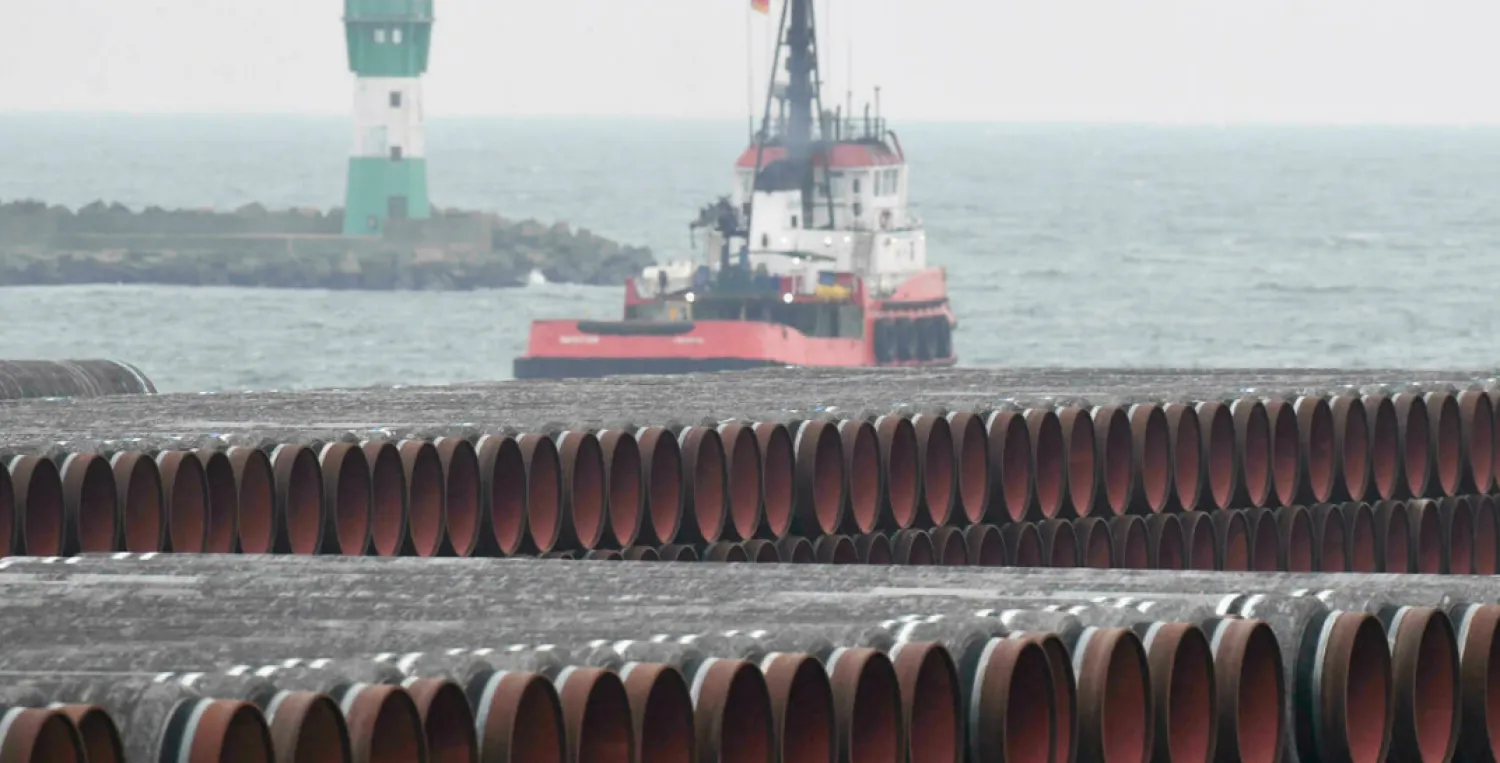

US, Germany Make Deal on Russia's Nord Stream 2 Gas Pipeline to Europe

Pipes for the Nord Stream 2 Russian gas pipeline are stored on the premises of the port of Mukran on the island of Ruegen in Germany, December 4, 2020. © Stefan Sauer, AP
TT

US, Germany Make Deal on Russia's Nord Stream 2 Gas Pipeline to Europe

Pipes for the Nord Stream 2 Russian gas pipeline are stored on the premises of the port of Mukran on the island of Ruegen in Germany, December 4, 2020. © Stefan Sauer, AP

The United States and Germany have announced a deal to allow the completion of a controversial Russian gas pipeline to Europe without the imposition of further US sanctions. The agreement aims to stanch fears about European dependence on Russian energy, but it was immediately assailed by critics who said it doesn't go far enough.

Under the terms of the deal Wednesday, the US and Germany committed to countering any Russian attempt to use the Nord Stream 2 pipeline as a political weapon. And, they agreed to support Ukraine and Poland, both of which are bypassed by the project and fear Russia's intentions, by funding alternative energy and development projects.

“The United States and Germany are united in their determination to hold Russia to account for its aggression and malign activities by imposing costs via sanctions and other tools," they said in a joint statement that covered Nord Stream 2 as well as Russia's support for separatists in Ukraine, The Associated Press reported.

“Should Russia attempt to use energy as a weapon or commit further aggressive acts against Ukraine, Germany will take action at the national level and press for effective measures at the European level, including sanctions, to limit Russian export capabilities to Europe in the energy sector,” it said.

The Nord Stream 2 project has posed a major foreign policy dilemma for the Biden administration. US officials from both parties have long feared that it would give Russia too much power over European gas supplies. But the pipeline is almost completed and the US has been determined to rebuild ties with Germany that were damaged during the Trump administration.

Poland and Ukraine expressed their displeasure over the decision to allow the pipeline's completion and said the efforts to reduce the Russian security threat were not sufficient.

“This decision has created a political, military and energy threat for Ukraine and Central Europe, while increasing Russia’s potential to destabilize the security situation in Europe, perpetuating divisions among NATO and European Union member states,” the Polish and Ukrainian foreign ministers said in a joint statement.

The Kremlin said Russian President Vladimir Putin spoke with Merkel on Wednesday and they discussed the possibility of extending a deal on transit of Russian gas via Ukraine after 2024.

In a nod to Poland, Germany also agreed to sign onto the “Three Seas Initiative,” an EU and US-promoted scheme that aims to boost investment, infrastructure development and energy security among the countries bordering the Baltic, Black, and Adriatic seas. The German government, the statement said, would help to contribute up to $1.7 billion of European Union funding for the initiative through 2027.

Despite the agreement, there remains strong bipartisan opposition to the pipeline in Congress, as well as in Ukraine and Poland, and like the Trump administration before it, the Biden administration also says it opposes the pipeline. US officials have said sanctions won't stop it.

The top Republican on the House Foreign Affairs Committee, Rep. Michael McCaul of Texas, said he had no doubt Russia “will use the Nord Stream 2 pipeline as a weapon of coercion against Ukraine and transatlantic energy security as soon as it is operational. Promises to invest in future Ukrainian energy projects and ambiguous threats of consequences won’t change that reality."

Sen. Ted Cruz, R-Texas, also objected, calling it “weak," and several Democrats, including Senate Foreign Relations Committee Chairman Bob Menendez of New Jersey and Sen. Jeanne Shaheen of New Hampshire, have been consistently critical of the administration's approach.

“I am not yet convinced that this agreement — or any bilateral agreement — can sufficiently provide assurances to our European allies and minimize the considerable economic impact and security implications of this pipeline’s completion,” Shaheen said in a statement.

The State Department's third-ranking official, Under Secretary of State for Political Affairs Victoria Nuland, categorically denied reports that Ukraine had been warned against publicly complaining about the agreement and noted that the State Department's counselor, Derek Chollet, was visiting both Kyiv and Warsaw this week to inform them of the deal. She told lawmakers on Wednesday that the deal was the best way to deal with the situation.



Top Trump Iran Negotiator Says Visits US Aircraft Carrier in Middle East

US Special Envoy Steve Witkoff delivers a press conference upon the signing of the declaration on deploying post-ceasefire force in Ukraine, during the so-called "Coalition of the Willing" summit, at the Elysee Palace in Paris, France, January 6, 2026. (Reuters)
TT

Top Trump Iran Negotiator Says Visits US Aircraft Carrier in Middle East

US Special Envoy Steve Witkoff delivers a press conference upon the signing of the declaration on deploying post-ceasefire force in Ukraine, during the so-called "Coalition of the Willing" summit, at the Elysee Palace in Paris, France, January 6, 2026. (Reuters)

US President Donald Trump's lead Iran negotiator Steve Witkoff on Saturday said he visited the USS Abraham Lincoln aircraft carrier currently in the Arabian Sea, with Washington and Tehran due to hold further talks soon.

"Today, Adm. Brad Cooper, Commander of US Naval Forces Central Command, Jared Kushner, and I met with the brave sailors and Marines aboard the USS Abraham Lincoln, her strike group, and Carrier Air Wing 9 who are keeping us safe and upholding President Trump's message of peace through strength," said Witkoff in a social media post.

Iranian Foreign Minister Abbas Araghchi said on Saturday he hoped talks with the United States would resume soon, while reiterating Tehran's red lines and warning against any American attack.


Israel’s Netanyahu Expected to Meet Trump in US on Wednesday and Discuss Iran

Israeli Prime Minister Benjamin Netanyahu delivers a speech during a special session to mark the 77th anniversary of the Knesset's establishment and the 60th anniversary of the dedication of the current building at the Knesset, the Israeli parliament, in Jerusalem, 02 February 2026. (EPA)
TT

Israel’s Netanyahu Expected to Meet Trump in US on Wednesday and Discuss Iran

Israeli Prime Minister Benjamin Netanyahu delivers a speech during a special session to mark the 77th anniversary of the Knesset's establishment and the 60th anniversary of the dedication of the current building at the Knesset, the Israeli parliament, in Jerusalem, 02 February 2026. (EPA)

Israeli Prime Minister Benjamin Netanyahu is expected to meet US President Donald Trump on Wednesday in Washington, where they will discuss negotiations with Iran, Netanyahu's office said on Saturday.

Iranian and US officials held indirect nuclear ‌talks in the ‌Omani capital ‌Muscat ⁠on Friday. ‌Both sides said more talks were expected to be held again soon.

A regional diplomat briefed by Tehran on the talks told Reuters Iran insisted ⁠on its "right to enrich uranium" ‌during the negotiations with ‍the US, ‍and that Tehran's missile capabilities ‍were not raised in the discussions.

Iranian officials have ruled out putting Iran's missiles - one of the largest such arsenals in the region - up ⁠for discussion, and have said Tehran wants recognition of its right to enrich uranium.

"The Prime Minister believes that any negotiations must include limiting ballistic missiles and halting support for the Iranian axis," Netanyahu's office said in a ‌statement.


Italy FM Rules Out Joining Trump’s ‘Board of Peace’

Italy's Minister for Foreign Affairs Antonio Tajani speaks to the press during the EPP Leaders’ meeting, in Zagreb, Croatia, 30 January 2026. (EPA)
TT

Italy FM Rules Out Joining Trump’s ‘Board of Peace’

Italy's Minister for Foreign Affairs Antonio Tajani speaks to the press during the EPP Leaders’ meeting, in Zagreb, Croatia, 30 January 2026. (EPA)

Italy will not take part in US President Donald Trump's "Board of Peace", Italian Foreign Minister Antonio Tajani said Saturday, citing "insurmountable" constitutional issues.

Trump launched his "Board of Peace" at the World Economic Forum in Davos in January and some 19 countries have signed its founding charter.

But Italy's constitution bars the country from joining an organization led by a single foreign leader.

Prime Minister Giorgia Meloni, a Trump ally, last month noted "constitutional problems" with joining, but suggested Trump could perhaps reopen the framework "to meet the needs not only of Italy, but also of other European countries".

Tajani appeared Saturday to rule that out.

"We cannot participate in the Board of Peace because there is a constitutional limit," he told the ANSA news agency.

"This is insurmountable from a legal standpoint," he said, the day after meeting US Secretary of State Marco Rubio and US Vice President JD Vance at the Olympics in Milan.

Although originally meant to oversee Gaza's rebuilding, the board's charter does not limit its role to the Palestinian territory and appears to want to rival the United Nations.