


Tunisian President Suspends Parliament, Dismisses PM

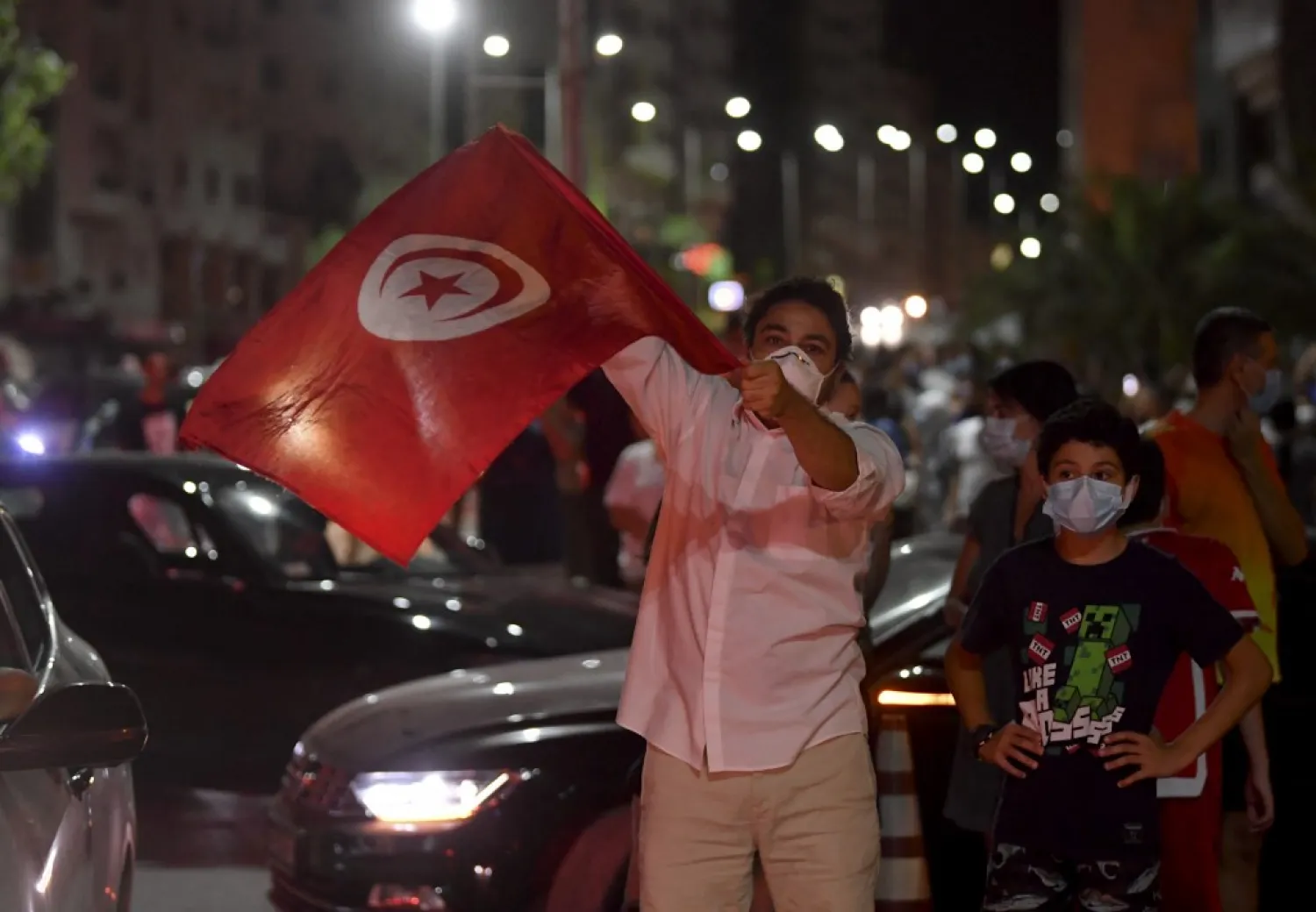
People celebrate in the street after Tunisian President Kais Saied announced the dissolution of parliament and Prime Minister Hichem Mechichi’s government in Tunis on July 25, 2021. (AFP)
TT

Tunisian President Suspends Parliament, Dismisses PM

People celebrate in the street after Tunisian President Kais Saied announced the dissolution of parliament and Prime Minister Hichem Mechichi’s government in Tunis on July 25, 2021. (AFP)

Tunisian President Kais Saied announced Sunday the suspension of parliament and dismissal of Prime Minister Hichem Mechichi following a day of protests against the ruling party, which condemned the move as a “coup d’etat”.

Earlier Sunday, thousands of Tunisians had marched in several cities protesting against the Islamist-inspired Ennahdha party, criticizing what they said were government failures in the North African nation and a crippling coronavirus surge.

After Saied announced parliament’s suspension following an emergency meeting at his palace, the sounds of car horns and fireworks filled the streets.

In Tunis, hundreds defied a coronavirus curfew to congregate on the capital’s roads.

“Finally some good decisions!” Maher, celebrating in the city’s northwest, told AFP.

Thirty-something Nahla, brandishing a Tunisian flag, was jubilant.

“These are courageous decisions -- Saied is unblocking Tunisia,” she told AFP. “This is the president we love!”

Since Saied was elected president in 2019, he has been locked in a showdown with Mechichi and parliament speaker and head of Ennahda Rached Ghannouchi, a rivalry that has blocked ministerial appointments and diverted resources from tackling Tunisia’s many economic and social problems.

‘Imminent danger’

“We are navigating the most delicate moments in the history of Tunisia,” Saied said Sunday.

He said the constitution did not allow for the dissolution of parliament, but did allow him to suspend it, citing Article 80 which permits it in case of “imminent danger”.

In a later Facebook post, he clarified that the suspension would be for 30 days.

“I have taken the necessary decisions to save Tunisia, the state and the Tunisian people,” he added.

“What Kais Saied is doing is a coup d’etat against the revolution and against the constitution, and the members of Ennahdha and the Tunisian people will defend the revolution,” the party countered in a statement on Facebook.

The premier’s office had not responded to his sacking on Sunday night.

Saied said he would take over executive power “with the help” of a government, whose new chief will be appointed by the president himself.

He also said that parliamentary immunity would be lifted for deputies.

A senior Ennahdha official, speaking to AFP on condition of anonymity, said the protests and subsequent celebrations had been orchestrated by Saied.

“We are also capable of organizing large demonstrations to show the number of Tunisians who are opposed to these decisions,” they said.

‘A true statesman’

Earlier Sunday in Tunis, hundreds rallied in front of parliament, shouting slogans against Ennahdha and premier Mechichi.

Demonstrations were also reported in the towns of Gafsa, Kairouan, Monastir, Sousse and Tozeur.

Several protesters were arrested and a journalist was injured when people hurled stones and police fired tear gas canisters, an AFP reporter said.

“The people want the dissolution of parliament,” the crowd chanted.

After Saied’s announcement, Tunis Farhat, a 49-year-old in Gafsa, told AFP that the president had understood what people wanted.

“He has shown himself to be a true statesman,” he said.

“Our patience has reached its limit, there’s no room for losers. That’s it, game is over!” said 24-year-old Ibrahim, echoing an old slogan from the massive demonstrations which toppled long-time ruler Zine El Abidine Ben Ali’s regime in 2011.

But one man in his forties watched on without enthusiasm.

“These fools are celebrating the birth of a new dictator,” he said.

Despite a decade passing since the 2011 revolution, Tunisia remains prone to political turmoil that has stymied efforts to revive crumbling public services.

The country’s fractious political class has been unable to form lasting, effective governments.

Tunisia has recently been overwhelmed by Covid-19 cases, including more than 18,000 deaths.

Last week, Mechichi fired his health minister over his handling of the pandemic as cases skyrocketed.



Syria Says its Forces Have Taken over al-Tanf Base after a Handover from the US

FILE: Members of the Maghawir al-Thawra Syrian opposition group receive firearms training from US Army Special Forces soldiers at the al-Tanf military outpost in southern Syria in 2018. (AP/Lolita Baldor)
TT

Syria Says its Forces Have Taken over al-Tanf Base after a Handover from the US

FILE: Members of the Maghawir al-Thawra Syrian opposition group receive firearms training from US Army Special Forces soldiers at the al-Tanf military outpost in southern Syria in 2018. (AP/Lolita Baldor)

Syrian government forces have taken control of a base in the east of the country that was run for years by US troops as part of the war against the ISIS group, the Defense Ministry said in a statement Thursday.

The al-Tanf base sits on a strategic location, close to the borders with Jordan and Iraq. In a terse statement, the Syrian Defense Ministry said the handover of the base took place in coordination with the US military and Syrian forces are now “securing the base and its perimeters.”

The US military did not immediately respond to an email from The Associated Press regarding the Syrian statement.

The Syrian Defense Ministry also said that Syrian troops are now in place in the desert area around the al-Tanf garrison, with border guards to deploy in the coming days.

The deployment of Syrian troops at al-Tanf and in the surrounding areas comes after last month’s deal between the government and the US-backed and Kurdish-led Syrian Democratic Forces, or SDF, to merge into the military.

Al-Tanf garrison was repeatedly attacked over the past years with drones by Iran-backed groups but such attacks have dropped sharply following the fall of Bashar Assad’s government in Syria in December 2024.

Syria’s interim President Ahmad al-Sharaa has been expanding his control of the country, and last month government forces captured wide parts of northeast Syria after deadly clashes with the SDF. A ceasefire was later reached between the two sides.

Al-Tanf base played a major role in the fight against the ISIS group that declared a caliphate in large parts of Syria and Iraq in 2014. ISIS was defeated in Iraq in 2017 and in Syria two years later.

Over the past weeks, the US military began transferring thousands of ISIS prisoners from prisons run by the SDF in northeastern Syria to Iraq, where they will be prosecuted.

The number of US troops posted in Syria has changed over the years.

The number of US troops increased to more than 2,000 after the Oct. 7, 2023, attack by Hamas in Israel, as Iranian-backed militants targeted American troops and interests in the region in response to Israel’s bombardment of Gaza.

The force has since been drawn back down to around 900.


Appeal Trial of Tunisia Jailed Prominent Lawyer Starts

People stand outside a closed court during a nationwide strike in Tunis, Tunisia November 22, 2018. REUTERS/Zoubeir Souissi
TT

Appeal Trial of Tunisia Jailed Prominent Lawyer Starts

People stand outside a closed court during a nationwide strike in Tunis, Tunisia November 22, 2018. REUTERS/Zoubeir Souissi

The appeal trial of a prominent Tunisian lawyer jailed on anti-terror charges started on Thursday, after the judge rejected the defense's demand of his provisional release on health grounds.

Ahmed Souab's lawyers and relatives said his health condition had become critical since his jailing in April last year as part of what many said was a crackdown on political dissent.

The court rejected his provisional release and postponed the hearing to February 23, his lawyer, Fedi Snene, told AFP.

Souab -- also a rights advocate and a former judge -- was detained after claiming that judges were under political pressure to hand down hefty sentences last year in a mass trial of critics of President Kais Saied.

He had been a member of the defense team during the high-profile mass trial, and last October he was sentenced to five years in prison in a speedy trial that lasted less than two minutes.

UN Special Rapporteur on human rights defenders Mary Lawlor said on Wednesday Souab had been convicted on "baseless charges" and called for his "immediate release".

Snene rejected accusations against Souab, saying "he should not be in prison".

"He is a well-known man of law, who served for nearly 30 years as a judge before becoming a lawyer," Snene added.

Souab's son, Saeb, told AFP the family had submitted a "substantial medical file" asking the judge for his release pending a verdict.

Saeb said his father suffered a heart attack in 2022 and that his cardiologist had certified that prison conditions could worsen his health.

Souab had accused authorities of putting "a knife to the throat of the judge who was to deliver the verdict" during the mass trial that saw around 40 public figures sentenced to long terms on charges including plotting against the state.


At Least 21 Drown in Nile Boat Sinking in Sudan

At least 21 people drowned when a boat sank in the Nile River in northern Sudan, according to the local state government and eyewitnesses interviewed by AFP. (REUTERS)
TT

At Least 21 Drown in Nile Boat Sinking in Sudan

At least 21 people drowned when a boat sank in the Nile River in northern Sudan, according to the local state government and eyewitnesses interviewed by AFP. (REUTERS)

At least 21 people drowned when a boat sank in the Nile River in northern Sudan, according to the local state government and eyewitnesses interviewed by AFP.

River Nile State said Thursday that 21 bodies had been recovered after the accident, listed their names and warned that some passengers were still missing.

The boat was crossing the river between the villages of Tayba al-Khawad and Deim al-Qarai, according to the local government's statement.

The statement did not explain the cause of the accident.

Eyewitnesses told AFP the boat was carrying 30 people.

The Sudanese Doctors Network said in a statement that six of the boat's passengers survived.

The group said the incident exposes "the fragility of river transport and the absence of basic safety requirements, as well as the complete absence of local authorities and civil defense rescue teams in the early hours of the incident".

Many Sudanese rely on river transport via single-engine boats captained by solo operators.

The country's infrastructure has been collapsing due to a war that has been ongoing for nearly three years.

The war has divided the country between the army and their enemy, the paramilitary Rapid Support Forces, with road closures and a severe deterioration in public services and medical and educational infrastructure.