


Key UN Climate Science Talks Open Amid Floods, Fires

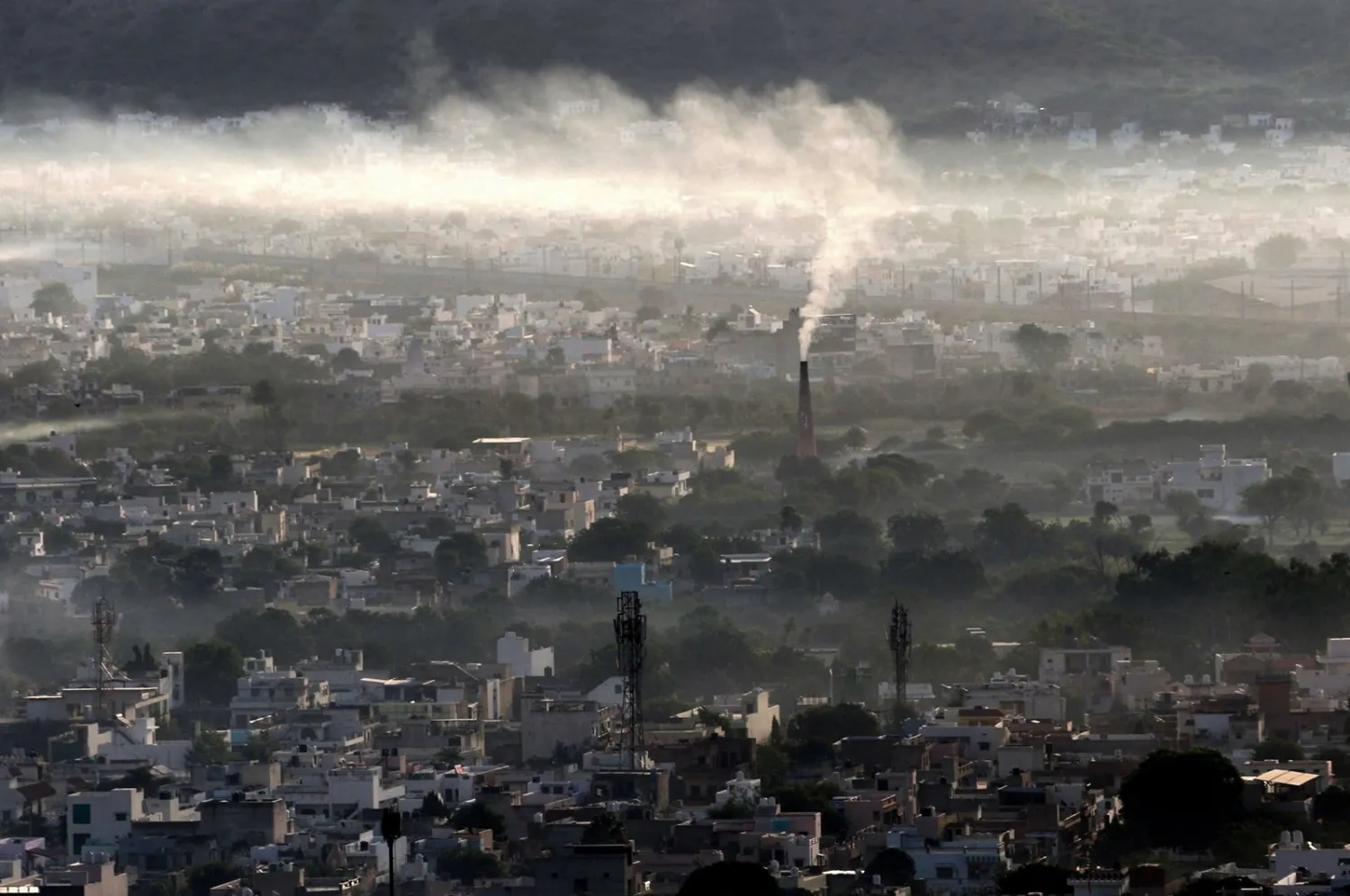
Smoke billows from a factory chimney during a smoggy morning in Ajmer, northern India on November 2, 2020. (AFP Photo)
TT

Key UN Climate Science Talks Open Amid Floods, Fires

Smoke billows from a factory chimney during a smoggy morning in Ajmer, northern India on November 2, 2020. (AFP Photo)

Nearly 200 nations start online negotiations Monday to validate a UN science report that will anchor autumn summits charged with preventing climate catastrophe on a planetary scale.

Record-smashing heatwaves, floods and drought across three continents in recent weeks, all amplified by global warming, make the Intergovernmental Panel on Climate Change (IPCC) assessment more than timely.

"It's going to be a wake-up call, there's no doubt about that," said Richard Black, founder and senior associate of the London-based Energy and Climate Intelligence Unit.

The report, he noted, comes only weeks ahead of a UN General Assembly, a G20 summit, and the 197-nation COP26 climate summit in Glasgow.

The world is a different place since the IPCC's last comprehensive assessment in 2014 of global heating, past and future.

Lingering doubts that warming was gathering pace or almost entirely human in origin, along with the falsely reassuring notion that climate impacts are tomorrow's problem, have since evaporated in the haze of deadly heat waves and fires.

Another milestone since the last IPCC tome: the Paris Agreement has been adopted, with a collective promise to cap the planet's rising surface temperature at "well below '' two degrees Celsius (36 degrees Fahrenheit) above late-19th century levels.

Carbon pollution from burning fossil fuels, methane leaks and agriculture has driven up the thermometer 1.1 degrees Celsius so far, and emissions are rising sharply again after a brief, Covid-imposed interlude, according to the International Energy Agency (IEA).

The 2015 treaty also features an aspirational limit on warming of 1.5 degrees Celsius, with many parties no doubt assuming this goal could be safely ignored.

But an IPCC special report in 2018 showed how much more devastating an extra 2 degrees Celsius would be, for humanity and the planet.

- Low-balling the danger -
"1.5 Celsius became the de facto target" -- and proof of the IPCC's influence in shaping global policy, IPCC lead author and Maynooth University professor Peter Thorne told AFP.

Scientists have calculated that greenhouse gas emissions must decline 50 percent by 2030, and be phased out entirely by 2050 to stay within the range of 1.5 degrees Celsius.

A third sea change over the last seven years is in science itself.

"Today we have better climate projection models, and longer observations with a much clearer signal of climate change," climatologist Robert Vautard, also an IPCC lead author and director of France's Pierre-Simon Laplace Institute, told AFP.

Arguably the biggest breakthrough is so-called attribution studies, which for the first time allow scientists to rapidly quantify the extent to which climate change has boosted an extreme weather event's intensity or likelihood.

For example, within days of the deadly "heat dome" that scorched Canada and the western US last month, the World Weather Attribution consortium calculated that the heatwave would have been virtually impossible without manmade warming.

But after-the-fact analysis is not the same as foresight, and the IPCC -- set up in 1988 to inform UN climate negotiations -- has been criticized by some for low-balling the danger, a pattern that Harvard science historian Naomi Oreskes has called "erring on the side of least drama".

- 'Transformational change' -
From Monday, representatives from 195 nations, with lead scientists at their elbow, will vet a 20 to 30-page "summary for policymakers" line by line, word by word.

The virtual meeting for this first instalment -- covering physical science -- of the three-part report will take two weeks rather than the usual one, with the document's release slated for August 9.

Part two of the report, to be published in February 2022, covers impacts.

A leaked draft obtained by AFP warns that climate change will fundamentally reshape life on Earth in the coming decades even if planet-warming carbon pollution is tamed, and calls for "transformational change" lest future generations face far worse.

Part three, to be unveiled the following month, examines solutions for reducing emissions.

Based almost entirely on published research, the report under review this week will likely forecast -- even under optimistic scenarios -- a temporary "overshoot" of the 1.5 degrees Celsius target.

There will also be a new focus on so-called "low-probability, high-risk" events, such as the irreversible melting of ice sheets that could lift sea levels by meters, and the decay of permafrost laded with greenhouse gases.

"Feedbacks which amplify change are stronger than we thought and we may be approaching some tipping point," said Tim Lenton, Director of the University of Exeter's Global Systems Institute.



Top Trump Iran Negotiator Says Visits US Aircraft Carrier in Middle East

US Special Envoy Steve Witkoff delivers a press conference upon the signing of the declaration on deploying post-ceasefire force in Ukraine, during the so-called "Coalition of the Willing" summit, at the Elysee Palace in Paris, France, January 6, 2026. (Reuters)
TT

Top Trump Iran Negotiator Says Visits US Aircraft Carrier in Middle East

US Special Envoy Steve Witkoff delivers a press conference upon the signing of the declaration on deploying post-ceasefire force in Ukraine, during the so-called "Coalition of the Willing" summit, at the Elysee Palace in Paris, France, January 6, 2026. (Reuters)

US President Donald Trump's lead Iran negotiator Steve Witkoff on Saturday said he visited the USS Abraham Lincoln aircraft carrier currently in the Arabian Sea, with Washington and Tehran due to hold further talks soon.

"Today, Adm. Brad Cooper, Commander of US Naval Forces Central Command, Jared Kushner, and I met with the brave sailors and Marines aboard the USS Abraham Lincoln, her strike group, and Carrier Air Wing 9 who are keeping us safe and upholding President Trump's message of peace through strength," said Witkoff in a social media post.

Iranian Foreign Minister Abbas Araghchi said on Saturday he hoped talks with the United States would resume soon, while reiterating Tehran's red lines and warning against any American attack.


Israel’s Netanyahu Expected to Meet Trump in US on Wednesday and Discuss Iran

Israeli Prime Minister Benjamin Netanyahu delivers a speech during a special session to mark the 77th anniversary of the Knesset's establishment and the 60th anniversary of the dedication of the current building at the Knesset, the Israeli parliament, in Jerusalem, 02 February 2026. (EPA)
TT

Israel’s Netanyahu Expected to Meet Trump in US on Wednesday and Discuss Iran

Israeli Prime Minister Benjamin Netanyahu delivers a speech during a special session to mark the 77th anniversary of the Knesset's establishment and the 60th anniversary of the dedication of the current building at the Knesset, the Israeli parliament, in Jerusalem, 02 February 2026. (EPA)

Israeli Prime Minister Benjamin Netanyahu is expected to meet US President Donald Trump on Wednesday in Washington, where they will discuss negotiations with Iran, Netanyahu's office said on Saturday.

Iranian and US officials held indirect nuclear ‌talks in the ‌Omani capital ‌Muscat ⁠on Friday. ‌Both sides said more talks were expected to be held again soon.

A regional diplomat briefed by Tehran on the talks told Reuters Iran insisted ⁠on its "right to enrich uranium" ‌during the negotiations with ‍the US, ‍and that Tehran's missile capabilities ‍were not raised in the discussions.

Iranian officials have ruled out putting Iran's missiles - one of the largest such arsenals in the region - up ⁠for discussion, and have said Tehran wants recognition of its right to enrich uranium.

"The Prime Minister believes that any negotiations must include limiting ballistic missiles and halting support for the Iranian axis," Netanyahu's office said in a ‌statement.


Italy FM Rules Out Joining Trump’s ‘Board of Peace’

Italy's Minister for Foreign Affairs Antonio Tajani speaks to the press during the EPP Leaders’ meeting, in Zagreb, Croatia, 30 January 2026. (EPA)
TT

Italy FM Rules Out Joining Trump’s ‘Board of Peace’

Italy's Minister for Foreign Affairs Antonio Tajani speaks to the press during the EPP Leaders’ meeting, in Zagreb, Croatia, 30 January 2026. (EPA)

Italy will not take part in US President Donald Trump's "Board of Peace", Italian Foreign Minister Antonio Tajani said Saturday, citing "insurmountable" constitutional issues.

Trump launched his "Board of Peace" at the World Economic Forum in Davos in January and some 19 countries have signed its founding charter.

But Italy's constitution bars the country from joining an organization led by a single foreign leader.

Prime Minister Giorgia Meloni, a Trump ally, last month noted "constitutional problems" with joining, but suggested Trump could perhaps reopen the framework "to meet the needs not only of Italy, but also of other European countries".

Tajani appeared Saturday to rule that out.

"We cannot participate in the Board of Peace because there is a constitutional limit," he told the ANSA news agency.

"This is insurmountable from a legal standpoint," he said, the day after meeting US Secretary of State Marco Rubio and US Vice President JD Vance at the Olympics in Milan.

Although originally meant to oversee Gaza's rebuilding, the board's charter does not limit its role to the Palestinian territory and appears to want to rival the United Nations.