


Trial Begins in Vatican Financial Scandal

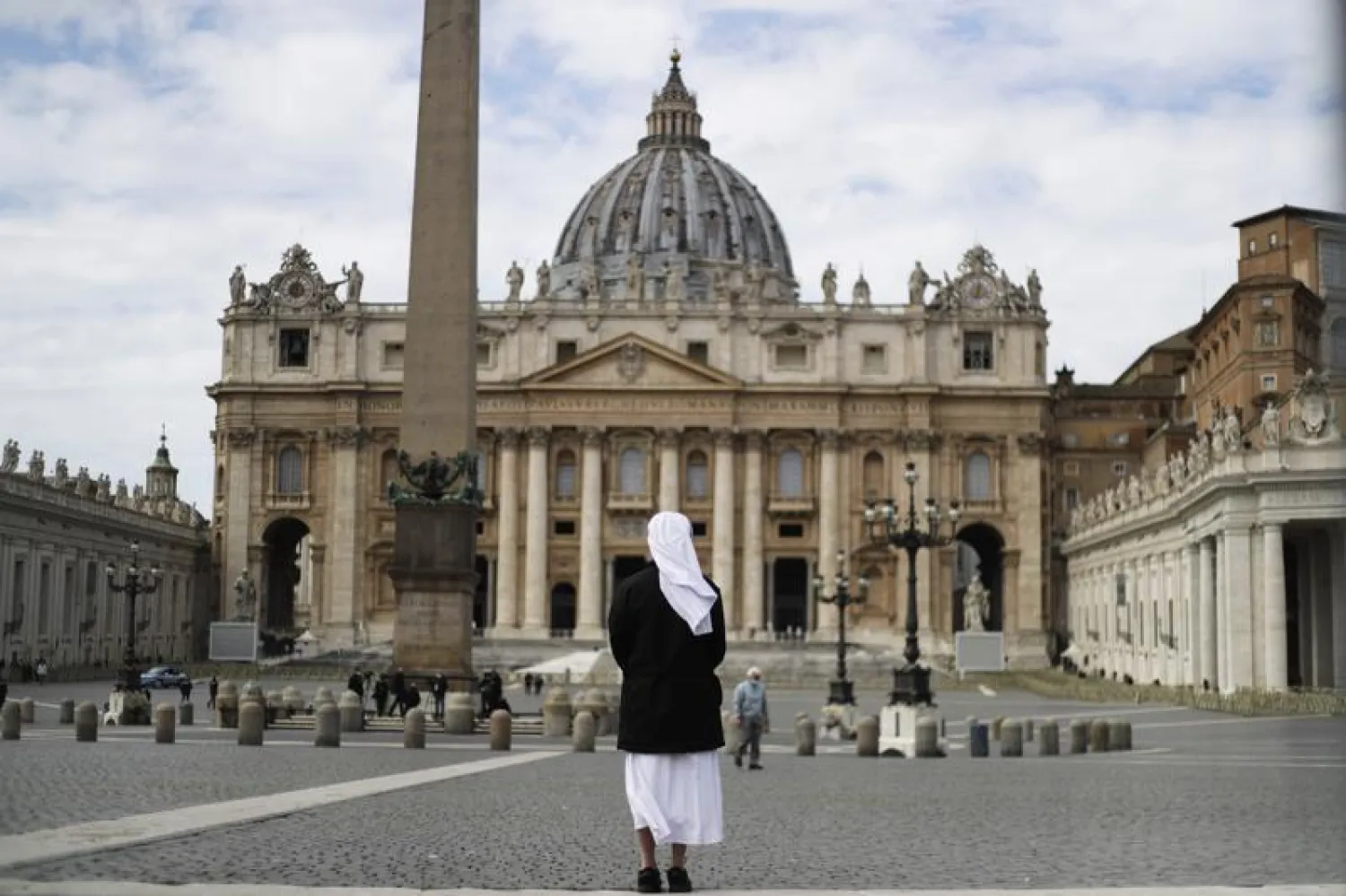
FILE - In this Sunday, March 21, 2021 filer, a nun stands in St. Peter's Square at the Vatican. Vatican prosecutors have alleged a jaw-dropping series of scandals in launching the biggest criminal trial in the Vatican’s modern history, which opens Tuesday in a modified courtroom in the Vatican Museums. (AP Photo/Gregorio Borgia, File)
TT

Trial Begins in Vatican Financial Scandal

FILE - In this Sunday, March 21, 2021 filer, a nun stands in St. Peter's Square at the Vatican. Vatican prosecutors have alleged a jaw-dropping series of scandals in launching the biggest criminal trial in the Vatican’s modern history, which opens Tuesday in a modified courtroom in the Vatican Museums. (AP Photo/Gregorio Borgia, File)

A financial scandal involving an opaque, loss-making Vatican property deal paid for with charity funds goes to trial Tuesday after a two-year probe that has implicated a once-powerful cardinal.

Vatican prosecutors allege that ten defendants, including high-rolling London financiers and church employees, engaged in various crimes such as embezzlement, fraud, and corruption, reported AFP.

It is unclear whether former cardinal Angelo Becciu, then number two at the powerful Secretariat of State, will appear in the makeshift courtroom held within the Vatican Museums on the trial's opening day.

Becciu, 73, who says he is the innocent victim of a plot, is the highest-profile defendant embroiled in the Church's ruinous purchase of a 17,000-sq meter London property in the upmarket neighborhood of Chelsea under his watch.

The case against Becciu, which carries charges of embezzlement, abuse of office and witness tampering, also includes separate allegations over hundreds of thousands of euros of church funds paid to his brother's charity.

The trial ensnaring the former right-hand man to Pope Francis -- who was fired by the pontiff in September and stripped of his privileges as cardinal -- represents the first time a cardinal has been indicted by Vatican criminal prosecutors in modern history.

- Bags of money -
The complex case alleged by prosecutors paints a picture of dubious, risky investments involving millions of dollars of Vatican money, little or no oversight, and double-dealing by outside consultants and insiders trusted with the financial interests of the Secretariat of State, the Vatican's most important department charged with general affairs and diplomacy.

A 487-page indictment released earlier this month sheds light on hefty bank transfers, text messages between collaborators from seized cellphones -- even bags of money changing hands and secret meetings in luxury hotels.

The primary defendants are "actors in a rotten predatory and lucrative system, sometimes made possible thanks to limited, but very incisive, complicity and internal connivance," wrote prosecutors.

Since becoming pope in 2013, Francis has vowed to clean up the Church's finances, dogged for decades by scandal. After a 2019 raid on the Secretariat's offices by Vatican police, Francis stripped the body of oversight of its own funds, handing that responsibility to others.

The scandal is particularly embarrassing because funds used for risky ventures, including the disastrous 350-million-euro ($415 million) investment in Chelsea, came from the Peter's Pence, an annual fund for the pope's charities.

- Risky ventures -
The current case dates from 2013, when the Secretariat borrowed more than $200 million, mainly from Credit Suisse, to invest in a Luxembourg fund managed by an Italian-Swiss businessman, Raffaele Mincione. Half was intended for stock market purchases and the rest for part of the London building.

Mincione, prosecutors allege, used the money to invest in high-risk ventures over which the Church had no control. By 2018, the Secretariat had already lost millions and tried to pull out of the deal.

But another London-based financier, Gianluigi Torzi, brought in to broker the purchase of the rest of the building and cut ties with Mincione, instead joined forces with him, say prosecutors.

Torzi arranged for the Holy See to give Mincione £40 million to buy out the financier's share of the London property, but allegedly inserted a clause into the deal that gave himself control of the building through voting rights.

Torzi is accused of demanding 15 million euros to relinquish control.

Mincione and Torzi were helped, prosecutors claim, by Enrico Crasso, a former financial consultant to the Secretariat, and employee Fabrizio Tirabassi, both of whom face charges including fraud.

Also implicated are two former top officials within the Vatican's financial regulator, including its ex-president, Swiss lawyer Rene Bruelhart, whom prosecutors say did not do enough to protect the Secretariat's interests.

In another twist, Becciu is accused of paying defendant Cecilia Marogna 575,000 euros in Vatican funds earmarked for freeing captive priests and nuns abroad that Marogna -- dubbed "the Cardinal's lady" by the Italian press -- spent on luxury goods and hotels.

Prosecutors claim the Vatican's top hierarchy, including Becciu's boss and pope ally Cardinal Pietro Parolin, were in favor of the London venture, but unaware of its financial details.



Cuba to Protect Essential Services as US Moves to Cut Off Oil Supply

 People wait for transportation as Cubans brace for fuel scarcity measures after US tightens oil supply blockade, in Havana, Cuba, February 6, 2026. (Reuters)
People wait for transportation as Cubans brace for fuel scarcity measures after US tightens oil supply blockade, in Havana, Cuba, February 6, 2026. (Reuters)
TT

Cuba to Protect Essential Services as US Moves to Cut Off Oil Supply

 People wait for transportation as Cubans brace for fuel scarcity measures after US tightens oil supply blockade, in Havana, Cuba, February 6, 2026. (Reuters)
People wait for transportation as Cubans brace for fuel scarcity measures after US tightens oil supply blockade, in Havana, Cuba, February 6, 2026. (Reuters)

Cuba detailed a wide-ranging plan on Friday to protect essential services and ration fuel as the communist-run government dug in its heels in defiance of a US effort to cut off oil supply to the Caribbean island.

The rationing measures are the first to be announced since President Donald Trump threatened to slap tariffs on the US-bound products of any country exporting fuel to Cuba and suggested hard times ahead for Cubans already suffering severe shortages of food, fuel ‌and medicine.

Government ‌ministers said the measures would guarantee ‌fuel supply ⁠for key sectors, ‌including agricultural production, education, water supply, healthcare and defense.

Commerce Minister Oscar Perez-Oliva struck a defiant tone as he laid out details of the government plan.

"This is an opportunity and a challenge that we have no doubt we will overcome," Perez-Oliva told a television news program. "We are not going to collapse."

The government will supply fuel to the ⁠tourism and export sectors, including for the production of Cuba's world-famous cigars, to ensure ‌the foreign exchange necessary to fund other basic ‍programs, Perez-Oliva said, adding, "If we ‍don't have income, then we will not overcome this situation."

Domestic ‍and international air travel will not be immediately affected by the fuel rationing, although drivers will see cutbacks at the pump until supply normalizes, he said.

The government said it would protect ports and ensure fuel for domestic transportation in a bid to protect the island nation's import and export sectors.

Perez-Oliva also announced an ambitious ⁠plan to plant 200,000 hectares (500,000 acres) of rice to guarantee "an important part of our demand," but acknowledged fuel shortfalls would push the country to depend more on renewable energy for irrigation needs and animal-power for tilling fields.

Education Minister Naima Ariatne, appearing on the same program, said infant-care centers and primary schools would remain open and in person, but secondary schools and higher education would implement a hybrid system that would require more "flexibility" and vary by institution and region.

"As a priority, we want to leave (open) our primary schools," Ariatne said.

Top officials said ‌health care would also be prioritized, with special emphasis on emergency services, maternity wards and cancer programs.


Trump Signs Order Preparing for Tariffs on Iran’s Trade Partners

A man walks past a mural depicting the US Statue of Liberty with the torch-bearing arm broken, painted on the outer walls of the former US embassy, in Tehran on February 6, 2026. (AFP)
TT

Trump Signs Order Preparing for Tariffs on Iran’s Trade Partners

A man walks past a mural depicting the US Statue of Liberty with the torch-bearing arm broken, painted on the outer walls of the former US embassy, in Tehran on February 6, 2026. (AFP)

US President Donald Trump on Friday signed an executive order threatening tariffs on Iran's trade partners, after he pledged a further round of talks with Tehran next week.

The order, effective from Saturday, called for a fresh "imposition of tariffs" on countries still doing business with Iran.

It comes amid heightened tensions between Washington and Tehran, with an American naval group led by an aircraft carrier in Middle Eastern waters and indirect talks held on Tehran's nuclear program in Oman on Friday.

The levies "may be imposed on goods imported into the United States that are products of any country that directly or indirectly purchases, imports, or otherwise acquires any goods or services from Iran", the order said.

Trump issued a threat of 25 percent tariffs on any country trading with Iran last month.

This order establishes a process for his administration to impose tariffs on goods from those countries.

The rate is to be determined by Secretary of State Marco Rubio, although the order specifies that it could be "for example" 25 percent, the level first mentioned by the US president in mid-January.

Tariffs would affect trade with a number of countries including Russia, Germany, Türkiye and the United Arab Emirates.

More than a quarter of Iran's trade is with China, with $18 billion in imports and $14.5 billion in exports in 2024, according to World Trade Organization data.

The talks on Friday in Muscat, mediated by Oman, were the first between the two foes since the United States joined Israel's war with Iran in June with strikes on nuclear sites.

"We likewise had very good talks on Iran," Trump told reporters on board Air Force One en route to his Mar-a-Lago resort in Florida, adding, "we're going to meet again early next week."

Diplomatic relations between Iran and the US broke down with the 1979 revolution that brought the current government into power after hostages were taken at the US embassy in Tehran for 444 days.

Direct engagement has been rare in the decades since.

Iran remains under an internet blackout amid a harsh government crackdown on economic protests that began in December across the country.

The US-based Human Rights Activists News Agency (HRANA) said Friday it has confirmed 6,505 protesters were killed, as well as 214 members of the security forces and 61 bystanders.


Trump Says US Talks with Iran ‘Very Good,’ More Negotiations Expected

US President Donald Trump gaggles with reporters while aboard Air Force One on February 6, 2026 en route to Palm Beach, Florida. (Getty Images via AFP)
TT

Trump Says US Talks with Iran ‘Very Good,’ More Negotiations Expected

US President Donald Trump gaggles with reporters while aboard Air Force One on February 6, 2026 en route to Palm Beach, Florida. (Getty Images via AFP)

US President Donald Trump said Friday Washington held "very good talks" on Iran after the two sides held an indirect dialogue in Oman.

Iran for its part said it expected to hold more negotiations with the United States, hailing a "positive atmosphere" during a day of talks in the Gulf sultanate.

With an American naval group led by an aircraft carrier in Middle Eastern waters, US and Iranian delegations held talks in Muscat mediated by Oman without publicly meeting face-to-face.

Shortly after the talks concluded, the US announced new sanctions against shipping entities and vessels, aimed at curbing Iran's oil exports. But it was not clear if the move was linked to the talks.

The talks were the first between the two foes since the United States joined Israel's war with Iran in June with strikes on nuclear sites.

"We likewise had very good talks on Iran," Trump told reporters on board Air Force One en route to his Mar-a-Lago resort in Florida, adding, "we're going to meet again early next week."

However, as Iran warned against further threats after Washington raised the specter of new military action, Trump said: "If they don't make a deal, the consequences are very steep."

Foreign Minister Abbas Araghchi, who led Iran's delegation in Muscat, said talks "focused exclusively" on the Iranian nuclear program, which the West believes is aimed at making an atomic bomb but Tehran insists is peaceful.

The US delegation, led by Middle East envoy Steve Witkoff and Trump's influential son-in-law Jared Kushner, had also wanted Tehran's backing for militant groups, its ballistic missile program and treatment of protesters on the agenda.

"In a very positive atmosphere, our arguments were exchanged and the views of the other side were shared with us," Araghchi told Iranian state TV, adding that the two sides had "agreed to continue negotiations."

Speaking to the official IRNA news agency, Araghchi expressed hope that Washington would refrain from "threats and pressure" so that "the talks can continue."

- 'Destabilizing power' -

Admiral Brad Cooper, the commander of US Central Command, was present at the talks, according to images published by the Oman News Agency.

Multiple sessions of talks in the morning and afternoon saw both sides shuttling to and from the residence of Omani Foreign Minister Badr Albusaidi.

The foreign ministry of US ally Qatar expressed hope the talks would "lead to a comprehensive agreement that serves the interests of both parties and enhances security and stability in the region."

The White House has made clear it wants the talks to rein in Tehran's ability to make a nuclear bomb, an ambition the country has always denied.

French Foreign Minister Jean-Noel Barrot said on Friday that Iran should stop being a "destabilizing power," citing its nuclear program and support for "terrorist" groups.

Barrot also called on "groups supported by Iran" to exert "the utmost restraint" in the event of any military escalation involving Iran.

- 'Maximum pressure' -

Trump initially threatened military action against Tehran over its crackdown on protesters last month, which rights groups say killed thousands, and even told demonstrators "help is on its way."

Regional powers urged the United States not to intervene, calling on Washington and Tehran to instead return to talks.

The US-based Human Rights Activists News Agency (HRANA) said Friday it has confirmed 6,505 protesters were killed, as well as 214 members of the security forces and 61 bystanders.

Those numbers are expected to climb because the magnitude of the crackdown has masked by the blanket internet shutdown imposed by the authorities for a fortnight, rights groups say.

Almost 51,000 people are also confirmed to have been arrested amid "the growing use of forced confessions," according to HRANA.

Yet Trump's rhetoric in recent days has focused on reining in the Iranian nuclear program and the US has maneuvered a naval group led by aircraft carrier USS Abraham Lincoln into the region.

Iran has repeatedly vowed it will hit back at US bases in the region if attacked.

The new sanctions to curb Iran's oil exports come with Trump "committed to driving down the Iranian regime's illicit oil and petrochemical exports under the administration's maximum pressure campaign," State Department spokesman Tommy Pigott said in a statement.