


Lebanon’s New PM Begins Bid to Form Much-Delayed Govt

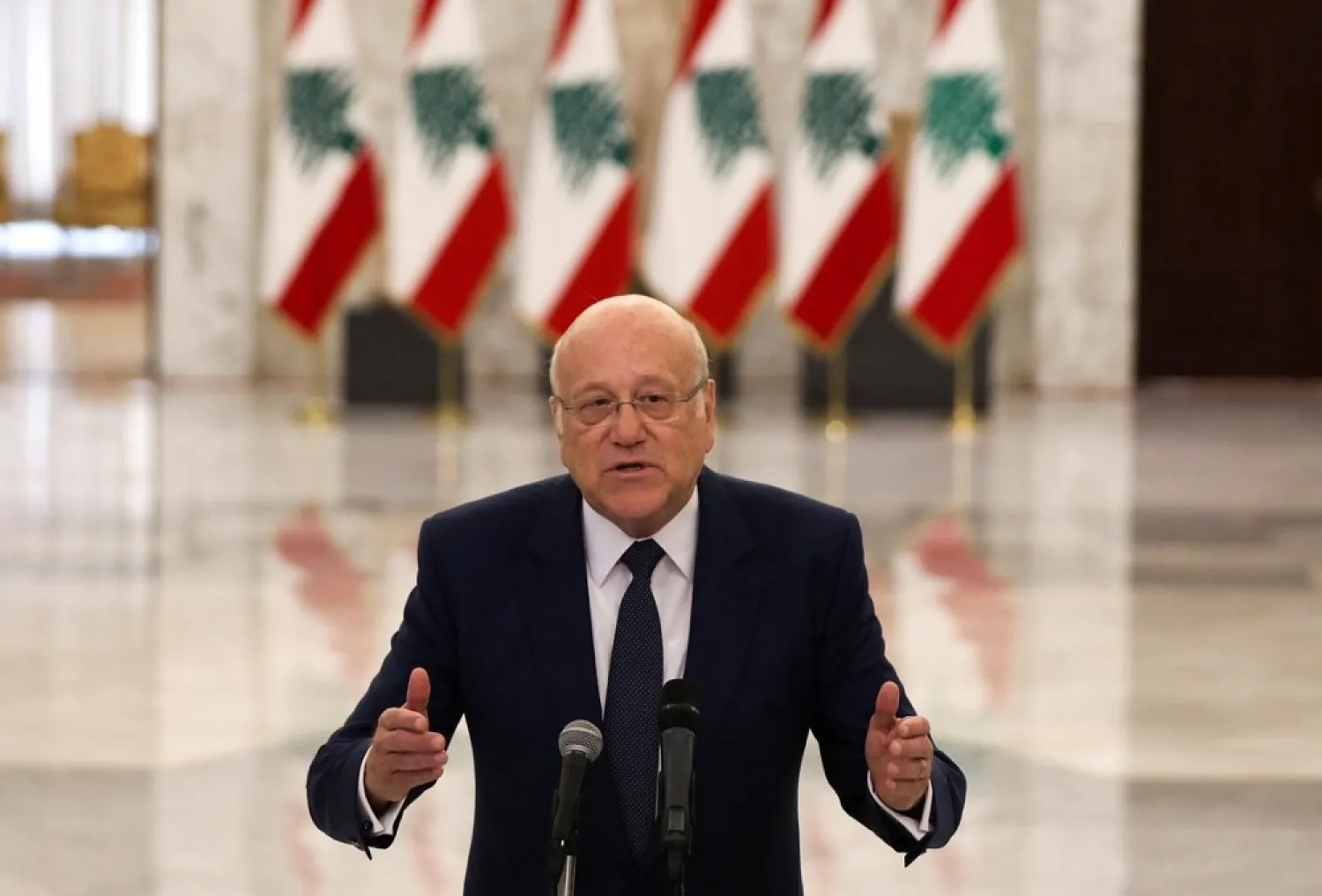
Lebanon’s new Prime Minister-designate Najib Mikati. (Reuters)
TT

Lebanon’s New PM Begins Bid to Form Much-Delayed Govt

Lebanon’s new Prime Minister-designate Najib Mikati. (Reuters)

Lebanon’s new Prime Minister-designate Najib Mikati Tuesday held consultations with political parties that he said “unanimously” agreed on the need to put together a government quickly to rescue the crisis-hit country.

But after nearly a year of extreme drift, an economic crisis described by the World Bank as one of the world’s worst since the 1850’s and continued squabbling among political players, he faces an uphill battle.

Mikati, a billionaire who has already twice served as prime minister, took on the task on Monday, days after fellow veteran politician Saad Hariri threw in the towel.

The last government resigned amid public outrage over a deadly explosion of hundreds of tons of poorly stored fertilizer at Beirut port last August.

The institutional vacuum is holding up a potential financial rescue plan for the country, which defaulted on its debt last year.

On Tuesday, Mikati met with top political parties, including the Hezbollah party and the Free Patriotic Movement founded by President Michel Aoun and now headed by his son-in-law Gebran Bassil.

“There was unanimous agreement from all blocs and lawmakers on the need to speed up the process of cabinet formation,” Mikati said after consultations ended.

The meetings are the customary official step that follows a new prime minister’s designation, but the high-stakes horse-trading has yet to even begin.

Skepticism
Following a meeting with Mikati, Hezbollah lawmaker Mohammad Raad said his party is ready to “cooperate seriously” with the new PM-designate.

Bassil, accused by critics of repeatedly obstructing previous efforts to form a new government, said his party would stand aside this time.

We will “not to participate in the next cabinet, which means we will not get involved in the formation process”.

In an interview with the An-Nahar newspaper, Mikati vowed his lineup would be “purely technical” and tasked with bridging the gap to elections due next year.

Several lawmakers, including deputy speaker Elie Ferzli, backed this push on Tuesday.

“The government will consist of specialists,” Ferzli said. “As for the nominating process, it will rest on Mikati and his agreements with the president.”

The designation of 65-year-old Mikati, Lebanon’s richest man and to many a symbol of its corrupt oligarchy, was met with general skepticism.

A native of Tripoli, Lebanon’s second city and one of its poorest, he was accused by a state prosecutor in 2019 of illicit enrichment, a charge he denies.

“How can I trust a thief who stole from me and my children and their future?” asked 57-year-old Beirut resident Mohammed Deeb, after Mikati’s designation.

“As long as this (political) class is still in power, nothing will change.”

On Sunday evening, dozens of protesters gathered outside Mikati’s Beirut home, accusing him of corruption and cronyism.

Most aid blocked
Lebanon’s former colonial ruler France and other Western governments stopped short of welcoming Mikati’s designation and simply urged him to swiftly deliver a competent lineup.

But Lebanon’s bickering politicians view Mikati as a consensus candidate, who may be capable of easing the near-year-long political deadlock.

Mikati, the third politician in a year to attempt the job, promised his government would work on implementing a French roadmap conditioning a huge aid package on reform and transparency.

In some of his first comments after his designation, Mikati said he would prioritize what little international aid is currently available towards addressing severe power blackouts, according to the Al-Akhbar newspaper.

Lebanon can no longer provide mains electricity to its citizens for more than a handful of hours each day, nor can it afford to buy the fuel needed to power generators.

Almost none of the international community’s demands for a broad program of reforms have so far been met.

Further stalling the bankrupt state’s recapitalization has been the government’s failure to engage the International Monetary Fund and discuss a fully-fledged rescue plan.

Until then, the monetary institution is due to send around $900 million, but experts warn it will not be enough and risks being misused.



EU Condemns Israel's West Bank Control Measures

The Israeli settlement of Har Homa, seen from the West Bank city of Bethlehem, Tuesday, Dec. 17, 2024. (AP)
TT

EU Condemns Israel's West Bank Control Measures

The Israeli settlement of Har Homa, seen from the West Bank city of Bethlehem, Tuesday, Dec. 17, 2024. (AP)

The European Union on Monday condemned new Israeli measures to tighten control of the West Bank and pave the way for more settlements in the occupied Palestinian territory, AFP reported.

"The European Union condemns recent decisions by Israel's security cabinet to expand Israeli control in the West Bank. This move is another step in the wrong direction," EU spokesman Anouar El Anouni told journalists.


Atrocities in Sudan's El-Fasher Were 'Preventable Human Rights Catastrophe'

Sudanese displaced people who left El Fasher after its fall, sit in the shade in Tawila at the Rwanda camp reception point on December 17, 2025. (Photo by AFP)
TT

Atrocities in Sudan's El-Fasher Were 'Preventable Human Rights Catastrophe'

Sudanese displaced people who left El Fasher after its fall, sit in the shade in Tawila at the Rwanda camp reception point on December 17, 2025. (Photo by AFP)

The atrocities unleashed on El-Fasher in Sudan's Darfur region last October were a "preventable human rights catastrophe", the United Nations said Monday, warning they now risked being repeated in the neighbouring Kordofan region.


"My office sounded the alarm about the risk of mass atrocities in the besieged city of El-Fasher for more than a year ... but our warnings were ignored," UN rights chief Volker Turk told the Human Rights Council in Geneva.


He added that he was now "extremely concerned that these violations and abuses may be repeated in the Kordofan region".


Arab League Condemns Israel's Decisions to Alter Legal, Administrative Status of West Bank

A general view shows the opening session of the meeting of Arab foreign ministers at the Arab League Headquarters (Reuters)
TT

Arab League Condemns Israel's Decisions to Alter Legal, Administrative Status of West Bank

A general view shows the opening session of the meeting of Arab foreign ministers at the Arab League Headquarters (Reuters)

The General Secretariat of the Arab League strongly condemned decisions by Israeli occupation authorities to impose fundamental changes on the legal and administrative status of the occupied Palestinian territories, particularly in the West Bank, describing them as a dangerous escalation and a flagrant violation of international law, international legitimacy resolutions, and signed agreements, SPA reported.

In a statement, the Arab League said the measures include facilitating the confiscation of private Palestinian property and transferring planning and licensing authorities in the city of Hebron and the area surrounding the Ibrahimi Mosque to occupation authorities.

It warned of the serious repercussions of these actions on the rights of the Palestinian people and on Islamic and Christian holy sites.

The statement reaffirmed the Arab League’s firm support for the legitimate rights of the Palestinian people, foremost among them the establishment of their independent state on the June 4, 1967 borders, with East Jerusalem as its capital.