

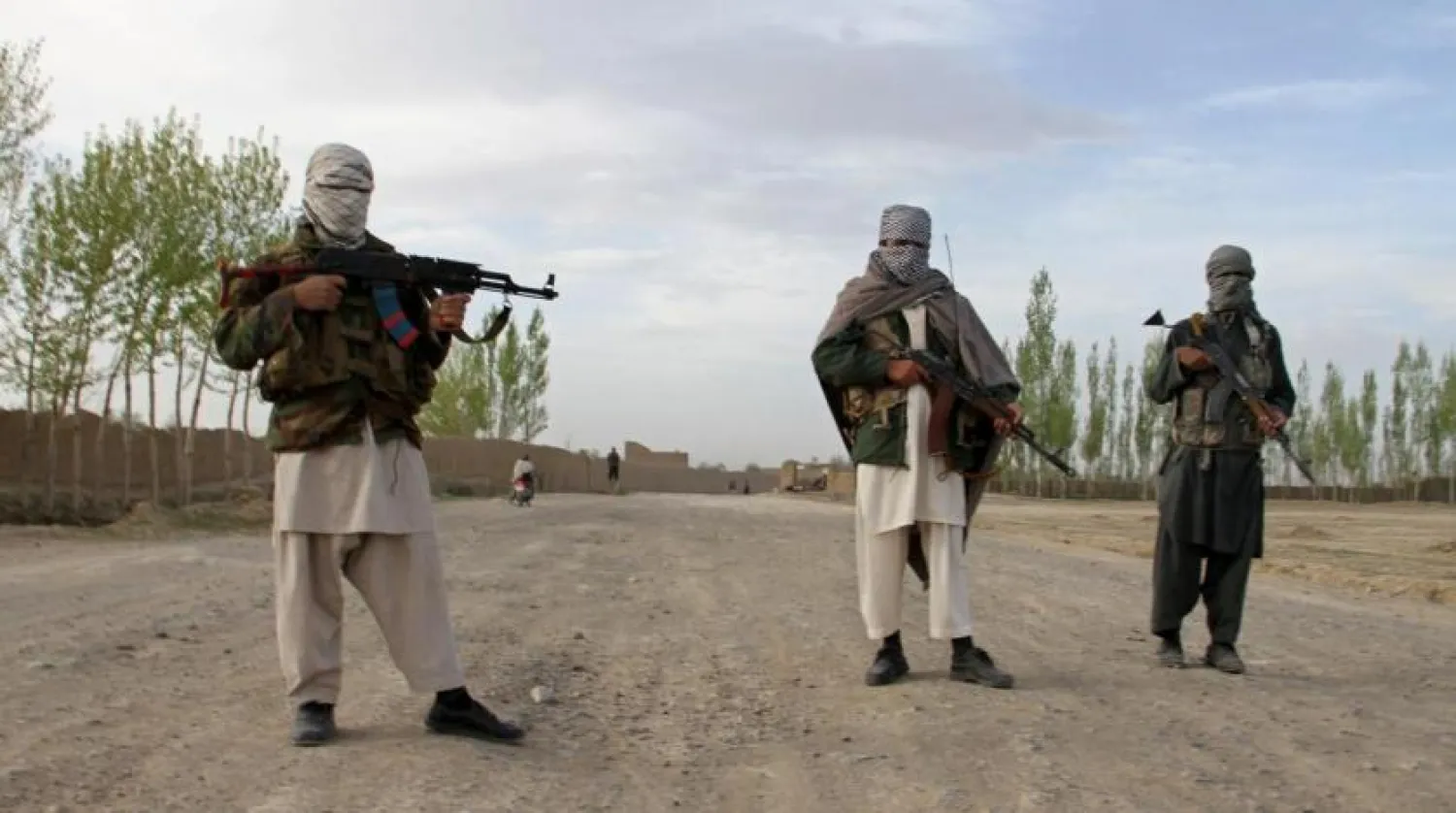

Taliban Tell China Afghanistan Will Not Be Base for Separatists

Members of the Taliban stand at the site of the execution of three men in Ghazni province, Afghanistan, April 18, 2015. REUTERS/Stringer/File Photo
TT

Taliban Tell China Afghanistan Will Not Be Base for Separatists

Members of the Taliban stand at the site of the execution of three men in Ghazni province, Afghanistan, April 18, 2015. REUTERS/Stringer/File Photo

A top-level Taliban delegation visiting China assured Beijing the group will not allow Afghanistan to be used as a base for plotting against another country, an insurgent spokesman said Wednesday.

The delegation is in China for talks with Beijing officials, spokesman Mohammad Naeem told AFP, as the insurgents continue a sweeping offensive across Afghanistan -- including areas along their shared border.

Their frontier is just 76 kilometers (47 miles) long -- and at a rugged high altitude without a road crossing -- but Beijing fears Afghanistan could be used as a staging ground for Uyghur separatists in Xinjiang, said AFP.

He said Taliban “assured China that Afghanistan's soil would not be used against any country's security," Naeem said.

"They (China) promised not to interfere in Afghanistan's affairs, but instead help to solve problems and bring peace."

Taliban officials have cranked up their international diplomacy in recent months, seeking global recognition for when they hope to return to power.

They have made sweeping advances across Afghanistan since May, when US-led foreign forces began the last stage of a withdrawal due to be completed next month.

Beijing hosted a Taliban delegation in 2019, but back-door links with the insurgents stretch back longer, through Pakistan.

Communist Party leaders in Beijing and the fundamentalist Taliban have little ideological common ground, but experts feel shared pragmatism could see mutual self-interest trump sensitive differences.

For Beijing, a stable and cooperative administration in Kabul would pave the way for an expansion of its Belt and Road Initiative into Afghanistan and through the Central Asian republics.

The Taliban, meanwhile, would consider China a crucial source of investment and economic support.

"China can deal with the Taliban... but they still find the Taliban's religious agenda and motivations inherently discomforting," Andrew Small, author of "The China–Pakistan Axis", told AFP earlier this month.

"They have never been sure how willing or able the Taliban really are to enforce agreements on issues such as harboring Uyghur militants."

The Taliban's campaign has so far seen them capture scores of districts, border crossings and encircle several provincial capitals.

Government forces have abandoned some rural districts without a fight, but are digging in to defend provincial capitals even as the insurgents tighten a noose around the cities.

Rights groups have accused the insurgents of committing atrocities in territories under their control, including in the border town of Spin Boldak, where Afghan officials accuse Taliban fighters of killing around 100 civilians.

The nine-member Taliban team in China is led by Mullah Abdul Ghani Baradar, co-founder of the hardline movement.



Top Trump Iran Negotiator Says Visits US Aircraft Carrier in Middle East

US Special Envoy Steve Witkoff delivers a press conference upon the signing of the declaration on deploying post-ceasefire force in Ukraine, during the so-called "Coalition of the Willing" summit, at the Elysee Palace in Paris, France, January 6, 2026. (Reuters)
TT

Top Trump Iran Negotiator Says Visits US Aircraft Carrier in Middle East

US Special Envoy Steve Witkoff delivers a press conference upon the signing of the declaration on deploying post-ceasefire force in Ukraine, during the so-called "Coalition of the Willing" summit, at the Elysee Palace in Paris, France, January 6, 2026. (Reuters)

US President Donald Trump's lead Iran negotiator Steve Witkoff on Saturday said he visited the USS Abraham Lincoln aircraft carrier currently in the Arabian Sea, with Washington and Tehran due to hold further talks soon.

"Today, Adm. Brad Cooper, Commander of US Naval Forces Central Command, Jared Kushner, and I met with the brave sailors and Marines aboard the USS Abraham Lincoln, her strike group, and Carrier Air Wing 9 who are keeping us safe and upholding President Trump's message of peace through strength," said Witkoff in a social media post.

Iranian Foreign Minister Abbas Araghchi said on Saturday he hoped talks with the United States would resume soon, while reiterating Tehran's red lines and warning against any American attack.


Israel’s Netanyahu Expected to Meet Trump in US on Wednesday and Discuss Iran

Israeli Prime Minister Benjamin Netanyahu delivers a speech during a special session to mark the 77th anniversary of the Knesset's establishment and the 60th anniversary of the dedication of the current building at the Knesset, the Israeli parliament, in Jerusalem, 02 February 2026. (EPA)
TT

Israel’s Netanyahu Expected to Meet Trump in US on Wednesday and Discuss Iran

Israeli Prime Minister Benjamin Netanyahu delivers a speech during a special session to mark the 77th anniversary of the Knesset's establishment and the 60th anniversary of the dedication of the current building at the Knesset, the Israeli parliament, in Jerusalem, 02 February 2026. (EPA)

Israeli Prime Minister Benjamin Netanyahu is expected to meet US President Donald Trump on Wednesday in Washington, where they will discuss negotiations with Iran, Netanyahu's office said on Saturday.

Iranian and US officials held indirect nuclear ‌talks in the ‌Omani capital ‌Muscat ⁠on Friday. ‌Both sides said more talks were expected to be held again soon.

A regional diplomat briefed by Tehran on the talks told Reuters Iran insisted ⁠on its "right to enrich uranium" ‌during the negotiations with ‍the US, ‍and that Tehran's missile capabilities ‍were not raised in the discussions.

Iranian officials have ruled out putting Iran's missiles - one of the largest such arsenals in the region - up ⁠for discussion, and have said Tehran wants recognition of its right to enrich uranium.

"The Prime Minister believes that any negotiations must include limiting ballistic missiles and halting support for the Iranian axis," Netanyahu's office said in a ‌statement.


Italy FM Rules Out Joining Trump’s ‘Board of Peace’

Italy's Minister for Foreign Affairs Antonio Tajani speaks to the press during the EPP Leaders’ meeting, in Zagreb, Croatia, 30 January 2026. (EPA)
TT

Italy FM Rules Out Joining Trump’s ‘Board of Peace’

Italy's Minister for Foreign Affairs Antonio Tajani speaks to the press during the EPP Leaders’ meeting, in Zagreb, Croatia, 30 January 2026. (EPA)

Italy will not take part in US President Donald Trump's "Board of Peace", Italian Foreign Minister Antonio Tajani said Saturday, citing "insurmountable" constitutional issues.

Trump launched his "Board of Peace" at the World Economic Forum in Davos in January and some 19 countries have signed its founding charter.

But Italy's constitution bars the country from joining an organization led by a single foreign leader.

Prime Minister Giorgia Meloni, a Trump ally, last month noted "constitutional problems" with joining, but suggested Trump could perhaps reopen the framework "to meet the needs not only of Italy, but also of other European countries".

Tajani appeared Saturday to rule that out.

"We cannot participate in the Board of Peace because there is a constitutional limit," he told the ANSA news agency.

"This is insurmountable from a legal standpoint," he said, the day after meeting US Secretary of State Marco Rubio and US Vice President JD Vance at the Olympics in Milan.

Although originally meant to oversee Gaza's rebuilding, the board's charter does not limit its role to the Palestinian territory and appears to want to rival the United Nations.