


Iraq’s Kadhimi Wins Round of ‘Strategic Dialogue’ with US

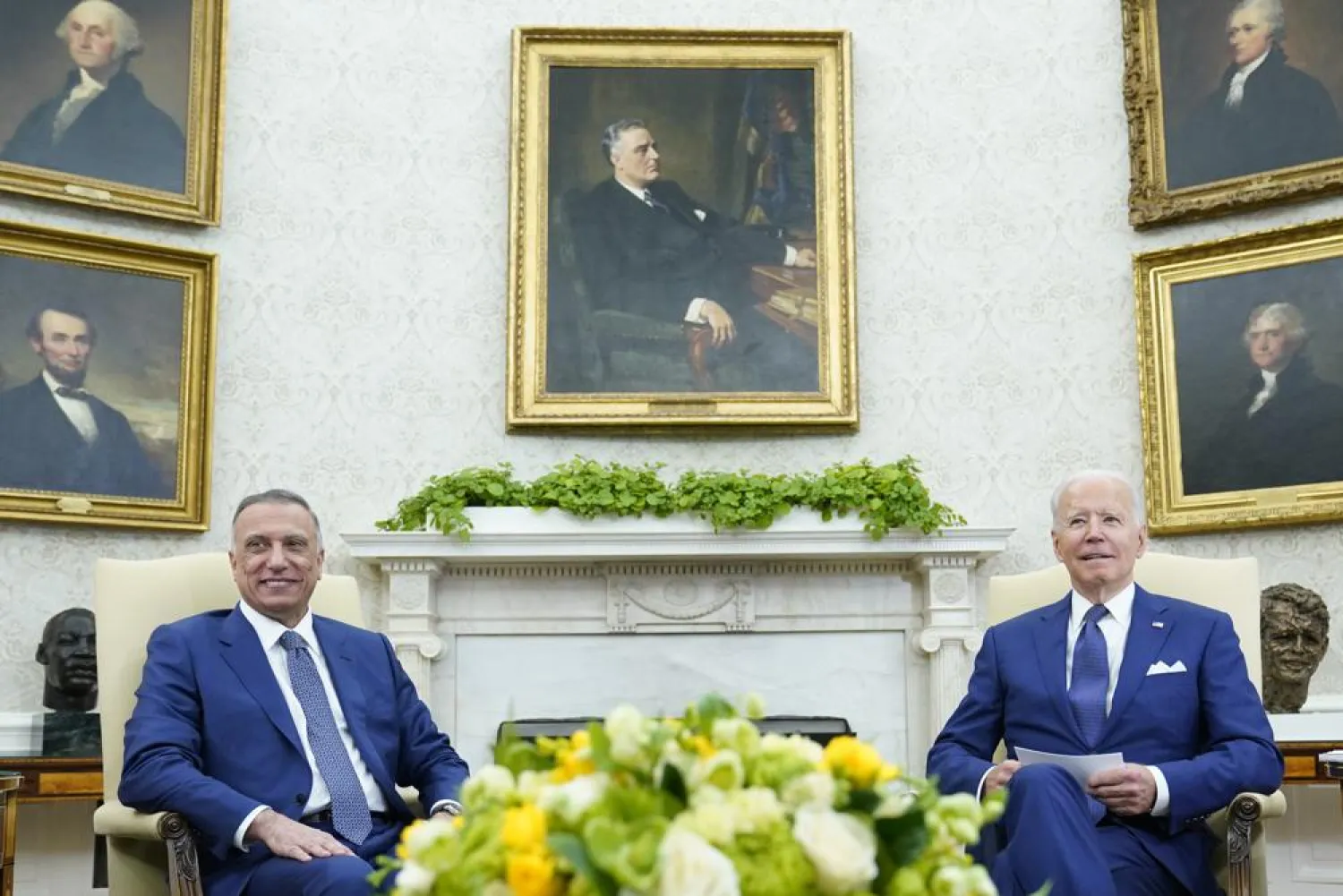
US President Joe Biden, right, meets with Iraqi Prime Minister Mustafa al-Kadhimi, left, in the Oval Office of the White House in Washington, Monday, July 26, 2021. (AP)
TT

Iraq’s Kadhimi Wins Round of ‘Strategic Dialogue’ with US

US President Joe Biden, right, meets with Iraqi Prime Minister Mustafa al-Kadhimi, left, in the Oval Office of the White House in Washington, Monday, July 26, 2021. (AP)

Iraqi Prime Minister Mustafa al-Kadhimi stressed that elections will be held on time on October 10 in spite of a boycott declared by several political forces.

The premier is riding high on the recent round of strategic dialogue he had held in the United States. Kadhimi and US President Joe Biden sealed an agreement on Monday formally ending the US combat mission in Iraq by the end of 2021, but American forces will still operate there in an advisory role.

Influential cleric Moqtada al-Sadr was the first to express his support to Kadhimi’s talks in the US. His Sadrist movement was the first to announce its withdrawal from the elections.

Political parties have said that conditions are not suitable to hold the polls, so they opted to withdraw.

This contrasts with Biden’s declaration that Washington supports holding the elections. The announcement backs Kadhimi’s position against his rivals in the democratic game in Iraq and with the other type of rivals – the armed factions.

The factions appear divided over the PM’s talks in Washington. The Fatih coalition, headed by Hadi al-Ameri, voiced his support of the strategic dialogue, while armed factions loyal to Iran have cast doubt over the talks, especially in regards to the American troop pullout from Iraq.

Head of the parliamentary foreign relations committee Dhafer al-Aani hoped to Asharq Al-Awsat that Kadhimi’s fruitful talks in Washington would reflect positively on Iraq.

He noted that the consensus between the PM and Washington favors the anti-government protesters and Iraq’s higher interests.

On the discrepancy in position among the armed factions towards the dialogue with the US, he explained that this was all part of Iran’s strategy where it allows parties to express varying views in order to allow itself great room to maneuver. This is especially significant now with Tehran holding negotiations with the US in Vienna over its nuclear deal.

MP Abdullah al-Khirbit said Kadhimi had made a “real accomplishment” in Washington.

“Kadhimi has embarrassed everyone, whether they support or oppose the US troops,” he told Asharq Al-Awsat.

MP Hussein Arab said: “The Iraqi negotiator succeeded in achieving Iraqi victory and we must all support it.”

“The agreement ended the disputes over the deployment of combat forces that are unwelcome in Iraq. Resisting these forces now becomes legitimate. However, the agreement specified the nature of the ongoing deployment of American forces, who would be tasked with training, armament and intelligence duties,” he explained.

Kurdish former MP Majid Shingali told Asharq Al-Awsat that the Kurds view the agreement reached with the US as a “major accomplishment.”

The Kurds, he went on to say, do not support the American troop withdrawal, rather they would have preferred that they stay.

“Regardless of how one would describe the remaining forces, their deployment is important in providing the Iraqi army and Kurdish Peshmerga with assistance. Their stay in the country guarantees Iraq’s stability and security against some armed factions, especially those loyal to Iran,” he added.

Israeli Fire Kills Five in Gaza and the West Bank, Medics Say

 Election campaign banners showing candidates for the upcoming municipal elections hang on a building in Deir el-Balah in the central Gaza Strip on April 21, 2026.  (Photo by Eyad Baba / AFP)
Election campaign banners showing candidates for the upcoming municipal elections hang on a building in Deir el-Balah in the central Gaza Strip on April 21, 2026. (Photo by Eyad Baba / AFP)
TT

Israeli Fire Kills Five in Gaza and the West Bank, Medics Say

 Election campaign banners showing candidates for the upcoming municipal elections hang on a building in Deir el-Balah in the central Gaza Strip on April 21, 2026.  (Photo by Eyad Baba / AFP)
Election campaign banners showing candidates for the upcoming municipal elections hang on a building in Deir el-Balah in the central Gaza Strip on April 21, 2026. (Photo by Eyad Baba / AFP)

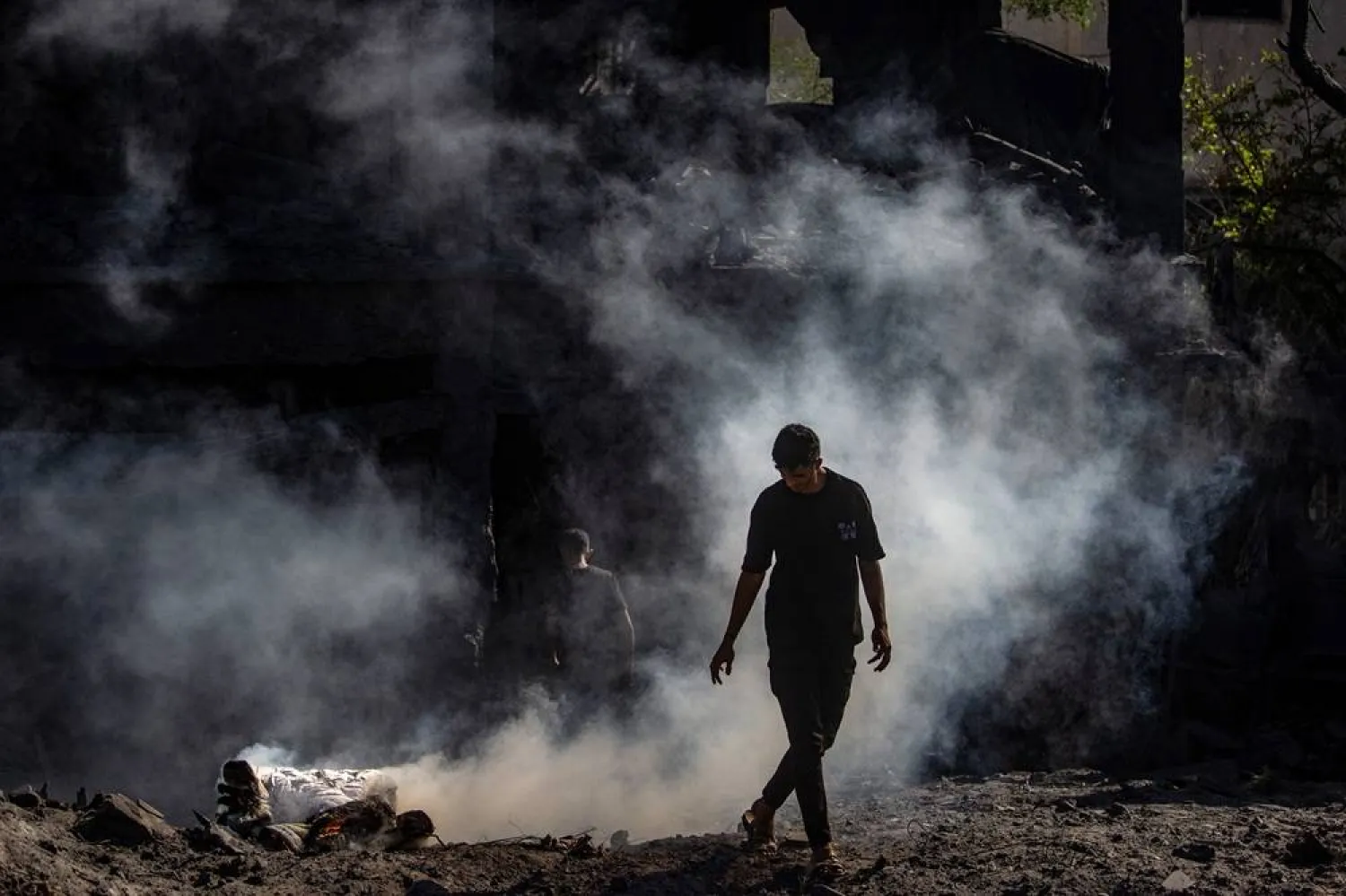
Israeli airstrikes killed at least four Palestinians in Gaza on Thursday, while soldiers shot and killed a 15-year-old child during an army raid in the Israeli-occupied West Bank, Palestinian health officials said.

One person was killed in a strike in southern Gaza's Khan Younis in which several others were wounded, local medics said. Israel's military said it had targeted militants transporting munitions, who it said had posed a threat to Israeli soldiers, Reuters reported.

Three others, including a rescue worker, were killed in a separate strike in Maghazi, a Palestinian refugee camp in the Deir al Balah area in central Gaza, health officials said. Israel's military had no immediate comment on that strike.

Israel has carried out repeated strikes on Gaza since a US-brokered ceasefire came into effect in October. Both Israel and Hamas have accused each other of ceasefire violations.

There is no mechanism for enforcing the ceasefire. Four Israeli soldiers and more than 780 Palestinians have been killed in Gaza since the ceasefire started.

At Gaza City's Al Shifa Hospital, the territory's largest medical facility, relatives stood among mourners gathered to bury five people, including three children, who were killed on Wednesday in an Israeli airstrike on a northern Gaza town.

"There is no ceasefire, no truce, nothing at all," said Mohammed Baalousha, a relative of one of the victims. "There is no safety in any area."

Israel's military has not commented on the strike.

WEST BANK VIOLENCE

In the West Bank city of Nablus, health officials said Israeli forces shot and killed a teenager during an ongoing raid in the city.

The health ministry said Israeli settlers shot and killed a 25-year-old Palestinian man in Deir Dibwan town near Ramallah a day ago, in the latest in what human rights groups have described as a surge in violence against Palestinians waged by Israeli settlers and soldiers.

The Israeli military did not immediately comment on either incident. The Palestinian health ministry said at least 15 people had been killed by Israeli settlers' attacks so far this year.


Disputes Over Quotas Stall Iraq Government Talks

A handout image released by the Iraqi Parliament Media Office on April 11, 2026, shows Iraqi members of parliament attending a session to elect a new president, in Baghdad. (Photo by IRAQ PARLIAMENT MEDIA OFFICE / AFP)
TT

Disputes Over Quotas Stall Iraq Government Talks

A handout image released by the Iraqi Parliament Media Office on April 11, 2026, shows Iraqi members of parliament attending a session to elect a new president, in Baghdad. (Photo by IRAQ PARLIAMENT MEDIA OFFICE / AFP)

Rivalries within Iraq’s Shiite Coordination Framework have led to a political deadlock over naming a new prime minister, as internal disagreements persist over both the selection mechanism and the division of ministerial posts among the bloc’s factions.

According to sources, a meeting of Coordination Framework leaders - postponed several times in recent days - will focus on finding a solution that reconciles two approaches: one based on the “electoral weight” of member blocs, and the other on “political consensus” to choose a compromise candidate acceptable to all parties.

The bloc has failed to agree on a nominee during two previous meetings after votes between two leading candidates ended in a tie, deepening divisions and delaying a decision. The upcoming session is seen as potentially decisive, though another postponement remains possible if differences persist.

An Iraqi political source said a decision on the prime minister could come within hours as the constitutional deadline approaches.

“I expect the matter to be settled one way or another, because next Saturday marks the final deadline, and continued delay is already having a negative impact even among their own base,” the source said.

The source added that if the alliance adopts the criterion of electoral weight, Ihsan al-Awadi, the candidate backed by Prime Minister Mohammed Shia al-Sudani, would have the strongest chances. However, if the decision remains confined to the bloc’s leadership, the contest would stay within a pool of 12 votes, with the balance possibly tipping in favor of Bassem al-Badri.

The dispute extends beyond the selection mechanism to include internal bargaining over the distribution of ministries and sovereign portfolios. Some factions have tied their support for any candidate to the size of their share in the next government, further complicating negotiations.

Two prominent candidates have emerged with nearly equal backing within the Coordination Framework, resulting in a deadlock and reviving the option of a compromise candidate if neither consensus nor a majority decision can be reached.

The Coordination Framework, formed after the most recent elections, includes several major Shiite forces, among them alliances led by former prime ministers Nouri al-Maliki and Haider al-Abadi, as well as the bloc of current Prime Minister Mohammed Shia al-Sudani, who is heading a caretaker government. Political pressure is mounting as the constitutional deadline nears for the president to designate a new prime minister.

The election of President Nizar Amidi has triggered the formal government formation process, with a constitutional deadline set to expire on April 26, placing political forces under pressure to avoid a return to prolonged deadlock.

With complications persisting, there are many scenarios, including a last-minute agreement, further delay, or a shift toward a compromise candidate. The standoff underscores fragile cohesion within the Shiite camp and a widening gap between electoral calculations and the demands of political consensus.


Fallout from Iran War Casts Shadow over Egypt’s New Budget

Egypt’s House of Representatives being briefed on the government’s outlook on the state budget (House of Representatives)
TT

Fallout from Iran War Casts Shadow over Egypt’s New Budget

Egypt’s House of Representatives being briefed on the government’s outlook on the state budget (House of Representatives)

The economic fallout from the Iran war has cast a shadow over Egypt’s new state budget, Finance Minister Ahmed Kouchouk told parliament on Wednesday, as he presented the draft before it was referred to specialized committees for discussion, with the government pledging swift amendments “to enhance its ability to deal with current and potential risks.”

Kouchouk’s statement came a day after Prime Minister Mostafa Madbouly addressed the House of Representatives, focusing on the damage caused by the conflict and ways to manage its repercussions.

He said the government was treating the current regional escalation as a “prolonged crisis,” whose end is difficult to predict given the complexity and overlap of regional and international dynamics, and suggested its economic effects could last through the end of the year.

During the presentation of the 2026-2027 fiscal year budget, 600 billion Egyptian pounds ($11.5 billion) were allocated for energy subsidies, including electricity support, which rose by 39%, according to the finance minister.

A total of 832.3 billion pounds was earmarked for social protection - a 12% annual increase - to support the most vulnerable groups, alongside 90 billion pounds set aside for programs to support economic activity. (The dollar is equivalent to about 52 Egyptian pounds.)

The minister said spending priorities focus on healthcare, education, social protection, and support for production and exports, alongside flexible precautionary policies to address potential challenges and strike a balance between fiscal discipline and economic stimulus. He pointed to “uncertainty in markets and disruptions in trade and supply chains,” describing them as “major challenges and pressures on economies, especially emerging markets.”

Data presented to lawmakers also indicated a 3% reduction in fuel consumption and a 15% cut in electricity and lighting use in response to recent developments. Regarding national projects, the government decided to postpone or slow the implementation of “slow-moving” or fuel-intensive projects on an exceptional basis for three months, renewable if needed.

According to the minister, the government has also decided to limit spending in the final quarter of the current fiscal year to essential expenditures only, including wages, salaries, pensions, and the needs of the health, electricity and petroleum sectors.

Egypt’s budget has been affected by rising costs of securing energy supplies, prompting the government to increase subsidy allocations in the new budget while relying on consumption rationalization and hedging against future developments in the conflict, said economist Mohieddin Abdel Salam. He noted that Egypt has been significantly impacted by rising oil and gas prices.

Figures presented by the finance minister showed the government has mobilized about 135.6 billion pounds since early March to ensure the stability of vital sectors. This includes 90.6 billion pounds for the energy sector, 30 billion pounds to secure essential commodities, subsidized goods, wheat and sugar, and 15 billion pounds to support the healthcare sector and provide medicines.

Abdel Salam told Asharq Al-Awsat that uncertainty remains over Egypt’s ability to attract foreign investment, as some investors are wary of committing funds in the region due to war-related risks. However, he said Egypt could still benefit from opportunities if it manages to distance itself from ongoing tensions.

He noted that these conditions have led to tighter fiscal policies, reflected in holding interest rates steady rather than cutting them, as well as austerity measures and reduced spending by government institutions.

This can be seen in the new budget, he added, which focuses on vital sectors and strengthening social support, particularly amid declining revenues from the Suez Canal and tourism, and potential impacts on remittances from Egyptians abroad.