‘Code Red': UN Scientists Warn of Worsening Global Warming

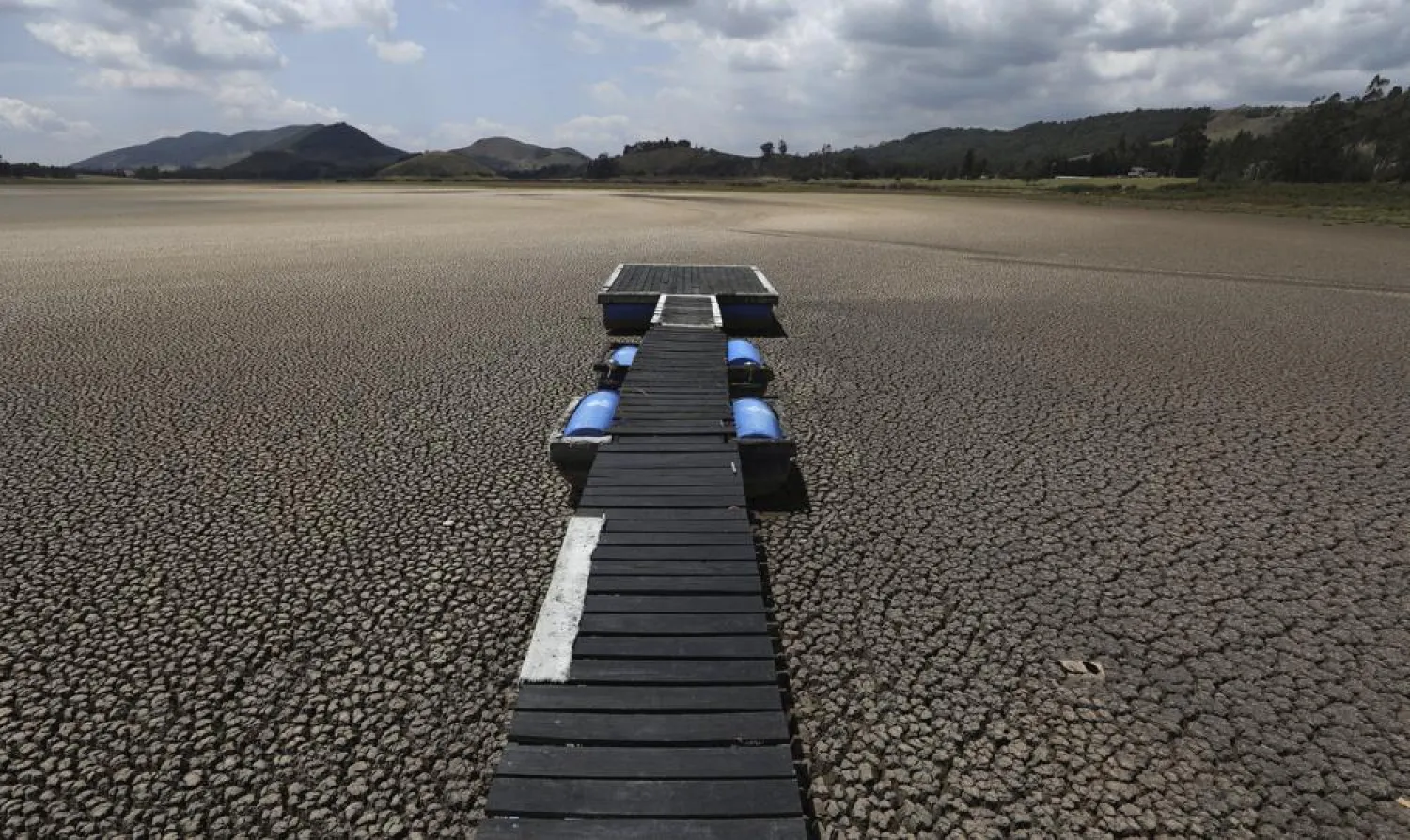
FILE - In this Wednesday, Feb. 17, 2021 file photo, a floating dock sits on the lakebed of the Suesca lagoon, in Suesca, Colombia. The lagoon, a popular tourist destination near Bogota that has no tributaries and depends on rain runoff, has radically decreased its water surface due to years of severe droughts in the area and the deforestation and erosion of its surroundings. (AP Photo/Fernando Vergara, File)
TT

‘Code Red': UN Scientists Warn of Worsening Global Warming

FILE - In this Wednesday, Feb. 17, 2021 file photo, a floating dock sits on the lakebed of the Suesca lagoon, in Suesca, Colombia. The lagoon, a popular tourist destination near Bogota that has no tributaries and depends on rain runoff, has radically decreased its water surface due to years of severe droughts in the area and the deforestation and erosion of its surroundings. (AP Photo/Fernando Vergara, File)

Earth is getting so hot that temperatures in about a decade will probably blow past a level of warming that world leaders have sought to prevent, according to a report released Monday that the United Nations called a “code red for humanity.”

“It’s just guaranteed that it’s going to get worse,” said report co-author Linda Mearns, a senior climate scientist at the US National Center for Atmospheric Research. “Nowhere to run, nowhere to hide.”

But scientists also eased back a bit on the likelihood of the absolute worst climate catastrophes.

The authoritative Intergovernmental Panel on Climate Change (IPCC) report, which calls climate change clearly human-caused and “unequivocal” and “an established fact,” makes more precise and warmer forecasts for the 21st century than it did last time it was issued in 2013.

Each of five scenarios for the future, based on how much carbon emissions are cut, passes the more stringent of two thresholds set in the 2015 Paris climate agreement. World leaders agreed then to try to limit warming to 1.5 degrees Celsius (2.7 degrees Fahrenheit) above levels in the late 19th century because problems mount quickly after that. The world has already warmed nearly 1.1 degrees Celsius (2 degrees Fahrenheit) since then.

Under each scenario, the report said, the world will cross the 1.5-degree-Celsius warming mark in the 2030s, earlier than some past predictions. Warming has ramped up in recent years, data shows.

“Our report shows that we need to be prepared for going into that level of warming in the coming decades. But we can avoid further levels of warming by acting on greenhouse gas emissions,” said report co-chair Valerie Masson-Delmotte, a climate scientist at France’s Laboratory of Climate and Environment Sciences at the University of Paris-Saclay.

In three scenarios, the world will also likely exceed 2 degrees Celsius (3.6 degrees Fahrenheit) over pre-industrial times — the less stringent Paris goal — with far worse heat waves, droughts and flood-inducing downpours unless there are deep emissions cuts, the report said.

“This report tells us that recent changes in the climate are widespread, rapid and intensifying, unprecedented in thousands of years,” said IPCC Vice Chair Ko Barrett, senior climate adviser for the US National Oceanic and Atmospheric Administration.

With crucial international climate negotiations coming up in Scotland in November, world leaders said the report is causing them to try harder to cut carbon pollution. US Secretary of State Anthony Blinken called it “a stark reminder."

The 3,000-plus-page report from 234 scientists said warming is already accelerating sea level rise and worsening extremes such as heat waves, droughts, floods and storms. Tropical cyclones are getting stronger and wetter, while Arctic sea ice is dwindling in the summer and permafrost is thawing. All of these trends will get worse, the report said.

For example, the kind of heat wave that used to happen only once every 50 years now happens once a decade, and if the world warms another degree Celsius (1.8 degrees Fahrenheit), it will happen twice every seven years, the report said.

As the planet warms, places will get hit more not just by extreme weather but by multiple climate disasters at once, the report said. That’s like what’s now happening in the Western US, where heat waves, drought and wildfires compound the damage, Mearns said. Extreme heat is also driving massive fires in Greece and Turkey.

Some harm from climate change — dwindling ice sheets, rising sea levels and changes in the oceans as they lose oxygen and become more acidic — is “irreversible for centuries to millennia,” the report said.

The world is “locked in” to 15 to 30 centimeters (6 to 12 inches) of sea level rise by mid-century, said report co-author Bob Kopp of Rutgers University.

Scientists have issued this message for more than three decades, but the world hasn't listened, said United Nations Environment Program Executive Director Inger Andersen.
For the first time, the report offers an interactive atlas for people to see what has happened and may happen to where they live.

Nearly all of the warming that has happened on Earth can be blamed on emissions of heat-trapping gases such as carbon dioxide and methane. At most, natural forces or simple randomness can explain one- or two-tenths of a degree of warming, the report said.

The report described five different future scenarios based on how much the world reduces carbon emissions. They are: a future with incredibly large and quick pollution cuts; another with intense pollution cuts but not quite as massive; a scenario with moderate emission cuts; a fourth scenario where current plans to make small pollution reductions continue; and a fifth possible future involving continued increases in carbon pollution.

In five previous reports, the world was on that final hottest path, often nicknamed “business as usual.” But this time, the world is somewhere between the moderate path and the small pollution reductions scenario because of progress to curb climate change, said report co-author Claudia Tebaldi, a scientist at the US Pacific Northwest National Lab.

While calling the report “a code red for humanity,” UN Secretary-General Antonio Guterres kept a sliver of hope that world leaders could still somehow prevent 1.5 degrees of warming, which he said is “perilously close.”

Alok Sharma, the president of the upcoming climate negotiations in Scotland, urged leaders to do more so they can “credibly say that we have kept 1.5 degrees alive.”

“Anything we can do to limit, to slow down, is going to pay off,” Tebaldi said. “And if we cannot get to 1.5, it’s probably going to be painful, but it’s better not to give up.”

In the report’s worst-case scenario, the world could be around 3.3 degrees Celsius (5.9 degrees Fahrenheit) hotter than now by the end of the century. But that scenario looks increasingly unlikely, said report co-author and climate scientist Zeke Hausfather, climate change director of the Breakthrough Institute.

“We are a lot less likely to get lucky and end up with less warming than we thought,” Hausfather said. “At the same time, the odds of ending up in a much worse place than we expected if we do reduce our emissions are notably lower.”

The report also said ultra-catastrophic disasters — commonly called “tipping points,” like ice sheet collapses and the abrupt slowdown of ocean currents — are “low likelihood” but cannot be ruled out. The much talked-about shutdown of Atlantic ocean currents, which would trigger massive weather shifts, is something that’s unlikely to happen in this century, Kopp said.

A "major advance” in the understanding of how fast the world warms with each ton of carbon dioxide emitted allowed scientists to be far more precise in the scenarios in this report, Mason-Delmotte said.

In a new move, scientists emphasized how cutting airborne levels of methane — a powerful but short-lived gas that has soared to record levels — could help curb short-term warming. Lots of methane the atmosphere comes from leaks of natural gas, a major power source. Livestock also produces large amounts of the gas, a good chunk of it in cattle burps.

More than 100 countries have made informal pledges to achieve “net zero” human-caused carbon dioxide emissions sometime around mid-century, which will be a key part of the negotiations in Scotland. The report said those commitments are essential.

“It is still possible to forestall many of the most dire impacts,” Barrett said.


Missing Teen Found Alive After 6 Days in Australian Woodlands

In this image made from video and provided by the Victoria State Police 17-year-old William, center right, is embraced by his mother Elizabeth, only first names were provided by police, while in a helicopter in Cowwarr, Australia, Thursday, Nov. 12, 2026, after William spent six days lost in eastern Australian woodlands. (Victoria Police via AP)
TT

Missing Teen Found Alive After 6 Days in Australian Woodlands

In this image made from video and provided by the Victoria State Police 17-year-old William, center right, is embraced by his mother Elizabeth, only first names were provided by police, while in a helicopter in Cowwarr, Australia, Thursday, Nov. 12, 2026, after William spent six days lost in eastern Australian woodlands. (Victoria Police via AP)

A 17-year-old boy with autism was found alive Thursday after six days lost in eastern Australian woodlands.

The boy, whom police identified only as William, had begun camping with a teenage friend when he disappeared last Friday near Walhalla, a former gold-mining town 185 kilometers (115 miles) east of Melbourne, police said.

A police helicopter crew found him surrounded by wilderness lying asleep on a flat rock beside a creek, and he was later reunited with his mother. William was in good spirits and mostly in good health, the police statement said.

Video shot from the rescue helicopter showed he was shirtless and sunburned. He was wearing shorts and boots and was using towels as blankets.

“I’m just over the moon that he’s alive,” his mother, Elizabeth, told reporters.

The AP has decided not to provide her family name to avoid identifying her son.

“And he’s never leaving the house again. He’s grounded for life. He’s not going anywhere ever again,” she joked.

William was later taken to a hospital for his health to be monitored, police said.

William's family have said he has Level 2 autism. That requires “substantial support,” according to the Australian advocacy group Autism360.

Such a person may have marked deficits in verbal and non-verbal social communication and rely heavily on routines and predictable activities.

Disruption can cause significant distress.

The Southern Hemisphere spring weather had been mild for the past week in the alpine region where William was lost and there had been little rain.

Elizabeth had dropped off her son and his friend last Friday for a weekend of camping. William walked a short distance from the campsite to the drop-off location to collect more camping equipment but never returned to his friend, police said.

After becoming lost, William trekked for days up and down “some very steep terrain,” Acting Police Inspector Jason Benbow said.

He spent the last two days where he was found at the creek, trapped by the steepness of his surrounds 2 kilometers (1.2 miles) from his camp site, Benbow said.

“He woke up to the sound of the helicopter, gave them a thumbs up and they winched him to safety,” Benbow told reporters.

The extensive police search for him involved more than 100 emergency services personnel and volunteers.


Europe’s Hera Spacecraft Begins Close Inspections of an Asteroid Rammed by NASA in a 2022 Test

This undated image provided by the European Space Agency on Nov. 5, 2026 and taken by the Hera spacecraft, shows asteroid Didymos. (European Space Agency via AP)
TT

Europe’s Hera Spacecraft Begins Close Inspections of an Asteroid Rammed by NASA in a 2022 Test

This undated image provided by the European Space Agency on Nov. 5, 2026 and taken by the Hera spacecraft, shows asteroid Didymos. (European Space Agency via AP)

A European spacecraft has begun close inspections of an asteroid rammed by NASA four years ago in a planetary defense test.

The European Space Agency announced Wednesday that the Hera spacecraft is now studying Didymos and its moonlet Dimorphos from just 15 miles to 18 miles (25 kilometers to 30 kilometers) away, The AP news reported.

NASA’s Dart spacecraft deliberately slammed into little Dimorphos in 2022 to see whether such a defensive move might help save Earth from a killer space rock one day.

The impact shortened the moonlet’s orbit around Didymos. More importantly, it nudged the moonlet into a slightly different path around the sun.

Next month, the small car-sized Hera, launched in 2024, will venture even closer — just 12 miles (20 kilometers) away.

ESA officials consider this a “crash site investigation” worthy of its finest robotic detective. Hera is carrying 25 science instruments as well as a pair of shoebox-sized Cubesats to survey Dimorphos even more closely and attempt to land on it.

The Dart spacecraft — short for Double Asteroid Redirection Test — sent rubble and even boulders flying off Dimorphos, providing an extra kick to the impact’s momentum. The debris trail extended thousands of miles (more than 10,000 kilometers) into space for months.

Some of that debris could still be in the vicinity, according to scientists.

Dimorphos is an estimated 500 feet (151 meters) in diameter. Didymos is roughly 2,560 feet (780 meters) in diameter.


Euclid Mission Data Release Spans More than 900 Million Galaxies

Looking across vast distances means peering into the past because of the time needed for light from distant objects to reach us (Reuters)
TT

Euclid Mission Data Release Spans More than 900 Million Galaxies

Looking across vast distances means peering into the past because of the time needed for light from distant objects to reach us (Reuters)

The European Space Agency has released its first big collection of data from the orbiting Euclid telescope's mission to map the universe's large-scale structure, including observations of more than 900 million galaxies, as scientists investigate the puzzling cosmic components dark matter and dark energy.

The data unveiled on Thursday covered a survey of the sky equal to about 9,500 times the size of the moon as viewed from Earth. The mission's goal is to complete the largest-ever three-dimensional atlas of the cosmos, spanning more than a third of the sky, in 2031.

Thursday's release encompassed around 13 months of Euclid observations, totaling an enormous 1.7 petabytes — 1.7 million gigabytes — of data, Reuters reported.

"It marks a major milestone for ESA's Euclid mission and for everyone involved," said astrophysicist Valeria Pettorino, ESA's Euclid project scientist.

Euclid, launched from Florida in 2023, is gathering data on how the universe has expanded and how its structure has formed over time while amassing information about the nature of dark energy and dark matter and the role of gravity on large scales.

"Euclid will not just take images of galaxies in the sky, in two dimensions, but will also measure their distance, the third dimension. This will tell us where galaxies are in space and time, across 10 billion years, and in all directions beyond our galactic plane," Pettorino said.

"Galaxies cluster along filaments, surrounded by empty space, and form a network that we call the cosmic web. Euclid will reconstruct the cosmic web and how it has grown over time. This is important because the exact configuration of the cosmic web, how many clusters or voids are there, how fast it changed, depend on the properties of dark energy and dark matter," Pettorino said.

The universe's contents include ordinary matter as well as dark matter and dark energy.

Ordinary matter — stars, planets, gas, dust and all the familiar stuff on Earth — represents about 5% of the contents. Dark matter, known from the gravitational effects it exerts on galactic scales, is invisible material that may make up about 27% of the cosmos. Dark energy, thought to be responsible for the accelerated expansion of the universe, may account for 68%.

Dark matter and dark energy do not emit or absorb light and cannot be directly observed.

Previous Euclid data releases covered only a few days of observations. The newly released dataset includes more than a year of data and still spans only 14% of the total sky area Euclid is due to survey in visible and near-infrared light over six years. This data release will be completed next year with the first results on dark energy and dark matter.

GRAVITATIONAL LENSING

Light traveling toward Earth from faraway galaxies can be bent and distorted by normal matter and dark matter in the foreground, an effect called gravitational lensing. Thus, the nearer galaxy's gravity warps the light coming from the one behind.

Gravitational lensing is one of the tools being used to study dark matter's distribution. The new Euclid data includes about 15,000 strong gravitational lens candidates, exceeding the total number discovered in the previous half century.

"Gravitational lenses are nature's own weighing scales," said Natalie Lines, a doctoral student in astrophysics at the University of Portsmouth in England and a member of the Euclid Consortium of scientists.

"How strongly the light is bent tells us how much matter a galaxy contains, including invisible components like dark matter. With thousands of lenses, we can study how dark matter is spread through galaxies and understand how galaxies form and evolve over cosmic time," Lines said.

Lines noted the sharpness of the Euclid images over a huge area of the cosmos.

"Telescopes on Earth can cover large areas of the night sky, but their view is blurred by the atmosphere. The Hubble and James Webb space telescopes take beautifully sharp images, but only of tiny patches of sky. Euclid does both at once, and that is crucial for finding things that are small and rare, like strong gravitational lenses," Lines said.

Looking across vast distances means peering into the past because of the time needed for light from distant objects to reach us. The most distant objects Euclid has viewed are quasars, the brilliant cores of galaxies powered by supermassive black holes. The telescope has pinpointed 60 million of them.

"Euclid has found some dating back to when the universe was just 5% of its current age, so their light set off around 13 billion years ago," Lines said.