


Houthi Conditions to End Marib Fighting Complicate Peace Efforts in Yemen

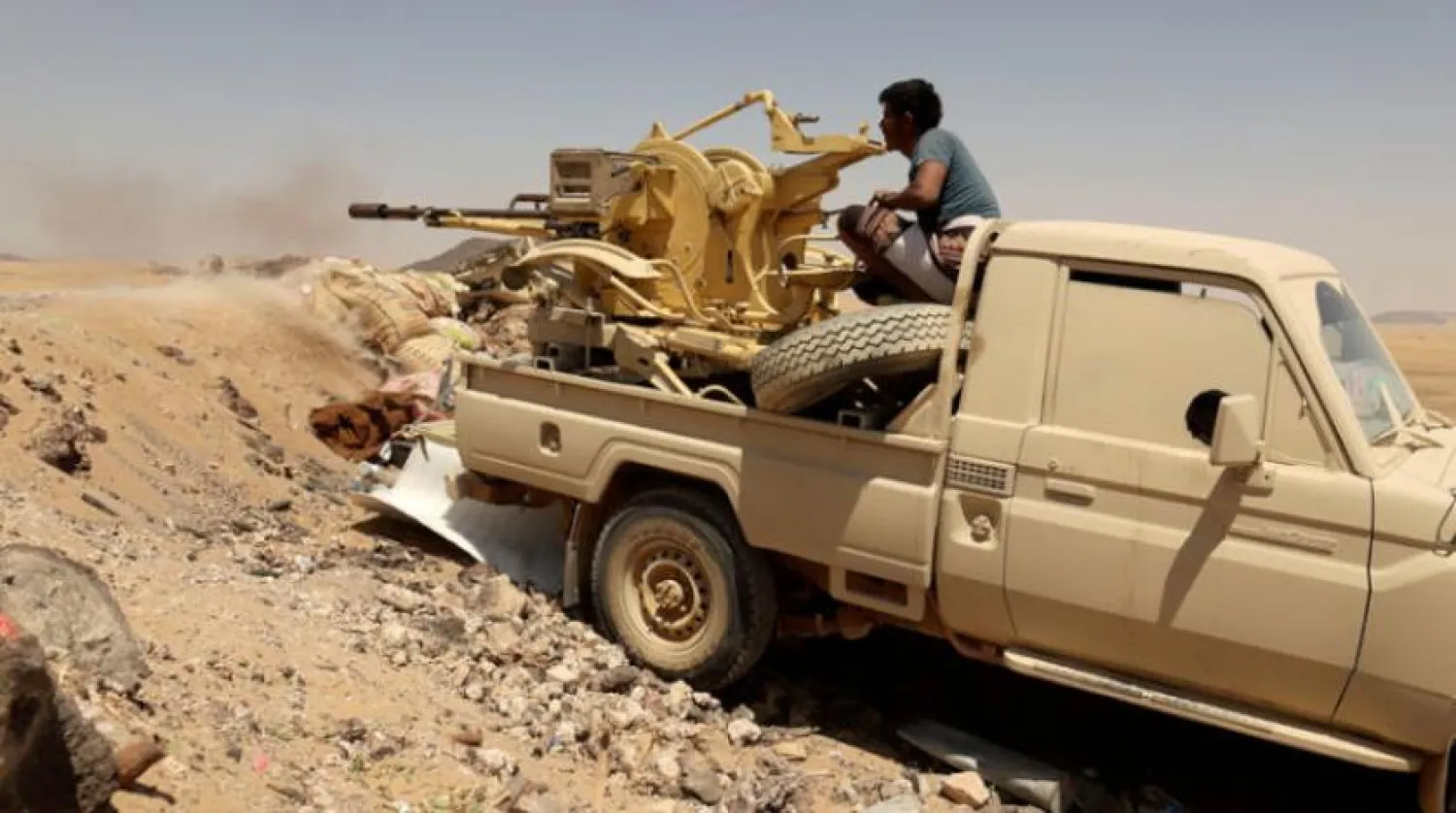
A pro-government fighter in Marib. (Reuters)
TT

Houthi Conditions to End Marib Fighting Complicate Peace Efforts in Yemen

A pro-government fighter in Marib. (Reuters)

The Iran-backed Houthi militias have finally revealed their conditions to end their offensive on the Yemeni province of Marib that is home to over 2 million refugees.

The conditions will likely complicate peace efforts in the war-torn country, agreed officials and activists.

The Houthis revealed that they had submitted their conditions – the so-called “Marib initiative” – to Omani mediators. Their initiative contrasts with the initiative proposed by former United Nations envoy Martin Griffiths that was based on the Saudi initiative that was suggested this year.

The Saudi proposal calls for a nationwide ceasefire, reopening of the Sanaa International Airport, using Hodeidah port revenues to pay salaries and kicking off negotiations to reach lasting peace.

The Houthi initiative demands the formation of a joint command for Marib, joint security forces and joint technical committees. The militias have also demanded shares of oil and gas, as well as the reoperation of the export pipeline that extends from Marib to the Houthi-held Ras Issa port on the Red Sea. They demanded the release of their loyalists from detention centers controlled by the legitimate government and the freedom of movement of their members to and from Marib.

In sum, noted Yemeni observers, the Houthis are demanding that they be handed control of the oil-rich province that they have been seeking to occupy militarily for over a year.

Undersecretary at the Information Ministry Abdulbasit Al-Qaedi told Asharq Al-Awsat: “These conditions do not signify surrender or peace. Rather, the Houthis want to fulfill through peace demands they haven’t been able to achieve through war.”

“They want to impose conditions and this is in no way a reflection of their desire for peace,” he added.

The Omani mediators had approached the Houthis with the Saudi initiative, but were instead met with the “Marib initiative”, reflecting their rejection of the Kingdom’s efforts, he went on to say.

The Houthis “don’t care about peace” and their leader is “trying to impose his conditions and outsmart the international community,” Al-Qaedi remarked.

The Yemenis, he stated, are aware of these ploys and have experienced them throughout the long years of war.

He noted how the Houthis have always reneged on commitments, turned against agreements and rejected all international resolutions, including United Nations Security Council resolution 2216 and the Stockholm Agreement. Moreover, they have refused to withdraw from Hodeidah, release detainees or end the siege on Taiz city.

Political analyst Mahmoud al-Taher said the Houthis were trying to deliver several messages through their initiative.

They want to show the tribes, especially those in Marib, whom they have repeatedly failed in winning over, that the Houthis were now calling the shots. Once the international community surrenders Marib to the militias, then the tribes will no longer be welcome in the province, he explained to Asharq Al-Awsat.

Moreover, through these conditions, the Houthis are leading the international community, starting with the United States, to believe that they are fighting the ISIS and al-Qaeda groups. They are claiming that these groups are based in Marib, which is a dangerous accusation against the entire Yemeni population, he warned.

It is as if they are saying that whoever rejects the Iranian agenda in Yemen is embracing ISIS and al-Qaeda, he explained.

Furthermore, if they succeed in fooling the international community, the Houthis will likely resort to the same tactics in seizing all other provinces, he noted.


Somalia's Capital Votes in First Step toward Restoring Universal Suffrage

Members of the Justice and Solidarity Party (JSP) campaign in the streets as they share their political aims with voters in Mogadishu, Somalia, 22 December 2025. EPA/SAID YUSUF WARSAME
TT

Somalia's Capital Votes in First Step toward Restoring Universal Suffrage

Members of the Justice and Solidarity Party (JSP) campaign in the streets as they share their political aims with voters in Mogadishu, Somalia, 22 December 2025. EPA/SAID YUSUF WARSAME

Residents of Somalia's capital Mogadishu will vote on Thursday in municipal elections meant to pave the way for the East African country's first direct national polls in more than half a century.

With the exception of votes in the semi-autonomous region of Puntland and the breakaway region of Somaliland, Somalia last held direct elections in 1969, months before military general, Mohamed Siad Barre, took power in a coup, Reuters said.

After years of civil ‌war that ‌followed Barre's fall in 1991, indirect elections ‌were ⁠introduced in ‌2004. The idea was to promote consensus among rival clans in the face of an armed insurgency, although some Somalis say politicians prefer indirect elections because they create opportunities for corruption.

Under the system, clan representatives elect lawmakers, who then choose the president. The president, in turn, has been responsible for appointing Mogadishu's mayor.

The vote in Mogadishu, a ⁠city of some 3 million people where security conditions have improved in recent years ‌despite continuing attacks by al Qaeda-linked al ‍Shabaab militants, is seen as ‍a test run for direct elections at the national level.

Around ‍1,605 candidates are running on Thursday for 390 posts in Mogadishu's district councils, said Abdishakur Abib Hayir, a member of the National Electoral Commission. Council members will then choose a mayor.

"It shows Somalia is standing on its feet and moving forward," Hayir told Reuters. "After the local election, elections can and will take place in ⁠the entire country."

A 2024 law restored universal suffrage ahead of federal elections expected next year. However, President Hassan Sheikh Mohamud reached a deal in August with some opposition leaders stipulating that while lawmakers would be directly elected in 2026, the president would still be chosen by parliament.

Opposition parties have argued the rapid introduction of a new electoral system would benefit Mohamud's re-election prospects.

They also question whether the country is safe enough for mass voting given al Shabaab's control over vast areas of the countryside and regular strikes ‌on major population centers.


Sudan's RSF Says Captured Areas Near Chad Border

Sudanese refugee girls carry water supplies near a polling station in the refugee camp of Zamzam, on the outskirts of el-Fasher, Darfur, Sudan, on April 13, 2010. (AP)
TT

Sudan's RSF Says Captured Areas Near Chad Border

Sudanese refugee girls carry water supplies near a polling station in the refugee camp of Zamzam, on the outskirts of el-Fasher, Darfur, Sudan, on April 13, 2010. (AP)

Sudan’s Rapid Support Forces (RSF) announced on Wednesday that it had seized full control of areas bordering Chad in North Darfur in western Sudan.

The RSF released videos of its forces as they deployed in several towns in the regions.

The Sudanese army has yet to comment on the development.

In a statement, the RSF said that along with allies forces, it captured the regions of Um Qamra and Abu Barro in the westernmost point in North Darfur.

It accused the army and its allied forces of carrying out “systematic attacks” and “reprisals” against civilians in the area.

The RSF said the capture of the regions “ends the deployment of armed forces” and puts and end to the “reprisals and chaos”.

It added that it has deployed military units “to protect the civilians and secure roads and public areas to restore normal life there.”

On Tuesday, prior to the capture, Darfur region governor and leader of the Sudan Liberation Movement/Army Minni Minnawi had warned of an imminent RSF attack.

He had called on the people to defend themselves and their property, adding: “Defend your existence... the land that is not protected by its people gets stolen, and the dignity that is not defended is killed.”

His call had prompted harsh criticism in Darfur who accused him of attempting to embroil the people in an uneven confrontation with the RSF that is far better equipped and ready to fight.

They wondered why the joint forces of various parties had withdrawn from the area and not held their ground to fight the RSF.

The RSF had in the early hours of Wednesday launched attacks on the towns of al-Tina and Kernoi, capturing them without resistance.

With its latest capture, the RSF now has control of Sudan’s borders with Chad, Libya, Central Africa and South Sudan.


Shaibani: Syrian-Russian Ties Entering New Phase

Russia's Foreign Minister Sergei Lavrov and Syria's Foreign Minister Asaad al-Shaibani attend a meeting in Moscow, Russia December 24, 2025. (Russian Foreign Ministry/Handout via Reuters)
TT

Shaibani: Syrian-Russian Ties Entering New Phase

Russia's Foreign Minister Sergei Lavrov and Syria's Foreign Minister Asaad al-Shaibani attend a meeting in Moscow, Russia December 24, 2025. (Russian Foreign Ministry/Handout via Reuters)

Syrian Foreign Minister Asaad al-Shaibani stressed on Wednesday that relations between Damascus and Moscow were entering a new phase based on mutual respect.

He met in Moscow with his Russian counterpart Sergei Lavrov, saying: “We aspire to establish balanced relations with everyone.”

“We are working on attracting investments to Syria to improve the economy,” he added, remarking: “We are forging ahead in rebuilding the country.”

For his part, Lavrov said the meeting tackled various issues, underlining the importance of maintaining Syria’s territorial integrity and bolstering bilateral ties between Damascus and Moscow.

On Tuesday, Shaibani and Defense Minister Major General Murhaf Abu Qasra met with Russian President Vladimir Putin to discuss political, military, and economic issues of mutual interest, with particular emphasis on strategic cooperation in the defense industry sector, reported Syria’s state news agency SANA.

They reviewed ways to advance military and technical partnership in a manner that strengthens the defensive capabilities of the Syrian army and keeps pace with modern developments in military industries.

Discussions focused on upgrading military equipment, transferring technical expertise and know-how, and expanding cooperation in research and development to boost Syria’s national defense system and support security and stability in Syria and the region.

On the political front, the two sides exchanged views on regional and international developments, underscoring the importance of continued political and diplomatic coordination between Damascus and Moscow in international forums.

They stressed the need to respect international law, rejecting all forms of external interference in the internal affairs of states.

Economically, the meeting addressed prospects for expanding economic and trade cooperation, including support for reconstruction projects, development of infrastructure sectors, and encouragement of investment in Syria.

The talks also covered boosting trade exchange and facilitating partnerships in ways that positively impact the Syrian economy and contribute to improving living conditions.

Putin underscored Russia’s steadfast support for Syria, stressing the importance of preserving Syria’s unity, territorial integrity, and full sovereignty, and rejecting “any projects aimed at partitioning the country or undermining its independent national decision”.

He also renewed Moscow’s condemnation of repeated Israeli violations of Syrian territory, describing them as “a direct threat to regional security and stability”.
