


Arab Youth Center Launches Arab Youth Council for Climate Change

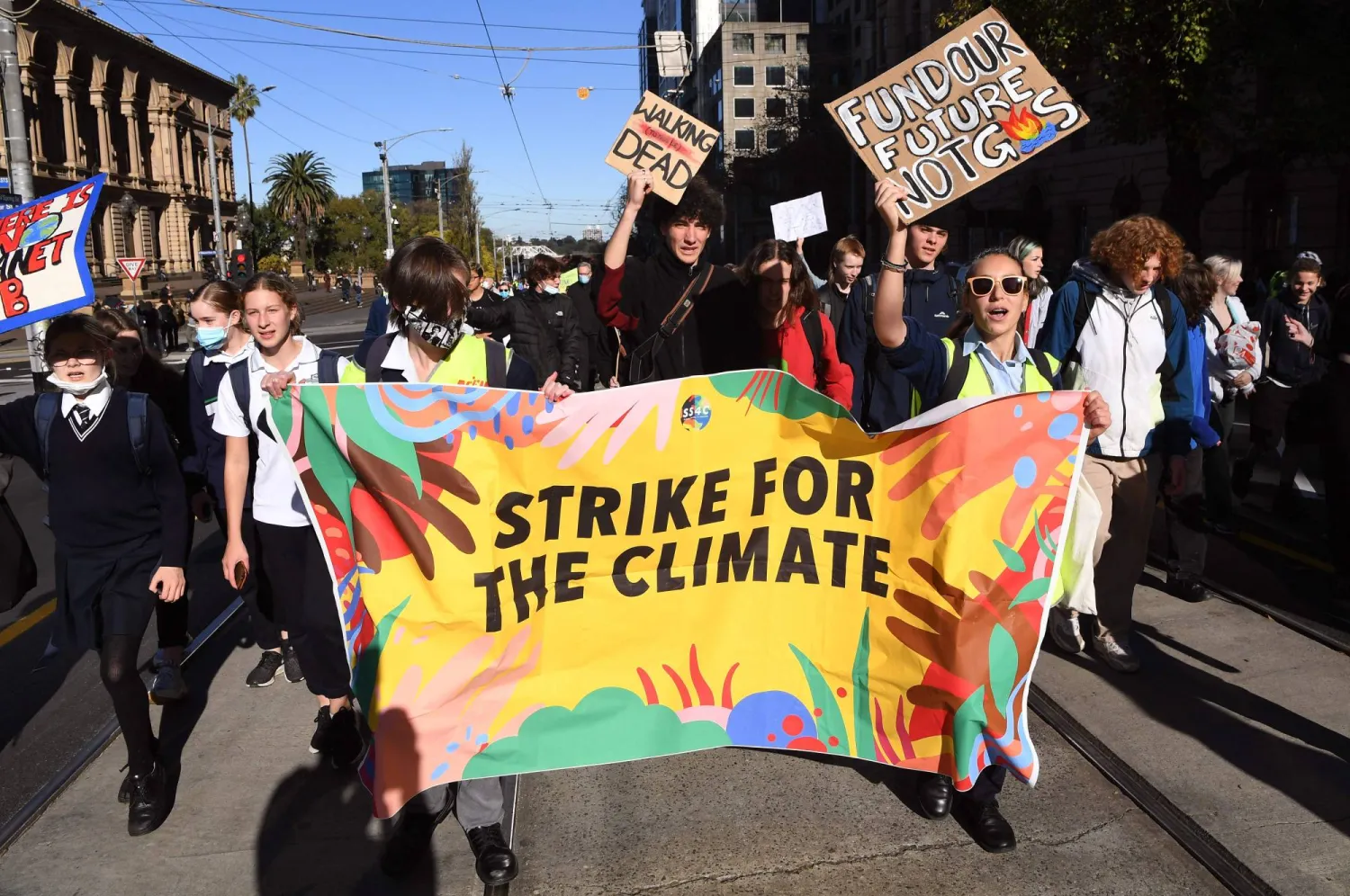
Students march during a rally calling for climate action in
Melbourne on May 21. | AFP
Students march during a rally calling for climate action in Melbourne on May 21. | AFP
TT

Arab Youth Center Launches Arab Youth Council for Climate Change

Students march during a rally calling for climate action in
Melbourne on May 21. | AFP
Students march during a rally calling for climate action in Melbourne on May 21. | AFP

The UAE-based Arab Youth Center (AYC) announced the foundation of the Arab Youth Council for Climate Change (AYCCC), a regional platform that shed lights on environmental matters, supports Arab strategies related to the environment and climate change, and contributes to empowering leaders and young creators that would convoy the COPE 28 Summit hosted by the UAE in 2022.

AYC will launch the Council in cooperation with several key partners, including the Arab League, the UAE Ministry of Climate Change and Environment (MOCCAE), the Office of the UAE’s Special Envoy for Climate Change, and many Arab institutions from the private sector.

The launch comes amid a growing Arab and global interest in the efforts aimed at coping with climate change on the official, institutional, and media levels.

AYCCC has outlined several strategic goals, including equipping young Arabs with the skills required to face the challenges posed by climate change, and representing their voices at Arab and international environmental events, state news agency WAM reported.

The work of the Council, whose session lasts for two years, will cover six areas including optimal natural resources and water management, clean and renewable energy, circular economy, agriculture and food security, reducing greenhouse gas emissions and improving air quality, and adaptation to climate change.

For his part, Dr. Abdullah Al Nuaimi, cabinet member and minister of climate change and environment, said: "Launching AYCCC would contribute to the creation of a comprehensive Arab model that focuses on climate problems, enhances efforts to mitigate the causes of climate change, and improve the capacities of all sectors to cope with its repercussions in the region."

Dr. Sultan Al Jaber, minister of Industry and Advanced Technology and the UAE’s Special Envoy for Climate Change, said: "The UAE supports the young generation which plays a key role in shaping the future. The launch of the council is a strategic step that enhances the participation of young people and promotes their effective role in the climate-related efforts."

Shamma Al Mazrui added: "Climate change has become a serious challenge affecting our future. It is threatening food and water security, and negatively affecting quality of life in cities and communities. As the interest of young people in pressing issues increases, AYC – under the guidance of His Highness Sheikh Mansour bin Zayed Al Nahyan – responded by launching AYCCC to achieve a quantum leap in Arab youth’s engagement with environmental issues."

United Nations Resident Coordinator for the UAE, Dr. Dena Assaf, praised the newly formed Council, saying "We foresee that AYCCC can have a leading role at the regional level, and thus an ability to influence the new generation of Arab youth, who will be the leaders of tomorrow. This initiative can support putting climate change at the core of national agendas of governments in this vital region of the world."

Around 40% of young people say they are ready to adopt sustainable behaviors that can protect and preserve the environment and contribute to mitigating the causes of climate change, especially if these behaviors become easier to embrace.



Saudi Arabia: AlUla Advances to 85th Place in IMD Smart City Index 2026

AlUla seeks to become an ideal destination for living, working and visiting. SPA
TT

Saudi Arabia: AlUla Advances to 85th Place in IMD Smart City Index 2026

AlUla seeks to become an ideal destination for living, working and visiting. SPA

AlUla has recorded the highest improvement in the IMD Smart City Index 2026, advancing from 112th place in 2025 to 85th this year, placing it among the most improved cities globally in this edition of the index.

This result reflects AlUla's ambition to become an ideal destination for living, working and visiting.

This achievement is a continuation of the comprehensive and sustainable development objectives pursued by the Royal Commission for AlUla (RCU) since its establishment, and in line with the AlUla vision, which targets the development of infrastructure, improvement of services, and enhancement of quality of life for the people and residents of AlUla, whilst preserving the unique natural and cultural environment of the governorate.

This year's edition of the index measures city performance across key pillars including quality of life, service efficiency, technology, environmental sustainability, and smart governance.

These pillars are central to the commission's priorities and are being continuously advanced in partnership with stakeholders across the public and private sectors.

On the quality of life front, RCU continues to develop services for the people and residents of AlUla, spanning education, healthcare, infrastructure, and public utilities, within an approach that balances urban development requirements with the preservation of the destination's identity.

Sustainability also serves as a foundational pillar within the comprehensive development framework for the governorate. In this regard, RCU has announced the lifting of the suspension on land sales and transactions in central and southern AlUla, a strategic step that opens the door for citizens and investors to participate in real estate activities within a regulated environment.

On the education front, RCU has established an integrated system that encompasses a language institute offering instruction in five languages, a scholarship program that has benefited more than 690 students, teacher qualification programs in which more than 800 educators have enrolled, and community activities that have engaged approximately 7,400 students.

In the area of transport, RCU has completed the expansion of AlUla International Airport, increasing its annual passenger capacity from 400,000 to 700,000, doubling the number of passport control lanes, and integrating smart technologies to enhance the passenger experience, alongside the introduction of smart mobility solutions within the governorate.

RCU continues to develop infrastructure through the construction of power stations and water storage facilities, as well as the enhancement of public utilities, all within the framework of the second masterplan, "Path to Prosperity", which aims to elevate quality of life and advance community development

This progress aligns with the objectives of Saudi Vision 2030 and reflects the accelerating transformation AlUla is undergoing across urban development and sustainability, supporting its ambitions to establish itself as a leading international cultural and tourism destination, and contributing to its growing presence on global smart city rankings.


Argentine MPs Approve Bill to Allow Mining in Glaciers

FILE PHOTO: A general view of the Perito Moreno glacier, near the city of El Calafate in the Patagonian province of Santa Cruz, Argentina April 21, 2025. REUTERS/Bernat Parera/File Photo
TT

Argentine MPs Approve Bill to Allow Mining in Glaciers

FILE PHOTO: A general view of the Perito Moreno glacier, near the city of El Calafate in the Patagonian province of Santa Cruz, Argentina April 21, 2025. REUTERS/Bernat Parera/File Photo

Argentine MPs approved a bill early Thursday promoted by President Javier Milei that authorizes mining in ecologically sensitive areas of glaciers and permafrost, and has outraged environmentalists.

The amendment to the so-called Glacier Law, which was already approved by the Senate in February, would make it easier to mine for metals such as copper, lithium and silver in frozen parts of the Andes mountains, said AFP.

The Chamber of Deputies, Argentina's lower house of Congress, approved the amendment with 137 votes in favor, 111 against and three abstentions after nearly 12 hours of debate.

Environmentalists say the reforms will weaken protections for crucial water sources.

Thousands of people took part in a demonstration on Wednesday afternoon outside parliament, marked by isolated skirmishes with police.

Some held aloft banners with slogans such as "Water is more precious than gold!" and "A glacier destroyed cannot be restored!"

Seven Greenpeace activists were arrested earlier in the day after scaling a statue outside parliament and unfurling a banner urging lawmakers "not to betray the Argentine people."

The passage of the amendment is a new coup for Milei, who pushed through looser labor laws in February despite repeated street protests.

Nicolas Mayoraz, an MP from Milei's ruling La Libertad Avanza party, assured lawmakers that combining "environmental protection and sustainable development is possible."

Environmental activist Flavia Broffoni rubbished the government's position.

"The science is clear...there is absolutely no possibility of creating what they (the government) call a 'sustainable mine' in a periglacial environment," she told AFP after addressing the protest outside parliament.

- Lithium race -

There are nearly 17,000 glaciers or rock glaciers -- a mix of rock and ice -- in Argentina, according to a 2018 inventory.

In the northwest of the country, where mining activity is concentrated, glacial reserves have shrunk by 17 percent in the last decade, mainly due to climate change, according to the Argentine Institute of Snow Science, Glaciology and Environmental Sciences.

Milei, a free-market radical who does not believe in man-made climate change, argues the bill is necessary to attract large-scale mining projects.

Argentina is a major producer of lithium, which is critical to the global tech and green energy sectors.

The Central Bank has estimated, based on industry forecasts, that the country could triple its mining exports by 2030.

"Environmentalists would rather see us starve than have anything touched," Milei has argued.

Supporters of the reform argue that it will clear up ambiguities in the current law, from 2010, on which periglacial areas -- areas on the edges of glaciers -- can be economically developed.

"We want legal certainty, we want clear definitions," Michael Meding, director of the Los Azules copper mining project in San Juan, told AFP.

Enrique Viale, president of the Argentine Association of Environmental Lawyers, told AFP that the reform threatened the water supply of "70 percent" of Argentines.

Under the current law, a scientific body designates protected glaciers and periglacial environments.

The reform would give individual provinces more powers to decide which areas need protection and which can be exploited for economic purposes.

It has been backed by the governors of northern Andean provinces with strong mining sectors, namely Mendoza, San Juan, Catamarca and Salta.


Artemis Crew's Families Enthralled by Messages from Space

TOPSHOT - This screen grab from NASA's feed released on April 3, 2026, shows the four Artemis II crew members (L-R) Canadian Space Agency (CSA) astronaut Jeremy Hansen, Artemis II mission specialist, NASA astronauts Reid Wiseman, Artemis II commander, Christina Koch, Artemis II mission specialist and Victor Glover, Artemis II pilot as they head to orbit the Moon for the first time in more than half a century. The spacecraft lifted off from Kennedy Space Center in Florida at 18:35 EDT the previous day. (Photo by Handout / NASA TV / AFP)
TT

Artemis Crew's Families Enthralled by Messages from Space

TOPSHOT - This screen grab from NASA's feed released on April 3, 2026, shows the four Artemis II crew members (L-R) Canadian Space Agency (CSA) astronaut Jeremy Hansen, Artemis II mission specialist, NASA astronauts Reid Wiseman, Artemis II commander, Christina Koch, Artemis II mission specialist and Victor Glover, Artemis II pilot as they head to orbit the Moon for the first time in more than half a century. The spacecraft lifted off from Kennedy Space Center in Florida at 18:35 EDT the previous day. (Photo by Handout / NASA TV / AFP)

A week after astronaut Jeremy Hansen blasted off on the historic Artemis II mission to the Moon, his wife Catherine recalled the anxiety and thrill of witnessing the journey from afar.

The Canadian obstetrician-gynecologist told AFP that she has closely followed the mission carrying her husband among a crew of four, hanging onto every update during family phone calls and from NASA mission control.

"It's incredible to me to know that they were up close," said Catherine, wearing rocket-shaped earrings during a video call.

Lifting off from Florida, Hansen became the first non-American to journey toward the Moon as the crew reached a record-breaking distance of 250,000 miles (400,000 kilometers) from Earth.

Catherine and her children followed the lunar flyby from NASA mission control in Houston on Monday, and later heard Hansen share his observations in a family call.

"Jeremy was describing... the fact that it looks so three-dimensional, like this globe outside the window," recalled his wife.

"He certainly will continue to describe to us and everyone else what it felt like to be that close to that celestial body."

- 'Emotional' -

Catherine said, before liftoff, her husband gave her a pair of powerful binoculars to follow the space voyage.

"Our family would lie down and look at various places on the Moon that he would identify based on his mapping and his study guides," she said.

Some of those sites were later observed up close by the Artemis II crew.

As the astronauts flew on the far side of the Moon, they lost connection with Earth for some 40 minutes during an expected communications blackout.

That was the moment Catherine got especially anxious. "I wanted to be there for that, because as someone who has never flown in space, I wanted to make sure they actually reacquired signal."

As onlookers held their breath, she was surprised by the "energy in mission control."

"There was no stress or anxiety. Everyone just trusted that this is what's going to happen: they're going to lose signal and come back again," she said.

"It has been a very emotional week."

Catherine and their three children also recorded videos that Jeremy was able to watch near the Moon.

"When you're out in deep space by the Moon, and you are listening to a video they recorded for you before you launch. That's something," the Canadian astronaut told a press conference.

- 'Get him home safely' -

"There's been a lot of happiness and excitement, a lot of joy" but also "some anxiety and some wanting to get him home safely," Catherine said.

She is now preparing for the moment when the crew splashes down in the Pacific Ocean, expected for Friday.

The Artemis II, the first mission to carry humans around the Moon in more than 50 years, was considered a risky first spaceflight for Jeremy.

Described by NASA as a "test mission," the flight aimed to verify the reliability of the rocket and Orion capsule, which had not carried humans before.

At the moment of liftoff, Catherine was with her children and the other astronauts' families near the launch pad in Florida.

"It was absolutely incredible. And I think everyone is sort of at a loss for words," she recalled.

"I don't think anyone was quite prepared."