

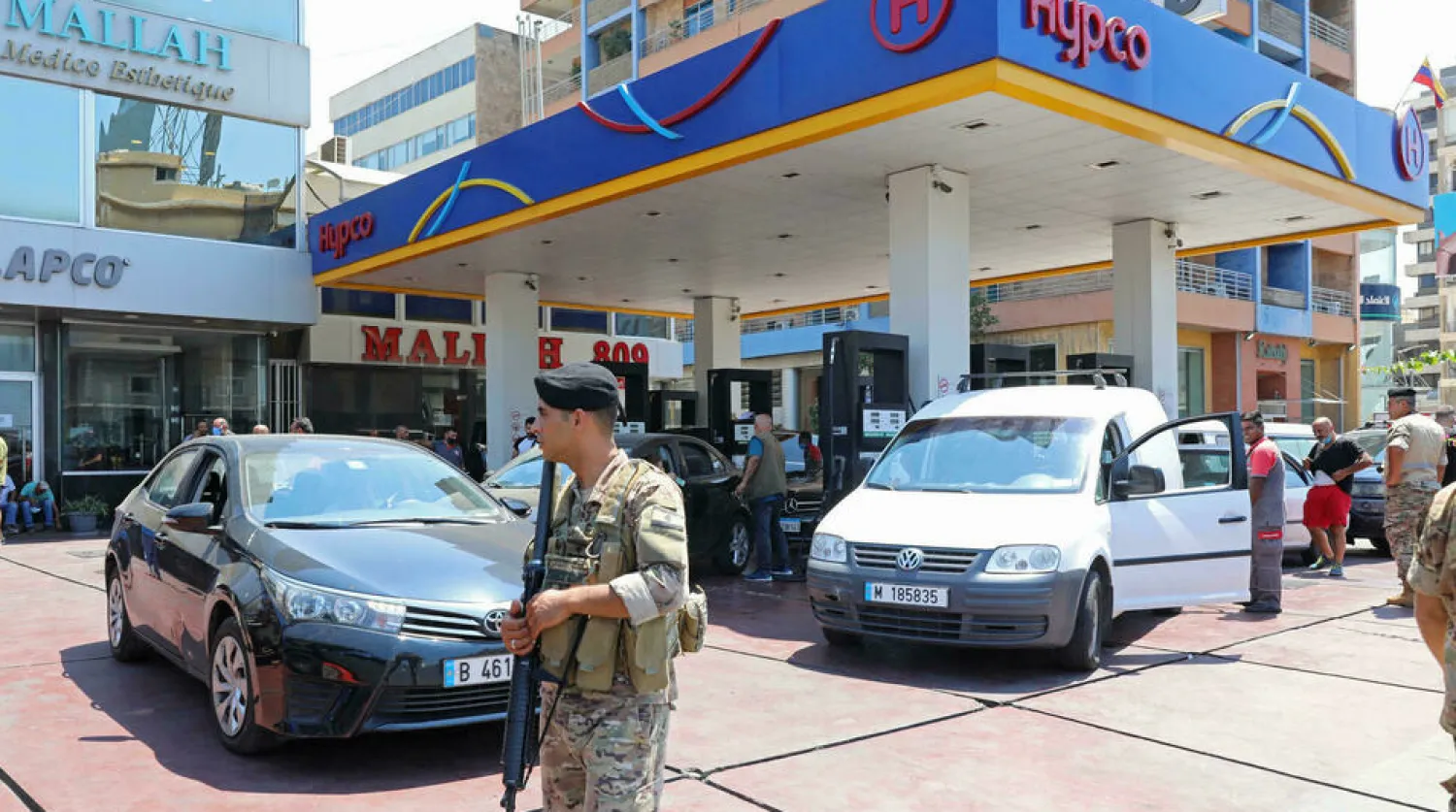

Lebanon Army Deploys at Pumps as Bank Chief Firm on Ending Fuel Subsidies

Lebanon's army has deployed at gas stations to stop fuel hoarding in the country after the central bank's decision to stop fuel subsidies sparked panic in the crisis-hit country ANWAR AMRO AFP
TT

Lebanon Army Deploys at Pumps as Bank Chief Firm on Ending Fuel Subsidies

Lebanon's army has deployed at gas stations to stop fuel hoarding in the country after the central bank's decision to stop fuel subsidies sparked panic in the crisis-hit country ANWAR AMRO AFP

Lebanon's army seized fuel from gas stations on Saturday to curb hoarding amid crippling shortages, as the central bank chief stood firm on his decision to scrap fuel subsidies.

Compounding the country's crisis, a top private hospital said it may have to close due to power outages caused by shortages of diesel, warning this could cause hundreds of deaths.

Lebanon is grappling with a financial crisis branded by the World Bank as one of the planet's worst since the 1850s.

Foreign currency reserves are fast depleting, forcing the central bank to scale down funding for imports in an effort to shore up the little money Lebanon has left.

The Lebanese pound has lost more than 90 percent of its value on the black market, and 78 percent of the population lives below the poverty line.

On Wednesday central bank chief Riad Salameh said he would scrap fuel subsidies to ease pressure on fast-depleting foreign reserves.

His decision sparked panic, with huge queues forming outside bakeries and petrol stations as Lebanese struggled to stock up.

Salameh told a radio station Saturday he would not back down.

"I will not review the removal of subsidies on fuel unless the use of compulsory reserves is legalized," by a parliamentary vote, he said.

Fuel shortages have left many with just two hours of electricity a day, forcing the closure of businesses.

Warning of "imminent disaster", the American University of Beirut Medical Center said it would be forced to cease operations within 48 hours.

Without fuel, "forty adult patients and fifteen children living on respirators will die immediately," it said in a statement.

"One hundred and eighty people suffering from renal failure will die poisoned after a few days... Hundreds of cancer patients, adults and children, will die in subsequent weeks."

Fuel importers blame the crisis on delays by the central bank in opening credit lines to fund imports.

Salameh on Saturday accused importers and distributors of hoarding fuel to sell at higher prices on the black market, or across the border in Syria.

With the situation rapidly deteriorating, the army raided gas stations on Saturday and seized fuel to distribute to desperate customers.

A statement said the military had confiscated more than 78,000 litres of gasoline stored at two gas stations as well as 57,000 litres of diesel fuel from a third one.

Internal Security Forces also said they had seized thousands of litres of petrol and diesel fuel stockpiled at one gas pump.

Pictures and video footage posted by the army on its social media pages showed soldiers working pumps at gas stations and filling up car tanks.

An AFP correspondent said troops were deployed at several gas stations north of Beirut, where hundreds of vehicles were trapped in long queues to fill up on petrol.

Video footage posted online showed motorists cheering as the army raided gas stations.

Later, many petrol stations across the country which had been closed claiming they had no fuel, reopened.

But some Lebanese remained bitter.

"The army's decision is too late," said one motorist who had been waiting for hours in the scorching heat.

- Political crisis -

The central bank's funding of fuel and other basic commodity imports has contributed to foreign reserves falling by more than 50 percent from their pre-crisis level of more than $30 billion.

Salameh said inaction by politicians had led Lebanon to breaking point.

"Everybody was aware... they were aware in government, parliament and the president's office" that reserves were falling, he said.

Salameh has headed the central bank since 1993 and is suspected by many Lebanese of helping facilitate large transfers of money abroad by the political elite during mass protests that began in October 2019.

He is under judicial investigation in Lebanon, Switzerland and France over several cases, including diversion of public funds and illicit enrichment.

At home, many blame him for capital controls in place since 2019 that have trapped dollar savings and denied even the poorest segment of the population full access to their deposits.

Political wrangling over a new government has added to Lebanon's dire situation.

The last cabinet resigned amid public outrage following last August's monster explosion at Beirut port that killed more than 200 people.

International donors have pledged hundreds of millions of dollars in humanitarian aid to Lebanon.

But the aid is conditional on the formation of a new government prepared to spearhead reforms, and on the resumption of talks with the International Monetary Fund.



UN: At Least 15 Children Killed in Sudan Drone Strike

The war in Sudan, ongoing since mid-April 2023, has caused extensive destruction across the country (AFP)
TT

UN: At Least 15 Children Killed in Sudan Drone Strike

The war in Sudan, ongoing since mid-April 2023, has caused extensive destruction across the country (AFP)

A drone strike on a displacement camp in Sudan killed at least 15 children earlier this week, the United Nations reported late on Wednesday.

"On Monday 16 February, at least 15 children were reportedly killed and 10 wounded after a drone strike on a displacement camp in Al Sunut, West Kordofan," the UN children's agency said in a statement.

Across the Kordofan region, currently the Sudan war's fiercest battlefield, "we are seeing the same disturbing patterns from Darfur -- children killed, injured, displaced and cut off from the services they need to survive," UNICEF's Executive Director Catherine Russell said.


MSF Will Keep Operating in Gaza 'as Long as We Can'

(FILES) A Palestinian man walks on his crutches to the Doctors Without Borders or Medecins Sans Frontieres (MSF) clinic, in the al-Rimal neighborhood of Gaza City on new year's Eve, December 31, 2025. (Photo by Omar AL-QATTAA / AFP)
TT

MSF Will Keep Operating in Gaza 'as Long as We Can'

(FILES) A Palestinian man walks on his crutches to the Doctors Without Borders or Medecins Sans Frontieres (MSF) clinic, in the al-Rimal neighborhood of Gaza City on new year's Eve, December 31, 2025. (Photo by Omar AL-QATTAA / AFP)

The head of Doctors Without Borders in the Palestinian territories told AFP the charity would continue working in Gaza for as long as possible, following an Israeli decision to end its activities there.

In early February, Israel announced it was terminating all the activities in Gaza by the medical charity, known by its French acronym MSF, after it failed to provide a list of its Palestinian staff.

MSF has slammed the move, which takes effect on March 1, as a "pretext" to obstruct aid.

"For the time being, we are still working in Gaza, and we plan to keep running our operations as long as we can," Filipe Ribeiro told AFP in Amman, but said operations were already facing challenges.

"Since the beginning of January, we are not anymore in the capacity to get international staff inside Gaza. The Israeli authorities actually denied any entry to Gaza, but also to the West Bank," he said.

Ribeiro added that MSF's ability to bring medical supplies into Gaza had also been impacted.

"They're not allowed for now, but we have some stocks in our pharmacies that will allow us to keep running operations for the time being," he said.

"We do have teams in Gaza that are still working, both national and international, and we have stocks."

In December, Israel announced it would prevent 37 aid organizations, including MSF, from working in Gaza from March 1 for failing to submit detailed information about their Palestinian employees, drawing widespread condemnation from NGOs and the United Nations.

It had alleged that two MSF employees had links with Palestinian militant groups Hamas and Islamic Jihad, which the medical charity has repeatedly and vehemently denied.

MSF says it did not provide the names of its Palestinian staff because Israeli authorities offered no assurances regarding their safety.

Ribeiro warned of the massive impact the termination of MSF's operations would have for healthcare in war-shattered Gaza.

"MSF is one of the biggest actors when it comes to the health provision in Gaza and the West Bank, and if we are obliged to leave, then we will create a huge void in Gaza," he said.

The charity says it currently provides at least 20 percent of hospital beds in the territory and operates around 20 health centers.

In 2025 alone, it carried out more than 800,000 medical consultations, treated more than 100,000 trauma cases and assisted more than 10,000 infant deliveries.


Egyptian-Turkish Military Talks Focus on Strengthening Partnership

The Commander of the Egyptian Air Force during his meeting with the Turkish Air Force chief in Cairo on Wednesday (Egyptian military spokesperson)
TT

Egyptian-Turkish Military Talks Focus on Strengthening Partnership

The Commander of the Egyptian Air Force during his meeting with the Turkish Air Force chief in Cairo on Wednesday (Egyptian military spokesperson)

Senior Egyptian and Turkish air force commanders met in Cairo on Wednesday for talks focused on strengthening military partnership and expanding bilateral cooperation, in the latest sign of warming defense ties between the two countries.

The meeting brought together the Commander of the Egyptian Air Force, Lt. Gen. Amr Saqr, and his Turkish counterpart, Gen. Ziya Cemal Kadioglu, to review a range of issues of mutual interest amid growing cooperation between the two air forces.

Egypt’s military spokesperson said the talks reflect the Armed Forces’ commitment to deepening military collaboration with friendly and partner nations.

Earlier this month, Egypt and Türkiye signed a military cooperation agreement during talks in Cairo between Egyptian President Abdel Fattah el-Sisi and his Turkish counterpart, President Recep Tayyip Erdogan.

Sisi highlighted similar viewpoints on regional and international issues, while Erdogan noted that enhanced cooperation and forthcoming joint steps would help support regional peace.

Cairo and Ankara also signed an agreement last August on the joint production of vertical take-off and landing (VTOL) drones. Production of unmanned ground vehicles has also begun under a partnership between the Turkish firm HAVELSAN and Egypt’s Kader Factory.

During the talks, Saqr underscored the importance of coordinating efforts to advance shared interests and expressed hope for closer ties that would benefit both air forces.

Kadioglu, for his part, stressed the depth of bilateral partnership and the strong foundations of cooperation between the two countries’ air forces.

According to the military spokesperson, Kadioglu also toured several Egyptian Air Force units to review the latest training and armament systems introduced in recent years.

Military cooperation between Egypt and Türkiye has gained momentum since 2023, following the restoration of full diplomatic relations and reciprocal presidential visits that reflected positively on the defense sector.

In September last year, the joint naval exercise “Sea of Friendship 2025” was held in Turkish territorial waters, aimed at enhancing joint capabilities and exchanging expertise against a range of threats.