


Jimmy Carter, Trounced in 1980, Gets Fresh Look from History

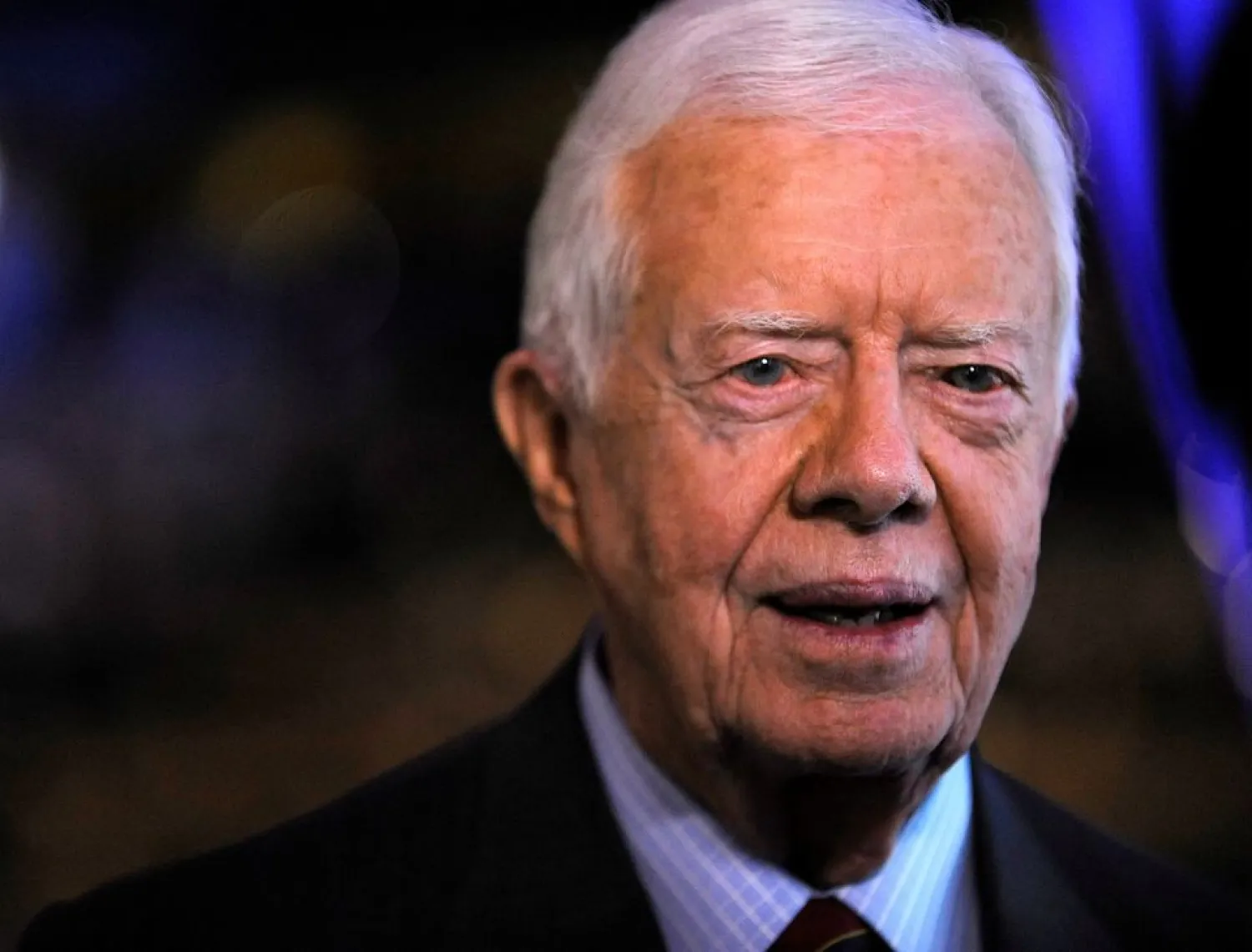
FILE PHOTO - Former US President Jimmy Carter attends the 2008 Democratic National Convention in Denver, Colorado, US August 25, 2008. REUTERS/Eric Thayer/File Photo
TT

Jimmy Carter, Trounced in 1980, Gets Fresh Look from History

FILE PHOTO - Former US President Jimmy Carter attends the 2008 Democratic National Convention in Denver, Colorado, US August 25, 2008. REUTERS/Eric Thayer/File Photo

Jimmy Carter is sometimes called a better former president than he was president.

Nodding to Carter's decades of work as a globe-trotting humanitarian but with a glaring reminder of his landslide defeat in 1980, the backhanded compliment rankles Carter allies and, they say, the former president himself.

Yet now, 40 years removed from the White House, the most famous resident of Plains, Georgia, is riding a new wave of attention as biographers, filmmakers, climate activists and Carter’s fellow Democrats push to recast his presidential legacy, even as Republicans sometimes try to remind voters of the volatile economy and international affairs that doomed Carter to one term.

The renewed spotlight is especially significant for the broad swath of Americans too young to remember a presidency that spanned from 1977 to 1981. Sandwiched between the Watergate era of Richard Nixon and two terms of Ronald Reagan, Carter's tenure came before Millennials or Generation Z voters were born and earlier than most of Generation X reached political awareness.

“People have always come up to tell me how much, my grandfather and my grandmother meant to them,” Jason Carter, 46, said in an interview. “They used to be my parents’ age or older. Now they’re younger than I am, sometimes much younger. It’s a remarkable thing.”

Many of those fans have known Carter, now 96 and largely confined to his home, only as the aging humanitarian occasionally in the news for building Habitat for Humanity houses, a critique of a successor or his latest health challenge.

In the past year, however, CNN released a documentary titled: “Jimmy Carter: Rock & Roll President” and independent documentarists Jim Pattiz and Will Pattiz debuted “Carterland” at the Atlanta Film Festival. Two new books hit shelves in the same span: one a comprehensive biography, the other a narrower look at Carter’s time in Washington. In the preceding two years, new books included an explanation of how Carter’s 1976 victory rewrote the rules of modern presidential campaigns and an in-depth analysis of Carter’s White House years by his then-domestic policy adviser.

Altogether, the new works depict not a failed president but an ambitious, far-reaching one who is getting a more nuanced assessment from history than he got from his contemporaries.

The Pattiz brothers, documentary filmmakers born a decade after Carter left the White House, emerged from producing “Carterland” to see the 39th president as a visionary on environmental issues, especially.

“Carter had these very farsighted views of how he wanted to solve the energy crisis, and it involved conservation, but also involved turning away from fossil fuels and turning toward renewable energy, things like solar power and other renewables,” said Jim Pattiz, 29.

Carter put solar panels on the White House, and he called for “shared sacrifice” to confront energy shortages. But he couldn’t overcome voters’ frustrations with fuel prices and availability. The solar panels were removed during Reagan’s presidency. But Will Pattiz, 30, said time vindicated Carter. If “President Carter had gotten an extra term in office,” he said, “we likely wouldn’t be having a climate crisis right now.”

Carter likely wouldn't go that far. In 2019, the former president used his last annual presentation at The Carter Center in Atlanta to blame himself for his post-presidential center being “basically mute on the subject of global warming.”

In his new book, “The Outlier,” historian Kai Bird writes that Carter’s “domestic and foreign policy ledgers are lengthy and fulsome.” Carter’s brokerage of the Camp David Accords between Israel and Egypt remain his most undisputed success. But Bird also highlights Carter policies sometimes associated more with others. Carter negotiated SALT II nuclear arms treaty with the Soviet Union, leaving Reagan a firm foundation for his dealings with the Kremlin.

The Iran hostage crises cemented Carter's defeat. But Bird and Stuart Eizenstat, Carter's domestic policy adviser, detail in their books how Carter and his administration won the hostages' release, even if Tehran held them until Reagan's inauguration.

On the domestic front, it was Carter, not Reagan, who started the widespread deregulation of industries including airlines, natural gas, railroads and trucking. Carter came as close to a major health care overhaul as any president did until President Barack Obama's 2010 Affordable Care Act. And for all the political damage Carter suffered for inflation it was Carter’s appointee as Federal Reserve chairman, Paul Volcker, whose monetary policies curbed the spikes of the late 1970s and early 1980s.

Jason Carter said the new wave of analyses look beyond “the political failure of not getting reelected as the defining factor” of Carter's presidency.

Beyond policy details, Amber Roessner, a 41-year-old University of Tennessee professor who wrote “Jimmy Carter and the Birth of the Marathon Media Campaign,” said Carter's broader political identity from the 1970s has “regained some saliency.”

Carter, she said, ran and governed with a “message of moral reform,” emphasizing competence and moderation. He espoused his born-again Christianity and called in his nomination acceptance for “love to be aggressively translated into simple justice.”

In 1976, that was the antidote to the Watergate scandal, Nixon's resignation and the dynamics that lingered from Vietnam and the civil rights era. Now, it translates to the 21st century's hyperpartisan politics, the nation's latest reckoning with racism and former President Donald Trump's turbulent tenure and serial mistruths.

“There are so many parallels,” Roessner said.

It was enough to draw multiple Democratic presidential candidates to Plains during the 2020 presidential campaign, something that hadn't happened in the previous four decades.

“There was so much distrust in government (and) he had a message of truth and honesty,” Minnesota Sen. Amy Klobuchar told The Associated Press, explaining after one of her visits why she sometimes invoked Carter as she campaigned.

Biden, who as a young Delaware politician became the first US senator to endorse Carter's 1976 bid, capped the pilgrimage parade in April, as he and first lady Jill Biden visited privately with Jimmy and Rosalynn Carter at their home.

“We talked about old times,” Biden told reporters afterward.

If anything, two presidents huddling in small-town south Georgia carried a weightier message: Old is new again.




German Killed in Swiss Avalanche, 4 Other Skiers Hurt

Swiss Air Force's aerobatic team "The Patrouille Suisse" perform prior to the FIS alpine skiing Men's World Cup Super G event in Wengen, Swiss Alps, on January 19, 2026. (Photo by Dimitar DILKOFF / AFP)
TT

German Killed in Swiss Avalanche, 4 Other Skiers Hurt

Swiss Air Force's aerobatic team "The Patrouille Suisse" perform prior to the FIS alpine skiing Men's World Cup Super G event in Wengen, Swiss Alps, on January 19, 2026. (Photo by Dimitar DILKOFF / AFP)

A German man has been killed in an avalanche in the Swiss alps and four other people were hurt as they were cross-country skiing, Swiss police said Saturday.

The incident happened on Friday, on the Piz Badus peak near the village of Tujetsch in the center-south of the country, AFP reported.

Police said a group of seven cross-country skiers were swept up in the avalanche, with five of them buried underneath.

One member of the party raised the alarm in a phone call to local police, who deployed helicopters with rescue workers and dogs to the site.

The German man was found lifeless under the snow and ice, the police said, adding that the four others hurt -- whose nationalities were not given -- suffered light injuries and were flown to nearby hospitals.


NASA's New Moon Rocket Heads to the Pad Ahead of Astronaut Launch

NASA's Artemis II SLS (Space Launch System) rocket and Orion spacecraft, secured to the mobile launcher, is seen inside the Vehicle Assembly building as preparations continue for roll out to Launch Pad 39B, Thursday, Jan. 15, 2026, at NASA's Kennedy Space Center in Florida. (Keegan Barber/NASA via AP)
TT

NASA's New Moon Rocket Heads to the Pad Ahead of Astronaut Launch

NASA's Artemis II SLS (Space Launch System) rocket and Orion spacecraft, secured to the mobile launcher, is seen inside the Vehicle Assembly building as preparations continue for roll out to Launch Pad 39B, Thursday, Jan. 15, 2026, at NASA's Kennedy Space Center in Florida. (Keegan Barber/NASA via AP)

NASA’s giant new moon rocket headed to the launch pad Saturday in preparation for astronauts’ first lunar fly-around in more than half a century.

The out-and-back trip could blast off as early as February.

The 322-foot (98-meter) rocket began its 1 mph (1.6 kph) creep from Kennedy Space Center’s Vehicle Assembly Building at daybreak. The four-mile (six-kilometer) trek was expected to take until nightfall.

Throngs of space center workers and their families gathered in the predawn chill to witness the long-awaited event, delayed for years, The Associated Press reported. They huddled together ahead of the Space Launch System rocket’s exit from the building, built in the 1960s to accommodate the Saturn V rockets that sent 24 astronauts to the moon during the Apollo program. The cheering crowd was led by NASA’s new administrator Jared Isaacman and all four astronauts assigned to the mission.

Weighing in at 11 million pounds (5 million kilograms), the Space Launch System rocket and Orion crew capsule on top made the move aboard a massive transporter that was used during the Apollo and shuttle eras. It was upgraded for the SLS rocket’s extra heft.

The first and only other SLS launch — which sent an empty Orion capsule into orbit around the moon — took place back in November 2022.

“This one feels a lot different, putting crew on the rocket and taking the crew around the moon,” NASA’s John Honeycutt said on the eve of the rocket’s rollout.

Heat shield damage and other capsule problems during the initial test flight required extensive analyses and tests, pushing back this first crew moonshot until now. The astronauts won’t orbit the moon or even land on it. That giant leap will take come on the third flight in the Artemis lineup a few years from now.

Commander Reid Wiseman, pilot Victor Glover and Christina Koch — longtime NASA astronauts with spaceflight experience — will be joined on the 10-day mission by Canadian astronaut Jeremy Hansen, a former fighter pilot awaiting his first rocket ride.

They will be the first people to fly to the moon since Apollo 17’s Gene Cernan and Harrison Schmitt closed out the triumphant lunar-landing program in 1972. Twelve astronauts strolled the lunar surface, beginning with Neil Armstrong and Buzz Aldrin in 1969.

NASA is waiting to conduct a fueling test of the SLS rocket on the pad in early February before confirming a launch date. Depending on how the demo goes, “that will ultimately lay out our path toward launch,” launch director Charlie Blackwell-Thompson said on Friday.

The space agency has only five days to launch in the first half of February before bumping into March.


Iron Age Teeth Fossils Reveal Diet Diversity of Italians 2,500 Years Ago

The fresco on the wall of a house in Pompeii that dates back 2,000 years (AFP)
TT

Iron Age Teeth Fossils Reveal Diet Diversity of Italians 2,500 Years Ago

The fresco on the wall of a house in Pompeii that dates back 2,000 years (AFP)

Italians began exploring a varied diet sometime between the 7th and 6th centuries BC, according to a new analysis of ancient teeth from Iron Age Italians.

Unravelling details about the lifestyles of ancient cultures is a challenging task, as it requires specific, well-preserved fossils of long-deceased individuals, The Independent reported.

Fossil human teeth are an excellent resource to understand ancient diets, acting as archives of each individual’s life history.

However, collecting information from teeth across different eras remains a challenge.

In the new study, researchers combined multiple analyses of teeth remains from the Italian archaeological site of Pontocagnano to interpret the health and diet of people in the region during the 7th and 6th centuries BC.

Scientists assessed the dental tissue of 30 teeth from 10 individuals, obtaining data from canine and molar teeth to reconstruct each ancient person’s history during the first six years of their lives.

Researchers found that the Iron Age Italians had a diet rich in cereals, legumes, abundant carbohydrates, and even fermented foods and drinks.

“We could follow childhood growth and health with remarkable precision and identify traces of cereals, legumes, and fermented foods in adulthood, revealing how this community adapted to environmental and social challenges,” said Roberto Germano, an author of the study.

Emanuela Cristiani, another author of the study said, “In the case of Pontocagnano, the analysis of dental calculus revealed starch granules from cereals and legumes, yeast spores, and plant fibres, providing a very concrete picture of the diet and some daily activities of these Iron Age communities.”

The findings offer strong evidence of this ancient Italian population regularly consuming fermented foods and beverages, researchers said.

Their diets likely diversified at the time as their contact with Mediterranean cultures increased, they added.

The researchers noted that while the study may not be completely representative of the broader Italian population, it provides a “very concrete picture” of the diet and some daily activities of Iron Age communities in the Italian region.

“This and other modern approaches represent a major technological and disciplinary advancement that is revolutionizing the study of the biocultural adaptations of past populations,” said Alessia Nava, another author of the study from Sapienza University of Rome.