

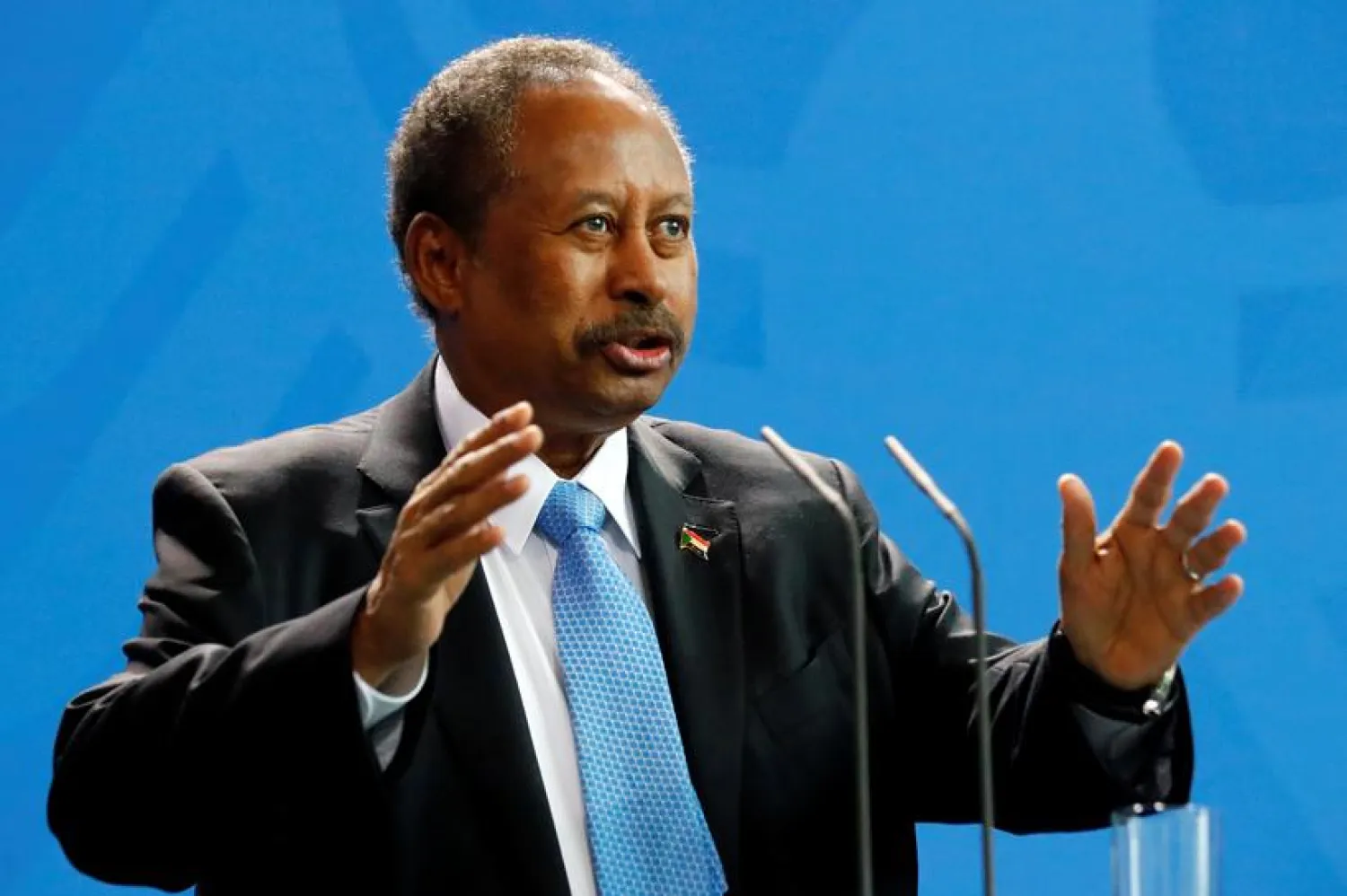

Hamdok: We Want to Ensure the Success of Democratic Transition

Sudan's Prime Minister Abdalla Hamdok (File photo: Reuters)
TT

Hamdok: We Want to Ensure the Success of Democratic Transition

Sudan's Prime Minister Abdalla Hamdok (File photo: Reuters)

Sudan should not meet the fate of many regional countries that faced difficulties and challenges during their transition, leading to their collapse, said Prime Minister Abdullah Hamdok.

Speaking at the first meeting of the national mechanism to implement the "National Crisis and Transition Issues - The Way Forward" initiative, Hamdok called on the Sudanese people to ensure the success of the transitional period and its goals.

The PM said that he did not hold clear or direct consultations with the military. However, they are aware of all the initiative developments, indicating that he met the Head of Sovereign Council, Abdel Fattah al-Burhan, and his deputy, Mohammad 'Hemdeti' Hamdan.

The meeting addressed the tasks of the initiative, and they asserted the need to include issues of democratic transition.

Hamdok asserted that dialogue and consultation with the military component would continue because its role is vital to complete the transition and agree on the axes of the initiative, not just security and military reform.

The Prime Minister stressed that the mechanism for implementing the initiative is temporary to accomplish specific tasks within two months.

He called on the Sudanese to maintain "the unique Sudanese experience towards democratic transition."

Sudan's comprehensive national crisis is political, said Hamdok, reiterating that Sudan "will not succeed in moving from this stage to democratic civil rule unless it confronts these issues with courage and clarity."

He said that the initiative's main objective is to unite the forces of the revolution to support and accomplish the transition.

For his part, the head of the mechanism, Fadlallah Barama Nasser, said that the national initiative comes at a critical stage.

Nasser indicated that the mechanism is the last chance and a lifeline to ensure the country doesn't slip into chaos.

Nasser, who is also the designated head of the National Umma Party, stressed that the mechanism would include opinions vital for its implementation, tasks, and chances of success.

He said: "We have less than 60 days to accomplish a great task," adding that "it is a difficult task, but not impossible."

The National Mechanism includes 71 members from leaders of political parties, indigenous administrations, Sufi orders, and civil society organizations.

It calls for extensive dialogue and discussions to achieve the most significant degree of consensus among Sudanese components on construction and democratic transition issues.



Survivors: Sudan Gold Mine Collapse Kills at Least 60

A group of armed defectors from the Rapid Support Forces (RSF) arrive in a vehicle as they are believed to be surrendering to the Sudanese military, in the west of Omdurman on August 19, 2026. (Photo by Ebrahim Hamid / AFP)
TT

Survivors: Sudan Gold Mine Collapse Kills at Least 60

A group of armed defectors from the Rapid Support Forces (RSF) arrive in a vehicle as they are believed to be surrendering to the Sudanese military, in the west of Omdurman on August 19, 2026. (Photo by Ebrahim Hamid / AFP)

A gold mine collapsed in southern Sudan, killing at least 60 small-scale miners, two survivors told AFP on Wednesday, while many more are missing and feared dead under the rubble.

Shafts began collapsing in the Al-Zaraa mine near the town of El-Nahud in West Kordofan on Tuesday, and by the following morning 60 bodies had been retrieved.

"We don't know how many more are still inside," one of the survivors, Khair al-Sayyed Jabara, told AFP after an all-night rescue operation with fellow miners, using the same rudimentary tools they use to mine.

"Everyone's working very hard to retrieve the bodies or any survivors, but it's difficult. We need heavy machinery to clear the rock and soil."

Since war erupted in April 2023 between Sudan's army and the Rapid Support Forces, the war efforts of both sides have been largely funded by the gold industry, in addition to foreign backers.

The conflict has devastated Sudan's already fragile economy and left much of the country out of work, pushing many into a dangerous gold rush.

Artisanal and small-scale mining, which takes place in unofficial zones or decommissioned mines, accounts for the majority of gold extracted.

Al-Amin Suleiman, another miner who was working at the rim of Al-Zaraa on Tuesday, told AFP that "the shafts here are all close together, if one collapses, it brings down all the ones next to it".

"This is what happened here. So far, 60 bodies have been pulled out but there are people still trapped underground since yesterday. I don't think they are alive."

Sudan is suffering the world's largest hunger and displacement crises, with nearly 20 million people facing crisis levels of hunger.


Israel Detains US-Palestinian Journalist

 Israeli forces stand guard during the demolition of a Palestinian building near Hebron in the Israeli-occupied West Bank, September 16, 2026. (Reuters)
Israeli forces stand guard during the demolition of a Palestinian building near Hebron in the Israeli-occupied West Bank, September 16, 2026. (Reuters)
TT

Israel Detains US-Palestinian Journalist

 Israeli forces stand guard during the demolition of a Palestinian building near Hebron in the Israeli-occupied West Bank, September 16, 2026. (Reuters)
Israeli forces stand guard during the demolition of a Palestinian building near Hebron in the Israeli-occupied West Bank, September 16, 2026. (Reuters)

Israeli authorities detained a Palestinian-American journalist on Tuesday as she returned from a reporting assignment in the occupied West Bank, her sister and a colleague said.

Naqaa Hamed covered violence by Israeli settlers towards Palestinians in the West Bank, including in the village of Qusra, where settlers trapped residents inside and refused to let in food or other supplies.

Hamed "was abducted today at the Tequ' checkpoint in Bethlehem while returning from covering the suffering of Palestinians", her sister Fatima Bajes Salem wrote on Facebook.

Soldiers arrested Hamed after stopping her and fellow reporters, said journalist Hamada Mansour, who was travelling with her.

He told AFP that Hamed's colleagues were allowed to leave.

He added that she was working for Turkish public broadcaster TRT.

Media reports said Hamed also worked until recently for Iranian English-speaking broadcaster Press TV, which reported on the arrest, identifying her as its West Bank correspondent.

According to Mansour, Hamed was a freelance journalist who no longer worked for the outlet.

Israeli authorities have not commented on the arrest.

Israel's largest news site Ynet cited unidentified Israeli military sources as saying Hamed is suspected of "cooperating with an enemy entity and may also be under suspicion of espionage".


Syria’s Al-Sharaa: Economic Transition Demands ‘Shock’ Decisions

Syrian President Ahmad al-Sharaa speaks at the Arab Media Summit in Dubai on Tuesday. (Asharq Al-Awsat)
TT

Syria’s Al-Sharaa: Economic Transition Demands ‘Shock’ Decisions

Syrian President Ahmad al-Sharaa speaks at the Arab Media Summit in Dubai on Tuesday. (Asharq Al-Awsat)

Syrian President Ahmad al-Sharaa said his country has gone from being a security and political “problem” troubling the region to an economic and strategic opportunity that could contribute to the security of supply chains, energy and trade between East and West.

Speaking at the Arab Media Summit in Dubai on Tuesday, al-Sharaa projected Syria’s economy would reach about $50 billion this year, up from roughly $20 billion in 2024.

He acknowledged that the economic transition requires “shock” decisions, in what appeared to be an implicit reference to measures such as fuel price increases that have triggered protests in several Syrian regions in recent days.

He stressed that his government did not want to pursue a “policy of complaints or promises,” but instead focus on work, with success measured by results felt by Syrians.

Syria is moving away from an economic model marked by heavy bureaucracy, state dominance and corruption toward one giving greater scope to the private sector and investment, he explained.

A sudden transition, however, could cause “a kind of shock”, he added.

The government had studied the experiences of countries that underwent similar transformations and managing the transition required a degree of gradualism alongside decisions that could sometimes be “shocking”, he warned.

Syria’s economy stood at about $60 billion at its prewar peak in 2010 before falling to around $20 billion in 2024. It grew to roughly $32 billion in 2025 and is expected to reach about $50 billion in 2026, before recovering to around its 2010 level in 2027.

Al-Sharaa said ambitions extended beyond a return to prewar levels, with economic programs targeting the possibility of expanding the economy to about $200 billion over the following five to 10 years, provided stability prevailed and the region and world avoided major upheaval.

Regional risks

Regional risks remain among Syria’s biggest challenges, according to al-Sharaa.

The country faces a “heavy legacy resulting from 60 years of destruction and 14 years of continuous war,” he remarked, adding that ending Syria's conflict was not enough to ensure lasting stability without greater regional and strategic security.

“What frightens us most is that wars expand further and further,” he said.

Damascus is working with Arab countries to reduce the impact of wars and mitigate future risks, he added, stressing that Syria could play a pivotal role in strengthening regional stability.

He said the country was undergoing a broad transition involving the rebuilding of state institutions, economic transformation, attracting investment and rehabilitating infrastructure, alongside efforts to consolidate domestic stability and restore its place in its Arab and regional surroundings.

Al-Sharaa described Syria as having gone from “a source of Captagon and human trafficking, and a foothold for spreading conflicts and problems in the region” to a country seeking to become “an area of stability.”

He pointed to growing discussions of its potential role in regional trade, supply-chain and energy security, as well as its position on routes linking East and West.

‘Syria is not a follower’

Turning to foreign policy, al-Sharaa stressed that Damascus sought relations based on “credibility and trust” while preserving the independence of its decision-making.

“Syria does not need to be a follower of any party,” he declared, adding that the country had the civilization, expertise and human resources to make independent decisions while drawing strength from “its brothers and its surroundings.”

Moreover, he stressed that Syria cannot do without its Arab and Islamic surroundings, and relies heavily on Arab states for political support and to benefit from their expertise and development experience.

The country does not want “to start from the zero where these countries began, but from the 100 they have reached,” he revealed.

On international sanctions, he noted that Syria had been among the world’s most heavily sanctioned countries for decades, with the impact extending beyond state institutions to society and the economy.

Generations of Syrians had been unable to engage normally with financial transactions, bank guarantees and the global financial system because of the country’s prolonged isolation, he continued.

He further praised efforts by Prince Mohammed bin Salman, Saudi Crown Prince and Prime Minister, and Turkish President Recep Tayyip Erdogan with US President Donald Trump over sanctions, describing their lifting as a historic turning point for his country.

“I believe Syria was born again after the sanctions were lifted,” al-Sharaa said, adding that the main restrictions had been broken and responsibility now lay in adopting the right “policies, procedures and choices” to move the economy and the state forward.