

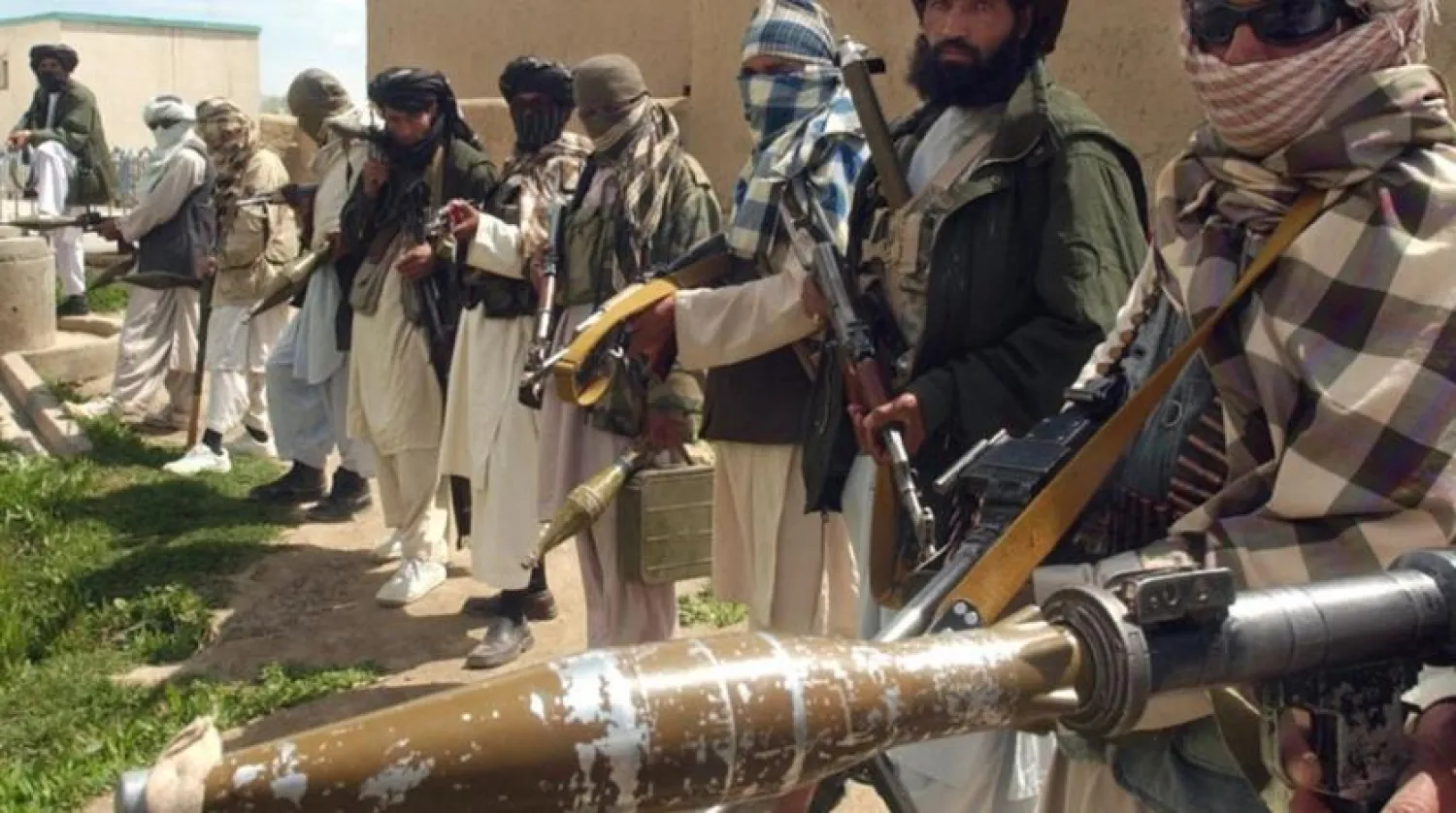

Taliban Close to Forming New Afghan Govt, But Panjshir Fighting Rages

Taliban militants in a line holding guns and explosives. Photo: AFP
TT

Taliban Close to Forming New Afghan Govt, But Panjshir Fighting Rages

Taliban militants in a line holding guns and explosives. Photo: AFP

The Taliban are due to form a government within days despite fighting in Afghanistan’s Panjshir Valley Friday where forces battling the extremists say they are enduring “heavy” assaults.

The Taliban face the enormous challenge of shifting gears from insurgent group to governing power, days after the United States fully withdrew its troops and ended two decades of war.

But they are still battling to extinguish the last flame of resistance in the Panjshir Valley -- which held out for a decade against the Soviet Union’s occupation and also the Taliban’s first rule from 1996-2001.

Late Friday, celebratory gunfire rang across Kabul as rumors spread that the valley had fallen, but the Taliban made no official claim and a resident told AFP by phone that the reports were false.

Fighters from the National Resistance Front -- made up of anti-Taliban militia and former Afghan security forces -- are understood to have significant weapon stockpiles in the valley, which lies around 80 kilometers (50 miles) north of Kabul.

Earlier Friday pro-Taliban Twitter accounts aired video clips purporting to show the new regime’s fighters had captured tanks and other heavy military equipment inside the valley.

Taliban and resistance tweets suggested the key district of Paryan had been taken and lost again, but that could also not be independently verified.

While the West has adopted a wait-and-see approach to the group, there were some signs of engagement with the new leaders gathering pace.

China confirmed a tweet from a Taliban spokesman hours earlier, indicating that Beijing will keep its embassy in Kabul open.

“We hope the Taliban will establish an open and inclusive political structure, pursue moderate and stable domestic and foreign policy and make a clean break with all terrorist groups,” foreign ministry spokesman Wang Wenbin said.

The United Nations said it had restarted humanitarian flights to parts of the country, linking the Pakistani capital Islamabad with Mazar-i-Sharif in northern Afghanistan and Kandahar in the south.

The country’s flag carrier Ariana Afghan Airlines resumed domestic flights on Friday, while the United Arab Emirates sent a plane carrying “urgent medical and food aid”.

Western Union and Moneygram, meanwhile, said they were restarting money transfers, which many Afghans rely on from relatives abroad to survive, and Qatar said it was working to reopen the airport in Kabul -- a lifeline for aid.

Threat of humanitarian disaster
Even before the Taliban’s lightning offensive, Afghanistan was heavily aid-dependent -- with 40 percent of the country’s GDP drawn from foreign funding.

The UN has warned 18 million people are facing a humanitarian disaster, and another 18 million could quickly join them.

Qatar said it hopes to see the establishment of humanitarian aid corridors at Afghan airports within 48 hours, Doha’s envoy to Afghanistan told Al Jazeera Friday.

The new rulers have pledged to be more accommodating than during their first stint in power, which also came after years of conflict -- first the Soviet invasion of 1979, and then a bloody civil war.

That regime was notorious for its brutal interpretation of Sharia law, and its treatment of women, who were forced inside, deprived of access to school and work, and denied freedom of movement.

This time round, the Taliban have made repeated declarations that they will not carry out revenge attacks on opponents, women will have access to education and some employment.

They have promised a more “inclusive” government that represents Afghanistan’s complex ethnic makeup.

British Foreign Secretary Dominic Raab said, during a visit to Pakistan, that the international community must test the Taliban on their “sincerity” and “see whether they can deliver”.

Women’s protest
Speculation is rife about the makeup of a new government, although a senior official said this week that women were unlikely to be included.

In Kabul, some 30 women took to the streets to demand the right to work and inclusion in the government -- a day after several dozen women held a similar protest in the western city of Herat.

Women’s rights were not the only major concern in the lead-up to the Taliban’s announcement of a new government.

In Kabul, residents voiced worry over the country’s long-running economic difficulties, now seriously compounded by the hardline movement’s takeover.

“With the arrival of the Taliban, it’s right to say that there is security, but business has gone down below zero,” Karim Jan, an electronic goods shop owner, told AFP.

On Friday, Ali Maisam Nazary, a spokesman for the Panjshir resistance who is understood to be outside the valley but in close contact with key leader Ahmad Massoud, said there had been more attacks by Taliban forces overnight.

“There is heavy fighting,” Nazary said. “He (Massoud) is busy defending the valley.”

But there were signs of normality in Kabul on Friday, where a near-full house turned out to watch Afghanistan’s top cricketers play in a trial match, with Taliban and Afghan flags waving side by side in what witnesses described as a show of national unity.



French, Japanese Ships Cross Strait of Hormuz in First Since War

A cargo ship in the Gulf, near the Strait of Hormuz, as seen from northern Ras al-Khaimah, near the border with Oman’s Musandam governance, amid the US-Israeli conflict with Iran, in United Arab Emirates, March 11, 2026. (Reuters)
TT

French, Japanese Ships Cross Strait of Hormuz in First Since War

A cargo ship in the Gulf, near the Strait of Hormuz, as seen from northern Ras al-Khaimah, near the border with Oman’s Musandam governance, amid the US-Israeli conflict with Iran, in United Arab Emirates, March 11, 2026. (Reuters)

One French- and another Japanese-owned vessel are among a handful of vessels to have crossed the war-torn Strait of Hormuz, maritime tracking data showed Friday.

The passage, a vital maritime route for oil and liquified natural gas, has been virtually blocked by Iran since the start of the war, said AFP.

But both ships made the crossing on Thursday, according to ship tracking company Marine Traffic's website.

The Maltese-flagged Kribi belonging to the French maritime transport group CMA CGM crossed the waterway to leave the Gulf on Thursday afternoon, Marine Traffic's data showed.

By early Friday, it was off Muscat, Oman, still broadcasting the message "owner France" on its transponder system in the field usually used to give the destination.

The vessel's navigation data showed it had crossed via an Iranian-approved route through its waters, dubbed the "Tehran Toll Booth" by leading shipping journal Lloyd's List.

- Southern route -

In addition, three tankers -- including one co-owned by a Japanese company -- crossed the Strait of Hormuz on Thursday by taking an alternative, southern route.

They hugged close to the shore of Oman's Musandam Peninsula -- a first in nearly three weeks according to Lloyd's List.

Before the war, which started more than a month ago, about a fifth of global oil and liquefied natural gas (LNG) passed through the Strait.

All three ships signaled they were an "OMANI SHIP" in the message broadcast by their transponder as they crossed the strait.

The Sohar LNG, which was empty when crossing, is co-owned by Japanese shipping company Mitsui O.S.K.

That makes it the first Japanese vessel to exit the Gulf since the start of the war, according to a company statement quoted by Japanese media.

The Hong-Kong flagged New Vision, which crossed the strait on March 1 right after the war started, is expected in the French port of Le Havre on Saturday evening.

Since the conflict started however, that has dwindled to a trickle as Iran selectively attacks ships and energy facilities throughout the Gulf in retaliation for US and Israeli attacks.

A few commercial ships crossing the Strait of Hormuz recently have passed through the Iranian-approved route in the north of the waterway.

- Down to a trickle -

Just 221 commodities vessels have crossed the Strait of Hormuz since March 1, some more than once, according to Kpler data up to Friday morning.

In peacetime, the same waterway handles around 120 daily transits, according to Lloyd's List.

Of the vessels that made the crossing, 60 percent either came from Iran or were heading there.

It was not clear from the data how many had been cleared to make the crossing by Tehran.

But it did show that, among the 118 crossings by ships carrying cargo, 37 had left the Gulf carrying crude oil.

Most of those oil tankers -- 30 of them -- came from Iran or sailed under the Iranian flag. And most ships carrying Iranian oil did not specify their destination on their transponder.

Of those who did, all but one reported they were heading to China.

In the early days of the war, transponder data showed dozens of ships broadcasting messages such as "Chinese crew" or "Chinese owner" in the field usually used for their destination.

This appeared to be an attempt by the ships to avoid being targeted by Iran.


Iran Executes Two Linked to Opposition Group

Executions in Iran have surged in recent years - AFP
TT

Iran Executes Two Linked to Opposition Group

Executions in Iran have surged in recent years - AFP

Iran on Saturday executed two men it said were convicted of links to an opposition group, the People's Mojahedin Organization of ‌Iran, and ‌of carrying out armed ‌attacks, ⁠domestic media reported.

The ⁠executions were the latest in recent days of individuals with PMOI links.

The PMOI confirmed ⁠Saturday's executions, saying ‌in ‌a statement that Iran was "trying ‌to hide its ‌weakness by executing political prisoners, especially PMOI members and supporters." Four PMOI ‌members were executed earlier this week, ⁠it ⁠said.

The group said the two men executed on Saturday were arrested in January 2024 and had their death sentences upheld in December 2025.


Earthquake Kills 8 Members of Same Family near Afghan Capital

Previous earthquake in Afghanistan (Archive-Reuters)
TT

Earthquake Kills 8 Members of Same Family near Afghan Capital

Previous earthquake in Afghanistan (Archive-Reuters)

An earthquake that struck Afghanistan overnight killed eight members of the same family in Kabul province, the health ministry said on Saturday.

The 5.8-magnitude quake struck at 8.42 pm (1612 GMT) on Friday at a depth of 186 kilometers (115 miles) at the epicenter in northeastern Badakhshan province, according to the US Geological Survey (USGS).

Shaking was felt in multiple parts of the country, including the capital Kabul, according to AFP journalists.

"In the Gosfand Dara area of Kabul Province, eight members of a family died as a result of the earthquake," Health Ministry spokesman Sharafat Zaman said in a message to media.

He added that a child aged around two years old was the only survivor from the household and the country's disaster management agency said the boy had been injured in the tremor.

Afghanistan is frequently jolted by earthquakes, particularly along the Hindu Kush mountain range near where the Eurasian and Indian tectonic plates meet.

In August, a shallow magnitude 6 earthquake wiped out mountainside villages and killed more than 2,200 people in eastern Afghanistan, making it the deadliest tremor in the country's recent history.