
With No Tourist Handouts, Hungry Bali Monkeys Raid Homes

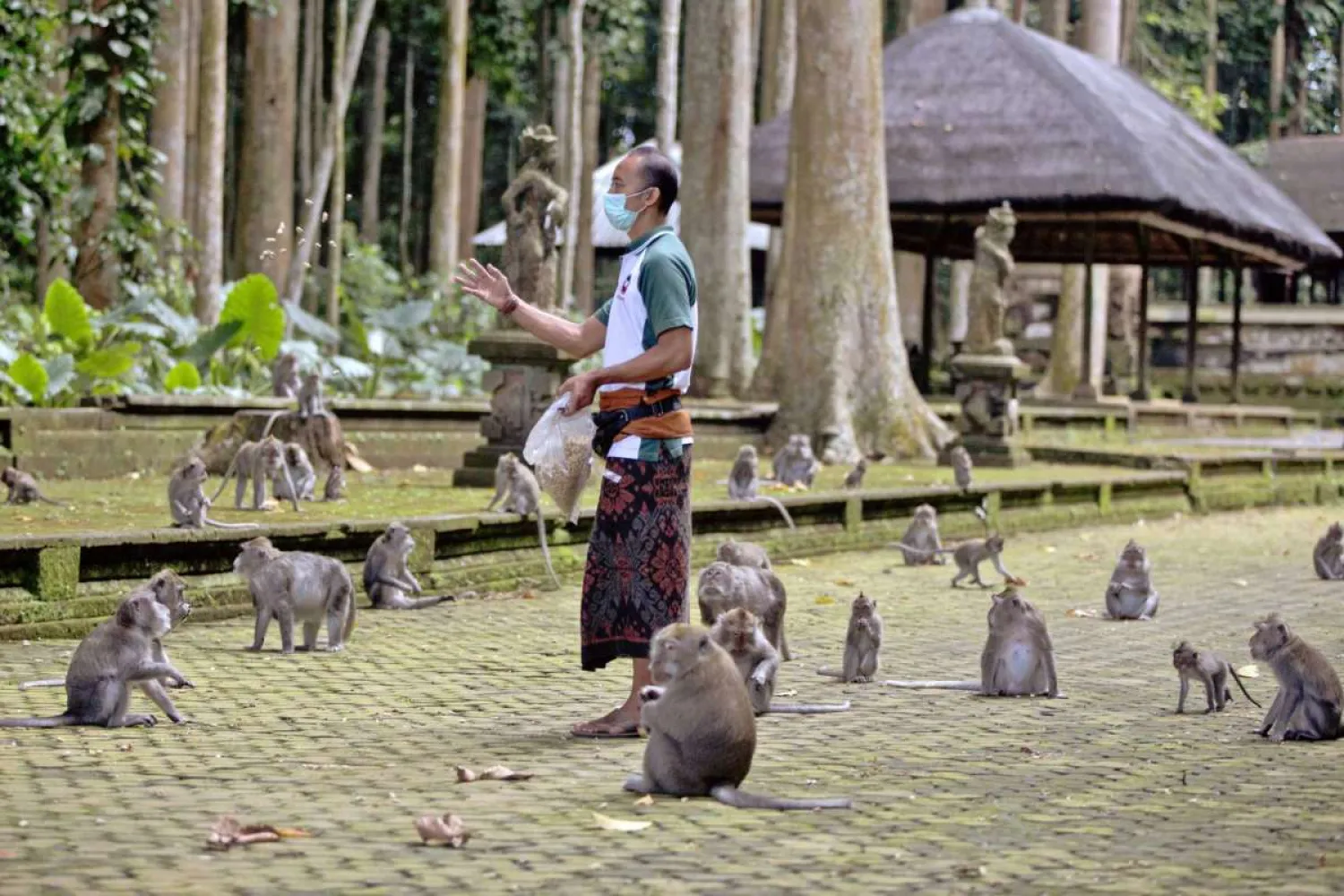
Made Mohon, the operation manager of Sangeh Monkey Forest, feeds macaques with donated peanuts during a feeding time at the popular tourist attraction site in Sangeh, Bali Island, Indonesia, Wednesday, Sept. 1, 2021.Firdia Lisnawati/AP
TT

With No Tourist Handouts, Hungry Bali Monkeys Raid Homes

Made Mohon, the operation manager of Sangeh Monkey Forest, feeds macaques with donated peanuts during a feeding time at the popular tourist attraction site in Sangeh, Bali Island, Indonesia, Wednesday, Sept. 1, 2021.Firdia Lisnawati/AP

Deprived of their preferred food source — the bananas, peanuts and other goodies brought in by tourists now kept away by the coronavirus — hungry monkeys on the resort island of Bali have taken to raiding villagers’ homes in their search for something tasty.

Villagers in Sangeh say the gray long-tailed macaques have been venturing out from a sanctuary about 500 meters (yards) away to hang out on their roofs and await the right time to swoop down and snatch a snack.

Worried that the sporadic sorties will escalate into an all-out monkey assault on the village, residents have been taking fruit, peanuts and other food to the Sangeh Monkey Forest to try to placate the primates, reported The Associated Press.

“We are afraid that the hungry monkeys will turn wild and vicious,” villager Saskara Gustu Alit said.

About 600 of the macaques live in the forest sanctuary, swinging from the tall nutmeg trees and leaping about the famous Pura Bukit Sari temple, and are considered sacred.

In normal times the protected jungle area in the southeast of the Indonesian island is popular among local residents for wedding photos, as well as among international visitors. The relatively tame monkeys can be easily coaxed to sit on a shoulder or lap for a peanut or two.

Ordinarily, tourism is the main source of income for Bali’s 4 million residents, who welcomed more than 5 million foreign visitors annually before the pandemic.

The Sangeh Monkey Forest typically had about 6,000 visitors a month, but as the pandemic spread last year and international travel dropped off dramatically, that number dropped to about 500.

Since July, when Indonesia banned all foreign travelers to the island and shut the sanctuary to local residents as well, there has been nobody.

Not only has that meant nobody bringing in extra food for the monkeys, the sanctuary has also lost out on its admission fees and is running low on money to purchase food for them, said operations manager Made Mohon.

The donations from villagers have helped, but they are also feeling the economic pinch and are gradually giving less and less, he said.

“This prolonged pandemic is beyond our expectations,” Made Mohon said, “Food for monkeys has become a problem.”

Food costs run about 850,000 rupiah ($60) a day, Made Mohon said, for 200 kilograms (440 pounds) of cassava, the monkeys' staple food, and 10 kilograms (22 pounds) of bananas.

The macaque is an omnivore and can eat a variety of animals and plants found in the jungle, but those in the Sangeh Monkey Forest have had enough contact with humans over the years that they seem to prefer other things.

And they’re not afraid to take matters into their own hands, Gustu Alit said.

Frequently, monkeys wander into the village and sit on roofs, occasionally removing tiles and dropping them to the ground. When villagers put out daily religious offerings of food on their terraces, the monkeys jump down and make off with them.

“A few days ago I attended a traditional ceremony at a temple near the Sangeh forest,” Gustu Alit said. “When I parked my car and took out two plastic bags containing food and flowers as offerings, two monkeys suddenly appeared and grabbed it all and ran into the forest very fast.”

Normally, the monkeys spend all day interacting with visitors — stealing sunglasses and water bottles, pulling at clothes, jumping on shoulders — and Gustu Alit theorizes that more than just being hungry, they’re bored.

“That’s why I have urged villagers here to come to the forest to play with the monkeys and offer them food,” he said. “I think they need to interact with humans as often as possible so that they do not go wild.”


Tips for Lowering Cortisol Levels and Reducing Stress

Chronic stress is bad for your health, physically and mentally. (Stanford University)
TT

Tips for Lowering Cortisol Levels and Reducing Stress

Chronic stress is bad for your health, physically and mentally. (Stanford University)

Like almost all our hormones, cortisol, known as the “stress hormone,” rises and falls naturally depending on a number of factors.

But if you're living in a constant state of stress, cortisol production can get stuck on overdrive, which can be damaging to your health. That's why we asked experts to share their best tips for how to lower cortisol, according to US magazine, Prevention.

Cortisol is an important hormone produced by the adrenal glands, explained Dr. Deena Adimoolam, an endocrinologist at Summit Health in Clifton, NJ.

“It’s important to understand that it is normal for cortisol values, just like all our hormones, to fluctuate depending on the time of day, our activities, stress levels, sleep patterns, and beyond,” she said.

That said, when cortisol levels are too high you can experience a number of unwanted mental and physical symptoms, including weight gain, muscle weakness, and high blood pressure.

Chronically high levels of cortisol can also contribute to poor mood regulation, interfere with learning and memory, and even impair immune and metabolic function, according to Dr. Monisha Bhanote, integrative lifestyle physician and author of "The Anatomy of Wellbeing".

Doctors advise that if a person is concerned that his cortisol levels are high, it’s always best to speak with a physician. But in the meantime, experts suggest trying out some of some strategies to lower cortisol levels naturally:

Prioritize sleep

Both Bhanote and Adimoolam agreed that finessing your sleep schedule is key to regulating cortisol levels. Aim for seven to nine hours of quality sleep each night to keep cortisol in check.

A balanced diet

Consuming a balanced diet can also help regulate cortisol, according to Bhanote. Be sure to craft a diet with “adequate vitamins and minerals, particularly magnesium and omega-3 fatty acids,” she said.

Pinpoint stressors

Stress is one of the most common causes of high cortisol levels (though it's not the only one), which is why Adimoolam suggested figuring out what aspects of your life are stressful. By identifying your stressors, you can then find ways to manage them and hopefully lower your cortisol.

Practice mindfulness or meditation

Mindfulness is a great relaxation technique that has been shown to reduce cortisol levels, our experts said. Bhanote suggested trying progressive muscle relaxation. It may also help you fall asleep.

Deep breathing exercises

Adimoolam also suggested deep breathing exercises as another powerful technique for reducing cortisol and lowering stress. Breath work has even been shown to lower blood pressure and hypertension.

Get outside

Bhanote recommended spending time outdoors to lower cortisol and reduce stress.

Socialize more

“Human connections and social support play a crucial role in managing stress and cortisol,” Bhanote explained. “Engaging in positive social interactions, seeking support when needed, and fostering strong relationships can be beneficial.”

Set aside time for you

A self-care routine is something everyone can do to keep cortisol levels in check, according to Adimoolam. Self-care can look different for everyone, but at its core, it “involves taking time to do things that will help you improve both your mental and physical health,” Haley Perlus, PhD in sports and performance psychologist, previously told Prevention.

Curb caffeine intake

“Overconsumption of caffeine can elevate cortisol levels,” Bhanote explained. “It’s advisable to consume it in moderation.”

Research shows that caffeine stimulates the central nervous system, leading to an increase in cortisol levels.

Use herbs, supplements with caution

“Certain adaptogenic herbs like ashwagandha and Rhodiola rosea have been traditionally used to combat stress,” Bhanote explained.


Passengers Flee Snake at Australian Train Station

People gather at Sydney Opera House during Australia Day 2026 celebrations, in Sydney, Australia, 26 January 2026. (EPA)
TT

Passengers Flee Snake at Australian Train Station

People gather at Sydney Opera House during Australia Day 2026 celebrations, in Sydney, Australia, 26 January 2026. (EPA)

Commuters jumped in fright as a snake slithered across a city train platform in Australia, proving nowhere is safe from the nation's creepy-crawlies.

Footage showed the small serpent wriggling down the platform in the city of Sydney on Sunday night.

One woman abandoned her bike after spotting the snake and flees in the opposite direction, while other passengers anxiously huddled together on the platform.

The impasse was solved when one passenger plucked up the courage to hoist the snake by its tail and drop it over the hand railing.

"A passenger who got off a train took it upon himself to handle the intruder," said government agency Transport for New South Wales, adding that "the man did not flinch".


Saudi Scientific Study Develops AI-Powered Detection of Obstructive Sleep Apnea

Sleep apnea affects more than one billion people worldwide. (AFP illustrative photo)
TT

Saudi Scientific Study Develops AI-Powered Detection of Obstructive Sleep Apnea

Sleep apnea affects more than one billion people worldwide. (AFP illustrative photo)

A Saudi scientific study has developed an intelligent model for detecting obstructive sleep apnea (OSA), a condition affecting more than one billion people worldwide, using unidirectional electrocardiography (ECG) signals and artificial intelligence (AI) techniques.

The findings, published in "Frontiers in Artificial Intelligence" and conducted by Dr. Malak Al-Marshad at the University Sleep Medicine and Research Center, College of Medicine, and Medical City at King Saud University, detailed the development of an “attention transformer-based deep learning model” designed to improve the accuracy and speed of diagnosing OSA.

The study noted that the proposed diagnostic approach is more efficient than traditional polysomnography (PSG), which is time-consuming, costly, and requires specialist analysis. The model uses transformer-based AI technology, similar to that in large language models, relying on a single ECG signal and autoencoder-based positional encoding to process raw data without complex preprocessing.

Results showed that the model outperformed previous studies by 13% in F1 score and achieved high temporal accuracy, detecting apnea events with precision down to one second. It offers physicians faster, more affordable, and reliable diagnostic support, even when using noisy real-world data.

The research reflects growing interest in applying AI in sleep medicine. King Saud University ranked 18th globally in sleep medicine research over the past five years, while Professor Ahmed BaHammam of the College of Medicine at King Saud University ranked fifth worldwide among sleep medicine scientists during the same period, according to the 2025 ScholarGPS rankings.