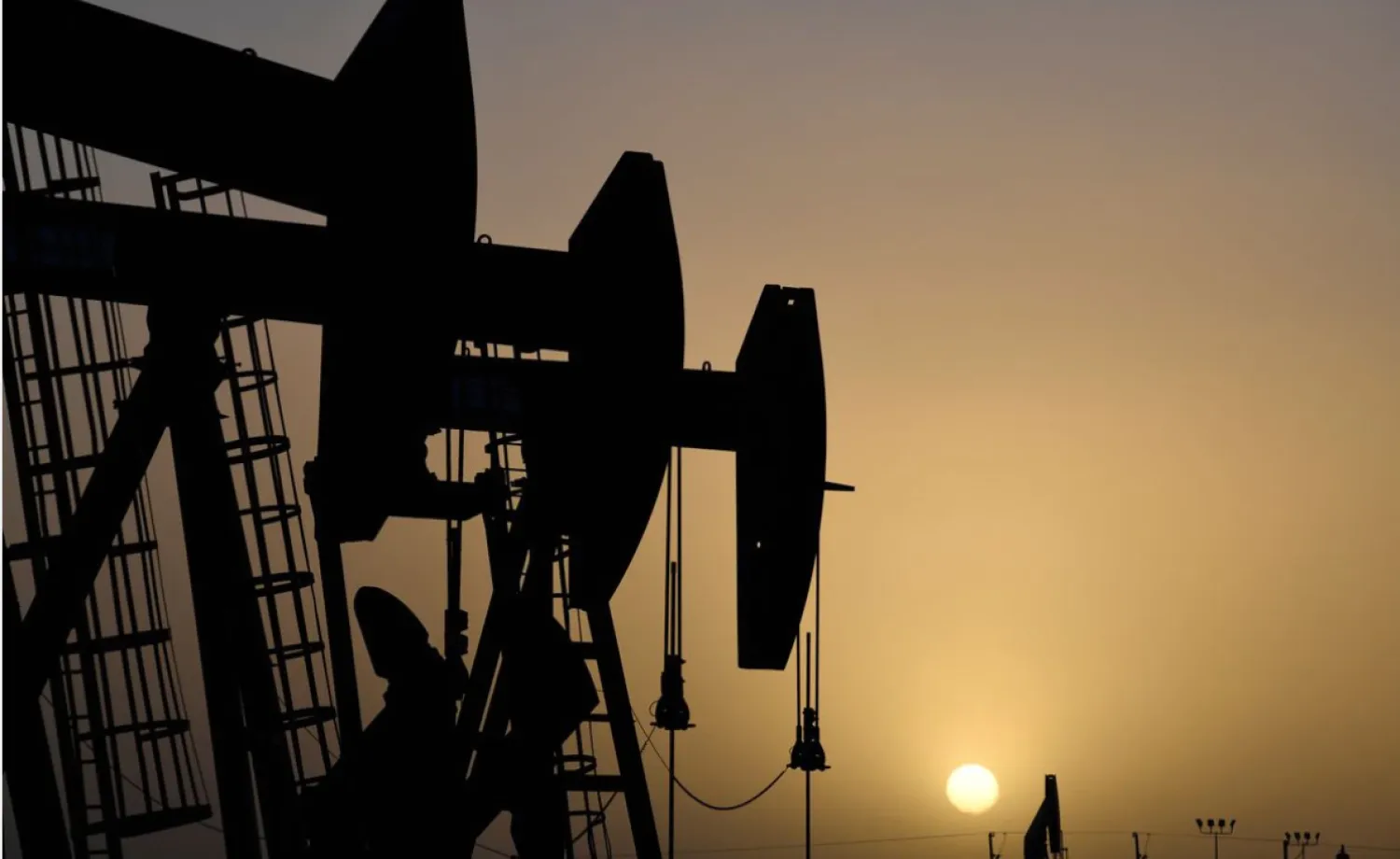
Oil Holds Steady on Slow Return of US Supplies

Pump jacks operate at sunset in Midland, Texas, US, February 11, 2019. REUTERS/Nick Oxford
TT

Oil Holds Steady on Slow Return of US Supplies

Pump jacks operate at sunset in Midland, Texas, US, February 11, 2019. REUTERS/Nick Oxford

Oil prices were little changed on Wednesday following overnight losses from a stronger dollar and demand concerns, with a slow production restart in the US Gulf of Mexico providing some support.

US West Texas Intermediate (WTI) crude futures rose 11 cents, or 0.2%, to $68.46 a barrel at 0429 GMT, after sliding 1.4% on Tuesday following the Labor Day holiday.

Brent crude futures fell 2 cents to $71.67 a barrel after falling 0.7% on Tuesday.

"The market is ... weighing up the impact of ongoing delays to the resumption of operations in the Gulf of Mexico," ANZ Research analysts said in a note.

Producers in the US Gulf of Mexico are still struggling to restart operations nine days after Hurricane Ida swept through the region with powerful winds and drenching rain.

About 79% of US Gulf production remained offline on Tuesday, with 79 production platforms still unoccupied. About 17.5 million barrels of oil has been lost to the market so far.

The Gulf's offshore wells make up about 17% of US output.

"Refinery operations appear to be making a quicker recovery," ING analysts said in a note.

Only about 1 million barrels per day of capacity was temporarily closed, down from a peak of more than 2 million bpd, ING said, citing the latest situation report from the Department of Energy.

"However, those refiners that have restarted are unlikely to be operating full capacity at the moment," the note added.

Traders will be closely watching inventory data from the American Petroleum Institute industry group due on Wednesday and the US Energy Information Administration on Thursday for a clearer picture of the storm's impact on crude production and refinery output.

Analysts polled by Reuters expect, on average, that crude stocks fell by 3.8 million barrels in the week to Sept. 3, and see gasoline stocks down by 3.6 million barrels and distillates down by 3 million barrels.

Oil prices fell on Tuesday in a widespread commodity selloff as the US dollar jumped on worries that rising COVID-19 cases in the United States and Asia will potentially lead to slower growth.


US to Stop Collecting Tariffs Deemed Illegal by Supreme Court on Tuesday

LOS ANGELES, CALIFORNIA - FEBRUARY 20: Shipping containers stand stacked while others rest on truck transport chassis at the Port of Los Angeles on February 20, 2026 in Los Angeles, California. Mario Tama/Getty Images/AFP
TT

US to Stop Collecting Tariffs Deemed Illegal by Supreme Court on Tuesday

LOS ANGELES, CALIFORNIA - FEBRUARY 20: Shipping containers stand stacked while others rest on truck transport chassis at the Port of Los Angeles on February 20, 2026 in Los Angeles, California. Mario Tama/Getty Images/AFP

The US Customs and Border Protection agency said it will halt collections of tariffs imposed under the International Emergency Economic Powers Act at 12:01 a.m. EST (0501 GMT) on Tuesday, more than three days after the Supreme Court declared the duties illegal.

The agency said in a message to shippers on its Cargo Systems ‌Messaging Service (CSMS) ‌that it will de-activate all tariff ‌codes ⁠associated with President ⁠Donald Trump's prior IEEPA-related orders as of Tuesday.

The IEEPA tariff collection halt coincides with Trump's imposition of a new, 15% global tariff under a different legal authority to replace the ones struck down by the Supreme ⁠Court on Friday.

CBP gave no reason why ‌it was continuing ‌to collect the tariffs at ports of entry days ‌after the Supreme Court's ruling, and its message ‌offered no information about possible refunds for importers.

The message noted that the collection halt does not affect any other tariffs imposed by Trump, including ‌those under the Section 232 national security statute and the Section 301 unfair ⁠trade practices ⁠statute.

"CBP will provide additional guidance to the trade community through CSMS messages as appropriate," the agency said.

Reuters reported on Friday that the Supreme Court decision made more than $175 billion in US Treasury revenue generated by the IEEPA tariffs subject to potential refunds, based on an estimate by Penn-Wharton Budget Model economists.

Their estimate from a ground-up forecasting model showed that IEEPA-based tariffs were generating more than $500 million per day in gross revenue.


Gold Climbs to 3-week High as US Tariff Ruling Stokes Uncertainty

A vendor displays gold bracelets for sale in a gold shop at the Grand Bazaar in Istanbul (AFP)
TT

Gold Climbs to 3-week High as US Tariff Ruling Stokes Uncertainty

A vendor displays gold bracelets for sale in a gold shop at the Grand Bazaar in Istanbul (AFP)

Gold climbed to a three-week high on Monday as uncertainty stoked by the US Supreme Court's decision to strike down a vast swathe of President Donald Trump's tariffs pressured the dollar and pushed investors to the safety of bullion.

Spot gold climbed 1.1% to $5,158.29 per ounce by 0558 GMT, having earlier hit its highest since January 30. ‌US gold futures for ‌April delivery were up 2% at $5,180.40.

"The court's ‌tariff ⁠ruling has, aside ⁠from earning the ire of the US president, added another layer of uncertainty to global markets, with traders again turning to gold as a defensive play," said Tim Waterer, chief market analyst at KCM Trade.

The US Supreme Court struck down Trump's sweeping tariffs that he pursued under a law meant for use in national emergencies, ⁠handing the Republican president a stinging defeat in ‌a landmark ruling on Friday ‌with major implications for the global economy.

After the court ruling, Trump said ‌he would raise a temporary tariff from 10% to 15% ‌on US imports from all countries.

Wall Street futures and the dollar slid in Asia on Monday as murkiness around US tariffs revived the "sell America" trade, Reuters reported.

"Whether gold can claw its way back above $5,400 in the near-term ‌may rest on how long tariff uncertainty lingers and whether the US engages in military action ⁠against Iran," Waterer ⁠said.

Iran has indicated it is prepared to make concessions on its nuclear program in talks with the US in return for the lifting of sanctions and recognition of its right to enrich uranium, as it seeks to avert a US attack.

Meanwhile, data on Friday showed that underlying US inflation increased more than expected in December, and signs are pointing to a further acceleration in January, which would strengthen expectations that the Federal Reserve won't cut interest rates before June.

Spot silver climbed 2.9% to $86.98 per ounce, a more than two-week high.
Spot platinum edged 0.1% higher to $2,158.55 per ounce, while palladium slipped 0.2% to $1,745.09.


EU Says US Must Honor a Trade Deal after Court Blocks Trump Tariffs

FILE PHOTO: US President Donald Trump speaks during a press briefing at the White House, in Washington, D.C., US, February 20, 2026. REUTERS/Kevin Lamarque/File Photo
TT

EU Says US Must Honor a Trade Deal after Court Blocks Trump Tariffs

FILE PHOTO: US President Donald Trump speaks during a press briefing at the White House, in Washington, D.C., US, February 20, 2026. REUTERS/Kevin Lamarque/File Photo

The European Union's executive arm requested “full clarity” from the United States and asked its trade partner to fulfill its commitments after the US Supreme Court struck down some of President Donald Trump’s most sweeping tariffs.

Trump has lashed out at the court decision and said Saturday that he wants a global tariff of 15%, up from the 10% he announced a day earlier.

The European Commission said the current situation is not conducive to delivering "fair, balanced, and mutually beneficial” trans-Atlantic trade and investment, as agreed to by both sides and spelled out in the EU-US Joint Statement of August 2025.

American and EU officials sealed a trade deal last year that imposes a 15% import tax on 70% of European goods exported to the United States. The European Commission handles trade for the 27 EU member countries.

A top EU lawmaker said on Sunday he will propose to the European Parliament negotiating team to put the ratifying process of the deal on pause.

“Pure tariff chaos on the part of the US administration,” Bernd Lange, the chair of Parliament’s international trade committee, wrote on social media. “No one can make sense of it anymore — only open questions and growing uncertainty for the EU and other US trading partners.”

The value of EU-US trade in goods and services amounted to 1.7 trillion euros ($2 trillion) in 2024, or an average of 4.6 billion euros a day, according to EU statistics agency Eurostat.

“A deal is a deal,” the European Commission said. “As the United States’ largest trading partner, the EU expects the US to honor its commitments set out in the Joint Statement — just as the EU stands by its commitments. EU products must continue to benefit from the most competitive treatment, with no increases in tariffs beyond the clear and all-inclusive ceiling previously agreed."

Jamieson Greer, Trump’s top trade negotiator, said in a CBS News interview Sunday morning that the US plans to stand by its trade deals and expects its partners to do the same.

He said he talked to his European counterpart this weekend and hasn’t heard anyone tell him the deal is off.

“The deals were not premised on whether or not the emergency tariff litigation would rise or fall,” Greer said. “I haven’t heard anyone yet come to me and say the deal’s off. They want to see how this plays out.”

Europe’s biggest exports to the US are pharmaceuticals, cars, aircraft, chemicals, medical instruments, and wine and spirits. Among the biggest US exports to the bloc are professional and scientific services like payment systems and cloud infrastructure, oil and gas, pharmaceuticals, medical equipment, aerospace products and cars.

“When applied unpredictably, tariffs are inherently disruptive, undermining confidence and stability across global markets and creating further uncertainty across international supply chains,” The Associated Press quoted the commission as saying.

As primarily a trading bloc, the EU has a powerful tool at its disposal to retaliate — the bloc’s Anti-Coercion Instrument. It includes a raft of measures for blocking or restricting trade and investment from countries found to be putting undue pressure on EU member nations or corporations.

The measures could include curtailing the export and import of goods and services, barring countries or companies from EU public tenders, or limiting foreign direct investment. In its most severe form, it would essentially close off access to the EU’s 450-million customer market and inflict billions of dollars of losses on US companies and the American economy.