


Paris Terror Trial Opens for 20 Accused in 2015 Attacks

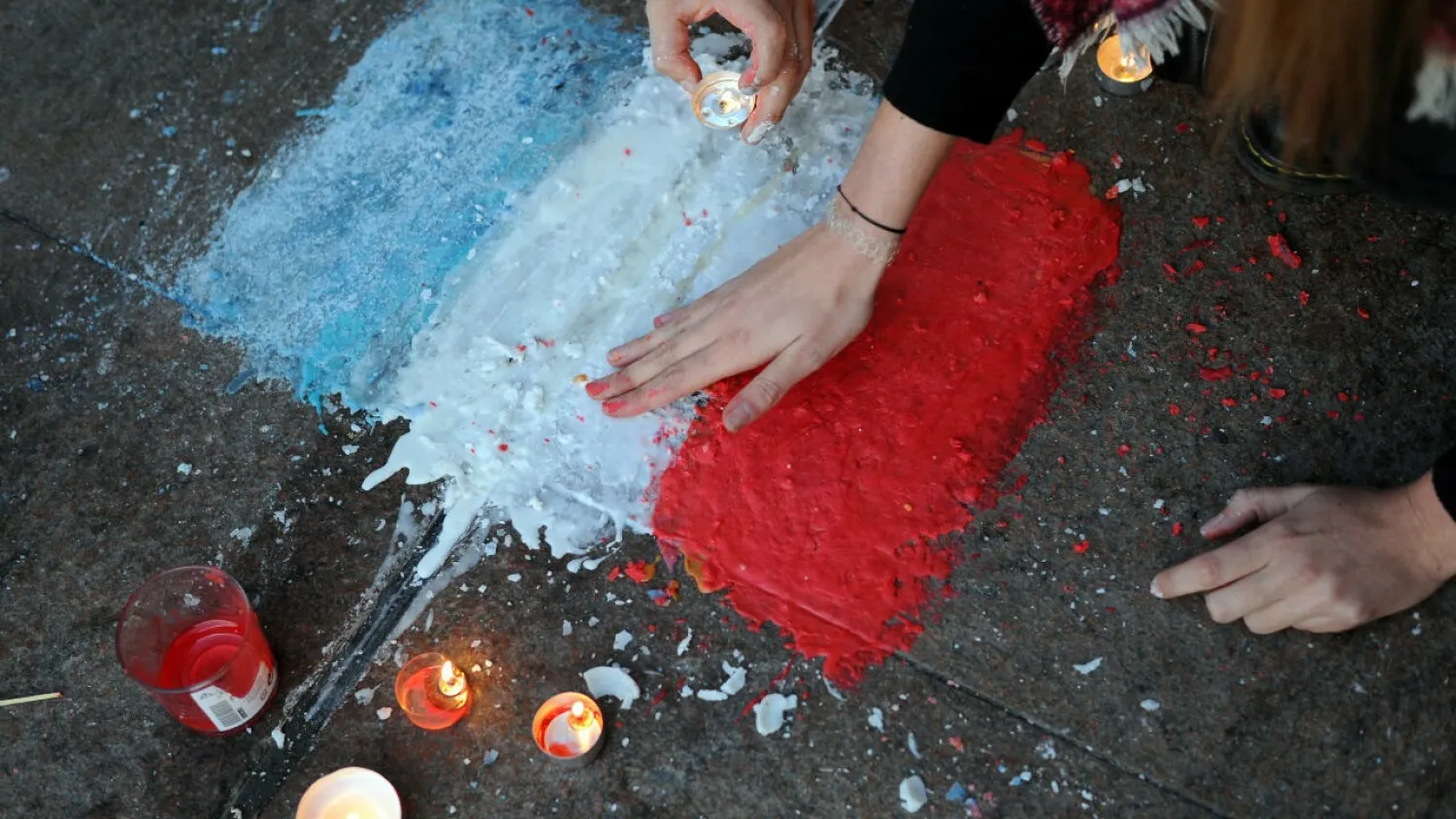
People light candles and draw a French flag in front of the town hall of Toulouse, on November 15, 2015, in tribute to the victims of the Paris attacks. (AFP)
TT

Paris Terror Trial Opens for 20 Accused in 2015 Attacks

People light candles and draw a French flag in front of the town hall of Toulouse, on November 15, 2015, in tribute to the victims of the Paris attacks. (AFP)

The trial of 20 men accused in a series of coordinated attacks on Paris in 2015 that spread fear across Europe and transformed France opened Wednesday in a custom-built complex embedded within a 13th-century courthouse.

Nine ISIS group gunmen and suicide bombers struck within minutes of one another at several locations around Paris on Nov. 13, 2015, leaving 130 people dead and hundreds wounded. It was the deadliest violence to strike France since World War II and among the worst terror attacks to hit the West.

The worst carnage was at the Bataclan concert hall, where three men with assault rifles gunned down scores of people and grabbed a handful of hostages. Others targeted the national soccer stadium, where the president was attending a game, as well as cafes filled with people on a mild autumn night.

The lone surviving attacker from that night, Salah Abdeslam, is the key defendant — but he has so far refused to speak to investigators, denying them answers to many of the remaining questions about the attacks and the people who planned them. Abdeslam, whose brother was among the suicide bombers, appeared wearing a black short-sleeved shirt and black trousers, his long hair tied back.

When asked to state his profession, he declared he was “a fighter for ISIS” after intoning a prayer.

Abdeslam, who fled the night of the attacks after ditching his car and a malfunctioning suicide vest, is the only defendant charged with murder. The other defendants present face lesser terrorism charges.

The presiding judge, Jean-Louis Peries, acknowledged the extraordinary nature of the attacks, which changed security in Europe and France’s political landscape, and the trial to come. France only emerged from the state of emergency declared in the wake of the attacks in 2017, after incorporating many of the harshest measures into law.

“The events that we are about to decide are inscribed in their historic intensity as among the international and national events of this century,” he said.

Dominique Kielemoes, whose son bled to death at one of the cafes, said hearing victims’ testimonies at the trial will be crucial to both their own healing and that of the nation.

“The assassins, these terrorists, thought they were firing into the crowd, into a mass of people. But it wasn’t a mass — these were individuals who had a life, who loved, had hopes and expectations, and that we need to talk about at the trial. It’s important,” she said.

Of the 20 men charged, six will be tried in absentia. Abdeslam will be questioned multiple times — but it remains to be seen if he will break his silence beyond the sort of allegiance he offered Wednesday to ISIS groups.

“We were expecting it, and we were prepared for it and in fact, we’re not expecting anything from him,” Kielemoes said after Abdeslam first appeared.

The same ISIS network that hit Paris went on to strike Brussels months later, killing another 32 people.

Authorities have to extraordinary lengths to ensure security at the trial, building an entirely new courtroom within the storied 13th-century Palais de Justice in Paris, where Marie Antoinette and Emile Zola faced trial, among others.

Survivors of the attacks as well as those who mourn their dead on Wednesday packed the complex’s rooms, which were designed to hold 1,800 plaintiffs and over 300 lawyers.

For the first time, victims can also have a secure audio link to listen from home if they want with a 30-minute delay.

The trial is scheduled to last nine months. The month of September will be dedicated to laying out the police and forensic evidence. October will be given over to victims’ testimony. From November to December, officials including then-French President François Hollande — who was at the Stade de France on the night of the assaults — will testify, as will relatives of the attackers.

France changed after that night: Authorities immediately declared a state of emergency and now has armed officers constantly patrolling public spaces. The attacks sparked soul-searching among the French and Europeans more broadly since most of the perpetrators were born and raised in France or Belgium. And it transformed forever the lives of all those who suffered losses or bore witness to the violence.

“Our ability to be carefree is gone,” Kielemoes said. “The desire to go out, travel — all of that’s gone. Even if we still do a number of things, our appetite for life has disappeared.”

For Jean-Luc Wertenschlag, who lives above the cafe where his son died and who rushed downstairs soon after the first gunshots to try to save lives, it has even changed the way he moves around the city where he was born and raised. He never leaves home without the first aid gear he lacked that night, when he ripped off his shirt to stanch the bleeding of a victim.

“What we did that evening with other people, to provide assistance to the people wounded during the attack, was a way to stand against what these monsters had tried to do to us,” he said.

Among those scheduled to testify is Hollande, who in addition to being present at one of the scenes of attack gave the final order to police special forces to storm the Bataclan.

Hollande said Wednesday he would speak “not for the sake of French politics, but for the victims of the attacks.” He said he keenly felt the weight of responsibility that night and for the days and weeks later.

“When the cameras are turned off, you go back to the solitude of the Elysée (presidential palace),” Hollande told told France-Info. “You ask what can I do? ... Is what just happened going to change society?”

None of the proceedings will be televised or rebroadcast to the public, but they will be recorded for archival purposes. Video recording has only been allowed for a handful of cases in France considered to be of historical value, including last year’s trial for the 2015 attacks against the Charlie Hebdo newspaper in Paris and a kosher supermarket.



Russia Pledges ‘Full Support’ for Venezuela Against US ‘Hostilities’

The US Navy replenishment oiler USNS Kanawha (T-AO-196) arrives at port in Ponce, Puerto Rico, amid ongoing military movements, December 21, 2025. (Reuters)
TT

Russia Pledges ‘Full Support’ for Venezuela Against US ‘Hostilities’

The US Navy replenishment oiler USNS Kanawha (T-AO-196) arrives at port in Ponce, Puerto Rico, amid ongoing military movements, December 21, 2025. (Reuters)

Russia on Monday expressed "full support" for Venezuela as the South American country confronts a blockade of sanctioned oil tankers by US forces deployed in the Caribbean, the two governments said.

In a phone call, the foreign ministers of the two allied countries blasted the US actions, which have included bombing alleged drug-trafficking boats and more recently the seizure of two tankers.

A third ship was being pursued, a US official told AFP Sunday.

"The ministers expressed their deep concern over the escalation of Washington's actions in the Caribbean Sea, which could have serious consequences for the region and threaten international shipping," the Russian foreign ministry said of the call between ministers Sergei Lavrov and Yvan Gil.

"The Russian side reaffirmed its full support for and solidarity with the Venezuelan leadership and people in the current context," it added.

"The ministers agreed to continue their close bilateral cooperation and to coordinate their actions on the international stage, particularly at the UN, in order to ensure respect for state sovereignty and non-interference in internal affairs."

The UN Security Council is to meet Tuesday to discuss the mounting crisis between Venezuela and the United States after a request from Caracas, backed by China and Russia.

On Telegram, Venezuela's Gil said he and Lavrov had discussed "the aggressions and flagrant violations of international law being perpetrated in the Caribbean: attacks on vessels, extrajudicial executions, and illicit acts of piracy carried out by the United States government."

US forces have since September launched strikes on boats Washington said, without providing evidence, were trafficking drugs in the Caribbean Sea and eastern Pacific Ocean.

More than 100 people have been killed, some of them fishermen, according to their families and governments.

US President Donald Trump on December 16 announced a blockade of "sanctioned oil vessels" sailing to and from Venezuela.

Trump has claimed Caracas under Maduro is using oil money to finance "drug terrorism, human trafficking, murder and kidnapping.

Gil said Lavrov had affirmed Moscow's "full support in the face of hostilities against our country."


Turkish Agents Capture an ISIS Member on the Afghan-Pakistan Border

A Turkish soldier stands guard outside the Silivri Prison and Courthouse complex near Istanbul, Turkey. (File/Reuters)
TT

Turkish Agents Capture an ISIS Member on the Afghan-Pakistan Border

A Turkish soldier stands guard outside the Silivri Prison and Courthouse complex near Istanbul, Turkey. (File/Reuters)

Turkish intelligence agents have captured a senior member of the ISIS terror group in an area along the Afghanistan-Pakistan border, allegedly thwarting planned suicide attacks in Türkiye and elsewhere, Türkiye's state-run news agency reported Monday.

Anadolu Agency said the suspect was identified as Mehmet Goren and a member of the group's Afghanistan-based ISIS-Khorasan branch. He was caught in a covert operation and transferred to Türkiye.

It was not clear when the operation took place or whether Afghan and Pakistani authorities were involved.

The report said the Turkish citizen allegedly rose within the organization’s ranks and was given the task of carrying out suicide bombings in Türkiye, Pakistan, Afghanistan and Europe.

ISIS has carried out deadly attacks in Türkiye, including a shooting at an Istanbul night club on Jan. 1, 2017, which killed 39 people.

Monday's report said Goren’s capture allegedly also exposed the group's recruitment methods and provided intelligence on its planned activities.


Iran Arrests Norwegian-Iranian Dual Citizen

Iran's Evin Prison (File photo: Reuters)
TT

Iran Arrests Norwegian-Iranian Dual Citizen

Iran's Evin Prison (File photo: Reuters)

A Norwegian-Iranian dual citizen has been arrested in Iran, Norway's foreign ministry told AFP on Monday.

"The Ministry of Foreign Affairs is aware that a Norwegian citizen has been arrested in Iran, but due to our obligation to respect confidentiality we cannot provide further details," ministry spokesman Mathias Rongved said in an email.

He confirmed the individual was a dual Norwegian-Iranian national and noted the government advises against travel to Iran.

On its website, the Norwegian government states that Iran does not recognise dual citizenship, and it is "therefore very difficult -- virtually impossible -- for the embassy to assist Norwegian-Iranian citizens if they are imprisoned in Iran".

The US-based Human Rights Activists News Agency (HRANA) identified the dual national as Shahin Mahmoudi, born in 1979.

It said she was arrested on December 14 after being ordered to report to authorities in Saqqez, in Iran's western Kurdistan province.

She is being held at a detention center in Sanandaj, it added.

HRANA said her family had not been informed of the reason for her arrest nor had they received any news of her health and well-being.