


Somalia Power Struggle Escalates over Security Minister's Sacking

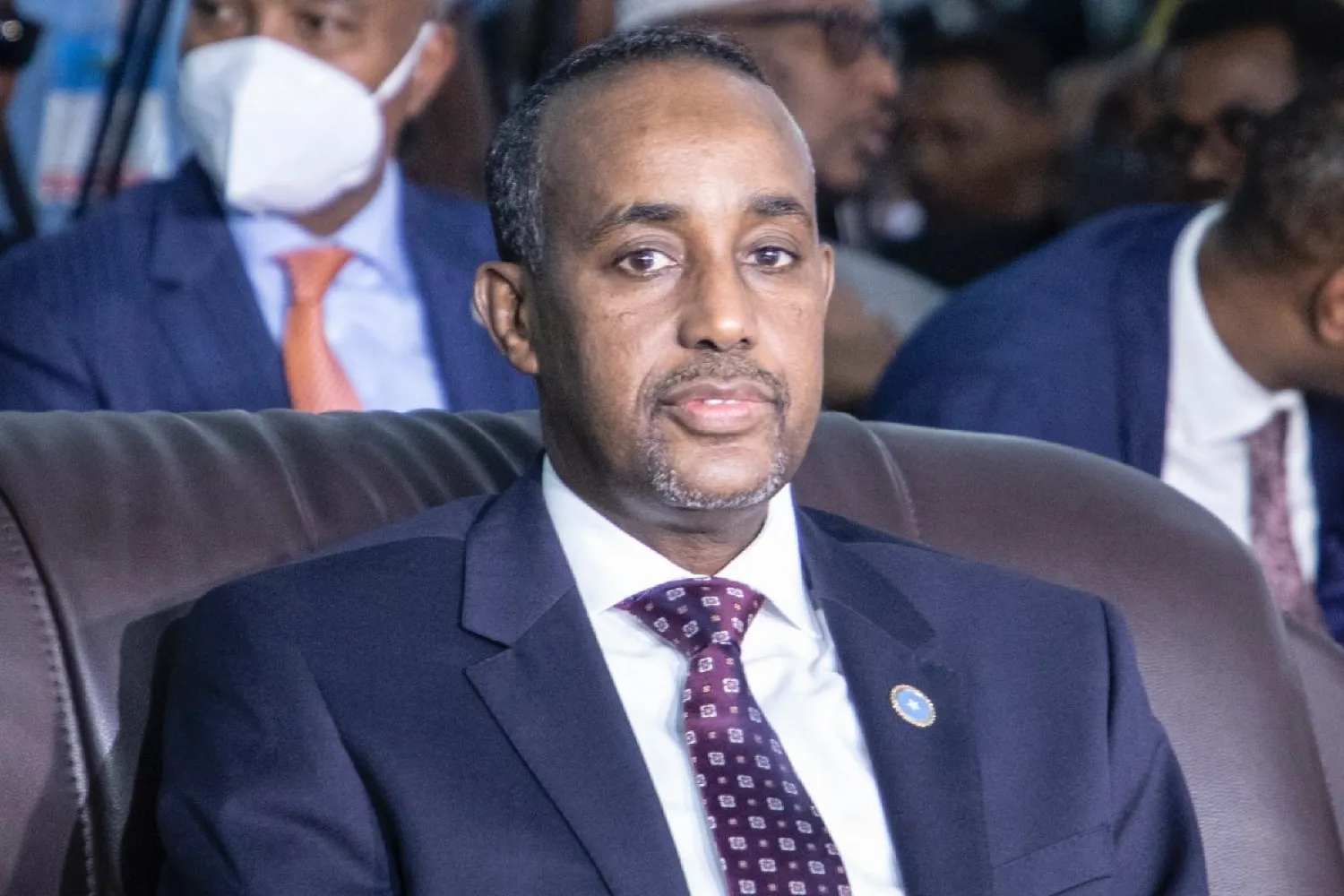
Somalia's Prime Minister Mohamed Hussein Roble was appointed by the president in September last year. Abdirahman Yusuf AFP/File
TT

Somalia Power Struggle Escalates over Security Minister's Sacking

Somalia's Prime Minister Mohamed Hussein Roble was appointed by the president in September last year. Abdirahman Yusuf AFP/File

The very public feud between President Mohamed Abdullahi Mohamed, commonly known as Farmajo, and Prime Minister Mohamed Hussein Roble has plunged the troubled country into fresh crisis as it struggles to hold long delayed elections and keep an insurgency at bay.

In a late-night move on Wednesday Roble fired the country's security minister and replaced him with a Farmajo critic, triggering an angry response from the president, reported Agence France-Presse.

Roble had earlier accused the president of obstructing a closely-watched inquiry into the disappearance of a young intelligence agent whose fate thrust the high-stakes dispute into the public eye.

"That is a dangerous existential threat to the country's governance system," said Roble, who described a pattern of interference in the investigative remit of Somalia's justice agencies.

Roble angered the president by this week firing the head of the National Intelligence and Security Agency (NISA) over his handling of the high-profile disappearance case, and putting another man in charge.

Farmajo said the sacking was "illegal and unconstitutional" and overruled his prime minister, naming another appointee to the top job, and appointing the dumped intelligence chief as his national security adviser.

Late Wednesday, Roble said he had decided to replace security minister Hassan Hundubey Jimale with Abdullahi Mohamed Nur to "revitalize" the ministry which oversees all security, police and intelligence agencies in the Horn of Africa nation.

Farmajo rejected the move as unconstitutional and "not valid" in a statement Thursday, and the sacked minister himself accused Roble of acting to "throw the country into a new conflict".

- Situation 'tense' -

The public spat has raised the political temperature in Mogadishu, where military units close to Farmajo's office were seen stationed outside NISA headquarters on Wednesday.

"The situation is tense, and many in the agency are confused now. Some senior officials seem to have taken sides," one NISA officer told AFP on condition of anonymity.

Meanwhile, journalists at state-run media outlets reported being instructed not to broadcast messages from Farmajo, whose four-year mandate expired in February.

"We have been told by the minister to stop reporting on matters from the president's office related to the political conflict," a staffer at the Ministry of Information told AFP on condition of anonymity.

A Swedish-trained civil engineer and political neophyte, Roble was appointed prime minister by Farmajo in September last year after his predecessor was ousted in a parliamentary no-confidence vote.

But the two men have clashed often, with the row threatening to throw an already fragile electoral process into deeper peril.

The international community has encouraged both leaders to focus on the elections, which are already months behind schedule.

"We urge Somali leaders to de-escalate the political confrontation surrounding this investigation and, in particular, avoid any actions that could lead to violence," said a statement issued Tuesday by the UN Assistance Mission in Somalia.

Farmajo's mandate was extended by parliament in April, setting off deadly gun battles in the streets of Mogadishu.

Roble was appointed to ease the political tensions and deliver elections, and a new timetable to a vote was cobbled together.

But the process fell behind, and Roble has accused Farmajo of trying to reclaim "election and security responsibilities" from him.

Elections in Somalia follow a complex indirect model, whereby state legislatures and clan delegates pick lawmakers for the national parliament, who in turn choose the president.

The next phase is scheduled between October 1 and November 25.

Analysts say the election impasse has distracted from Somalia's larger problems, most notably a violent insurgency waged by Al-Shabaab.

The Al-Qaeda allies were driven out of Mogadishu a decade ago but retain control of swathes of countryside and the capability to stage deadly attacks in the capital and elsewhere.

Last week, NISA said the intelligence officer abducted near her home in June was killed by the extremists.

But Al-Shabaab denied any role in the disappearance of 25-year-old Ikran Tahlil, whose family has accused NISA of murdering her.



Iran Says Return to Hostilities Will Affect Talks with US

An Iranian woman walks next to an anti-Israeli mural on a street in Tehran, Iran June 8, 2026. Majid Asgaripour/WANA (West Asia News Agency) via Reuters
TT

Iran Says Return to Hostilities Will Affect Talks with US

An Iranian woman walks next to an anti-Israeli mural on a street in Tehran, Iran June 8, 2026. Majid Asgaripour/WANA (West Asia News Agency) via Reuters

Iran said Monday that the resumption of hostilities in the Middle East war will have consequences for ongoing talks with the United States to reach peace in the region. 

"It is perfectly natural that the diplomatic process initiated to put an end to this imposed war would be affected," Iranian foreign ministry spokesman Esmaeil Baqaei said at a press conference in Tehran attended by AFP. 

He added that the United States held responsibility for the resumption of fighting with Israel, saying Israel's actions "cannot be separated" from US policy. 

"Without a doubt, as I said, the actions of the Zionist regime in the region cannot be separated from US policies," he stressed. 

"No one believes that the Zionist regime would carry out any action without prior coordination and cooperation with the United States," he said. 

Baqaei added, however, that Pakistan's mediation efforts to end the war with the US were continuing. 

"Diplomatic consultations are naturally continuing in all circumstances," he said. 


China Says Hopes Israel, Iran Maintain Ceasefire

 Israeli anti-air defense system interceptors, after missiles were launched towards Israel from Iran, as seen from Ramallah, in the Israeli-occupied West Bank, Jun 8, 2026. (Reuters)
Israeli anti-air defense system interceptors, after missiles were launched towards Israel from Iran, as seen from Ramallah, in the Israeli-occupied West Bank, Jun 8, 2026. (Reuters)
TT

China Says Hopes Israel, Iran Maintain Ceasefire

 Israeli anti-air defense system interceptors, after missiles were launched towards Israel from Iran, as seen from Ramallah, in the Israeli-occupied West Bank, Jun 8, 2026. (Reuters)
Israeli anti-air defense system interceptors, after missiles were launched towards Israel from Iran, as seen from Ramallah, in the Israeli-occupied West Bank, Jun 8, 2026. (Reuters)

China said it was "deeply concerned" Monday by fresh attacks between Israel and Iran, expressing hope that a fragile truce in the Middle East war would be respected.

"Resuming hostilities is not in any party's interest," foreign ministry spokesman Lin Jian told a news briefing, adding: "It is hoped all relevant parties will fulfil their commitment to a ceasefire."

Israel and Iran traded fire early Monday in retaliatory strikes that threatened to drag the wider Middle East back into a full-scale regional war, while Yemen’s Houthi militants also fired at Israel and warned they would target Israel-affiliated ships in the Red Sea, further escalating tension.

Israel launched strikes on central and western Iran early Monday in response to missile fire from Tehran and Iran retaliated with waves of attacks, in the most serious crossfire since an April ceasefire was reached.

Explosions could be heard in central Israel as air defenses sought to intercept incoming Iranian fire.

Tehran warned of retaliation on Sunday after Israel struck Beirut’s southern suburbs without warning in defiance of Washington’s request days ago to stand down.

Monday marked the 100th day of the Iran war, launched Feb. 28 when Israel and the United States killed Supreme Leader Ali Khamenei and other senior Iranian leaders.

The war raged until the two sides reached a ceasefire on April 8, but efforts at a permanent end to the hostilities have been challenged by Iran's chokehold on the Strait of Hormuz, through which a fifth of all traded oil and natural gas once passed in peacetime, as well as fighting between Israel and the Iran-backed Lebanese Hezbollah group.


Dismissal of Operations Chief on Iran Leaves Shockwaves in Mossad

Roman Gofman (left), the new Mossad chief, receives a ceremonial insignia during the agency’s leadership handover ceremony with Prime Minister Benjamin Netanyahu and outgoing director David Barnea. (X)
TT

Dismissal of Operations Chief on Iran Leaves Shockwaves in Mossad

Roman Gofman (left), the new Mossad chief, receives a ceremonial insignia during the agency’s leadership handover ceremony with Prime Minister Benjamin Netanyahu and outgoing director David Barnea. (X)

Israel’s foreign intelligence agency, the Mossad, is experiencing a major upheaval following a decision by its new director, Roman Gofman, to dismiss his deputy, known publicly only by the initial “A.”

The outgoing Mossad chief, David Barnea, had reportedly viewed “A” as his preferred successor.

According to sources close to Gofman, the move was carefully planned and coordinated with Prime Minister Benjamin Netanyahu. The sources said the purpose was to deliver a “preemptive blow” to “A,” who was allegedly planning to organize an internal bloc against the new director that could hinder his work and undermine his chances of success.

Agency officials have sought to reassure personnel that Gofman intends to appoint a new deputy from within the Mossad. That assurance, however, has done little to appease senior officials, many of whom have reportedly expressed their intention to resign, arguing that the degree of political interference in the agency’s management is unprecedented.

“A” was considered one of Barnea’s closest associates, and Barnea reportedly regarded him as the natural heir to the top post. The dismissed official played a central role in Mossad efforts aimed at bringing down Iran’s regime, an effort that has so far failed to achieve its objectives and, according to people close to Barnea, requires continued leadership and commitment.

Barnea described the dismissal as “an irresponsible act,” warning that it could disrupt the functioning of the Mossad, particularly with respect to operations concerning Iran.

During his career at the agency, “A” has held several high-profile positions. Among them, he oversaw a special project related to the case of missing Israeli airman Ron Arad. He has also headed and significantly expanded the Mossad’s “Influence” Division as part of preparations for the possibility that the agency might become involved in efforts to destabilize the Iranian regime.

In addition, “A” has led the Iranian portfolio within the Mossad and supervised planning for operations against Iran during two rounds of warfare, including efforts aimed at weakening the regime there, according to the Israeli news outlet Ynet. He reportedly received four decorations for daring operations carried out in Iran and several other countries in the region.

Criticism of Gofman has emerged from within the agency, particularly over the speed with which he removed his deputy. Because Gofman assumed leadership from outside the Mossad and lacks a background in intelligence work, critics argue that he should have retained “A” during a transition period in order to benefit from his experience and institutional knowledge.

According to informed sources within the agency, Gofman used his authority in a manner reminiscent of Netanyahu, seeking to establish control over the Mossad before anyone could limit his influence.

Israeli journalist and analyst Ronen Bergman said Mossad employees learned of the dismissal through an internal email on Friday morning. He expressed surprise that such a blow would be directed at “A,” who had generally been regarded as close to Netanyahu.

Bergman added that the decision came after assessments suggesting that “A” had a strong chance of becoming Mossad chief if Israel’s Supreme Court overturned Gofman’s appointment.

Once the court approved Gofman’s appointment, however, there appeared to be little reason to open additional internal battles within the agency while Israel remained engaged in conflict with Iran and confronted significant strategic challenges.

Meanwhile, American reports alleging an expansion of Israeli espionage activities targeting senior US officials have raised further questions about whether the agency’s internal crisis is also tied to a broader struggle over management of the Iran portfolio and the sensitive relationship between Netanyahu and US President Donald Trump’s administration.

The allegations that Israel spied on American officials involved in negotiations with Iran have generated significant concern in Tel Aviv. Israeli security agencies, together with former minister Ron Dermer, Netanyahu’s representative in relations with Washington, have reportedly launched intensive efforts to contain the political and intelligence fallout.

Israel’s immediate objective is to persuade Trump that the surveillance was not directed against him personally and that it began during the administration of former President Joe Biden.

Israeli sources claim that Biden’s administration withheld information and worked against Netanyahu’s government. They argue that any continuation of such activities under Trump resulted from “unintentional negligence” rather than an official policy decision.

The key question in both Tel Aviv and Washington is whether Trump will accept that explanation and move forward—as often occurs between allies—or view the episode as an act of disrespect and ingratitude, particularly given his support for Israel and Netanyahu on issues involving Iran, Lebanon, and Gaza.