

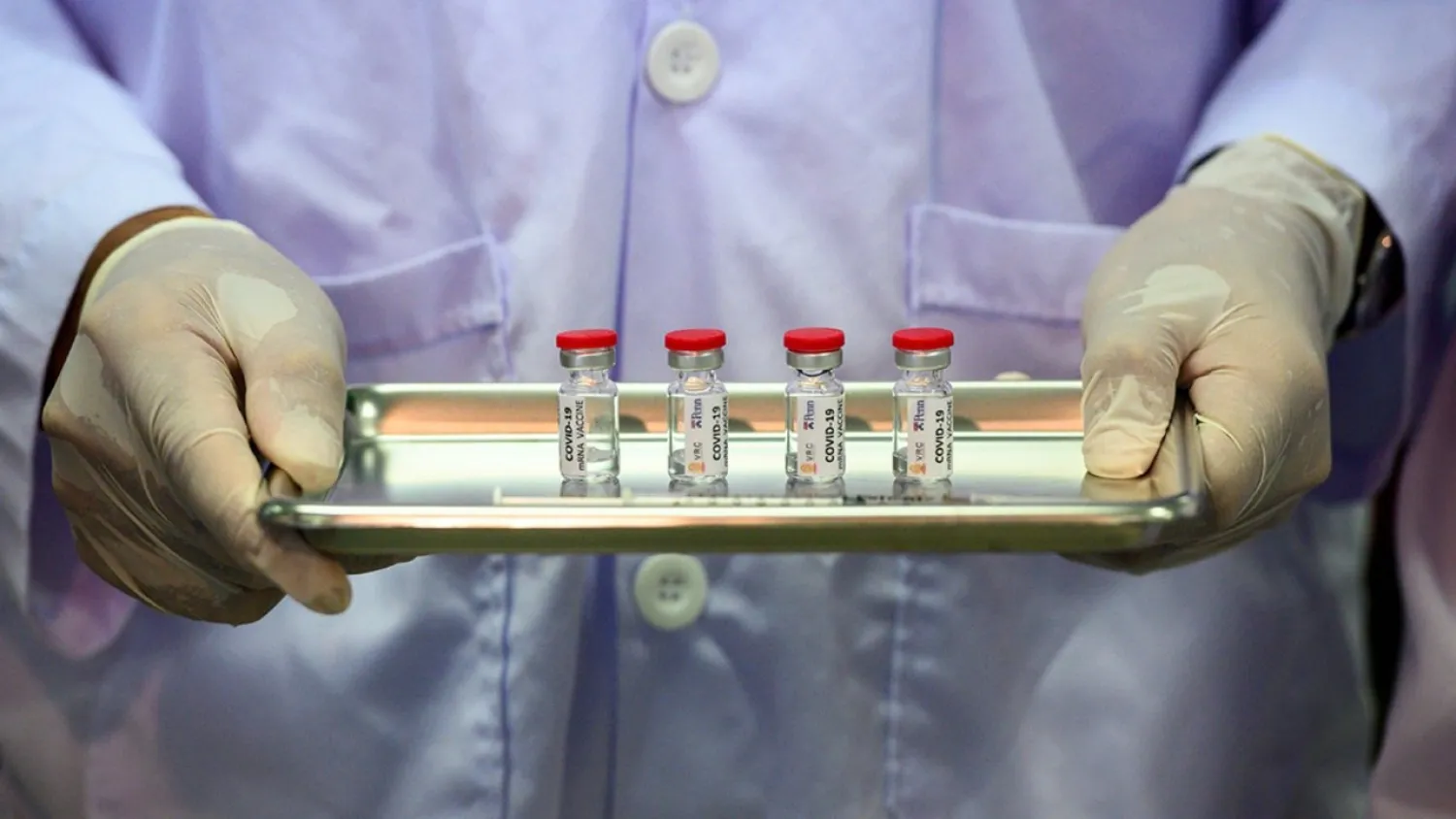

Trial COVID-19 Vaccines Grown in Cowpea Mosaic Virus

Mladen Antonov/AFP/Getty Images
TT

Trial COVID-19 Vaccines Grown in Cowpea Mosaic Virus

Mladen Antonov/AFP/Getty Images

Nanoengineers at the University of California San Diego have developed COVID-19 vaccine candidates that can take the heat. Their key ingredients are viruses and bacteria that affect plants.

The new fridge-free COVID-19 vaccines are still in the early stage of development. In experiments conducted on mice, the vaccine candidates triggered high production of neutralizing antibodies against SARS-CoV-2, the virus that causes COVID-19.

If it proves to be safe and effective in people, the vaccine could be a major game changer for global distribution efforts, including those in rural areas or resource-poor communities.

“What’s exciting about our vaccine technology is that it is thermally stable, so it can easily reach places where it is not achievable to set up ultra-low temperature freezers, or having trucks drive around with these freezers,” said Nicole Steinmetz, a professor of nanoengineering and the director of the Center for Nano-Immuno Engineering at the UC San Diego Jacobs School of Engineering.

The vaccines are detailed in a paper published Sept. 7 in the Journal of the American Chemical Society.

The researchers created two COVID-19 vaccine candidates. One is made from a plant virus, called cowpea mosaic virus. The other is made from a bacterial virus, or bacteriophage, called Q beta.

Both vaccines were made using similar recipes.

The researchers used cowpea plants and E. coli bacteria to grow millions of copies of the plant virus and bacteriophage, respectively, in the form of ball-shaped nanoparticles.

The researchers harvested these nanoparticles and then attached a small piece of the SARS-CoV-2 spike protein to the surface. The finished products look like an infectious virus so the immune system can recognize them, but they are not infectious in animals and humans.

The small piece of the spike protein attached to the surface is what stimulates the body to generate an immune response against the coronavirus.

The researchers note several advantages of using plant viruses and bacteriophages to make their vaccines.

For one, they can be easy and inexpensive to produce at large scales. “Growing plants is relatively easy and involves infrastructure that’s not too sophisticated,” said Steinmetz.

“And fermentation using bacteria is already an established process in the biopharmaceutical industry.”

Another big advantage is that the plant virus and bacteriophage nanoparticles are extremely stable at high temperatures.

As a result, the vaccines can be stored and shipped without needing to be kept cold. They also can be put through fabrication processes that use heat.

The team is using such processes to package their vaccines into polymer implants and microneedle patches.

These processes involve mixing the vaccine candidates with polymers and melting them together in an oven at temperatures close to 100 degrees Celsius. Being able to directly mix the plant virus and bacteriophage nanoparticles with the polymers from the start makes it easy and straightforward to create vaccine implants and patches.

The goal is to give people more options for getting a COVID-19 vaccine and making it more accessible. The implants, which are injected underneath the skin and slowly release vaccine over the course of a month, would only need to be administered once.

And the microneedle patches, which can be worn on the arm without pain or discomfort, would allow people to self-administer the vaccine.

“If clinics can offer a single dose of the transplant, this could protect a larger population and we can have a better chance of stopping transmission,” said Jon Pokorski, a professor of nanoengineering at the UC San Diego Jacobs School of Engineering, whose team developed the technology to make the implants and microneedle patches.

In tests, the team’s COVID-19 vaccine candidates were administered to mice either via implants, microneedle patches, or as a series of two shots. All three methods produced high levels of neutralizing antibodies in the blood against SARS-CoV-2.

It all comes down to the piece of the coronavirus spike protein that is attached to the surface of the nanoparticles. One of these pieces that Steinmetz’s team chose, called an epitope, is almost identical between SARS-CoV-2 and the original SARS virus.

“The fact that neutralization is so profound with an epitope that’s so well conserved among another deadly coronavirus is remarkable,” said co-author Matthew Shin, an instructor in nanoengineering.

“This gives us hope for a potential pan-coronavirus vaccine that could offer protection against future pandemics,” he said.

Another advantage of this particular epitope is that it is not affected by any of the SARS-CoV-2 mutations that have so far been reported. That’s because this epitope comes from a region of the spike protein that does not directly bind to cells.

This is different from the epitopes in the currently administered COVID-19 vaccines, which come from the spike protein’s binding region. This is a region where a lot of the mutations have occurred. And some of these mutations have made the virus more contagious.



Top Trump Iran Negotiator Says Visits US Aircraft Carrier in Middle East

US Special Envoy Steve Witkoff delivers a press conference upon the signing of the declaration on deploying post-ceasefire force in Ukraine, during the so-called "Coalition of the Willing" summit, at the Elysee Palace in Paris, France, January 6, 2026. (Reuters)
TT

Top Trump Iran Negotiator Says Visits US Aircraft Carrier in Middle East

US Special Envoy Steve Witkoff delivers a press conference upon the signing of the declaration on deploying post-ceasefire force in Ukraine, during the so-called "Coalition of the Willing" summit, at the Elysee Palace in Paris, France, January 6, 2026. (Reuters)

US President Donald Trump's lead Iran negotiator Steve Witkoff on Saturday said he visited the USS Abraham Lincoln aircraft carrier currently in the Arabian Sea, with Washington and Tehran due to hold further talks soon.

"Today, Adm. Brad Cooper, Commander of US Naval Forces Central Command, Jared Kushner, and I met with the brave sailors and Marines aboard the USS Abraham Lincoln, her strike group, and Carrier Air Wing 9 who are keeping us safe and upholding President Trump's message of peace through strength," said Witkoff in a social media post.

Iranian Foreign Minister Abbas Araghchi said on Saturday he hoped talks with the United States would resume soon, while reiterating Tehran's red lines and warning against any American attack.


Israel’s Netanyahu Expected to Meet Trump in US on Wednesday and Discuss Iran

Israeli Prime Minister Benjamin Netanyahu delivers a speech during a special session to mark the 77th anniversary of the Knesset's establishment and the 60th anniversary of the dedication of the current building at the Knesset, the Israeli parliament, in Jerusalem, 02 February 2026. (EPA)
TT

Israel’s Netanyahu Expected to Meet Trump in US on Wednesday and Discuss Iran

Israeli Prime Minister Benjamin Netanyahu delivers a speech during a special session to mark the 77th anniversary of the Knesset's establishment and the 60th anniversary of the dedication of the current building at the Knesset, the Israeli parliament, in Jerusalem, 02 February 2026. (EPA)

Israeli Prime Minister Benjamin Netanyahu is expected to meet US President Donald Trump on Wednesday in Washington, where they will discuss negotiations with Iran, Netanyahu's office said on Saturday.

Iranian and US officials held indirect nuclear ‌talks in the ‌Omani capital ‌Muscat ⁠on Friday. ‌Both sides said more talks were expected to be held again soon.

A regional diplomat briefed by Tehran on the talks told Reuters Iran insisted ⁠on its "right to enrich uranium" ‌during the negotiations with ‍the US, ‍and that Tehran's missile capabilities ‍were not raised in the discussions.

Iranian officials have ruled out putting Iran's missiles - one of the largest such arsenals in the region - up ⁠for discussion, and have said Tehran wants recognition of its right to enrich uranium.

"The Prime Minister believes that any negotiations must include limiting ballistic missiles and halting support for the Iranian axis," Netanyahu's office said in a ‌statement.


Italy FM Rules Out Joining Trump’s ‘Board of Peace’

Italy's Minister for Foreign Affairs Antonio Tajani speaks to the press during the EPP Leaders’ meeting, in Zagreb, Croatia, 30 January 2026. (EPA)
TT

Italy FM Rules Out Joining Trump’s ‘Board of Peace’

Italy's Minister for Foreign Affairs Antonio Tajani speaks to the press during the EPP Leaders’ meeting, in Zagreb, Croatia, 30 January 2026. (EPA)

Italy will not take part in US President Donald Trump's "Board of Peace", Italian Foreign Minister Antonio Tajani said Saturday, citing "insurmountable" constitutional issues.

Trump launched his "Board of Peace" at the World Economic Forum in Davos in January and some 19 countries have signed its founding charter.

But Italy's constitution bars the country from joining an organization led by a single foreign leader.

Prime Minister Giorgia Meloni, a Trump ally, last month noted "constitutional problems" with joining, but suggested Trump could perhaps reopen the framework "to meet the needs not only of Italy, but also of other European countries".

Tajani appeared Saturday to rule that out.

"We cannot participate in the Board of Peace because there is a constitutional limit," he told the ANSA news agency.

"This is insurmountable from a legal standpoint," he said, the day after meeting US Secretary of State Marco Rubio and US Vice President JD Vance at the Olympics in Milan.

Although originally meant to oversee Gaza's rebuilding, the board's charter does not limit its role to the Palestinian territory and appears to want to rival the United Nations.