


North and South Korea Conduct Dueling Missile Tests as Arms Race Heats up

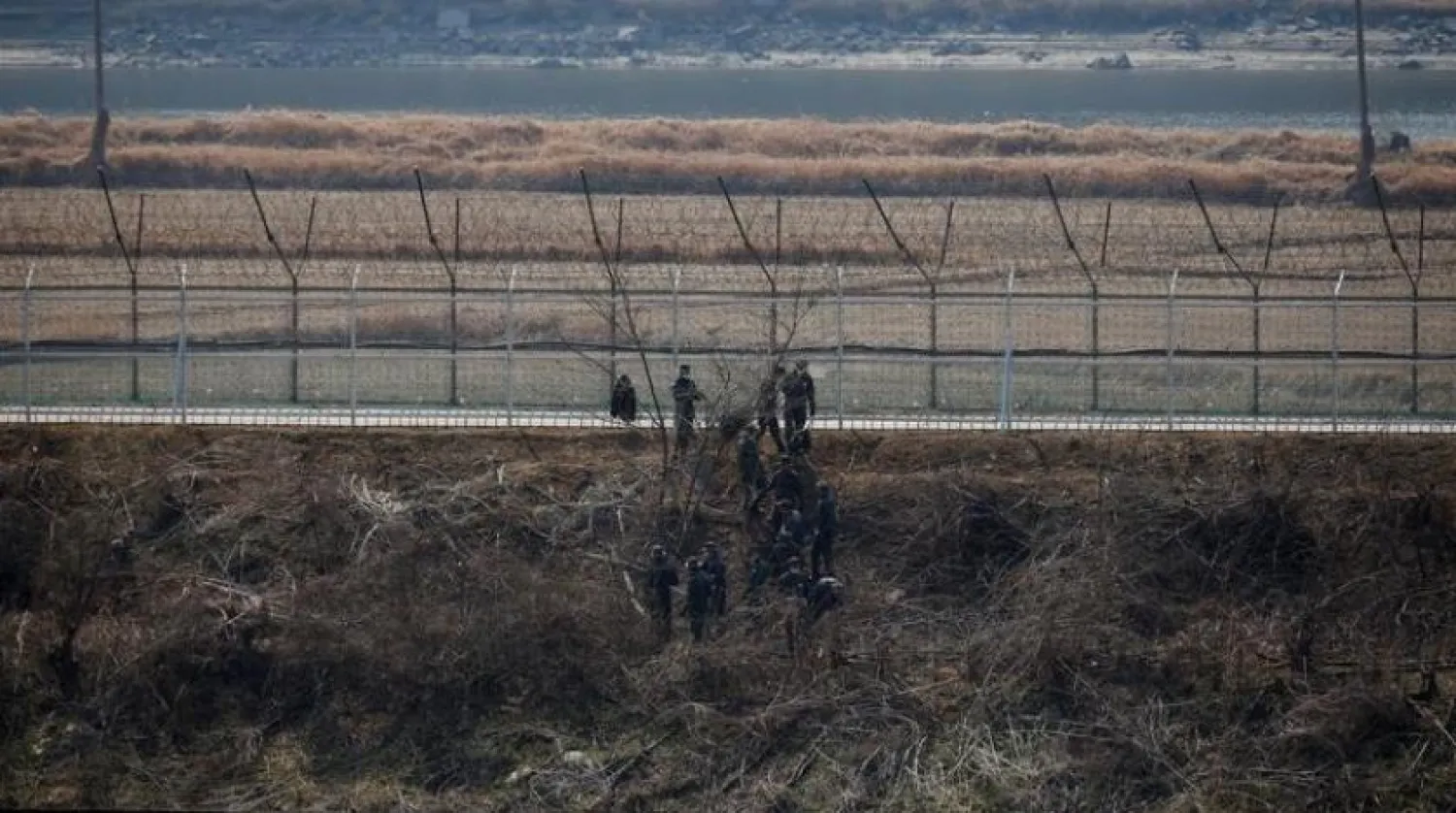
South Korean soldiers work in front of a military fence near the demilitarized zone separating the two Koreas in Paju, South Korea, March 24, 2021. (Reuters)
TT

North and South Korea Conduct Dueling Missile Tests as Arms Race Heats up

South Korean soldiers work in front of a military fence near the demilitarized zone separating the two Koreas in Paju, South Korea, March 24, 2021. (Reuters)

North Korea and South Korea test fired ballistic missiles on Wednesday, the latest volley in an arms race that has seen both countries develop increasingly sophisticated weapons while efforts to get talks going on defusing tension prove fruitless.

South Korea tested a submarine-launched ballistic missile (SLBM), becoming the first country without nuclear weapons to develop such a system.

South Korean President Moon was attending that test firing when word came of the North Korean launches, its first ballistic missile tests since March.

North Korea fired a pair of ballistic missiles that landed in the sea off its east coast, according to officials in South Korea and Japan, just days after it tested a cruise missile that is believed to have nuclear capabilities.

Japan’s defense ministry said late on Wednesday the missiles had landed inside Japan’s exclusive economic zone (EEZ), contradicting earlier government comments that they fell outside its waters.

North Korea has been steadily developing its weapons systems amid a stand-off over talks aimed at dismantling its nuclear and ballistic missile arsenals in return for US sanctions relief. The negotiations, initiated between former US President Donald Trump and North Korean leader Kim Jong Un in 2018, have stalled since 2019.

“North Korea fired two unidentified ballistic missiles from its central inland region towards the east coast, and intelligence authorities of South Korea and the United States are conducting detailed analysis for further information,” South Korea’s Joint Chiefs of Staff (JCS) said in a statement.

The missiles were fired just after 12:30 pm (0330 GMT), flying 800 km (497 miles) to a maximum altitude of 60 km (37 miles), the JCS reported.

‘The strongest Korea’
The United States condemned North Korea’s missile launch, saying it was in violation of multiple UN Security Council resolutions and posed a threat to Pyongyang’s neighbors, a State Department spokesperson said, without mentioning South Korea’s tests.

The US military’s Indo-Pacific Command said North Korea’s missile launches did not pose an immediate threat to US personnel, territory or allies, but highlighted the destabilizing impact of its illicit weapons program.

Japanese Prime Minister Yoshihide Suga called the missile launch “outrageous” and strongly condemned it as a threat to peace and security in the region.

China’s foreign ministry spokesman Zhao Lijian told a daily briefing that China hoped “relevant parties” would “exercise restraint”.

South Korea has been splurging on a range of new military systems, including ballistic missiles, submarines and its first aircraft carrier. It has a stated policy of non-proliferation of nuclear weapons and a nuclear-free Korean peninsula.

The arms race has accelerated under Moon for a number of reasons, including his push for more foreign policy autonomy, wariness of relying on the United States after Trump’s presidency and military developments in both North Korea and China, said Ramon Pacheco Pardo, a Korea expert at King’s College London.

“South Korea would face many political and legal obstacles to develop nuclear weapons, both internal and external,” he said. “So it will develop all other capabilities to deter North Korea and show who the strongest Korea is.”

President Moon cited the nuclear-armed North’s “asymmetric capabilities” as a reason for South Korea to develop better missiles.

“Enhancing our missile capability is exactly what’s needed as deterrence against North Korea’s provocation,” he said, while stressing that the SLBM test had been planned and was not in response to the North’s launches.

‘Foolish attitude’
In a statement carried by state media, Kim Yo Jong, the powerful sister of North Korean leader Kim Jong Un, criticized Moon’s speech, saying his talk of North Korean provocations was inappropriate.

Without mentioning the latest launches by the North, Kim Yo Jong said North Korea’s activities were routine defensive measures, and that inter-Korean ties could break down if Moon continues to “slander” the North.

She complained of an “illogical... foolish attitude” that portrayed South Korean behavior as a legitimate action to support peace and North Korea’s actions as a threat to peace.

Unlike the South, North Korea’s ballistic missile systems have been banned by UN Security Council resolutions.

In November 2017, North Korea tested an intercontinental ballistic missile capable of reaching the entire United States and declared it had become a nuclear power.

North Korea said it successfully tested a new long-range cruise missile last weekend. Analysts say that weapon could be its first cruise missile with a nuclear capability.

The latest launch came as foreign ministers of South Korea and China held talks in Seoul amid concern over North Korea’s tests and the stalled denuclearization negotiations.

Chinese Foreign Minister Wang Yi, when asked about the cruise missile tests, said all parties should work to promote peace and stability on the Korean peninsula.

“Not only North Korea but other countries are carrying out military activity,” he told reporters.

In a meeting with Wang on Wednesday, Moon asked for China’s support to restart dialogue, saying North Korea had not been responding to South Korean and US offers for talks or engagement such as humanitarian aid, Moon’s spokesperson said.



Top Trump Iran Negotiator Says Visits US Aircraft Carrier in Middle East

US Special Envoy Steve Witkoff delivers a press conference upon the signing of the declaration on deploying post-ceasefire force in Ukraine, during the so-called "Coalition of the Willing" summit, at the Elysee Palace in Paris, France, January 6, 2026. (Reuters)
TT

Top Trump Iran Negotiator Says Visits US Aircraft Carrier in Middle East

US Special Envoy Steve Witkoff delivers a press conference upon the signing of the declaration on deploying post-ceasefire force in Ukraine, during the so-called "Coalition of the Willing" summit, at the Elysee Palace in Paris, France, January 6, 2026. (Reuters)

US President Donald Trump's lead Iran negotiator Steve Witkoff on Saturday said he visited the USS Abraham Lincoln aircraft carrier currently in the Arabian Sea, with Washington and Tehran due to hold further talks soon.

"Today, Adm. Brad Cooper, Commander of US Naval Forces Central Command, Jared Kushner, and I met with the brave sailors and Marines aboard the USS Abraham Lincoln, her strike group, and Carrier Air Wing 9 who are keeping us safe and upholding President Trump's message of peace through strength," said Witkoff in a social media post.

Iranian Foreign Minister Abbas Araghchi said on Saturday he hoped talks with the United States would resume soon, while reiterating Tehran's red lines and warning against any American attack.


Israel’s Netanyahu Expected to Meet Trump in US on Wednesday and Discuss Iran

Israeli Prime Minister Benjamin Netanyahu delivers a speech during a special session to mark the 77th anniversary of the Knesset's establishment and the 60th anniversary of the dedication of the current building at the Knesset, the Israeli parliament, in Jerusalem, 02 February 2026. (EPA)
TT

Israel’s Netanyahu Expected to Meet Trump in US on Wednesday and Discuss Iran

Israeli Prime Minister Benjamin Netanyahu delivers a speech during a special session to mark the 77th anniversary of the Knesset's establishment and the 60th anniversary of the dedication of the current building at the Knesset, the Israeli parliament, in Jerusalem, 02 February 2026. (EPA)

Israeli Prime Minister Benjamin Netanyahu is expected to meet US President Donald Trump on Wednesday in Washington, where they will discuss negotiations with Iran, Netanyahu's office said on Saturday.

Iranian and US officials held indirect nuclear ‌talks in the ‌Omani capital ‌Muscat ⁠on Friday. ‌Both sides said more talks were expected to be held again soon.

A regional diplomat briefed by Tehran on the talks told Reuters Iran insisted ⁠on its "right to enrich uranium" ‌during the negotiations with ‍the US, ‍and that Tehran's missile capabilities ‍were not raised in the discussions.

Iranian officials have ruled out putting Iran's missiles - one of the largest such arsenals in the region - up ⁠for discussion, and have said Tehran wants recognition of its right to enrich uranium.

"The Prime Minister believes that any negotiations must include limiting ballistic missiles and halting support for the Iranian axis," Netanyahu's office said in a ‌statement.


Italy FM Rules Out Joining Trump’s ‘Board of Peace’

Italy's Minister for Foreign Affairs Antonio Tajani speaks to the press during the EPP Leaders’ meeting, in Zagreb, Croatia, 30 January 2026. (EPA)
TT

Italy FM Rules Out Joining Trump’s ‘Board of Peace’

Italy's Minister for Foreign Affairs Antonio Tajani speaks to the press during the EPP Leaders’ meeting, in Zagreb, Croatia, 30 January 2026. (EPA)

Italy will not take part in US President Donald Trump's "Board of Peace", Italian Foreign Minister Antonio Tajani said Saturday, citing "insurmountable" constitutional issues.

Trump launched his "Board of Peace" at the World Economic Forum in Davos in January and some 19 countries have signed its founding charter.

But Italy's constitution bars the country from joining an organization led by a single foreign leader.

Prime Minister Giorgia Meloni, a Trump ally, last month noted "constitutional problems" with joining, but suggested Trump could perhaps reopen the framework "to meet the needs not only of Italy, but also of other European countries".

Tajani appeared Saturday to rule that out.

"We cannot participate in the Board of Peace because there is a constitutional limit," he told the ANSA news agency.

"This is insurmountable from a legal standpoint," he said, the day after meeting US Secretary of State Marco Rubio and US Vice President JD Vance at the Olympics in Milan.

Although originally meant to oversee Gaza's rebuilding, the board's charter does not limit its role to the Palestinian territory and appears to want to rival the United Nations.