

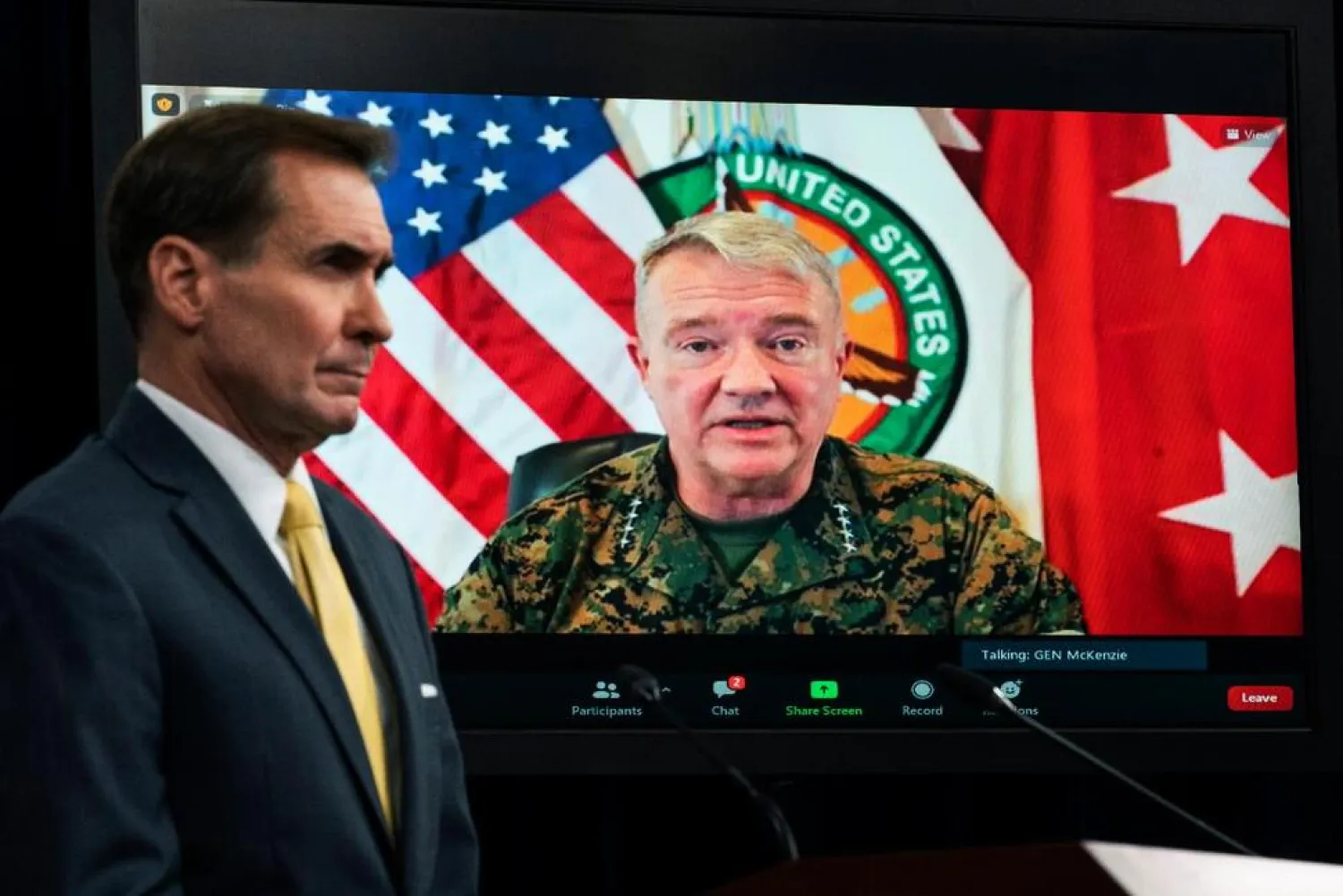

Pentagon Reverses Itself, Calls Deadly Kabul Strike an Error

In this Aug. 30, 2021, file photo Gen. Frank McKenzie, Commander of US Central Command, appears on screen as he speaks from MacDill Air Force Base, in Tampa, Fla. (AP)
TT

Pentagon Reverses Itself, Calls Deadly Kabul Strike an Error

In this Aug. 30, 2021, file photo Gen. Frank McKenzie, Commander of US Central Command, appears on screen as he speaks from MacDill Air Force Base, in Tampa, Fla. (AP)

The Pentagon has retreated from its defense of a drone strike that killed multiple civilians in Afghanistan last month, announcing that a review revealed that only civilians were killed in the attack, not an ISIS extremist as first believed.

“The strike was a tragic mistake,” Marine Gen. Frank McKenzie, head of US Central Command, told a Pentagon news conference Friday.

McKenzie apologized for the error and said the United States is considering making reparation payments to the family of the victims. He said the decision to strike a white Toyota Corolla sedan, after having tracked it for about eight hours, was made in an “earnest belief” — based on a standard of “reasonable certainty” — that it posed an imminent threat to American forces at Kabul airport. The car was believed to have been carrying explosives in its trunk, he said.

For days after the Aug. 29 strike, Pentagon officials asserted that it had been conducted correctly, despite 10 civilians being killed, including seven children. News organizations later raised doubts about that version of events, reporting that the driver of the targeted vehicle was a longtime employee at an American humanitarian organization and citing an absence of evidence to support the Pentagon’s assertion that the vehicle contained explosives.

The airstrike was the last of a US war that ended as it had begun in 2001 — with the Taliban in power in Kabul. The speed with which the Taliban overran the country took the US government by surprise and forced it to send several thousand troops to the Kabul airport for a hurried evacuation of Americans, Afghans and others. The evacuation, which began Aug. 14, unfolded under a near-constant threat of attack by the ISIS group’s Afghanistan affiliate.

McKenzie, who oversaw US military operations in Afghanistan, including a final evacuation of US forces and more than 120,000 civilians from Kabul airport, expressed his condolences to the family and friends of those killed.

“I am now convinced that as many as 10 civilians, including up to seven children, were tragically killed in that strike,” McKenzie said. “Moreover, we now assess that it is unlikely that the vehicle and those who died were associated with ISIS-K or were a direct threat to US forces,” he added, referring to the ISIS group’s Afghanistan affiliate.

Prior to the strike, US intelligence had indicated a likelihood that a white Toyota Corolla would be used in an attack against US forces, McKenzie said. On the morning of Aug. 29, such a vehicle was detected at a compound in Kabul that US intelligence in the preceding 48 hours had determined was used by ISIS to plan and facilitate attacks. The vehicle was tracked by US drone aircraft from that compound to numerous other locations in the city before the decision was made to attack it at a point just a couple of miles from Kabul airport, McKenzie said.

“Clearly our intelligence was wrong on this particular white Toyota Corolla,” he said.

Defense Secretary Lloyd Austin, in a written statement, apologized for what he called “a horrible mistake.”

“We now know that there was no connection” between the driver of the vehicle and the ISIS group, and that the driver’s activities that day were “completely harmless and not at all related to the imminent threat we believed we faced,” Austin said.

Gen. Mark Milley, chairman of the Joint Chiefs of Staff, told reporters two days after the attack that it appeared to have been a “righteous” strike and that at least one of the people killed was a “facilitator” for the ISIS group’s Afghanistan affiliate, which had killed 169 Afghan civilians and 13 American service members in a suicide bombing on Aug. 26 at the Kabul airport.

After McKenzie’s remarks on Friday, Milley expressed regret.

“This is a horrible tragedy of war and it’s heart wrenching,” Milley told reporters traveling with him in Europe. “We are committed to being fully transparent about this incident.”

“In a dynamic high-threat environment, the commanders on the ground had appropriate authority and had reasonable certainty that the target was valid, but after deeper post-strike analysis our conclusion is that innocent civilians were killed,” Milley added.

Accounts from the family of the victims, documents from colleagues seen by The Associated Press, and the scene at the family home — where Zemerai Ahmadi’s car was struck by a Hellfire missile just as he pulled into the driveway — all painted a picture of a family that had worked for Americans and were trying to gain visas to the United States, fearing for their lives under the Taliban.

The family said that when the 37-year-old Zemerai, alone in his car, pulled up to the house, he honked his horn. His 11-year-old son ran out and Zemerai let the boy get in and drive the car into the driveway. The other kids ran out to watch, and the Hellfire missile incinerated the car, killing seven children and an adult son and nephew of Zemerai.

Amnesty International, the humanitarian aid group, called the US military’s admission of a mistake a good first step.

“The US must now commit to a full, transparent, and impartial investigation into this incident,” said Brian Castner, a senior crisis adviser with Amnesty International. “Anyone suspected of criminal responsibility should be prosecuted in a fair trial. Survivors and families of the victims should be kept informed of the progress of the investigation and be given full reparation.”

Rep. Adam Schiff, the California Democrat who is chairman of the House Intelligence Committee, said a fuller explanation must be provided.

“We need to know what went wrong in the hours and minutes leading up to the strike to prevent similar tragedies in the future,” he said. “I am also concerned about the accuracy and completeness of public statements made in the immediate aftermath of the strike, and whether those accounted for all of the information possessed by the government at the time.”



UK PM's Communications Director Quits

British Prime Minister Keir Starmer delivers a speech at Horntye Park Sports Complex in St Leonards, Britain, February 05, 2026. Peter Nicholls/Pool via REUTERS
TT

UK PM's Communications Director Quits

British Prime Minister Keir Starmer delivers a speech at Horntye Park Sports Complex in St Leonards, Britain, February 05, 2026. Peter Nicholls/Pool via REUTERS

British Prime Minister Keir Starmer's director of communications Tim Allan resigned on Monday, a day after Starmer's top aide Morgan McSweeney quit over his role in backing Peter Mandelson over his known links to Jeffrey Epstein.

The loss of two senior aides ⁠in quick succession comes as Starmer tries to draw a line under the crisis in his government resulting from his appointment of Mandelson as ambassador to the ⁠US.

"I have decided to stand down to allow a new No10 team to be built. I wish the PM and his team every success," Allan said in a statement on Monday.

Allan served as an adviser to Tony Blair from ⁠1992 to 1998 and went on to found and lead one of the country’s foremost public affairs consultancies in 2001. In September 2025, he was appointed executive director of communications at Downing Street.


Road Accident in Nigeria Kills at Least 30 People

FILE PHOTO: A police vehicle of Operation Fushin Kada (Anger of Crocodile) is parked on Yakowa Road, as schools across northern Nigeria reopen nearly two months after closing due to security concerns, following the mass abductions of school children, in Kaduna, Nigeria, January 12, 2026. REUTERS/Nuhu Gwamna/File Photo
TT

Road Accident in Nigeria Kills at Least 30 People

FILE PHOTO: A police vehicle of Operation Fushin Kada (Anger of Crocodile) is parked on Yakowa Road, as schools across northern Nigeria reopen nearly two months after closing due to security concerns, following the mass abductions of school children, in Kaduna, Nigeria, January 12, 2026. REUTERS/Nuhu Gwamna/File Photo

At least 30 people have been killed and an unspecified number of people injured in a road accident in northwest Nigeria, authorities said.

The accident occurred Sunday in Kwanar Barde in the Gezawa area of Kano state and was caused by “reckless driving” by the driver of a truck-trailer, Gov. Abba Yusuf said in a statement. He did not specify what other vehicles were involved.

Yusuf described the accident as “heartbreaking and a great loss” to the affected families and the state. He did not provide more details of the accident, said The Associated Press.

Africa’s most populous country recorded 5,421 deaths in 9,570 road accidents in 2024, according to data by the country’s Federal Road Safety Corps.

Experts say a combination of factors including a network of bad roads, lax enforcement of traffic laws and indiscipline by some drivers produce the grim statistics.

In December, boxing heavyweight champion Anthony Joshua was in a deadly car crash that injured him and killed Sina Ghami and Latif “Latz” Ayodele, two of his friends, in southwest Nigeria.

Adeniyi Mobolaji Kayode, Joshua’s driver, was charged with dangerous and reckless driving and his trial is scheduled to begin later this month.

Africa has the highest road fatality rate in the world despite having only about 3% of the world’s vehicles, mainly due to weak enforcement of road laws, poor infrastructure and widespread use of unsafe transport. 


US Vice President Vance Heads to Armenia, Azerbaijan to Push Peace, Trade

US Vice President JD Vance speaks during the Critical Minerals Ministerial at the State Department in Washington, DC, US, February 4, 2026. (Reuters)
TT

US Vice President Vance Heads to Armenia, Azerbaijan to Push Peace, Trade

US Vice President JD Vance speaks during the Critical Minerals Ministerial at the State Department in Washington, DC, US, February 4, 2026. (Reuters)

US Vice President JD Vance will visit Armenia and Azerbaijan this week to push a Washington-brokered peace agreement that could transform energy and trade routes in the strategic South Caucasus region.

His two-day trip to Armenia, which begins later on Monday, comes just six months after the Armenian and Azerbaijani leaders signed an agreement at the White House seen as the first step towards peace after nearly 40 years of war.

Vance, the first US vice president to visit Armenia, is seeking to advance the Trump Route for International Peace and Prosperity (TRIPP), a proposed 43-kilometre (27-mile) corridor that would run across southern Armenia and give Azerbaijan a direct route to its exclave ‌of Nakhchivan ‌and in turn to Türkiye, Baku's close ally.

"Vance's visit should ‌serve ⁠to reaffirm the ‌US's commitment to seeing the Trump Route through," said Joshua Kucera, a senior South Caucasus analyst at Crisis Group.

"In a region like the Caucasus, even a small amount of attention from the US can make a significant impact."

The Armenian government said on Monday that Vance would hold talks with Prime Minister Nikol Pashinyan and that both men would then make statements, without elaborating.

Vance will then visit Azerbaijan on Wednesday and Thursday, the White House has said.

Under the agreement signed last year, ⁠a private US firm, the TRIPP Development Company, has been granted exclusive rights to develop the proposed corridor, with Yerevan ‌retaining full sovereignty over its borders, customs, taxation and security.

The ‍route would better connect Asia to Europe ‍while - crucially for Washington - bypassing Russia and Iran at a time when Western countries are ‍keen on diversifying energy and trade routes away from Russia due to its war in Ukraine.

Russia has traditionally viewed the South Caucasus as part of its sphere of influence but has seen its clout there diminish as it is distracted by the war in Ukraine.

Securing US access to supplies of critical minerals is also likely to be a key focus of Vance's visit.

TRIPP could prove a key transit corridor for the vast mineral wealth of ⁠Central Asia - including uranium, copper, gold and rare earths - to Western markets.

CLOSED BORDERS, BITTER RIVALS

In Soviet times the South Caucasus was criss-crossed by railways and oil pipelines until a series of wars beginning in the 1980s disrupted energy routes and shuttered the border between Armenia and Türkiye, Azerbaijan's key regional ally.

Armenia and Azerbaijan were locked in bitter conflict for nearly four decades, primarily over the mountainous region of Nagorno-Karabakh, an internationally recognized part of Azerbaijan that broke away from Baku's control as the Soviet Union fell apart in 1991.

Azerbaijan and Armenia fought two wars over Karabakh before Baku finally took it back in 2023. Karabakh's entire ethnic Armenian population of around 100,000 people fled to Armenia. The two neighbors have made progress in recent months on normalizing relations, including restarting ‌some energy shipments.

But major hurdles remain to full and lasting peace, including a demand by Azerbaijan that Armenia change its constitution to remove what Baku says contains implicit claims on Azerbaijani territory.