Amnesty Demands Two Billion Covid Jabs for Poorer World

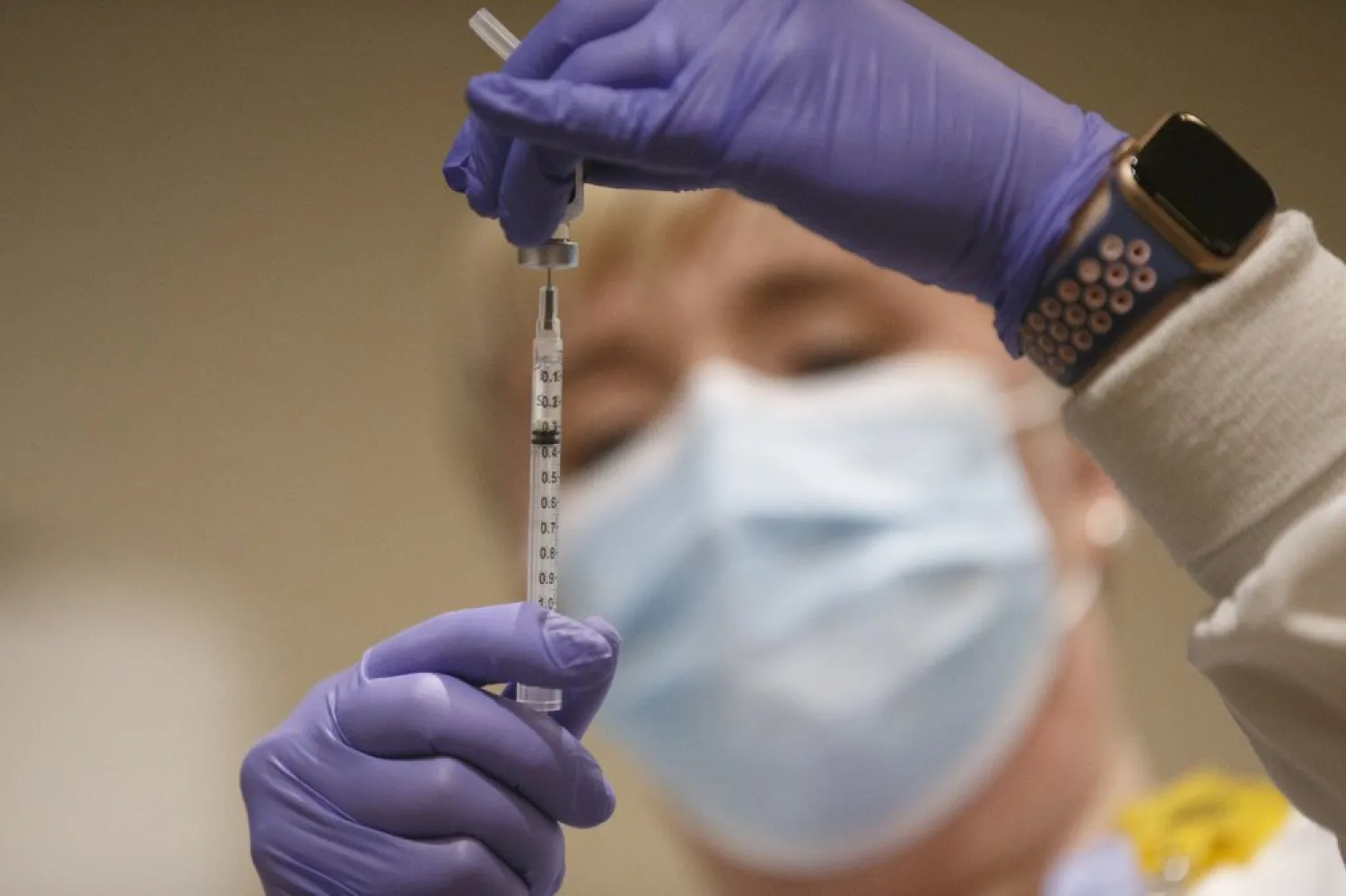
Tami Jeffries, R.N., prepares the first locally-available dose of the Pfizer-BioNTech COVID-19 vaccine at Mary Washington Hospital in Fredericksburg, Va. on Tuesday, Dec. 15, 2020. (Mike Morones/The Free Lance-Star via AP)
TT

Amnesty Demands Two Billion Covid Jabs for Poorer World

Tami Jeffries, R.N., prepares the first locally-available dose of the Pfizer-BioNTech COVID-19 vaccine at Mary Washington Hospital in Fredericksburg, Va. on Tuesday, Dec. 15, 2020. (Mike Morones/The Free Lance-Star via AP)

Covid vaccine manufacturers are putting profit before lives, Amnesty International said on Wednesday, as it demanded two billion doses for poorer nations by the end of the year.

The human rights group said in a new report that US President Joe Biden was expected to outline a pledge at the UN General Assembly to fully vaccinate 70 percent of the world's population by next September, reported AFP.

"We need leaders like President Biden to put billions of doses on the table and deliver the goods, otherwise this is just another empty gesture and lives will continue to be lost," Amnesty chief Agnes Callamard said.

The group said AstraZeneca, BioNTech, Johnson & Johnson, Moderna, Novavax and Pfizer had all refused to share doses or technology to enable more of the world to get Covid jabs.

Most people in the rich world have been inoculated, but parts of Latin America, Africa and Asia have plunged into renewed crises with "tens of thousands of preventable deaths every week", Amnesty said.

Out of 5.76 billion doses administered worldwide, only 0.3 percent have gone to low-income countries with over 79 percent heading to upper-middle and high-income countries, it said.

In letters sent to Amnesty, all the companies pledged their support for human rights, but the report said their actions violated that commitment.

AstraZeneca and Johnson & Johnson were selling their doses at cost price, it noted.

But all of the six companies had fought a bid by India and South Africa to waive vaccine-related intellectual property rights at the World Trade Organization, despite receiving hefty government support themselves.

Amnesty launched a new campaign which it said was backed by the World Health Organization and UN High Commissioner for Human Rights "to hold states and big pharma to account".

With 100 days to go till the end of the year, it said the WHO's target of vaccinating 40 percent of the population of low and lower-middle income countries was at risk.

It demanded richer countries redistribute "the hundreds of millions of excess doses currently sitting idle" and for vaccine developers to ensure that at least half of doses produced go to poorer countries.

"We're calling on states and pharmaceutical companies to drastically change course and to do everything needed to deliver two billion vaccines to low and lower-middle income countries starting now," Callamard said.

"Profits should never come before lives," she said. "No one should spend another year suffering and living in fear."


Trump Says No 'Definitive' Agreement with Netanyahu, US Talks with Iran to Continue

Image published by the Israeli Prime Minister's website from his meeting with the US President at the White House yesterday
TT

Trump Says No 'Definitive' Agreement with Netanyahu, US Talks with Iran to Continue

Image published by the Israeli Prime Minister's website from his meeting with the US President at the White House yesterday

President Donald Trump said after talks with Israeli Prime Minister Benjamin Netanyahu on Wednesday they reached no "definitive" agreement on how to move forward with Iran but he insisted negotiations with Tehran would continue to see if a deal can be achieved.

Netanyahu, who had been expected to press Trump to widen diplomacy with Iran beyond its nuclear program to include limits on its missile arsenal, stressed that Israel's security interests must be taken into account but offered no sign that the president made the commitments he sought, said Reuters.

In their seventh meeting since Trump returned to office last year, Netanyahu - whose visit was more muted than usual and closed to the press - was looking to influence the next round of US discussions with Iran following nuclear negotiations held in Oman last Friday.

The two leaders spoke behind closed doors for more than two and a half hours in what Trump described as a "very good meeting" but said no major decisions were made and stopped short of publicly accepting Netanyahu's entreaties.

Trump has threatened strikes on Iran if no agreement is reached, while Tehran has vowed to retaliate, stoking fears of a wider war as the US amasses forces in the Middle East. He has repeatedly voiced support for a secure Israel, a longstanding US ally and arch-foe of Iran.

In media interviews on Tuesday, Trump reiterated his blunt warning to Iran, while saying he believes Tehran wants a deal.

"There was ‌nothing definitive reached other ‌than I insisted that negotiations with Iran continue to see whether or not a Deal can be consummated," Trump said in ‌a ⁠social media post after ⁠the meeting with Netanyahu. "If it can, I let the Prime Minister know that will be a preference."

"If it cannot, we will just have to see what the outcome will be," Trump added, noting that the last time Iran decided against an agreement the US struck its nuclear sites last June.

TRUMP SAYS NO TO IRANIAN NUCLEAR WEAPONS, MISSILES

Trump told Fox Business in an interview broadcast on Tuesday that a good deal with Iran would mean "no nuclear weapons, no missiles," without elaborating. He also told Axios he was considering sending a second aircraft carrier strike group as part of a major US buildup near Iran.

Israel fears that the US might pursue a narrow nuclear deal that does not include restrictions on Iran's ballistic missile program or an end to Iranian support for armed proxies such as Hamas and Hezbollah, according to people familiar with the matter. Israeli officials have urged the US not to trust Iran's promises.

Iran has rejected such demands and says ⁠the Oman talks focused only on nuclear issues.

"The Prime Minister emphasized the security needs of the State of Israel in the context ‌of the negotiations, and the two agreed to continue their close coordination and tight contact," Netanyahu's office said in ‌a statement after Wednesday's talks.

The two leaders had also been expected to talk about potential military action if diplomacy with Iran fails, one source said.

Iran has said it is prepared to discuss ‌curbs on its nuclear program in exchange for lifting sanctions but has ruled out linking the issue to missiles.

"The Islamic Republic's missile capabilities are non-negotiable," Ali Shamkhani, an adviser ‌to Iran's supreme leader, said on Wednesday. Netanyahu's arrival at the White House was lower-key than usual. The two leaders were shown shaking hands in a photo released by the Israeli Embassy. But unlike previous Netanyahu visits with Trump, a press pool was not allowed into the Oval Office. It was not immediately known why he received such low-profile treatment.

GAZA ON THE AGENDA

Also on the agenda was Gaza, with Trump looking to push ahead with a ceasefire agreement he helped to broker. Progress on his 20-point plan to end the war and rebuild the shattered Palestinian enclave has stalled, with major gaps over ‌steps such as Hamas disarming as Israeli troops withdraw in phases.

"We discussed the tremendous progress being made in Gaza, and the Region in general," Trump said after the meeting.

Netanyahu's visit, originally scheduled for February 18, was brought forward amid renewed US ⁠engagement with Iran. Both sides at last week's ⁠Oman meeting said the negotiations were positive and further talks were expected soon.

Trump has been vague about broadening the negotiations. He was quoted as telling Axios on Tuesday that it was a "no-brainer" for any deal to cover Iran's nuclear program, but that he also thought it possible to address its missile stockpiles.

Iran says its nuclear activities are for peaceful purposes, while the US and Israel have accused it of past efforts to develop nuclear weapons.

During a 12-day war last June, Israel heavily damaged Iran's air defenses and missile arsenal. Two Israeli officials say there are signs Iran is working to restore those capabilities.

Trump threatened last month to intervene militarily during a bloody crackdown on anti-government protests in Iran, but ultimately held off.

ISRAEL WARY OF A WEAKENED IRAN REBUILDING

Tehran's regional influence has been weakened by Israel’s June attack, losses suffered by its proxies in Gaza, Lebanon, Yemen and Iraq, and the ousting of its ally, former Syrian President Bashar al-Assad.

But Israel is wary of its adversaries rebuilding after the multifront war triggered by Hamas' October 2023 assault on southern Israel.

While Trump and Netanyahu have mostly been in sync and the US remains Israel's main arms supplier, they appear to be at odds on another key issue.

Part of Trump's Gaza plan holds out the prospect for eventual Palestinian statehood - which Netanyahu and his coalition, the most far-right in Israel's history, have long resisted.

Netanyahu's security cabinet on Sunday authorized steps that would make it easier for Israeli settlers in the occupied West Bank to buy land while granting Israel broader powers in what the Palestinians see as the heartland of a future state.

The decision drew international condemnation, and Trump on Tuesday reiterated his opposition to West Bank annexation.



Turkish, Greek Leaders Voice Desire to Resolve Issues After Talks

In this photo released by the Turkish Presidency, Türkiye’s President Recep Tayyip Erdogan, right, and Greece's Prime Minister Kyriakos Mitsotakis, shake hands during their meeting in Ankara, Türkiye, Wednesday, Feb. 11, 2026. (Turkish Presidency via AP)
TT

Turkish, Greek Leaders Voice Desire to Resolve Issues After Talks

In this photo released by the Turkish Presidency, Türkiye’s President Recep Tayyip Erdogan, right, and Greece's Prime Minister Kyriakos Mitsotakis, shake hands during their meeting in Ankara, Türkiye, Wednesday, Feb. 11, 2026. (Turkish Presidency via AP)

The leaders of Türkiye and Greece voiced their desire to resolve longstanding maritime disputes hobbling ties during discussions in Ankara on Wednesday, as the NATO allies and historic rivals try to build on warming relations.

The neighbors have been at odds over a range of issues for decades, primarily maritime boundaries and rights in the Aegean, an area widely believed to hold energy resources and with key implications for airspace and military activity.

Following years of heightened tensions, a 2023 declaration on friendly relations prompted a thaw in rhetoric, though their maritime issues have remained unresolved and the two sides still disagree over ‌regional matters.

Speaking at ‌a press conference in Ankara with Greek Prime Minister Kyriakos Mitsotakis, ‌Turkish ⁠President Recep Tayyip Erdogan said ⁠they had discussed their issues in the Aegean and eastern Mediterranean "in an open and sincere way" during the talks.

"While the issues may be thorny, they are not unsolvable on the basis of international law. I saw that we were in agreement with my friend Kyriakos," Erdogan said.

He added that the two countries would continue working to achieve their goal of reaching $10 billion in bilateral trade.

Mitsotakis said he hoped circumstances would allow the sides to solve a dispute on ⁠the demarcation of maritime and exclusive economic zones in the Aegean ‌and eastern Mediterranean.

'IF NOT NOW, WHEN?'

"It is time to ‌remove any substantial and formal threats to our relations, if not now, when?" Mitsotakis said.

"Destiny has ‌appointed us to live in the same neighborhood. We cannot change geography, but we can ‌make it an ally, choosing convergence, dialogue and trust in international law... to build a future of peace, progress and prosperity for our people."

Despite the positive tone, Greece's foreign minister earlier said Athens planned to extend its territorial waters further, including potentially in the Aegean.

Shortly after, Ankara said it had issued ‌a maritime notice urging Greece to coordinate research activities in areas of the Aegean that Türkiye considers part of its continental shelf.

In ⁠1995, Türkiye’s parliament ⁠declared a casus belli — a cause for war — should Greece unilaterally extend its territorial waters beyond six nautical miles in the Aegean, a stance Athens says violates international maritime law. Greece says it wants only to discuss demarcation of maritime zones.

Mitsotakis also said the flows of migrants in the Aegean Sea had decreased by almost 60% last year due to cooperation between the two countries, adding this should be strengthened.

Fifteen migrants died in a shipwreck off the Greek island of Chios last week after their boat collided with a Greek coastguard vessel and sank in the Aegean Sea off the Turkish coast.

Türkiye is a transit country for migrants seeking to reach the European Union via Greece. Ankara says the EU has not fully delivered on commitments under a 2016 migration deal and Athens wants Türkiye to do more to curb irregular crossings.


US Energy Secretary in Venezuela for Oil Talks

Handout picture released by the US Embassy in Venezuela showing US Secretary of Energy Chris Wright (2-R) walking next to the new head of the United States diplomatic mission for Venezuela, Laura Dogu (2-L), upon his arrival at Maiquetia International Airport in Maiquetia, La Guaira state, Venezuela, on February 11, 2026. (Handout / US Embassy in Venezuela / AFP)
TT

US Energy Secretary in Venezuela for Oil Talks

Handout picture released by the US Embassy in Venezuela showing US Secretary of Energy Chris Wright (2-R) walking next to the new head of the United States diplomatic mission for Venezuela, Laura Dogu (2-L), upon his arrival at Maiquetia International Airport in Maiquetia, La Guaira state, Venezuela, on February 11, 2026. (Handout / US Embassy in Venezuela / AFP)

US Energy Secretary Chris Wright arrived in Venezuela on Wednesday for talks with acting president Delcy Rodriguez and oil industry executives on harnessing the country's vast crude reserves.

Wright is the highest-ranking official in the administration of US President Donald Trump to travel to Venezuela since US special forces seized and overthrew longtime socialist leader Nicolas Maduro on January 3.

Trump has backed Maduro's former deputy Rodriguez to succeed the ousted leader, on condition that she abide by US demands, including granting the United States access to Venezuelan oil and ease state repression.

Welcoming Wright to Venezuela on X, the US embassy in the country said: "Your visit is key to advancing @POTUS's (Trump's) vision of a prosperous Venezuela."

It added that "the US private sector will be essential to boost the oil sector, modernize the electric grid, and unlock Venezuela's enormous potential."

A photo posted by the embassy showed Wright on the tarmac at Maiquetia International Airport, which serves the capital Caracas, together with the new US charge d'affaires in Venezuela, Laura Dogu.

Venezuela sits on about a fifth of the world's oil reserves and was once a major crude supplier to the United States.

But it produced only around one percent of the world's total crude output in 2024, according to OPEC, due to years of under-investment, mismanagement and US sanctions.

Washington eased sanctions on Venezuelan oil last month after Rodriguez's administration passed a law throwing open the sector to private investment.

Trump wants US oil majors to rapidly rebuild the sector and boost output by millions of barrels a day.