

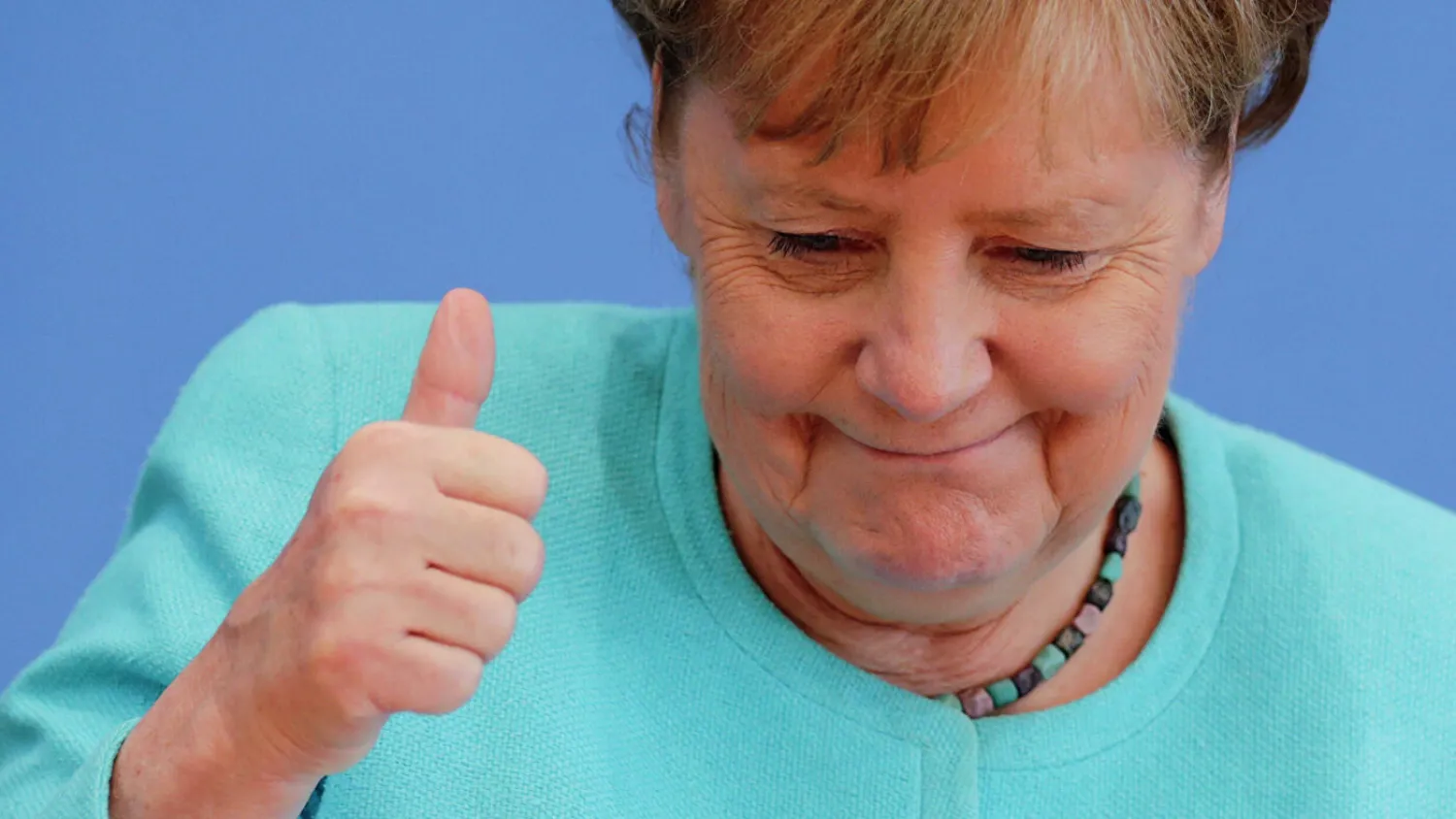

'Eternal' Chancellor: Germany's Merkel Prepares to Leave the Stage

Angela Merkel will become the first German chancellor to step down entirely by choice. HANNIBAL HANSCHKE POOL/AFP/File
TT

'Eternal' Chancellor: Germany's Merkel Prepares to Leave the Stage

Angela Merkel will become the first German chancellor to step down entirely by choice. HANNIBAL HANSCHKE POOL/AFP/File

She was called "the leader of the free world" as authoritarian populists were on the march in Europe and the United States, but Angela Merkel is wrapping up a historic 16 years in power with an uncertain legacy at home and abroad.

In office so long she was dubbed Germany's "eternal chancellor", Merkel, 67, leaves with her popularity so resilient she would likely have won a record fifth term had she sought it, reported Agence France-Presse.

Instead, Merkel will pass the baton as the first German chancellor to step down entirely by choice, with a whole generation of voters never knowing another person at the top.

Her supporters say she provided steady, pragmatic leadership through countless global crises as a moderate and unifying figure.

Yet critics argue a muddle-through style of leadership, pegged to the broadest possible consensus, lacked the bold vision to prepare Europe and its top economy for the coming decades.

What is certain is that she leaves behind a fractured political landscape. It is also because of the long shadow she casts that her party's candidate, Armin Laschet, has struggled to sharpen his own profile.

His Social Democratic opponent, Finance Minister Olaf Scholz, has actively -- and perhaps successfully -- sold himself as the real continuity candidate.

Assuming she stays on to hand over power, Merkel will tie or exceed Helmut Kohl's longevity record for a post-war leader, depending on how long the upcoming coalition negotiations drag on.

- 'Do the right thing' -
The unflappable Merkel has served for many in recent years as a welcome counter-balance to the big, brash men of global politics, from Donald Trump to Vladimir Putin.

A Pew Research Center poll this week showed large majorities in most democracies around the globe having "confidence in Merkel to do the right thing in world affairs".

However, the last days of her tenure have also been marred by what Merkel called the "bitter, dramatic and terrible" return to power of the Taliban in Afghanistan -- a debacle in which she shares the blame as Germany completed its evacuation.

A trained quantum chemist raised behind the Iron Curtain, Merkel has long been in sync with her change-averse electorate as a guarantor of stability.

Her major policy shifts reflected the wishes of large German majorities -- among them phasing out nuclear power after the 2011 Fukushima disaster -- and attracted a broad new coalition of women and urban voters to the once arch-conservative CDU.

- 'Austerity queen' -
Before the coronavirus pandemic, her boldest move -- keeping open German borders in 2015 to more than one million asylum seekers -- seemed set to determine her legacy.

But while many Germans rallied to Merkel's "We can do it" cry, the move also emboldened an anti-migrant party, Alternative for Germany (AfD), ushering a far-right bloc into parliament for the first time since World War II.

At the same time, hardline leaders such as Hungary's Viktor Orban accused her of "moral imperialism" with her welcoming stance.

Six years on, she lamented this month, the European Union appears no closer to a unified policy on migration.

The woman once known as the "climate chancellor" for pushing renewables also faces a mass movement of young activists arguing she has failed to face up to the climate emergency, with Germany not even meeting its own emissions-reduction commitments.

Merkel became Europe's go-to leader during the eurozone crisis when Berlin championed swingeing spending cuts in return for international bailout loans for debt-mired countries.

Angry protesters dubbed her Europe's "austerity queen" and caricatured her in Nazi garb while defenders credit her with holding the currency union together.

More recently, despite admitted missteps in the coronavirus pandemic including a sluggish vaccine roll-out, Germany's death toll has remained lower than those of many European partners relative to population.

- Kohl's 'girl' to 'Mummy' -
Merkel, the EU's and G7's most senior leader, started as a contemporary of George W. Bush, Tony Blair and Jacques Chirac when she became Germany's youngest and first female chancellor in 2005.

She was born Angela Dorothea Kasner on July 17, 1954 in the port city of Hamburg, the daughter of a Lutheran clergyman and a school teacher.

Her father moved the family to a small-town parish in the communist East at a time when tens of thousands were headed the other way.

She excelled in mathematics and Russian, which has helped her maintain the dialogue with the other veteran on the world stage, Russia's Putin, who was a KGB officer in Dresden when the Berlin Wall fell in 1989.

Merkel kept the name of her first husband, whom she married in 1977 and divorced five years later.

After the fall of the wall, Merkel, who was working in a chemistry lab, joined a pro-democracy group that would merge with Kohl's Christian Democrats.

The Protestant from the East whom Kohl nicknamed his "girl" would later be elected leader of a party until then dominated by western Catholic patriarchs.

As she rose to power, party rivals sneeringly called her "Mutti" (Mummy) behind her back but she deftly -- some said ruthlessly -- eliminated potential challengers.

Although her name has come up on wish lists for key EU or United Nations posts, Merkel has said she will leave politics altogether.

Asked on her final trip to Washington in June what she looked forward to most, she replied "not having to constantly make decisions".



Nigeria's President to Make a Sate Visit to the UK in March

Nigeria’s President Bola Tinubu gives a joint statement with Brazil’s President Luiz Inacio Lula da Silva, at the Planalto presidential palace, in Brasilia, Brazil, Aug. 25, 2025. (AP Photo/Eraldo Peres, File)
TT

Nigeria's President to Make a Sate Visit to the UK in March

Nigeria’s President Bola Tinubu gives a joint statement with Brazil’s President Luiz Inacio Lula da Silva, at the Planalto presidential palace, in Brasilia, Brazil, Aug. 25, 2025. (AP Photo/Eraldo Peres, File)

Nigeria’s president is set to make a state visit to the UK in March, the first such trip by a Nigerian leader in almost four decades, Britain’s Buckingham Palace said Sunday.

Officials said President Bola Tinubu and first lady Oluremi Tinubu will travel to the UK on March 18 and 19, The AP news reported.

King Charles III and Queen Camilla will host them at Windsor Castle. Full details of the visit are expected at a later date.

Charles visited Nigeria, a Commonwealth country, four times from 1990 to 2018 before he became king. He previously received Tinubu at Buckingham Palace in September 2024.m

Previous state visits by a Nigerian leader took place in 1973, 1981 and 1989.

A state visit usually starts with an official reception hosted by the king and includes a carriage procession and a state banquet.

Last year Charles hosted state visits for world leaders including US President Donald Trump, French President Emmanuel Macron and German President Frank-Walter Steinmeier.


Iran Strikes Hard Line on US Talks, Saying Tehran's Power Comes From Saying 'No'

Traffic moves through a street in Tehran on February 7, 2026. (Photo by ATTA KENARE / AFP)
TT

Iran Strikes Hard Line on US Talks, Saying Tehran's Power Comes From Saying 'No'

Traffic moves through a street in Tehran on February 7, 2026. (Photo by ATTA KENARE / AFP)

Iran's top diplomat insisted Sunday that Tehran's strength came from its ability to “say no to the great powers," striking a maximalist position just after negotiations with the United States over its nuclear program and in the wake of nationwide protests.

Foreign Minister Abbas Araghchi, speaking to diplomats at a summit in Tehran, signaled that Iran would stick to its position that it must be able to enrich uranium — a major point of contention with President Donald Trump, who bombed Iranian atomic sites in June during the 12-day Iran-Israel war.

Iran will never surrender the right to enrich uranium, even if war "is imposed on us,” he noted.

"Iran has paid a very heavy price for its peaceful nuclear program and for uranium enrichment." 

Israeli Prime Minister Benjamin Netanyahu is expected to travel to Washington this week, with Iran expected to be the major subject of discussion, his office said.

While Iranian President Masoud Pezeshkian praised the talks Friday in Oman with the Americans as “a step forward,” Araghchi's remarks show the challenge ahead. Already, the US moved the aircraft carrier USS Abraham Lincoln, ships and warplanes to the Middle East to pressure Iran into an agreement and have the firepower necessary to strike the Islamic Republic should Trump choose to do so, according to The AP news.

“I believe the secret of the Islamic Republic of Iran’s power lies in its ability to stand against bullying, domination and pressures from others," Araghchi said.

"They fear our atomic bomb, while we are not pursuing an atomic bomb. Our atomic bomb is the power to say no to the great powers. The secret of the Islamic Republic’s power is in the power to say no to the powers.”

‘Atomic bomb’ as rhetorical device Araghchi's choice to explicitly use an “atomic bomb” as a rhetorical device likely wasn't accidental. While Iran has long maintained its nuclear program is peaceful, the West and the International Atomic Energy Agency say Tehran had an organized military program to seek the bomb up until 2003.

Iran had been enriching uranium up to 60% purity, a short, technical step to weapons-grade levels of 90%, the only non-weapons state to do so. Iranian officials in recent years had also been increasingly threatening that Tehran could seek the bomb, even while its diplomats have pointed to Iranian Supreme Leader Ali Khamenei’s preachings as a binding fatwa, or religious edict, that Iran wouldn’t build one.

Pezeshkian, who ordered Araghchi to pursue talks with the Americans after likely getting Khamenei's blessing, also wrote on X on Sunday about the talks.

“The Iran-US talks, held through the follow-up efforts of friendly governments in the region, were a step forward,” the president wrote. “Dialogue has always been our strategy for peaceful resolution. ... The Iranian nation has always responded to respect with respect, but it does not tolerate the language of force.”

It remains unclear when and where, or if, there will be a second round of talks. Trump, after the talks Friday, offered few details but said: “Iran looks like they want to make a deal very badly — as they should.”

Aircraft carrier in the Arabian Sea During Friday's talks, US Navy Adm. Brad Cooper, the head of the American military's Central Command, was in Oman. Cooper's presence was apparently an intentional reminder to Iran about US military power in the region. Cooper later accompanied US special envoy Steve Witkoff and Jared Kushner, Trump's son-in-law, to the Lincoln out in the Arabian Sea after the indirect negotiations.

Araghchi appeared to be taking the threat of an American military strike seriously, as many worried Iranians have in recent weeks. He noted that after multiple rounds of talks last year, the US “attacked us in the midst of negotiations."

“If you take a step back (in negotiations), it is not clear up to where it will go,” Araghchi said.


Russia: Man Suspected of Shooting Top General Detained in Dubai

An investigator works outside a residential building where the assassination attempt on Russian Lieutenant General Vladimir Alexeyev took place in Moscow, Russia February 6, 2026. REUTERS/Anastasia Barashkova
TT

Russia: Man Suspected of Shooting Top General Detained in Dubai

An investigator works outside a residential building where the assassination attempt on Russian Lieutenant General Vladimir Alexeyev took place in Moscow, Russia February 6, 2026. REUTERS/Anastasia Barashkova

Russia's Federal Security Service (FSB) said on Sunday that the man suspected of shooting top Russian military intelligence officer Vladimir Alexeyev in Moscow has been detained in Dubai and handed over to Russia.

Lieutenant General Vladimir Alexeyev, deputy head of the GRU, ⁠Russia's military intelligence arm, was shot several times in an apartment block in Moscow on Friday, investigators said. He underwent surgery after the shooting, Russian media ⁠said.

The FSB said a Russian citizen named Lyubomir Korba was detained in Dubai on suspicion of carrying out the shooting.

Russian Foreign Minister Sergei Lavrov accused Ukraine of being behind the assassination attempt, which he said was designed to sabotage peace talks. ⁠Ukraine said it had nothing to do with the shooting.

Alexeyev's boss, Admiral Igor Kostyukov, the head of the GRU, has been leading Russia's delegation in negotiations with Ukraine in Abu Dhabi on security-related aspects of a potential peace deal.