


Hezbollah’s Rivals Dismiss Iran Fuel Shipment as Stunt ahead of Lebanon Elections

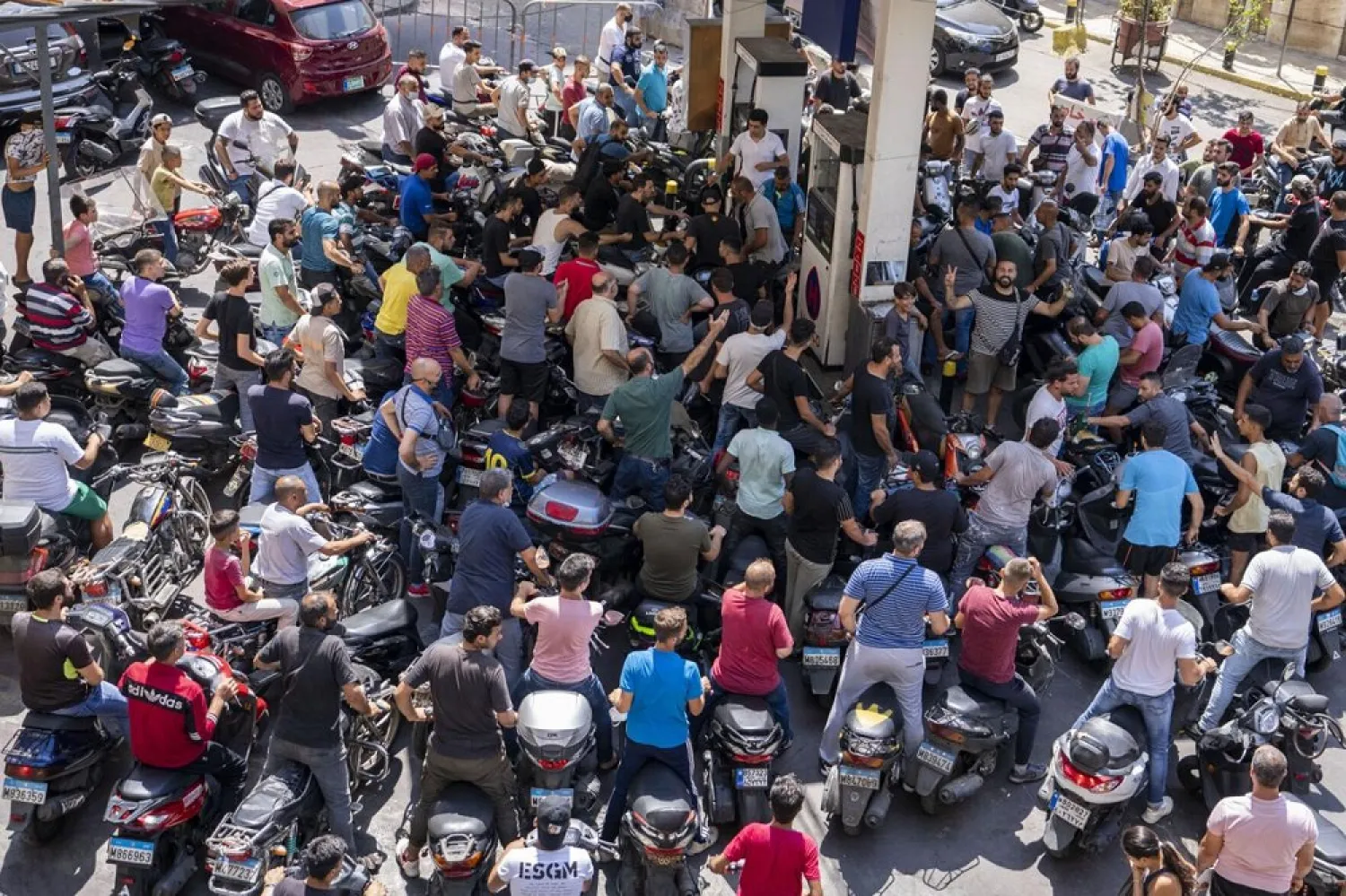
In this Aug. 31, 2021, file photo, motorcycle drivers wait to get fuel at a gas station in Beirut, Lebanon. (AP)
TT

Hezbollah’s Rivals Dismiss Iran Fuel Shipment as Stunt ahead of Lebanon Elections

In this Aug. 31, 2021, file photo, motorcycle drivers wait to get fuel at a gas station in Beirut, Lebanon. (AP)

Hezbollah may have heavily promoted its import of fuel from Iran that began in recent weeks, but it appears the arrival of the shipment will do little to ease the deepening crisis in Lebanon.

Rather, it appears the imported fuel has only plugged a small hole, while the wider image reveals that the move ultimately has electoral purposes with parliamentary polls set for next years, remarked various Lebanese parties.

Furthermore, not only has Hezbollah undermined the state by importing the fuel - and risking sanctions - but it has even sent the shipment to areas that are held by its Lebanese rivals where it was either rejected or welcomed.

Member of the Syndicate of Gas Station Owners George Brax told Asharq Al-Awsat that according to 2020 figures, Lebanon needs some 7.5 million liters of diesel fuel (mazout) a day to meet its needs.

Each Iranian vessel that arrives in Lebanon is loaded with some 40 million liters, of which Hezbollah is distributing some 3 million liters per day, which is hardly enough to meet the people’s daily needs, he noted.

The Iranian fuel changes nothing in the crisis, which is only getting worse, he stated.

Each vessel is enough to meet Lebanon’s needs for five days. According to its media, Hezbollah is distributing the shipment to sectors and parties of its choosing. Some of the fuel is handed out for free and others at around 20 percent less than the official price.

Hezbollah chief Hassan Nasrallah had previously declared that the first two shipments would include diesel fuel (mazout), while the third would include gasoline (benzene). He announced that the aim was to ease the suffering of the people and that the shipment would be dedicated to various institutions, including public hospitals, orphanages and the Red Cross, at no cost.

If they desired, several private institutions, including hospitals, bakeries and owners of power generators, could purchase some of the fuel at a price lower than the official rate.

Political analyst and Hezbollah critic, Ali al-Amine told Asharq Al-Awsat: “It is obvious that the quantities imported by Hezbollah are not helping ease the crisis as it is trying to lead its supporters to believe.”

In fact, its supporters are starting to realize this themselves, he noted.

This is just another stunt aimed at appeasing its supporters and electoral base to cover for its successive failures, especially among its followers, he remarked.

The distribution of the shipment in areas that are outside the party’s influence, such as the Christian towns of al-Forzol and Jabboule in the Bekaa Valley, has stirred debate.

A video posted on social media showed a nun in Jabboule thanking Nasrallah for the delivery, saying it will help warm orphans. Mayor of al-Forzol, Melhem al-Ghassan appeared in another video where he thanked Nasrallah and described him as an “honest man”.

Their comments drew widespread anger and demands for an apology.

The Lebanese Forces’s Zahle branch condemned Ghassan’s remarks, saying “they do not reflect the history and views of the majority of the people of the town who are known for their struggle and keenness on their dignity that has never been humiliated under any conditions or need.”

“The people of al-Forzol believe in the rise of the state of institutions and they will not side with a party that is working on undermining institutions and destroying the foundations of the state,” it said of Hezbollah.

The LF called on Ghassan to retract his statements and apologize to the people, reminding him that it was the town’s municipality’s duty to provide the people’s needs.

Al-Amine remarked that the controversy stirred in al-Forzol was exactly what Hezbollah wanted.

“It is as if it is saying: ‘We are bringing you the mazout, but you don’t want it.’ It is attempting to portray itself as filling the void left by the state, which the party itself is weakening and whose absence it is exploiting,” he explained.

The party is seeking to exploit crises to its advantage and such ploys have become obvious to its supporters, he added.



Israeli Reservist Rams Vehicle into Palestinian Man Praying in West Bank

Israeli security forces secure a street as they leave the Palestinian village of Bizariya, in the occupied West Bank, where Israeli authorities demolished the house of a Palestinian man killed in July after he and another man reportedly killed an Israeli settler on the same day, on December 24, 2025. (AFP)
TT

Israeli Reservist Rams Vehicle into Palestinian Man Praying in West Bank

Israeli security forces secure a street as they leave the Palestinian village of Bizariya, in the occupied West Bank, where Israeli authorities demolished the house of a Palestinian man killed in July after he and another man reportedly killed an Israeli settler on the same day, on December 24, 2025. (AFP)

An Israeli reservist soldier rammed his vehicle into a Palestinian man as he prayed on a roadside in ​the occupied West Bank on Thursday, after earlier firing shots in the area, the Israeli military said.

"Footage was received of an armed individual running over a Palestinian individual," it said in a statement, adding the individual was a reservist ‌and his ‌military service had ‌been terminated.

The ⁠reservist ​acted "in severe ‌violation of his authority" and his weapon had been confiscated, the military said.

Israeli media reported that he was being held under house arrest.

The Israeli police did not immediately respond to a Reuters request for comment.

The ⁠Palestinian man went to hospital for checks after ‌the attack, but was unhurt ‍and is now ‍at home.

Video which aired on Palestinian ‍TV shows a man in civilian clothing with a gun slung over his shoulder driving an off-road vehicle into a man praying on ​the side of the road.

This year ​was one of the most violent on ⁠record for Israeli civilian attacks against Palestinians in the West Bank, according to United Nations data that shows more than 750 injuries.

More than a thousand Palestinians were killed in the West Bank between October 7, 2023 and October 17, 2025, mostly in operations by security forces and some by settler violence, according to the UN In ‌the same period, 57 Israelis were killed in Palestinian attacks.


Deadly Blast Hits Mosque in Syria’s Homs, Saraya Ansar al-Sunna Claims Responsibility

Syrian security forces stand inside a damaged mosque after several people were killed in an explosion at a mosque as the Syrian Arab News Agency (SANA) said, in Homs, Syria December 26, 2025. REUTERS/Ali Ahmed al-Najjar
TT

Deadly Blast Hits Mosque in Syria’s Homs, Saraya Ansar al-Sunna Claims Responsibility

Syrian security forces stand inside a damaged mosque after several people were killed in an explosion at a mosque as the Syrian Arab News Agency (SANA) said, in Homs, Syria December 26, 2025. REUTERS/Ali Ahmed al-Najjar

A bombing at a mosque in Syria during Friday prayers killed at least eight people and wounded 18 others, authorities said.

Images released by Syria’s state-run Arab News Agency showed blood on the mosque’s carpets, holes in the walls, shattered windows and fire damage. The Imam Ali bin Abi Talib Mosque is located in Homs, Syria's third-largest city.

SANA, citing a security source, said that preliminary investigations indicate that explosive devices were planted inside the mosque. Authorities were searching for the perpetrators, who have not yet been identified, and a security cordon was placed around the building, Syria’s Interior Ministry said in a statement.

In a statement on Telegram, the Saraya Ansar al-Sunna said its fighters "detonated a number of explosive devices" in the mosque.

The same group had previously claimed a suicide attack in June in which a gunman opened fire and then detonated an explosive vest inside a Greek Orthodox church in Dweil’a, on the outskirts of Damascus, killing 25 people as worshippers prayed on a Sunday.

Several countries, including Saudi Arabia, Jordan and Lebanon, condemned the attack. 


Fuel Shortage Forces Gaza Hospital to Suspend Most Services

The sun sets behind a makeshift tent camp for displaced Palestinians set up in an area of al-Bureij camp, in the central Gaza Strip, Wednesday, Dec. 24, 2025. (AP)
TT

Fuel Shortage Forces Gaza Hospital to Suspend Most Services

The sun sets behind a makeshift tent camp for displaced Palestinians set up in an area of al-Bureij camp, in the central Gaza Strip, Wednesday, Dec. 24, 2025. (AP)

A major Gaza hospital has suspended several services because of a critical fuel shortage in the devastated Palestinian territory, which continues to face a severe humanitarian crisis, it said.

Devastated by more than two years of war, the Al-Awda Hospital in the central Gaza district of Nuseirat cares for around 60 in-patients and receives nearly 1,000 people seeking medical treatment each day.

"Most services have been temporarily stopped due to a shortage of the fuel needed for the generators," said Ahmed Mehanna, a senior official involved in managing the hospital.

"Only essential departments remain operational: the emergency unit, maternity ward and pediatrics."

To keep these services running, the hospital has been forced to rent a small generator, he added.

Under normal conditions, Al-Awda Hospital consumes between 1,000 and 1,200 liters of diesel per day. At present, however, it has only 800 liters available.

"We stress that this shutdown is temporary and linked to the availability of fuel," Mehanna said, warning that a prolonged fuel shortage "would pose a direct threat to the hospital's ability to deliver basic services".

He urged local and international organizations to intervene swiftly to ensure a steady supply of fuel.

Despite a fragile truce observed since October 10, the Gaza Strip remains engulfed in a severe humanitarian crisis.

While the ceasefire agreement stipulated the entry of 600 aid trucks per day into Gaza, only 100 to 300 carrying humanitarian assistance can currently enter, according to the United Nations and non-governmental organizations.

The remaining convoys largely transport commercial goods that remain inaccessible to most of Gaza's 2.2 million people.

- Health hard hit -

On a daily basis, the vast majority of Gaza's residents rely on aid from UN agencies and international NGOs for survival.

Gaza's health sector has been among the hardest hit by the war.

During the fighting, the Israeli miliary repeatedly struck hospitals and medical centers across Gaza, accusing Hamas of operating command centers there, an allegation the group denied.

International medical charity Doctors Without Borders now manages roughly one-third of Gaza's 2,300 hospital beds, while all five stabilization centers for children suffering from severe malnutrition are supported by international NGOs.

The war in Gaza was sparked on October 7, 2023, following an unprecedented Hamas attack on Israel that resulted in the deaths of 1,221 people, most of them civilians, according to an AFP tally based on official Israeli figures.

In Israel's ensuing military campaign in Gaza, at least 70,942 people - also mostly civilians - have been killed, according to the health ministry in the Hamas-run territory.